Key Takeaway
UK plumber gained 12 extra jobs a month by automating admin. Full case study with Tradify, Xero, GoCardless stack, real costs, and step-by-step setup.
Mark was turning down work and still couldn't pay himself properly. A booked-out diary and an overdrawn account at the same time sounds impossible — until you meet the admin that sits between the two. This is the story of how one Leeds plumber closed that gap in ninety days, with tools that cost less than a tank of diesel a month and not a line of code.
The numbers here are built on real UK industry benchmarks and the prices verified across this cluster. The business is a composite, but every figure is one a sole trader with one employee could hit.
The Starting Point
Mark runs a two-man plumbing firm — himself and one engineer, Danny — out of a van and a spare room. Turnover sat around £140,000 a year. On paper, a healthy little business. In practice, a treadmill.
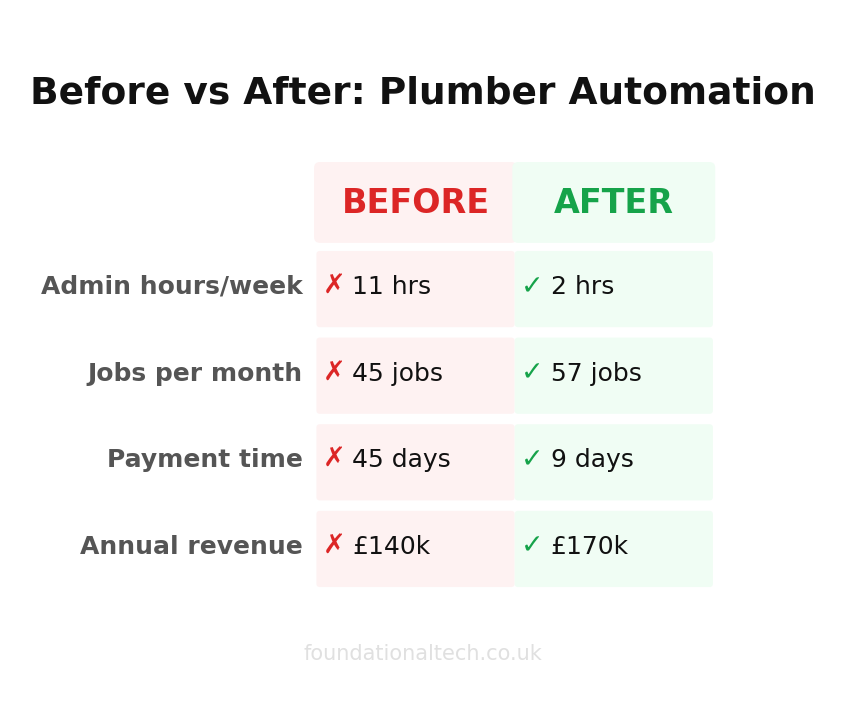
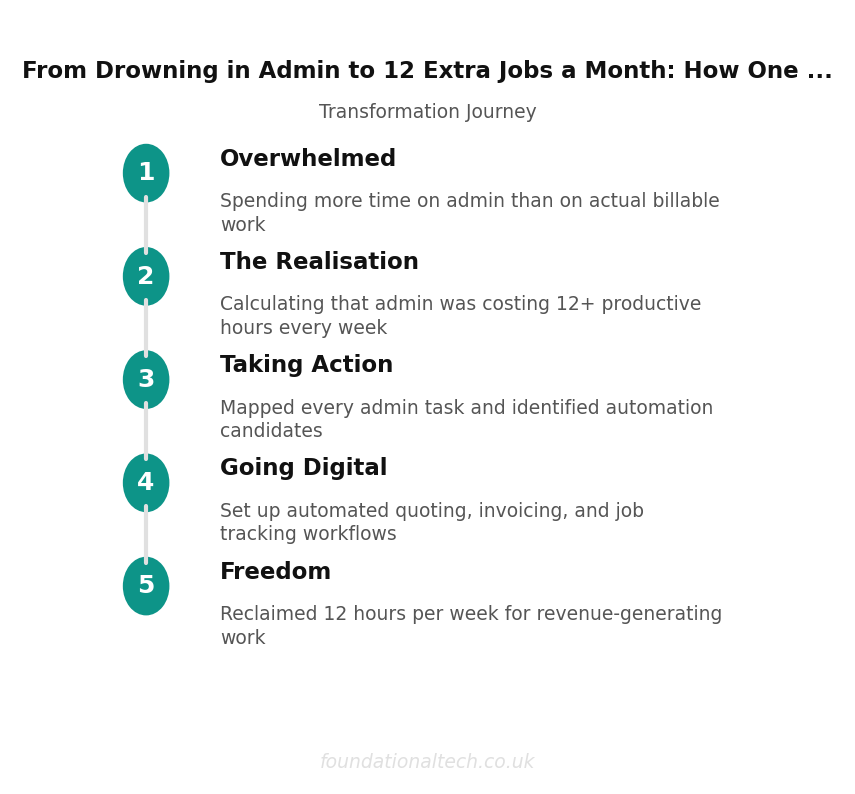
His evenings went on admin. Quotes written from scratch at the kitchen table, often two days after the customer asked, by which point half had gone elsewhere. Invoices sent late because he hated doing them, then chased by awkward phone calls weeks later. A shoebox of receipts handed to the bookkeeper in a panic each quarter. He reckoned on ten to twelve hours a week of paperwork — most of it after eight at night.
The cash flow was the real wound. Average time from finishing a job to actually being paid was around 45 days, because invoices went out late and nobody chased them. He was profitable and skint at once, dipping into an overdraft to cover materials while three grand sat unpaid in customers' inboxes. And because every quote took an evening, he simply stopped quoting some jobs. Work walked past the door because he didn't have the hours to chase it.
A typical week showed the damage. Mark would finish on site by five, eat, then sit down at half eight to write the two quotes he'd promised that morning — and not send them until the next night because he was too tired to finish. Of the ten enquiries that came in across the week, he'd reply to maybe six, and only three in time to matter. The other four were gone, won by whoever answered first.
Month 1: The Foundation
Mark didn't buy AI first. He fixed the plumbing of the business — the operational stack from the early articles in this cluster.
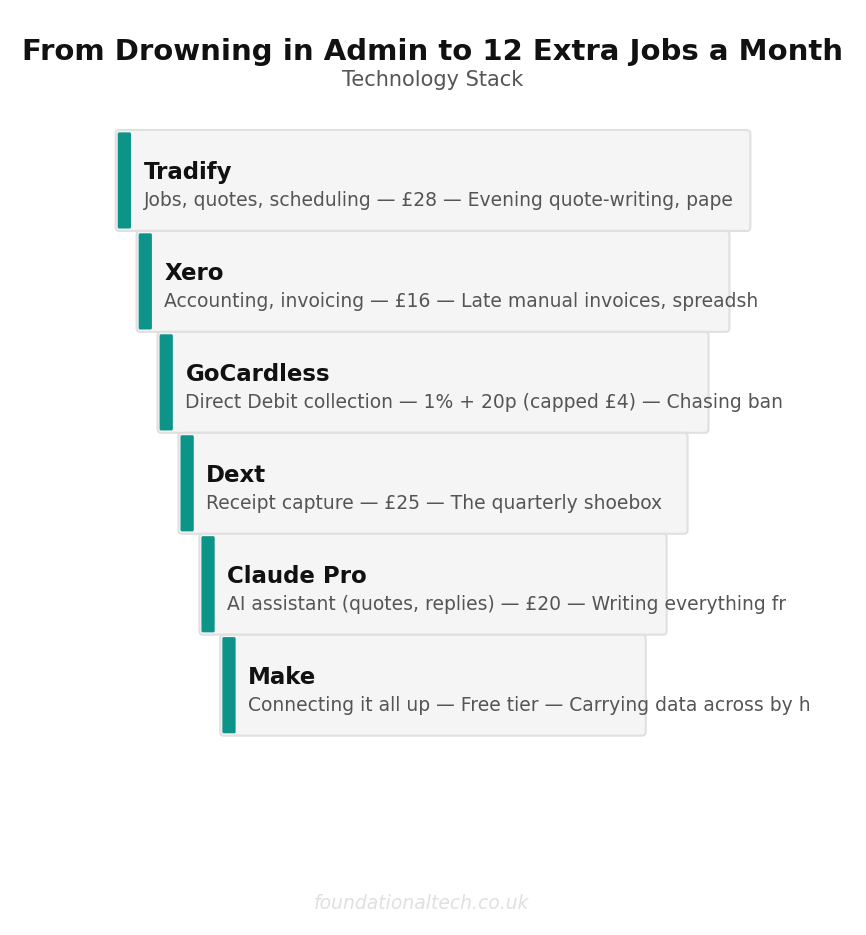
He moved jobs and quotes into Tradify (from £34 per user per month). Quotes that took an evening now took ten minutes from the van, sent before he'd left the driveway. He connected Xero (Starter from £15 a month) so invoices were raised the moment a job closed, not a fortnight later. Then the single biggest lever: GoCardless (1% per transaction plus 20p, capped at £4) wired into Xero, so agreed invoices collected themselves by Direct Debit instead of waiting on a bank transfer the customer kept forgetting.
He added Dext (from £24 a month) so receipts were photographed on the spot and fed straight into Xero — the quarterly shoebox gone. The setup wasn't glamorous and it took a fortnight of evenings to migrate his open jobs and learn the apps. But it was a fortnight spent once, not every quarter forever.
The GoCardless switch alone changed how the month felt. Where customers used to "sort it next week" and then forget, the agreed amount now left their account on the date set, automatically. Within four weeks the overdraft Mark had lived in for two years was clear. He didn't earn more that month — he just stopped lending his customers money for free.
By the end of month one nothing was automated with AI yet, but the leaks were plugged. Quotes went out same-day. Invoices went out on completion. Some payments now arrived on a date he set, not whenever the customer got round to it. The first month's lesson was unglamorous and important: software doesn't save you time until your process runs through it. He'd spent the fortnight rebuilding the process, and only then did the tools start paying him back.
Month 2: The AI Layer
With the stack in place, Mark added the AI block (articles 6 to 9 in this cluster).
He set up a single AI assistant — Claude Pro, about £20 a month — loaded once with his rates (£75 an hour, £60 call-out), his standard jobs and his plain, friendly tone. Now "quote for a combi swap, two days, Headingley" produced a finished quote in his format and voice in under a minute. Danny started using it too, dictating job notes from his phone.
Then he connected the two blocks with Make (free tier, which covered his volume comfortably). One automation watched his enquiry inbox and drafted a reply in his voice within minutes of a message landing — he just read it and pressed send. Another fired when a job was marked complete in Tradify: a warm thank-you text that referenced the actual work and asked for a Google review, with the link attached. He kept a firm hand on the wheel — AI never set a price, never touched a Gas Safe certificate, never went near his VAT — but the drafting, sorting and chasing now happened without him.
The enquiry-reply workflow was the one that changed his week. Before, a Saturday-morning message about a burst pipe might sit until Sunday night. Now a friendly, sensible reply was drafted within minutes, asking the right questions and promising a same-day visit — and Mark, watching the football, just checked it and tapped send. He reckoned that single workflow recovered three or four jobs a month that would otherwise have gone to a faster-fingered competitor. The review requests did quiet work too: his Google rating climbed from a handful of reviews to over forty in a quarter, because the ask now happened every time instead of only when he remembered.
He was careful about what he didn't automate. Prices stayed in his hands — AI drafted the quote, he read the number before it went. Certificates and the VAT return stayed manual by design. The rule he settled on was simple: automate the carrying and the chasing, never the deciding.
Month 3: The Compound Effect
By month three the pieces stopped being separate tools and started behaving like a back office. An enquiry arrived and got a near-instant reply, which converted it faster. From there it flowed into a same-day quote, became a job, and raised its own invoice. The invoice collected its own payment and asked for its own review — with Mark touching each step for seconds rather than hours.
Follow one job through to see it. A Tuesday morning enquiry about a leaking combi in Horsforth landed at 9:14. By 9:21 a drafted reply was in Mark's drafts, asking for the boiler's make and a photo; he glanced at it between jobs and sent it at 9:40. The customer replied with photos by lunch, and from the van Mark asked his AI assistant for a combi-swap quote at his rates — done in under a minute, sent by two. Job booked for Thursday. Thursday evening, Tradify marked it complete; Xero raised the invoice automatically, GoCardless collected it the following Tuesday by Direct Debit, and a thank-you text asking for a Google review went out on its own. Start to paid: six days. The same job, three months earlier, would have been a missed enquiry.
And because Danny was now quoting from the van as well, the business stopped depending entirely on Mark's evenings — the single change that made him feel he owned a business rather than a job.
What did he do with the nine hours? Some went back into the business — he finally had time to price up the bigger commercial jobs he'd been waving away, which is where a chunk of the revenue growth came from. The rest went home. For the first time in years he wasn't doing invoices at the kitchen table after the kids were in bed. That, more than any number on the spreadsheet, was the point.
The Numbers
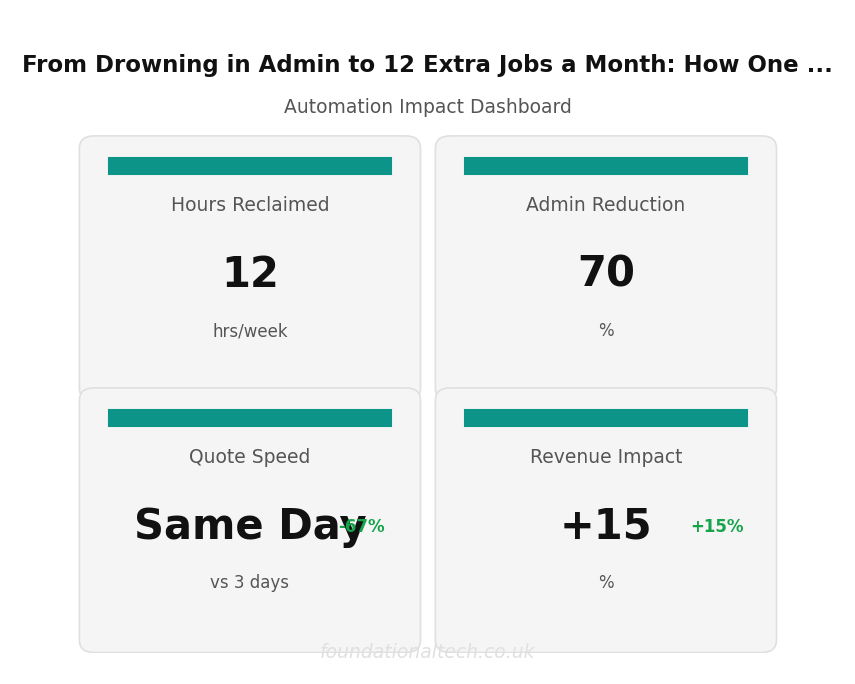
Hours saved per week: around 9 — admin dropped from ~11 hours to ~2.
Revenue increase: roughly 22% over the quarter, to about £170,000 annualised, driven by faster quoting and recovered enquiries.
Days to payment (before → after): 45 days → 9 days, thanks to on-completion invoicing and Direct Debit collection.
Client capacity increase: about 12 extra jobs a month, won mostly from enquiries he'd previously have missed or answered too late.
Annual cost of the full stack: roughly £1,130 a year (see table).
ROI: the stack cost under £95 a month; it returned around 9 hours a week plus an extra ~£30,000 of annualised turnover. The tools paid for themselves inside the first fortnight.
The Full Stack Summary
Tradify — Jobs, quotes, scheduling — £34 — Evening quote-writing, paper diary
Xero — Accounting, invoicing — £16 — Late manual invoices, spreadsheet
GoCardless — Direct Debit collection — 1% + 20p (capped £4) — Chasing bank transfers
Dext — Receipt capture — £24 — The quarterly shoebox
Claude Pro — AI assistant (quotes, replies) — £20 — Writing everything from scratch
Make — Connecting it all up — Free tier — Carrying data across by hand
Roughly £94 a month, plus payment fees — under £1,200 a year all in. Put that against what it returned and the maths stops being a close call. One recovered job a month covers the entire stack several times over; Mark was recovering around a dozen. The right way to read the table isn't "another six subscriptions to pay for." It's one part-time office manager's worth of work for under a hundred pounds a month — and this one never phones in sick or forgets to chase an invoice.
The Part That Nearly Didn't Stick
The version of this story that gets told afterward is tidy. The version Mark lived through had a wobble in week two, and it is worth being honest about it because it is the most common reason these projects fail.
The wobble was Danny. Mark took to the apps quickly because it was his business and his cash flow on the line. His engineer did not. For the first fortnight Danny kept scribbling hours on the back of a job sheet and texting them over on a Friday, exactly as before. The job-tagged timesheets Mark was counting on had gaps in them, and the management information he wanted — which jobs actually made money — was useless while half the hours were missing.
What fixed it was not a stern word; it was making the new way easier than the old one. Mark sat with Danny for twenty minutes, set up the app so starting a job was two taps on the home screen, and showed him that logging hours in the app meant never again getting a Friday-night text asking what he'd done on Tuesday. Once the tool saved Danny time rather than costing him time, the habit stuck on its own. The lesson Mark passes on is blunt: the software is the easy part; getting a second pair of hands to actually use it is the real work, and you do it by removing friction, not by issuing instructions.
There was a smaller wobble on the cash-flow side too. A couple of older customers bristled at the first automated payment reminder, reading a polite "this invoice is now due" as nagging. Mark softened the wording — warmer first nudge, the firmer tone held back until day fourteen — and the complaints stopped. The machine does the sending; you still own the tone.
Is This Realistic for Your Business?
Mark is a composite, so the fair question is whether his results travel. The cash-flow gains are the most repeatable part. Raising invoices on completion and collecting repeat work by Direct Debit will pull payment forward for almost any plumbing firm, because the problem they fix — invoices sent late and never chased — is close to universal in the trade. If you do nothing else from this story, those two changes alone are worth more than the whole stack costs.
The revenue growth is more variable. Mark won twelve extra jobs a month largely because demand existed and he had been too slow to catch it. A firm in a quieter patch, or one already replying within the hour, will see a smaller jump — the instant-reply workflow can only recover work that was being lost in the first place. So look at your own numbers: how many enquiries do you fail to answer in time each week, and how many quotes go out a day late? The size of that leak is the size of your likely gain.
The time savings, by contrast, are reliable wherever the admin is currently manual. If you are writing quotes at the kitchen table and reconstructing hours on a Sunday, wiring the stack together will hand you most of those evenings back regardless of how busy the diary is.
12 extra jobs/month
from time recovered by automating quoting, invoicing and payment collection
What They'd Do Differently
Three lessons Mark would pass on.
First, fix the foundation before the AI. He was briefly tempted to start with ChatGPT because it felt exciting, but the real money came from same-day quotes and automatic payment collection. AI made a good stack faster; it couldn't have fixed a broken one.
Second, automate payment collection earliest. GoCardless moved the needle on cash flow more than anything else, and it was the quickest win. If he'd done only one thing, it would have been that.
Third, start with one workflow, not ten. He nearly drowned trying to build five automations in a weekend. The version that stuck was one new workflow a week, each one lived-in before the next was added. Keep a human pressing send on anything that touches a customer, a price, or HMRC — the goal is to free up your hands, not to hand over the wheel.
The honest part of the story is that none of this was clever. There's no secret tool, no expensive consultant, no software a plumber can't set up himself across a few evenings. What changed Mark's business was sequence — foundation first, AI second, one workflow at a time — and the discipline to let the machine do the carrying while he kept the decisions. He's not bigger and he's not working harder. He's simply stopped being the bottleneck.
Could your plumbing business achieve similar results? Reply with your single biggest bottleneck — late quotes, slow payments, or missed enquiries — and I'll tell you which part of this stack to build first.
A & Y Financial Services builds these exact automation stacks for plumbing businesses across the UK. If you've read the architecture and want someone to implement it — that's what we do.