Key Takeaway
Stop chasing late payments as a UK plumber. UK average: 34 days. Set up automated invoicing, reminders, and Direct Debit with GoCardless and Xero.
The job finished on Tuesday. You wrote the invoice on Sunday night, after the kids were in bed. It landed in the customer's inbox on Monday. Three weeks later you're sending the second polite chaser and wondering whether to risk the awkward phone call.
The average UK plumber waits 34 days to be paid on completed work — money you've already spent on parts, fuel and an apprentice's wages. That gap is where small, profitable plumbing firms run out of cash. Not because the work dried up, but because the money for work already done arrives too slowly to pay this month's bills.
This article shows how to close that gap. The same five-tool stack from the pillar article — built around Tradify, Xero and GoCardless — turns invoicing from a Sunday-night chore into something that happens the moment you tap "complete." The invoice then collects itself on the due date, without a single chaser. Here's how each piece fits.
The Cash Flow Gap
The problem isn't your prices. It's the distance between finishing a job and the money landing in your account. Every step in that journey adds days.
34 days → 3 days
payment collection time with automated invoicing and Direct Debit
A typical manual cycle looks like this. You finish the job and mean to invoice it "tonight." Tonight becomes the weekend. You finally raise the invoice four to six days later, working from notes and a photo of the parts receipt. The customer opens it, files it under "later," and pays when they remember — or when you chase. By the time it clears, you're a month past the work and you've forgotten which job it was.
Across a year, that lag is brutal. If you turn over £120,000 and carry an average 34 days of unpaid invoices, roughly £11,000 of your money is sitting in other people's accounts at any moment. That's the overdraft you're paying interest on, the materials order you delayed, the van repair you put off.
The fix has three parts: raise the invoice instantly, give the customer a way to pay that collects itself, and let the software chase the stragglers so you never have to.
The Automated Billing Architecture
Invoices that raise themselves
The single biggest delay is the gap between finishing a job and writing the invoice. Tradify (from £29.50/user/month, or £28/user/month on the Pro plan for teams of four or more) removes it.
The job already lives in Tradify — the customer, the address, the hours logged on site, the parts you added from your phone. When you tap "complete," the invoice is built from that record: labour, materials and 20% VAT, itemised, with your logo on it. You send it before you've packed the tools away.
That one habit — invoicing on site instead of on Sunday — pulls payment forward by the four to six days you used to lose to "I'll do it later." It costs nothing extra. The data was already in the app.
Payment that collects itself
Sending the invoice faster only helps if the customer pays faster. This is where most plumbers leave money on the table, because "bank transfer when you get a minute" is an invitation to forget.
For repeat and contract customers — landlords, letting agents, maintenance plans — GoCardless is the answer. It collects by Direct Debit. The customer authorises a mandate once; after that, every invoice pulls automatically on its due date. No reminder, no phone call, no cheque in the post. On the Standard plan there's no monthly fee and no contract — you pay 1% + 20p per transaction, capped at £4. On a £200 boiler service that's £2.20. GoCardless plugs straight into both Tradify and Xero, so a paid invoice reconciles itself.
Think about what that does to a letting-agent relationship. You service eight boilers a month for the same agent. Under the old way, each one is a separate invoice they have to approve, queue and pay — and any of them can stall. With a mandate in place, you raise the invoices and the money simply arrives on the due date. The agent does nothing, you chase nothing, and your most predictable customer becomes your most reliable cash. That predictability is worth more than the few pounds the fees cost.
For one-off domestic jobs, add a "Pay now" card link to the invoice. Stripe charges 1.5% + 20p on UK cards (note that Stripe's fees carry 20% VAT, so factor that in if you're not reclaiming it). A customer who can tap a link and pay in ten seconds pays days sooner than one who has to find your sort code.
The principle is simple: never make the customer do work to pay you. Every extra step they have to take is another day you wait.
Chasers that send themselves
Some invoices still drift. The point of automation is that you never personally chase them again — the system does it on a schedule, in a tone you'd actually use.
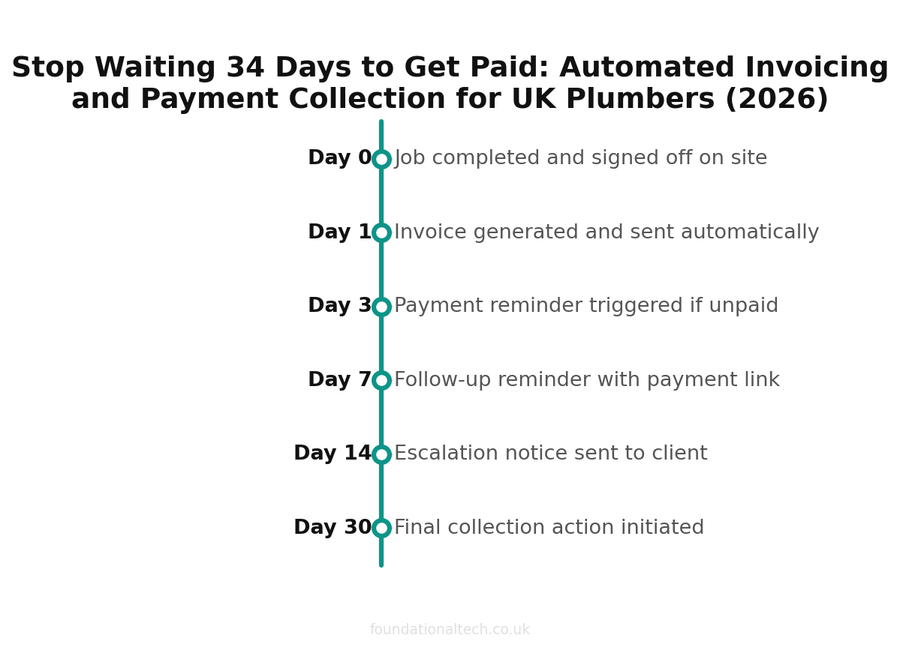
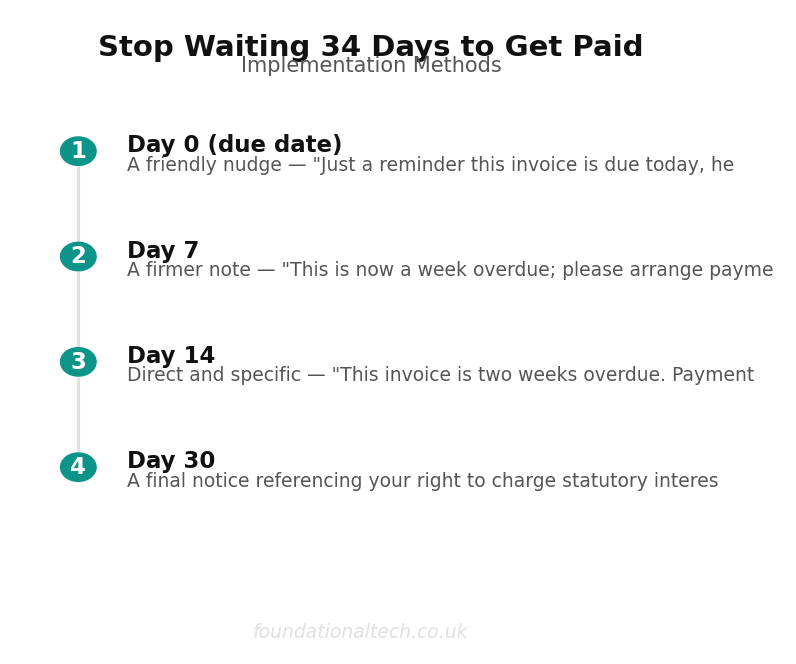
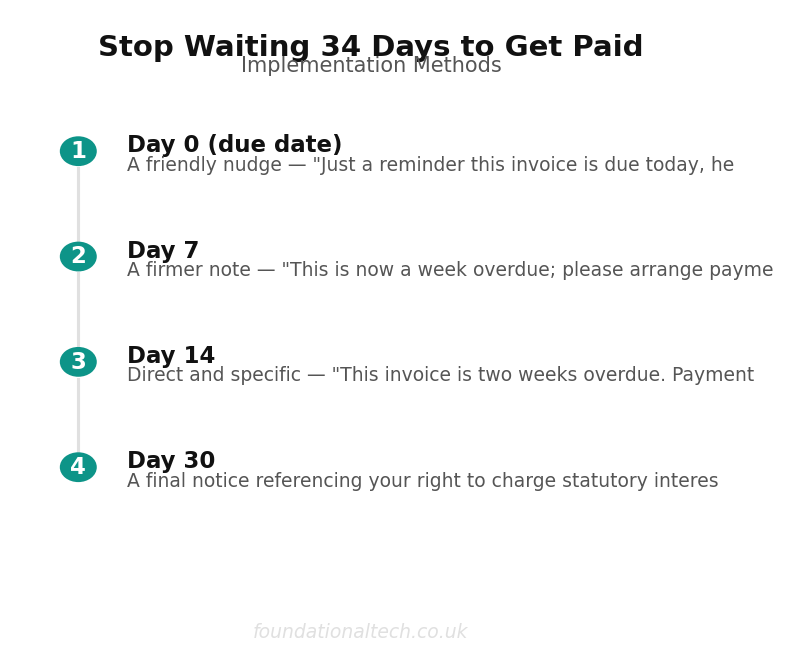
Set up an automated reminder sequence in Xero (or Tradify) along these lines:
Day 0 (due date): A friendly nudge — "Just a reminder this invoice is due today, here's the payment link again."
Day 7: A firmer note — "This is now a week overdue; please arrange payment or let us know if there's a problem."
Day 14: Direct and specific — "This invoice is two weeks overdue. Payment is due within 3 days to avoid a late-payment charge."
Day 30: A final notice referencing your right to charge statutory interest and recovery costs under the Late Payment of Commercial Debts legislation.
You write these four messages once. From then on, every overdue invoice gets chased on time, every time, without you remembering or steeling yourself for it. The awkward part of the job is now a setting.
There's a quieter benefit too. Because the reminders are automatic and dated, they don't feel personal to the customer — they read as standard process, not as you nagging a neighbour. That makes them more effective, not less. Most people pay the moment a clear, polite reminder lands; the few who don't are the ones you needed to know about early anyway. Either way, you find out without spending an evening rehearsing the phone call you didn't want to make.
Deposits and staged payments on bigger jobs
For anything larger than a call-out — a bathroom install, a full boiler swap, a re-pipe — waiting until the end to invoice is a cash flow mistake. You've laid out hundreds on parts before the customer has paid a penny.
Stage the billing instead. Take a deposit up front to cover materials, an interim payment at a clear midpoint, and the balance on completion. Tradify lets you raise a deposit invoice against the quote, then progress invoices as the job moves. Each one syncs to Xero, and each one is collectable by the same card link or Direct Debit mandate as everything else.
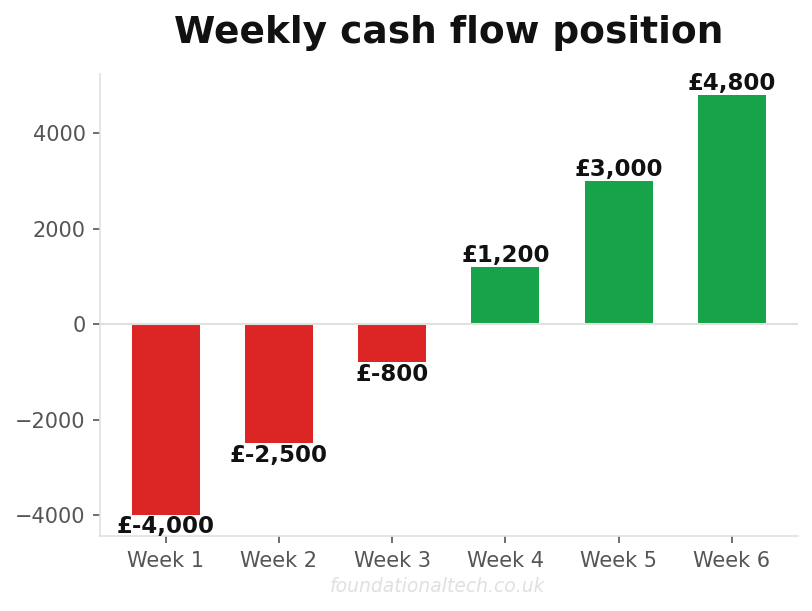
The effect on cash flow is immediate. On a £3,000 bathroom job, a 40% deposit puts £1,200 in your account before you order the suite. You're spending the customer's money on their materials, not financing the job from your own overdraft. Staged billing also flushes out the customer who was never going to pay — before you've sunk three days of labour into their house.
Reconciliation without the shoebox
The last hidden time-sink is matching payments to invoices. With a connected stack this disappears. Xero (Starter from £15/month, Standard £30/month, both excluding VAT) pulls your bank transactions in automatically via the bank feed. A GoCardless or Stripe payment arrives already linked to its invoice and reconciles itself. Bank transfers match by amount and reference. What used to be an hour of squinting at statements becomes a two-minute review of anything that didn't match cleanly.
Done weekly, that review keeps your numbers honest. You can see at a glance who still owes you, which jobs have cleared, and what your real bank balance is — not the rough figure you carry in your head. When the VAT return falls due, the figures are already there, because every invoice and payment was reconciled as it happened rather than reconstructed in a panic the night before the deadline.
£11,000/yr
tied up in unpaid invoices for a typical UK plumbing business
The Numbers
Put the pieces together and the change is measurable, not vague.
Invoicing on site instead of at the weekend pulls billing forward four to six days. Direct Debit on repeat customers — often a quarter to a third of a plumber's work — collects on the due date instead of three weeks late. Automated chasers cut the tail of late payers without costing you an evening. Realistically, a firm that ran at 34 days can reach the high teens within a couple of months.
On £120,000 of turnover, cutting average payment time from 34 days to 18 frees up roughly £5,000 of cash that was permanently stuck in unpaid invoices. That's the difference between dipping into an overdraft each month and ordering materials for the next job without flinching.
Picture the two versions of the same week. In the old version, you finish three jobs, mean to invoice them at the weekend, raise them on Sunday night, and start chasing two of them a fortnight later — meanwhile you've paid for the parts and the apprentice out of your own pocket. In the new version, all three invoices go out from the doorstep as you leave, two of them are repeat customers on Direct Debit who'll pay automatically on the due date, the third pays by card link that evening, and the deposit on next week's bathroom job is already in your account. Same three jobs, same prices. The difference is entirely in the plumbing of the money, not the work.
The tools to do this cost less than £80 a month combined — Tradify, Xero, and pay-as-you-go payment fees. Against a single afternoon a week of unpaid admin, and thousands in cash freed from your debtor book, it pays for itself in the first month.
You don't have to build all of it at once. Start with the habit that costs nothing: invoice on site, the day the job ends. Then add a payment link. Then Direct Debit your repeat customers. Each step pulls your money in a little faster.
What's your average days-to-payment right now? Check Xero or your bank — most plumbers guess two weeks and find it's nearer five. Reply with the real number.
Related guides: If you found this useful, see our guide on The Plumbing Business That Runs Itself: How UK Plumbers Automate Quoting, Scheduling and Invoicing in 2026 and Tradify to Xero in 15 Minutes: The Step-by-Step Integration Guide for UK Plumbers (2026).
A & Y Financial Services builds automated billing and cash-collection systems for UK plumbing businesses — invoicing, Direct Debit and reconciliation wired together so you get paid faster without chasing. That's what we do.