Key Takeaway
The full automation blueprint for UK plumbers — quoting, scheduling, invoicing and compliance connected end to end with Xero, Tradify and GoCardless.
The plumber who still writes quotes on a pad
I sat with a Gas Safe registered plumber in Reading last spring, watching him work through a Friday afternoon backlog. Fourteen missed calls. Six quotes he'd promised "by end of week" that were still scribbled on the back of a job sheet in his van. Two CP12 certificates he needed to email a landlord before Monday, sitting as photos in his phone's camera roll. An invoice from three weeks ago that hadn't been sent because he'd been waiting until he "had a minute" to do the paperwork.
He wasn't disorganised. He was one person running a business that needed three: an engineer, an office manager and a bookkeeper. That's the problem I see in almost every UK plumbing business I look at, whether it's a sole trader or a five-van outfit. The tools to fix it have existed for years — the issue is nobody had shown him how they fit together as a single continuous system rather than five separate subscriptions he'd have to babysit.
This article is that system. It's the stack I now recommend to plumbing and heating businesses, what each piece costs in 2026, and a full walkthrough of one job moving from first enquiry to reconciled payment without anyone touching a spreadsheet.
The core stack
There are dozens of trade job management platforms on the UK market, but for plumbing and heating specifically I keep coming back to the same four tools because they integrate cleanly with each other and with HMRC's Making Tax Digital requirements.
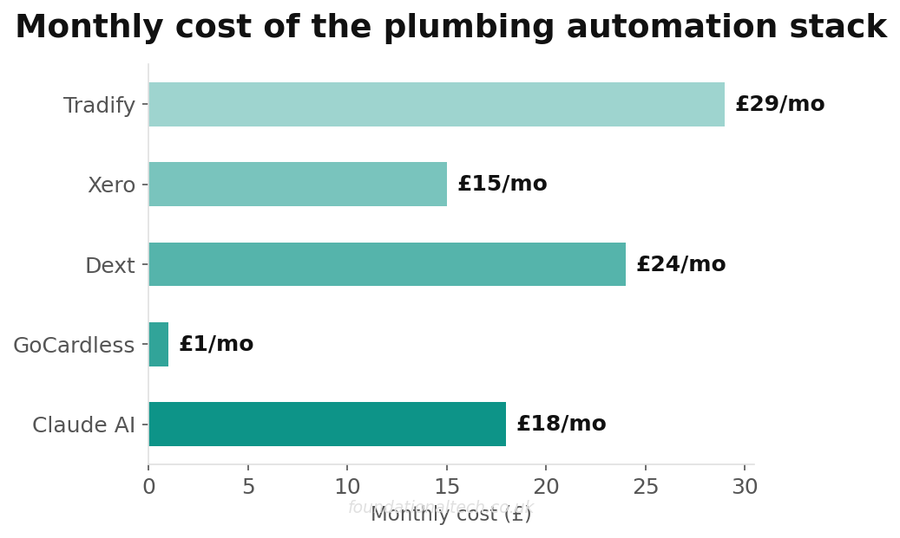
- Tradify — job management, quoting, scheduling and dispatch. £29.50 per month per user on the Grow plan, which is the one you need for the automations below.
- Xero — accounting and VAT. £15 per month on the Ignite plan, which covers a single user with unlimited invoices and bank reconciliation, and satisfies Making Tax Digital for VAT out of the box.
- GoCardless — Direct Debit and instant bank payment collection. No monthly fee on the standard plan; you pay 1% plus 20p per transaction, capped at £4, which for a typical £350 boiler service invoice works out cheaper than a card terminal.
- Dext — receipt and supplier invoice capture. £24 per month on the Business plan, which pulls in merchant receipts from Screwfix, Wolseley and City Plumbing automatically via email forwarding.
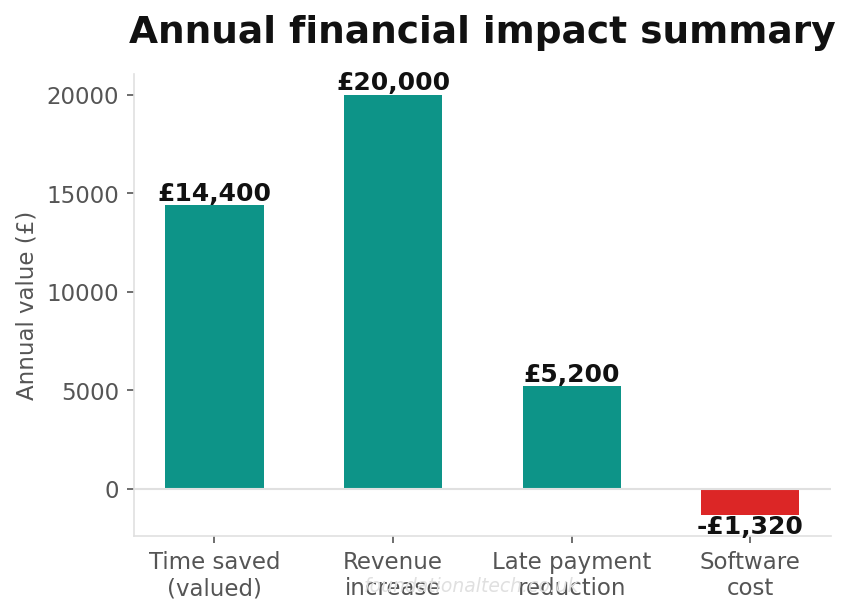
That's £68.50 a month before transaction fees, for a single-engineer business. Add a second engineer to Tradify and you're closer to £92. Either way, it's less than the cost of one missed invoice a month, and I've yet to work with a plumbing business that wasn't losing more than one invoice a month before they put this in place.
The quote-to-invoice workflow
The single biggest leak in a plumbing business's cash flow isn't bad debt — it's the gap between finishing a job and actually billing for it. Here's the workflow that closes that gap, step by step.
- Enquiry lands. Whether it comes through a website form, a phone call, or WhatsApp, it gets logged as a lead in Tradify within minutes, not at the end of the day from memory.
- Site visit or phone quote. Tradify's quoting tool builds the estimate from a pre-loaded price list — parts pulled from your Wolseley or Plumbase pricing, labour at your set hourly rate, and any Gas Safe-specific line items like a flue survey or a CP12 for a landlord job.
- Quote sent and tracked. The customer gets a branded PDF by email or SMS with a "accept online" button. You get a notification the moment they view it, and a second one if they accept — no more chasing "did you get my quote?"
- Job scheduled automatically. Accepting the quote creates a scheduled job in Tradify's calendar, which syncs to the engineer's phone. No separate step of "right, I need to book this in."
- Job completed on site. The engineer marks the job complete from the Tradify mobile app, attaches photos, logs parts actually used against the estimate, and — critically for gas work — completes any compliance paperwork before leaving the property.
- Invoice raised same day. Completing the job triggers an invoice draft in Tradify built from the actual parts and labour logged, not the original estimate. This is the step that recovers the most money: variations and extra parts get billed instead of quietly absorbed.
- Invoice pushed to Xero and GoCardless. The invoice syncs to Xero automatically and a payment request goes out via GoCardless with a Direct Debit or instant bank transfer link.
- Payment reconciled without touching a bank statement. When the customer pays, GoCardless settles into your business account and Xero matches the payment to the invoice on its own, because it already knows the reference.
The point of this sequence isn't novelty — it's that every step happens because the previous one finished, not because someone remembered to do it during a quiet moment that never comes.
A full walkthrough: Mrs Patterson's boiler
Let me make this concrete with a job I watched run end to end for a Kent-based heating engineer I work with.
Tuesday, 8.14am: Mrs Patterson calls about a boiler making a banging noise. The office (his wife, part-time) logs it as a lead in Tradify from her phone in ninety seconds — name, address, symptom, "urgent."
By 9am, the engineer has an appointment for 2pm that afternoon synced to his phone. He arrives, diagnoses a failing diverter valve, and quotes there and then using Tradify's mobile app — parts from his pre-set price list, labour at his standard callout-plus-hourly rate. Mrs Patterson accepts on her phone while he's still stood in the kitchen.
He doesn't have the part in the van, so the job gets rescheduled for Thursday — that reschedule happens inside Tradify and both parties get an automatic confirmation, no phone tag required. Thursday morning, Dext has already captured the receipt for the diverter valve because he forwarded the Wolseley trade counter email receipt to his Dext inbox address, which happens automatically if he's set his account preferences correctly, tagging it against the job.
Thursday afternoon: valve fitted, boiler tested, gas tightness test carried out and logged. Because this is gas work on a domestic appliance, he completes his job sheet with the test results before he leaves — this matters for the compliance section below. He marks the job complete in the app. The invoice — £268 including parts, labour and VAT — is in Mrs Patterson's inbox before he's back in the van, with a payment link.
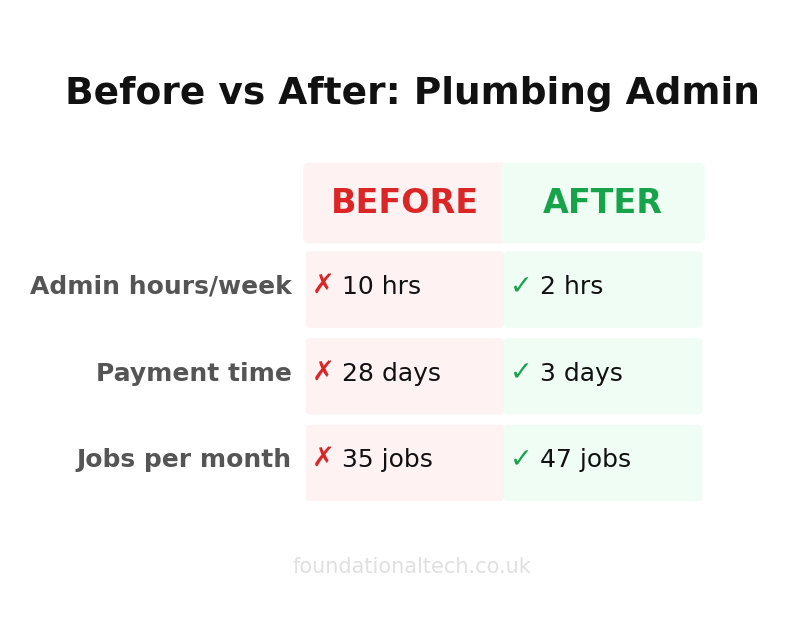
She pays by instant bank transfer through GoCardless that evening. By Friday morning, without either of them doing anything, the payment has landed in the business bank account, Xero has matched it to the invoice, and the job shows as "paid" in Tradify. Total elapsed time from "banging noise" to reconciled payment: three days, and roughly four minutes of one plumber who gained 12 extra jobs a month by automating admin time across the whole job. Add a configured AI assistant and even the quoting step shrinks to seconds.
Compare that to the version of this job I see most often — quote written on paper, invoice raised a fortnight later "when there's time," payment chased by text message three times, and reconciliation done in one long Sunday evening session once a month. Same job, same money, wildly different amount of stress and wildly different speed of cash hitting the account.
| Tool | Purpose | Monthly Cost |
|---|---|---|
| Tradify | Job management and quoting | £29/mo |
| Xero | Accounting and MTD compliance | £15/mo |
| Dext | Receipt capture from merchants | £24/mo |
| GoCardless | Direct Debit payment collection | 1% + 20p/txn |
| Claude AI | Quote drafting and client emails | From £18/mo |
| Total monthly cost | ~£92/mo | |
Gas Safe compliance: the part you cannot afford to get wrong
Everything above is about efficiency. This section is about risk, because for a Gas Safe registered engineer, record-keeping isn't optional admin — it's a legal requirement under the Gas Safety (Installation and Use) Regulations, and Gas Safe Register can and does audit engineers on their paperwork.
The requirements that matter most in day-to-day practice:
- CP12 / Landlord Gas Safety Records must be issued to the landlord (and tenant, where applicable) within 28 days of the previous certificate expiring, and landlords must keep records for at least two years.
- Every appliance checked on a job needs its own record of the checks carried out — flue flow, ventilation, tightness testing, appliance condition — not just a pass/fail note.
- Your Gas Safe ID card number and the categories you're registered for need to appear on the certificate, and you can only certify work within your registered categories.
- Building control notification is required for new installations of gas appliances in most cases, usually handled through Gas Safe's own notification system rather than the local authority directly.
Where this connects back to the software stack: Tradify (and most competitors like Commusoft or Simpro) has built-in digital certificate templates for CP12s and other Gas Safe forms. The engineer fills it out on the mobile app on site, it's signed digitally by both the engineer and the customer or landlord's representative, and it's stored against that customer's record permanently — not as a photo in a phone gallery that gets lost when the phone is replaced.
This matters for two separate reasons. First, if Gas Safe Register asks to see your records during an audit, you can pull every certificate for the last several years in seconds rather than digging through box files. Second, and more commonly useful, if a landlord loses their copy and calls asking for it eighteen months later, you're not searching a filing cabinet — you're re-sending a PDF from the customer record while you're on the phone with them.
I'd treat digital certificate storage as non-negotiable for any gas engineer, independent of everything else in this article. The cost of losing paperwork during a Gas Safe investigation, or worse, during a legal case following an incident, is not comparable to £29.50 a month.
Making Tax Digital and quarterly VAT
If your plumbing business is VAT registered — which applies once your taxable turnover crosses £90,000 — you're required to keep digital VAT records and submit returns through Making Tax Digital-compatible software. Xero has been MTD-compliant since the scheme launched and handles this without any extra configuration: VAT is calculated automatically as invoices are raised in Tradify and synced through, and the quarterly return is submitted to HMRC directly from Xero with a few clicks rather than being rebuilt in a spreadsheet.
The practical benefit for a plumbing business specifically is that materials VAT reclaimed on parts bought from merchants — captured automatically through Dext when receipts are forwarded from the trade counter — flows straight into the same VAT calculation. You're not manually re-entering merchant receipts at quarter-end trying to remember which £40 receipt from Plumbase was for which job.
What it costs, in full
For a one-engineer plumbing or heating business:
- Tradify (Grow plan, 1 user): £29.50/month
- Xero (Ignite plan): £15/month
- Dext (Business plan): £24/month
- GoCardless: no fixed fee, 1% + 20p per transaction (capped at £4)
- Total fixed cost: £68.50/month, plus roughly £15–25 a month in GoCardless transaction fees for a typical residential job volume
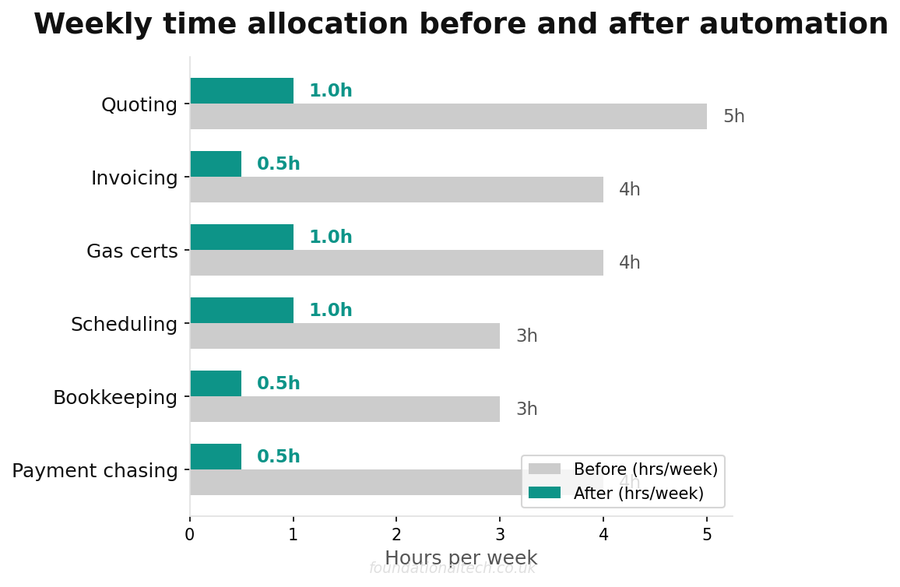
For a business with two or three engineers, the main additional cost is extra Tradify seats — typically another £20–25 per user per month — while Xero, Dext and GoCardless scale without a per-user penalty at this size. A three-engineer business is realistically looking at £110–120 a month in software, against admin time savings that, in every business I've worked with, run to several hours a week that would otherwise go on evening and weekend paperwork. The AI prompts for plumbers guide shows exactly which tasks to hand to AI first.
12 extra jobs per month
by eliminating admin hours with automated job-to-payment workflows
Getting started without disrupting live jobs
The mistake I see most often is trying to migrate everything in one weekend. It's better to sequence it:
Related guides: If you found this useful, see our guide on AI Automation for Plumbers: 3 No-Code Workflows That Connect ChatGPT to Tradify, Xero and Your Inbox (UK 2026) and Best Plumbing Job Management Software UK: 5 Tools Compared for 2026.
- Set up Xero first and get bank feeds connected — this alone tidies up reconciliation immediately, independent of anything else.
- Bring Tradify in for new jobs only, running it alongside whatever paper or spreadsheet system exists for jobs already in progress, rather than trying to migrate historic jobs.
- Connect GoCardless once a handful of invoices have gone through Tradify and Xero cleanly, so customers start seeing payment links from week two or three rather than week one.
- Add Dext last, once the receipt-forwarding habit — literally forwarding merchant emails to a dedicated address — has been explained to whoever does the buying.
Done in that order, most plumbing businesses are fully running the system within a month, without a single day where jobs stop getting quoted or invoiced while the new tools bed in.