Key Takeaway
A fully booked plumber nearly went broke from a cash flow gap. The automated invoicing fix that solved it in 2026.
The plumber called me on a Thursday, which I remember because he kept apologising for ringing during what he assumed were my office hours. He doesn’t have office hours. Nobody who unblocks drains at 9pm has office hours.
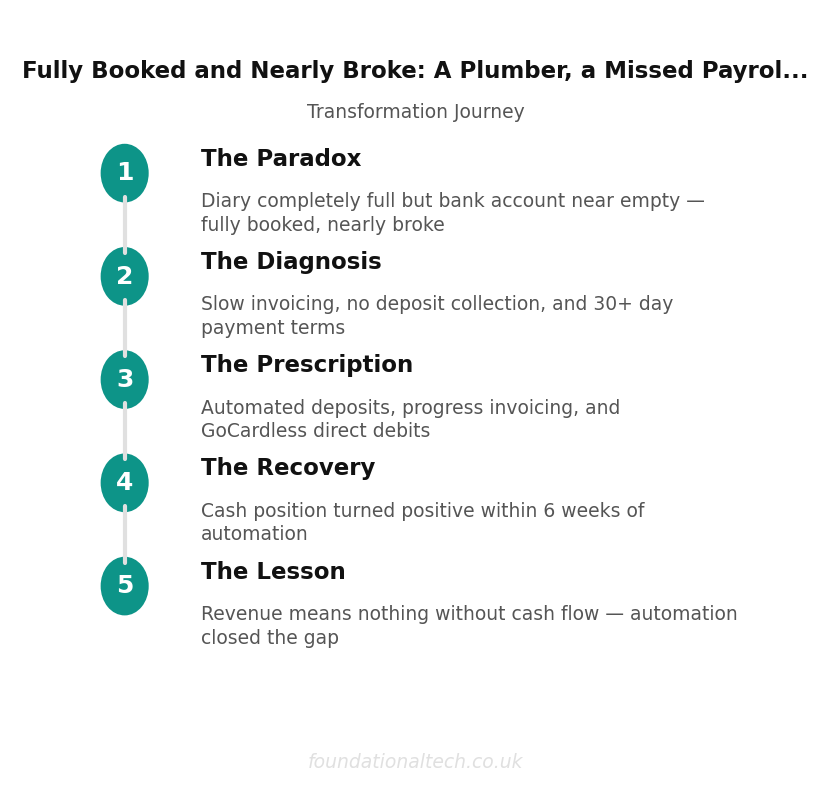
He was Gas Safe registered, eleven years in, one apprentice. Booked solid for a month. And he was ringing me because on Friday he needed to pay the apprentice’s wages, and he wasn’t sure the money would be there.
Let that sit for a second. Fully booked. Good reputation. Phone never stops. And he was lying awake about a payroll run he couldn’t cover.
I asked him how much work he’d completed but not yet been paid for. He went quiet, then counted out loud. A bathroom in Tettenhall, three weeks ago. A landlord’s boiler service, a fortnight back. A commercial job from May the customer’s “accounts department” kept promising to process.
By the time he finished he’d got to about nine thousand pounds. Nine grand of work he’d already done — already paid for the parts on, already paid the apprentice to help with — sitting in other people’s accounts. And he couldn’t make a £600 wage run.
That’s not a failing business. That’s a profitable business with a hole in the bottom of it.
The number that explains everything
There’s a figure I quote so often now that people think I’ve made it up. The average UK plumber waits 34 days to get paid on completed work.
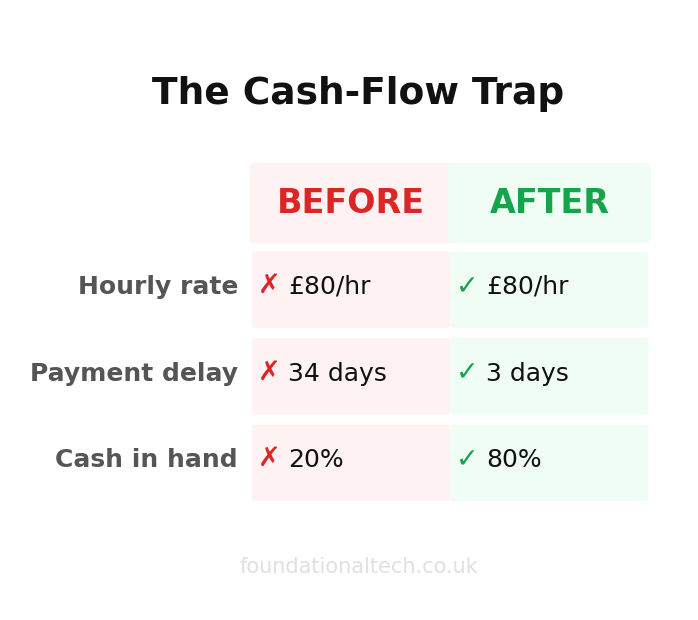
Thirty-four days. On a trade where you’ve often paid for the materials up front, before you’ve even turned up. You finish the job Tuesday. You write the invoice Sunday night, from a photo of a parts receipt. It lands Monday. The customer files it under “later.” And then you wait, and you chase, and you do the awkward text-message dance — “just following up on the below” — while your own bills land on time, every time, like clockwork.
And it lands harder on a trade than on almost any other kind of business, because of when the money moves. A plumber pays for the boiler, the radiators, the copper, the fittings — often before the job even starts, out of his own pocket, on his own card. The customer doesn’t see a penny of that until the work’s done and the invoice is finally settled, weeks later. So the gap isn’t only waiting to be paid. It’s waiting to be paid back for money you’ve already spent.
Every fresh job you take on while the last one sits unpaid digs the hole a little deeper, even as the diary looks healthier than it’s ever looked. That’s the cruel twist in it. The busier you are, the more of your own cash is out on loan to your customers — interest-free, on no fixed return date, secured against nothing but a promise and a chaser text. Nine thousand pounds, in his case. For a one-man-and-an-apprentice firm, nine grand sitting in other people’s accounts is the whole distance between making payroll and lying awake on a Thursday.
He wasn’t short of work. He wasn’t short of skill. He wasn’t even short of profit, on paper. He was short of his own money, because it was banked everywhere except with him. And the maddening part is that none of it showed up anywhere he’d think to look. The jobs were done well. The customers were happy. The accounts, if he’d ever had time to read them, said he was doing fine. The only place the problem lived was in the gap nobody had taught him to measure.
The work was never the problem for this man. The gap was the problem. The distance between finishing a job and the cash actually arriving. And he’d been taught — by every plumber before him — that this gap was just part of the trade. Like wet socks and being called out on Christmas Eve. Something you absorb.
It isn’t. But to see that, he first had to stop believing his own hours were the product.
I was in the exact same trap. Just better dressed.
Here’s the part I don’t love admitting.
When I was a “normal” accountant, I sold time. My whole model was hours. A client gave me a shoebox of chaos, I spent eleven hours making it neat, I billed for eleven hours. The messier the chaos, the more I earned. My income was quietly, perversely tied to inefficiency — mine and theirs.
So when I first started automating things — connecting Xero to everything, building workflows that did in ninety seconds what used to take me an afternoon — I had a genuinely sickening realisation. I was destroying my own billable hours. Every process I automated was money I could no longer charge for. I’d sit there at midnight, having just built something brilliant, thinking: you idiot, you’re making yourself redundant.
I nearly stopped. I want to be honest about that. There was a stretch in 2024 where the smart financial move looked like not getting good at this. Keep the work manual. Keep billing the hours.
What changed my mind wasn’t bravery. It was the same arithmetic I’d just done for the plumber, run on myself. If a machine can do the eleven hours in ninety seconds, then the eleven hours were never what the client was paying for. They were paying for the outcome — clean books, no HMRC trouble, knowing where they stood. I’d just been delivering that outcome the slow way and billing for the slowness.
The day I stopped selling my time and started selling the result was the day the business actually worked. Same skills. Same brain. Completely different model. And — this is the bit that matters — I got my evenings back and earned more, because I was no longer capped by how many hours were in a week.
The plumber and I had the identical trap. He thought his product was his labour. It’s not — it’s a working boiler and a customer who sleeps easy. Mine was never eleven tidy hours. It was a business owner who isn’t scared of the brown envelope.
What we actually did
No grand transformation. We went after the hole in the bottom of the bucket first, because that was the thing keeping him up at night.
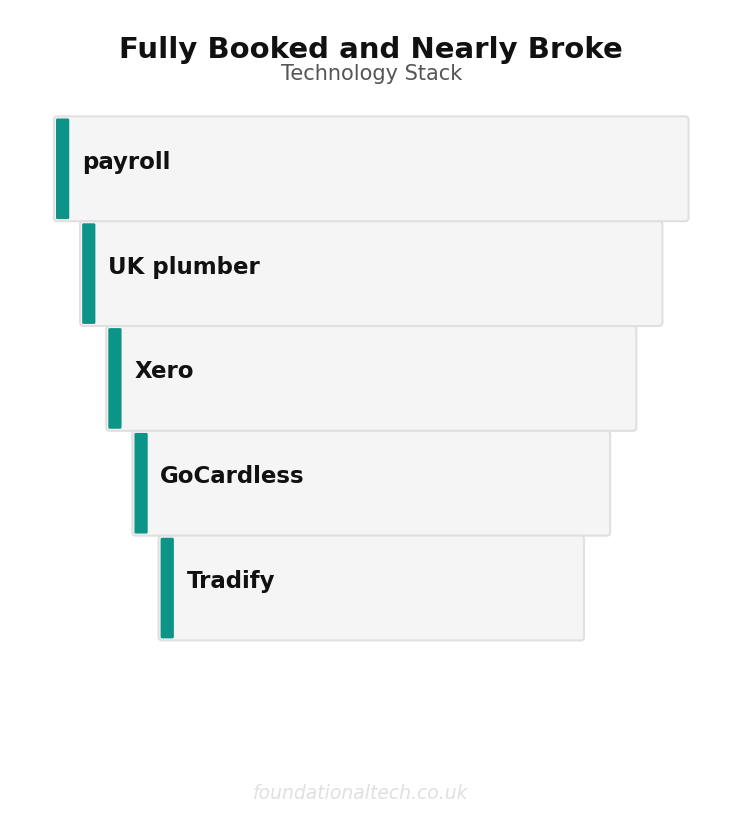
Invoices now raise themselves the moment he taps “complete” on the job — built from the parts and hours already logged on his phone, sent before he’s packed the van. No more Sunday-night admin from a faded receipt. That one change alone pulled his payments forward by the four or five days he used to lose to “I’ll do it tonight.”
Then GoCardless, so the money collects itself by Direct Debit on the due date. For his landlord and maintenance contracts especially — recurring work that used to need recurring chasing — it just arrives. He told me last week he hasn’t sent a “just following up” message in a month and it felt like he’d quit smoking.
For the one-off customers — the bathroom in Tettenhall, the commercial job with the slow “accounts department” — we let the system do the chasing. A polite reminder the day an invoice falls due, a firmer one a week later, both sent automatically in his name. No nuisance, no awkwardness, no Sunday spent steeling himself to send them. The jobs he’d written off as “just slow payers” started clearing in days rather than weeks.
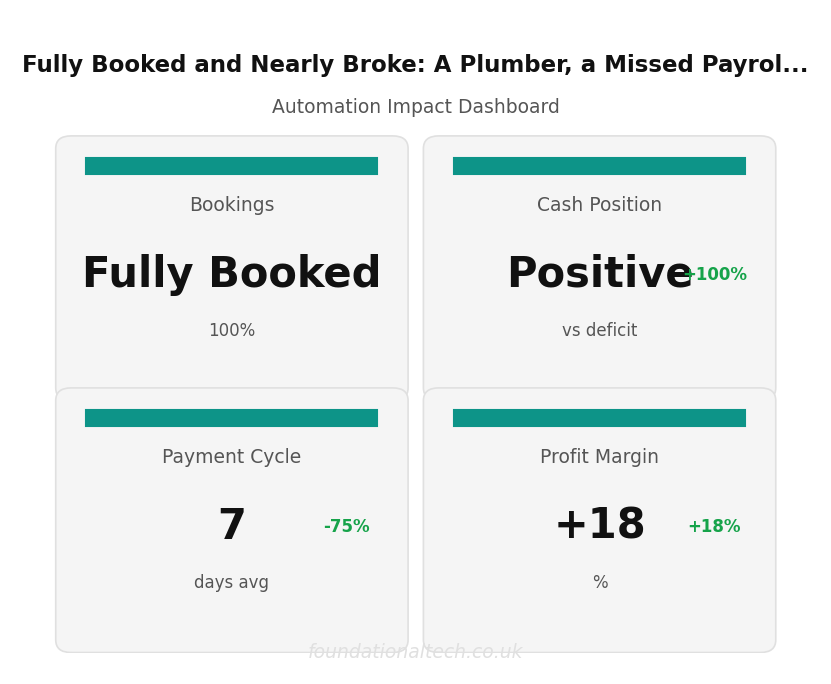
And because everything now runs from the job on his phone straight through to Xero, he can finally see the one number that used to be a fog: exactly how much he’s owed, and by whom, at any moment. Six weeks earlier that question had cost him a sleepless Thursday. Now it’s the first thing on the screen when he opens his phone over a brew.
The whole stack runs him under £80 a month — less than he was losing in a single afternoon chasing one slow payer. He hasn’t missed a payroll since. The apprentice got paid that Friday, and every Friday after, out of money that now lands while the job’s still warm instead of weeks down the line. But the cash was only half of it. The strange part, he said, wasn’t the technology. It was noticing how much room in his head the worry had quietly been renting — and how quiet it all went once the money stopped turning up late.
Fully booked, still broke
the cash-flow trap that catches plumbers billing £80/hr but waiting 34 days to get paid
The thing I want you to take from this
Whatever you do for a living, ask yourself one uncomfortable question: am I selling my time, or am I selling the result?
Because if it’s time, you have a ceiling and a trap. There are only so many hours, and every efficiency you find feels like a threat instead of a gift. That’s the headspace I was in. That’s the headspace the plumber was in. Most people never notice they’re standing in it, because everyone around them is standing there too.
The skills aren’t going anywhere. Nobody’s automating a Gas Safe inspection or a footing or a real conversation with a frightened client. What’s changing is the wrapper — the quoting, the invoicing, the chasing, the waiting. The admin that disguised itself as “just part of the job” and has been quietly taxing your evenings and your cash flow for years.
Hand that part over. It was never the work. It was never what people paid you for. It was just the slow way you’d learned to deliver the thing they actually wanted.
This week on Foundational Tech I published ten guides for plumbers and heating engineers covering exactly this. Automated quoting and invoicing, closing the 34-day cash-flow gap, Gas Safe and CP12 paperwork without the dread — and how Tradify, Xero and GoCardless click into one system that pays you on time. If you know a plumber who’s fully booked and somehow still skint, send them over.
Related guides: If you found this useful, see our guide on How to Connect Tradify, Xero, GoCardless and Dext: The Complete Plumbing Integration Map (2026) and AI Automation for Plumbers: 3 No-Code Workflows That Connect ChatGPT to Tradify, Xero and Your Inbox (UK 2026).
Are you selling your time or selling the result? And what’s the one piece of admin you’ve always treated as “part of the job” — the thing you’ve never once questioned because everyone in your trade does it the same way? Hit reply or leave a comment. I read every single one.