Key Takeaway
Automate timesheets, payroll, receipts for your UK plumber business in 2026. Step-by-step guide using Dext, Xero, and payroll tools to cut admin hours.
Ask a plumber what the worst part of running the firm is, and almost none of them say unblocking a drain or swapping a boiler. They say Sunday night — the hour spent working out who did what hours this week, totting them up for payroll, and emptying a glovebox of faded receipts they half-hope still count for VAT.
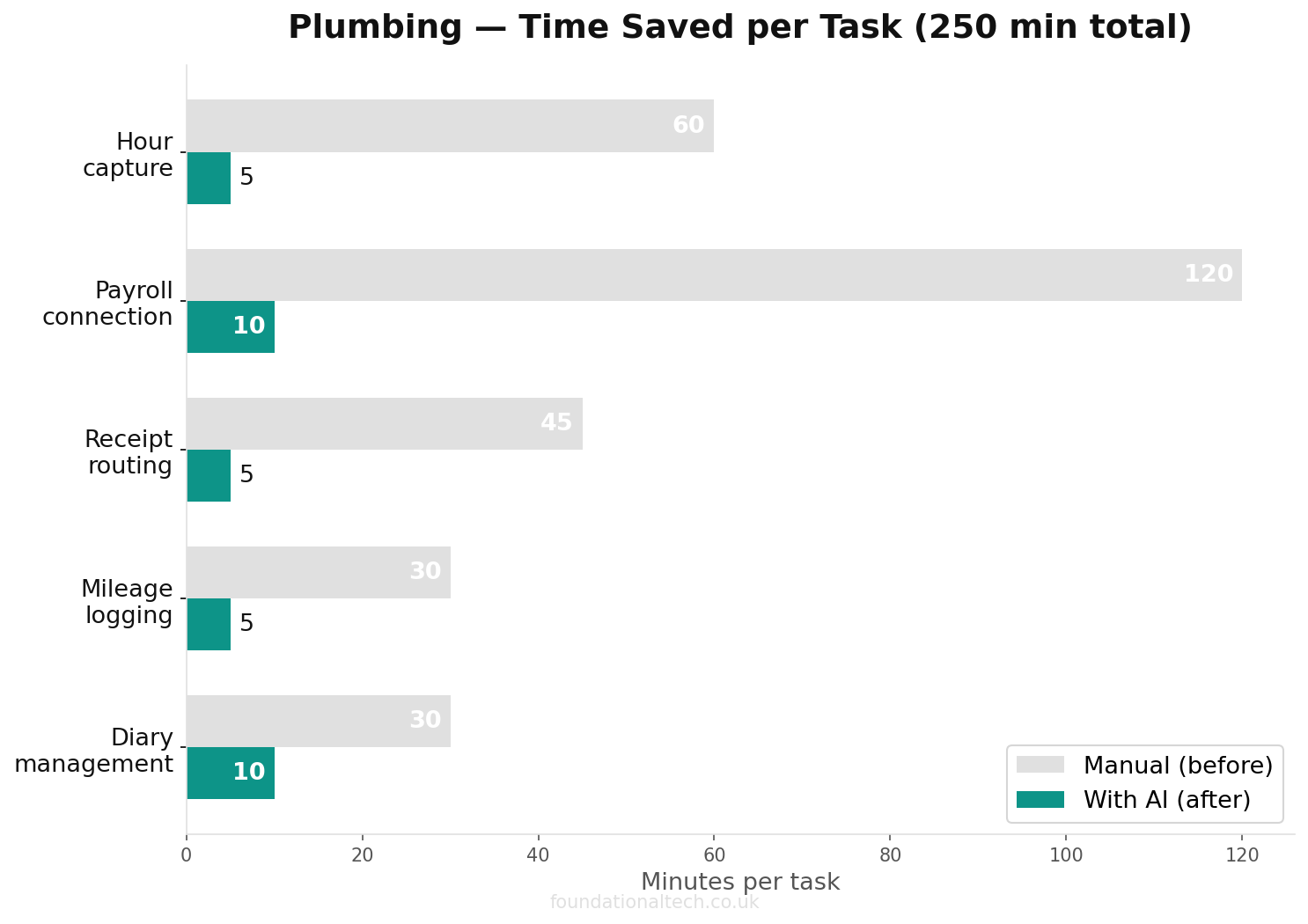
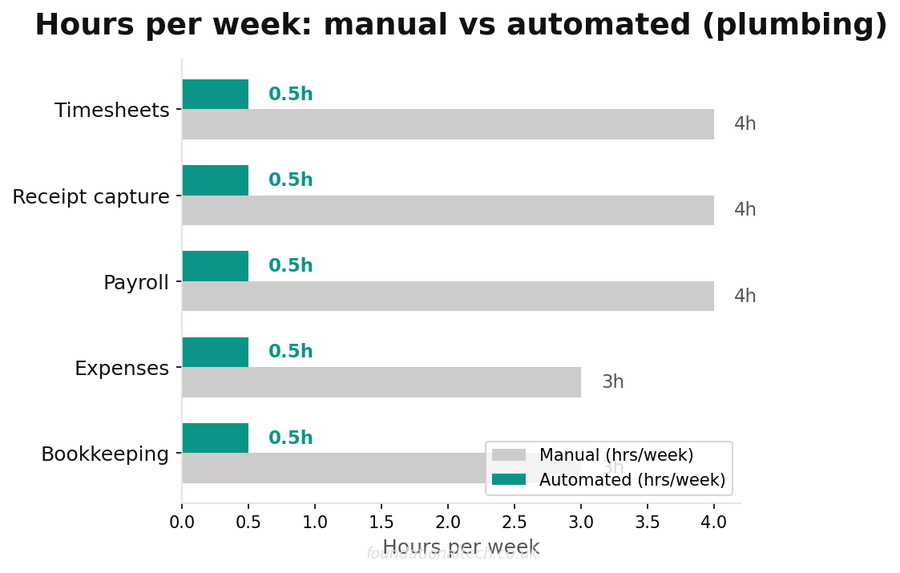
That back-office hour is the most expensive in the week, because it earns nothing and you do it tired. A plumber with one or two staff loses three to five hours every week to timesheets, payroll prep, receipt-wrangling and rescheduling. Call it 200 hours a year — the best part of five working weeks gone to admin you never trained for.
Almost all of it is automatable with tools you may already be paying for. This article covers the three functions that bleed the most time for a plumbing firm: capturing hours, running payroll, and handling receipts and expenses. It then shows how to wire them together so Sunday night becomes a ten-minute review.
The Hidden Cost
The back office is invisible until it goes wrong. Nobody invoices for the hour spent reconstructing an apprentice’s week from memory, or the VAT you couldn’t reclaim because the receipt faded in the van door. But it adds up in three quiet ways.
200+ hours/yr
spent on manual payroll and receipt processing for plumbing businesses
First, time: three to five unpaid hours a week at a charge-out rate of £60–£80 means you’re effectively paying yourself a few hundred pounds a week to do clerical work badly. Second, money lost: every receipt you can’t read is VAT you can’t reclaim — on a firm spending £2,000 a month at the merchants, mislaid receipts can quietly cost hundreds a year. Third, risk: payroll worked out from memory gets wages wrong, and getting an employee’s pay wrong is how you lose good staff.
The fix is to capture each piece of data once, at the moment it happens, and let it flow to where it’s needed — instead of reconstructing it all on Sunday.
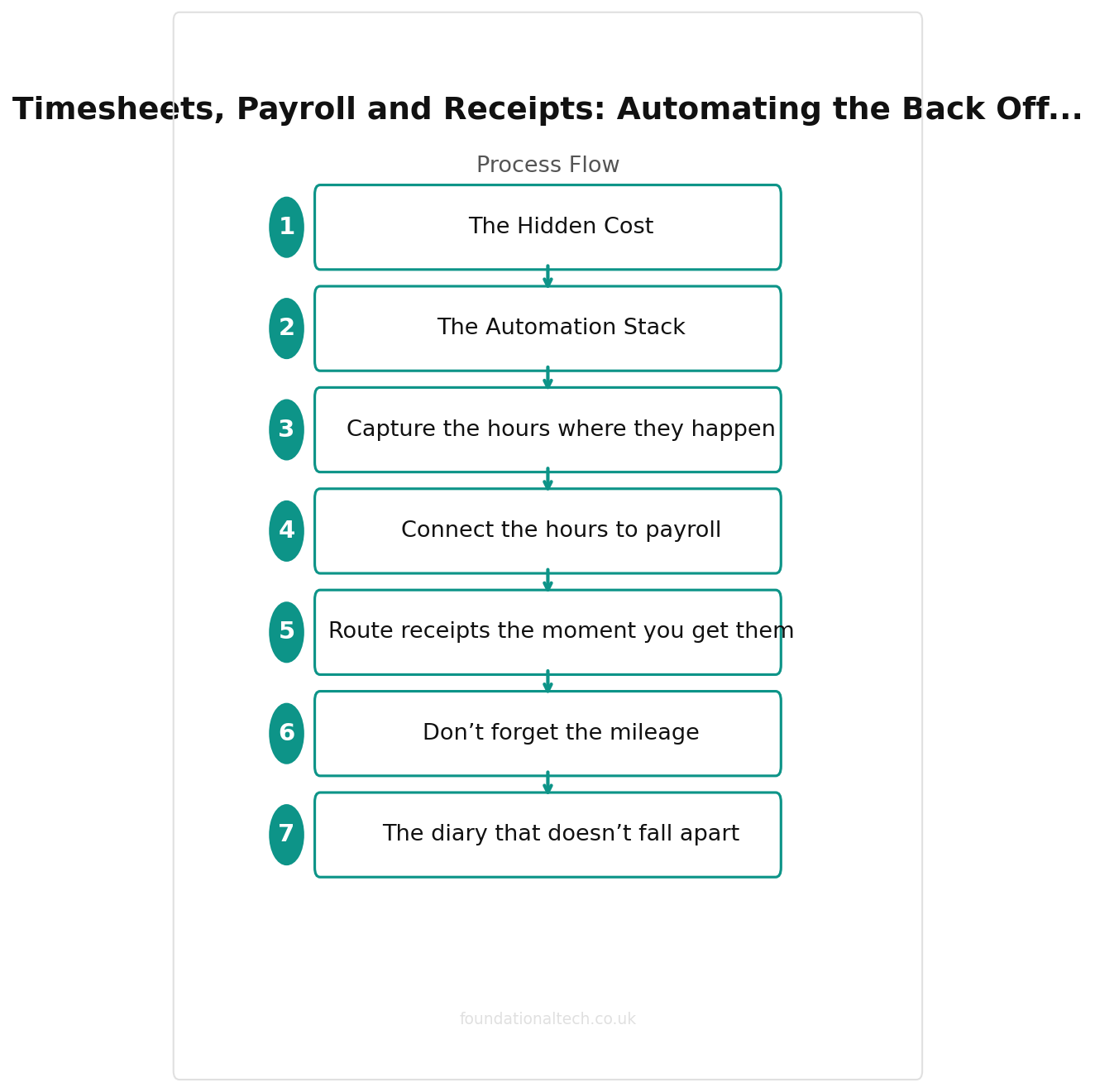
The Automation Stack
Capture the hours where they happen
The root cause of the Sunday-night payroll slog is that the hours were never recorded properly in the first place. You’re not doing payroll; you’re doing archaeology.
Tradify (from £29.50/user/month, £28/user/month on Pro for teams of four or more) lets your team clock on and off against the actual job from their phones. That single entry does two jobs at once. It costs the job, so you know which work actually made money and which quietly lost it. It also produces a clean, accurate record of hours worked, ready for payroll, with no end-of-week guesswork.
If you run a larger team or want dedicated rota and shift tools, Deputy (from around £3.50 per user/month) does the same job with stronger scheduling, and it exports timesheets straight into payroll. Either way, the principle holds: the hours are captured on site, by the person who worked them, the day they happen.
There’s a second payoff that’s easy to miss. Once every hour is logged against a job, you stop guessing which work pays. You might find the emergency call-outs you dread are your best earners per hour, while the big install you were proud of barely broke even after the third return visit. That’s information you can price on next time. The same clock-on that saves you Sunday night quietly tells you where the money actually comes from. And an apprentice who clocks on from their own phone tends to be more honest about start times than one whose hours you piece together from memory days later.
Connect the hours to payroll
Once hours are clean, payroll stops being a calculation and becomes a confirmation.
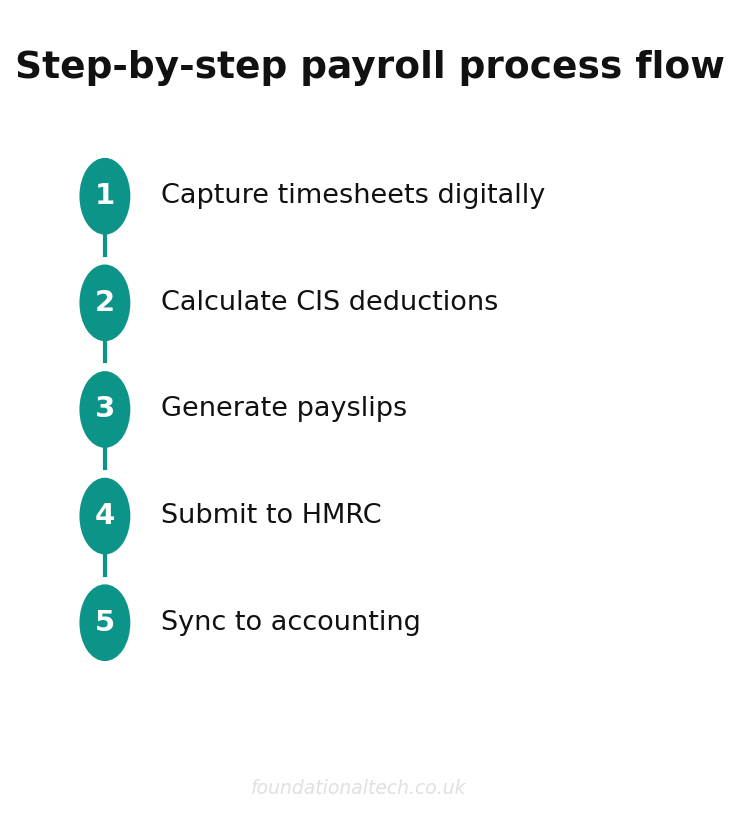
Xero Payroll is an add-on to your Xero subscription at £5/month for up to five employees (£1/month per extra person after that). It handles PAYE, National Insurance, pension auto-enrolment and Real Time Information submissions to HMRC automatically. Approved timesheets feed straight in, so you’re checking figures rather than typing them. Payslips generate and send themselves, and the payroll journal posts to your accounts with no extra entry.
For a solo plumber with no staff, you can skip this entirely. The moment you take on even one employee or a regular apprentice, it turns the most error-prone job in the business into a few minutes of review.
The risk it removes is bigger than the time it saves. Pay an apprentice the wrong amount two months running and you don’t just have a correction to make. You have someone who no longer trusts that the money will be right — which is how good staff start looking elsewhere. Get a PAYE or pension submission wrong and HMRC penalties follow on their own timetable. When the hours feed straight through and the calculations run themselves, those mistakes mostly stop happening. The ones that do are caught at the review stage rather than discovered in an angry text on payday.
A note on subcontractors: if you pay other plumbers as subbies rather than employees, you may fall under the Construction Industry Scheme (CIS) and need to deduct tax before paying them. Xero calculates CIS deductions and builds the monthly return automatically once it’s switched on in Settings. It’s worth checking with your accountant whether it applies to you, because missing a monthly CIS return triggers an automatic £100 penalty.
Route receipts the moment you get them
The glovebox full of faded paper is the most reclaimable money in the business — if you capture it before it fades.
Photograph every merchant and supplier receipt the moment it’s in your hand. Xero includes receipt capture built in (via Hubdoc) at no extra cost on current plans. Snap the receipt, and it reads the supplier, date, net, VAT and total. It then files the receipt to the right expense account and matches it against the bank transaction. The paper can go in the bin the same day.
If your receipt volume is high or you want sharper extraction and supplier-statement matching, Dext (from roughly £24/month for 250 documents) is the step up. It reads receipts and supplier bills more accurately and pushes them straight into Xero. For most one- and two-van plumbing firms, Xero’s built-in capture is plenty.
The rule is the same as everywhere else in the stack: capture once, at the point it happens, and never touch the data again.
Don’t forget the mileage
One reclaimable cost plumbers routinely lose is mileage and fuel. Log fuel receipts through the same capture flow, or record business mileage against jobs in Tradify. Either way you build the evidence trail for the fuel you can reclaim or the 45p-per-mile allowance you can claim, whichever your accountant uses. It’s a few hundred pounds a year that otherwise evaporates because nobody kept the record.
The diary that doesn’t fall apart
The other quiet time-sink is the diary. A paper diary or a phone full of texts collapses the moment a customer reschedules — and in plumbing, they always do. The boiler part is delayed, the tenant isn’t in, the emergency call-out bumps everything by a day.
Because your jobs already live in Tradify, rescheduling is a drag-and-drop, not a rewrite. Move the job, and the assigned engineer sees it, the customer can be notified automatically, and the hours and invoice still attach to the right record. You stop being the human switchboard who re-tells everyone when the plan changes. For a one-van firm that’s an hour a week back; for a small team it’s the difference between a calm Monday and a chaotic one.
It also closes the most common cause of a wasted morning: two engineers turning up to the same job, or none turning up to a job that quietly slipped off a paper diary. When the schedule is the single source of truth and everyone reads from the same screen, the double-bookings and no-shows that cost you a customer simply stop happening. The diary stops being something you hold in your head and becomes something the whole team can trust.
| Task | Manual | Automated |
|---|---|---|
| Receipt entry | 1 hr/week | 5 min/week |
| Timesheet chasing | 2 hrs/week | 10 min/week |
| Payroll processing | 3–4 hrs/week | 30 min/week |
| Error corrections | 2 hrs/month | Near zero |
Implementation Timeline
You don’t need to switch everything on at once. Roll it out over three weeks so nothing breaks at payroll time.
Week 1 — Set up. Turn on timesheets in Tradify (or Deputy) and get every team member clocking on and off against jobs from their phone. Connect Xero Payroll and enter your employees, tax codes and pension details. Switch on receipt capture in Xero and install the mobile app on everyone’s phone.
Week 2 — Run it in parallel. Have the team log hours digitally while you still keep your old method as a backup. At week’s end, compare the two. The digital record is almost always more accurate — that’s the point. Photograph every receipt this week and watch them land in Xero pre-coded.
Week 3 — Go live. Run payroll straight from the digital timesheets, no paper backup. Reconcile receipts from your phone in ten minutes instead of from a shoebox on Sunday. From here, the back office runs as a short weekly review rather than a dreaded evening.
What “good” looks like once it’s bedded in: on a Friday afternoon you open Xero, glance at the week’s approved timesheets, confirm the few receipts that didn’t auto-match, and you’re done. Payroll runs itself on its scheduled date and files RTI to HMRC without you opening anything. Pension contributions deduct and submit automatically under auto-enrolment, so you’re not manually working out who’s opted in. The numbers you used to dread — what you paid out in wages, what you owe HMRC, what’s reclaimable — are all sitting in front of you, current. No more reconstructing them once a quarter in a panic before the accountant’s deadline.
Total cost for a two-person firm: Tradify, Xero with Payroll, and built-in receipt capture come to roughly £80–£90 a month — most of which you’re already paying for the quoting and accounting side. The return is three to five hours a week handed back, payroll that’s right the first time, and every reclaimable pound of VAT actually reclaimed.
Related guides: If you found this useful, see our guide on Stop Waiting 34 Days to Get Paid: Automated Invoicing and Payment Collection for UK Plumbers (2026) and AI Automation for Plumbers: 3 No-Code Workflows That Connect ChatGPT to Tradify, Xero and Your Inbox (UK 2026).
How many hours does your admin and bookkeeping take per week? Reply with the number — I’m building a benchmark for UK plumbing firms, and the honest answers are usually higher than the guesses.