Key Takeaway
12 AI prompts for UK roofers in 2026. Copy-paste templates for scopes, insurance claims and customer letters.
These twelve prompts are built for roofing contractors. Not builders. Not plumbers. Roofers. Every prompt addresses a specific piece of paperwork that lands on your desk — or, more likely, lands in your head at 9pm when you are too tired to write it properly.
Each prompt is designed to be copied, pasted, and used immediately. Fill in the sections marked with square brackets. The AI will produce a first draft that is 85% to 90% right. Your job is the remaining 10% to 15%: checking facts, adjusting prices, and making sure nothing has been invented.
These work with Claude, ChatGPT, and Gemini. All of them. No special setup required — just paste the prompt into whichever AI you use and fill in your job details.
Prompt 1: Storm-Damage Survey to Insurer-Ready Scope of Work
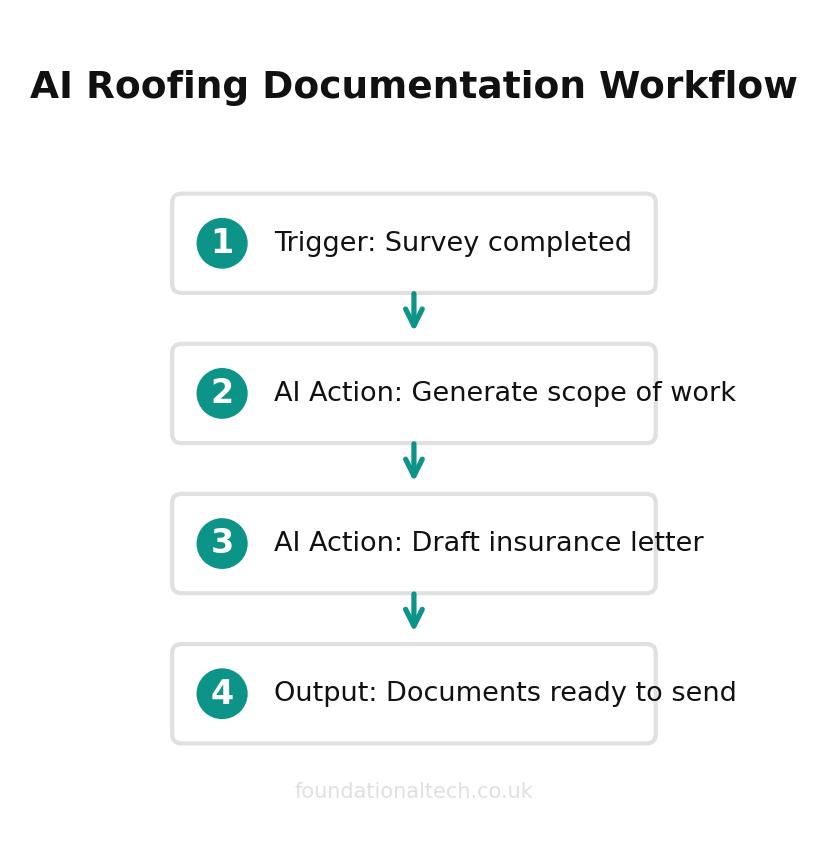
This is the single most valuable prompt in the collection. After a storm, the roofer who gets a professional scope to the loss adjuster first wins the job more often than not. This prompt produces a document formatted to match what loss adjusters expect: itemised, clearly separating storm damage from pre-existing wear, with quantities and rates.
You are a UK roofing contractor's administrative assistant. Produce an insurer-ready scope of work from the following storm-damage survey notes.
FORMAT REQUIREMENTS:
Itemise every defect as a separate line item with description, quantity, unit, and rate
Separate storm damage into Section A and pre-existing deterioration into Section B — loss adjusters reject scopes that bundle these together
Include a summary total for Section A only (storm damage — the insurable portion)
Use formal, precise language consistent with insurance industry standards
Reference "consequential storm damage" where appropriate, not "weather damage" or "storm issues"
All pricing in GBP (£), all measurements in metric
 SURVEY NOTES:
[Paste your voice note transcription or typed survey notes here]
PROPERTY DETAILS:
Address: [Full address including postcode]
Property type: [e.g., semi-detached, detached, terraced, bungalow]
Roof type: [e.g., pitched tile, pitched slate, flat felt, flat GRP]
Approximate roof age: [years, or era — e.g., "1970s original"]
Survey date: [date]
Surveyor: [your name/company]
 MY STANDARD RATES:
Roofer day rate: £[amount] per day
Labourer day rate: £[amount] per day
Scaffold hire: £[amount] (state if included or separate)
Skip hire: £[amount]
[Add any other standard rates]
 Do NOT invent measurements I have not provided. If a quantity is unclear from my notes, flag it with "[CONFIRM ON SITE]" rather than guessing. Do NOT make structural assessments — describe only what was observed.
Why it works: The instruction to separate storm damage from pre-existing wear is critical. Loss adjusters look for this distinction immediately. Scopes that fail to make it are sent back, costing you days. The "[CONFIRM ON SITE]" instruction prevents the AI from fabricating quantities — a common and dangerous failure mode.
Prompt 2: EagleView/RoofSnap Report Summary for Homeowners
Your aerial measurement report is packed with data the customer does not understand. This prompt translates it into plain English that builds confidence and justifies your quote.
I am a UK roofing contractor. I have the following aerial roof measurement data from an [EagleView/RoofSnap/iRoofing] report. Write a clear, professional summary for the homeowner that explains what these measurements mean in plain English. The tone should be reassuring and informative — this person is about to spend £[approximate total] on their roof and wants to understand what they are paying for.
MEASUREMENT DATA:
Total roof area: [X] square metres
Number of roof facets: [X]
Dominant pitch: [X] degrees
Ridge length: [X] linear metres
Hip length: [X] linear metres (if applicable)
Valley length: [X] linear metres (if applicable)
Eaves length: [X] linear metres
Verge length: [X] linear metres (if applicable)
[Any other measurements from the report]
 PROPERTY: [Type and approximate age]
PROPOSED WORK: [Brief description — e.g., "full strip and re-tile with Marley Modern concrete interlocking tiles"]
Explain each measurement in terms the homeowner can visualise. Do NOT include pricing in this summary. Do NOT make structural assessments. End with a brief note confirming that a physical site survey has also been completed to verify the aerial measurements.
Why it works: Homeowners who understand the scope of their roof are less likely to challenge the price. This document sits between the technical report and the quote, bridging the gap. The instruction to exclude pricing keeps this as a trust-building document rather than a negotiation tool.
Prompt 3: Staged Payment Chaser Sequence
Roofing jobs run on staged payments — deposit, strip, tile, completion — and each stage has its own chasing dynamic. This prompt produces a sequence of three messages for a specific overdue stage, escalating in firmness without burning the relationship.
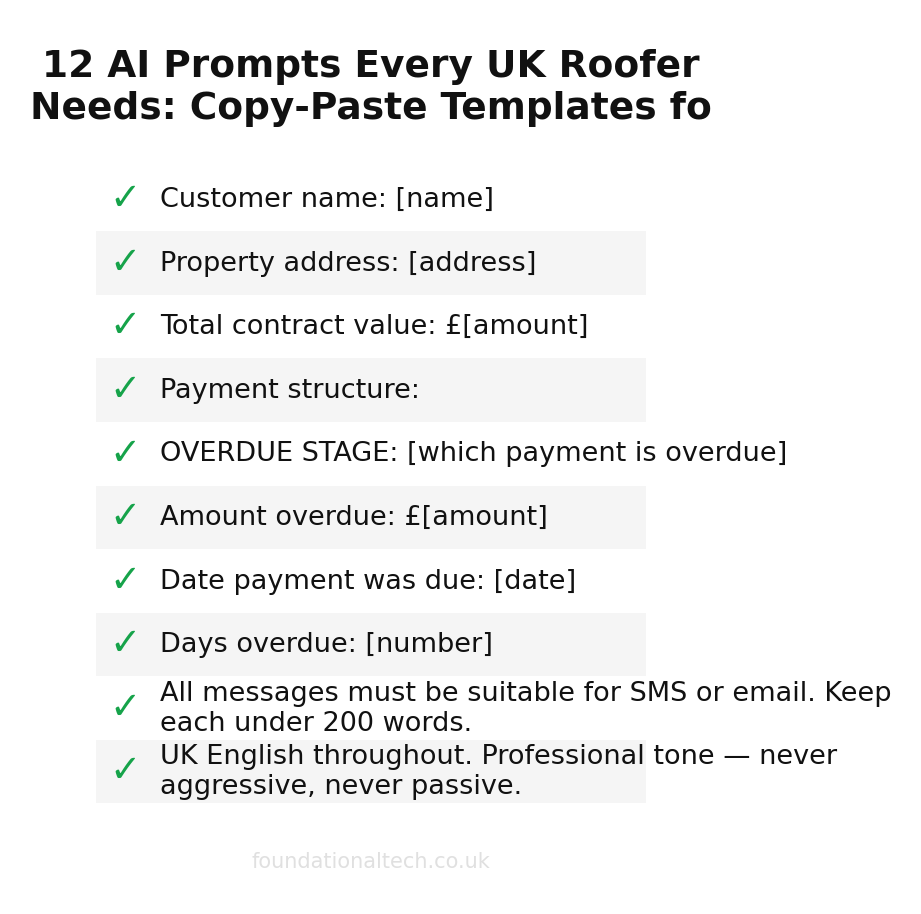
You are writing payment chaser messages for a UK roofing contractor. The customer owes a staged payment that is now overdue. Write THREE messages — to be sent at 3 days, 7 days, and 14 days overdue — escalating in firmness while remaining professional.

JOB DETAILS:
- Customer name: [name]
- Property address: [address]
- Total contract value: £[amount]
- Payment structure:
  - Deposit (20%): £[amount] — [paid/outstanding]
  - Strip completion (30%): £[amount] — [paid/outstanding]
  - Tiling/covering completion (30%): £[amount] — [paid/outstanding]
  - Final completion and snag (20%): £[amount] — [paid/outstanding]
- OVERDUE STAGE: [which payment is overdue]
- Amount overdue: £[amount]
- Date payment was due: [date]
- Days overdue: [number]

CONTEXT: [Any relevant context — e.g., "scaffold is still up and costing us £[X] per week in extended hire", "we cannot begin the next stage until this payment clears", "materials for the next phase are on order and cannot be cancelled"]

IMPORTANT CONSTRAINTS:
- Message 1 (3 days): Friendly reminder. Assume it was an oversight. Mention the specific stage completed and confirm satisfaction.
- Message 2 (7 days): Firm but professional. Reference the contract terms. If scaffold is still erected, mention the ongoing hire cost. State clearly that the next stage cannot proceed until payment is received.
- Message 3 (14 days): Final notice before formal action. Reference the Late Payment of Commercial Debts Act if this is a commercial client. For domestic clients, state that you will be instructing a debt recovery process. Mention that the incomplete roof may not be covered by your guarantee until final payment and completion.
- All messages must be suitable for SMS or email. Keep each under 200 words.
- UK English throughout. Professional tone — never aggressive, never passive.
Why it works: The staged payment structure is unique to roofing and construction. A generic "your invoice is overdue" message misses the nuance that scaffold is ticking at £150 per week while you wait for payment, or that you physically cannot tile a roof until the strip payment clears. This prompt captures those trade-specific pressure points.
Prompt 4: Scaffold Cost Explanation for Customer Queries
Customers always ask why scaffold costs so much. This prompt produces a clear explanation that justifies the cost and references the legal requirements.
A customer has queried the scaffold cost on their roofing quote. Write a clear, professional explanation I can send by email or text. The tone should be matter-of-fact and informative, not defensive.

SCAFFOLD DETAILS:
- Scaffold cost quoted: £[amount, typically £800-£1,200 for a standard domestic re-roof]
- Property type: [e.g., two-storey semi-detached, three-storey terraced, detached bungalow with restricted access]
- Scaffold configuration: [e.g., full scaffold to front and rear elevations, tower scaffold to rear only, scaffold with temporary roof]
- Hire period included: [X] weeks
- Extended hire rate: £[amount] per week beyond included period
- Any special requirements: [e.g., pavement licence from council, neighbour notification for party wall access, traffic management for busy road]

The explanation must reference:
- Working at Height Regulations 2005 — scaffold is a legal requirement for work above 2 metres, not an optional extra
- HSE enforcement — the contractor is legally responsible for providing safe access
- What the cost includes: erection, weekly hire, dismantling, and any required council licences
- Why the customer benefits: proper scaffold allows faster, safer work, which reduces labour days and overall cost
- Keep it under 250 words
- UK English, GBP pricing
Why it works: The scaffold question comes up on nearly every domestic re-roof job. Having a ready-made, legally referenced explanation saves you writing the same message repeatedly and positions the cost as a regulatory necessity rather than an optional expense.
Prompt 5: CompetentRoofer Self-Certification Covering Letter
When you self-certify under CompetentRoofer, the covering letter needs to reference the correct regulations and state the U-value achieved. This prompt produces that letter.
You are drafting a CompetentRoofer self-certification covering letter for a UK roofing contractor. This letter accompanies the Building Regulations compliance certificate for a completed re-roofing project.

PROJECT DETAILS:
- Contractor name and CompetentRoofer registration number: [your details]
- Property address: [full address]
- Homeowner name: [name]
- Date of completion: [date]
- Work undertaken: [e.g., "Full strip and re-roof of pitched roof to front and rear elevations, including replacement of breathable membrane, battens, and concrete interlocking tiles"]

BUILDING REGULATIONS COMPLIANCE:
- Percentage of roof covering replaced: [X]% (Part L applies if >50% replaced, or if >25% replaced in some interpretations — state which applies)
- Insulation installed: [type, e.g., "100mm Kingspan Kooltherm K7 between rafters plus 50mm K18 insulated plasterboard to underside"]
- U-value achieved: [X] W/m²K (Building Regs Part L 2021 target for a roof is 0.16 W/m²K for new build, 0.18 W/m²K for existing buildings — state which applies)
- Ventilation provision: [e.g., "10mm continuous eaves ventilation with tile vents to ridge providing equivalent of 5mm continuous ridge ventilation, per BS 5250"]

FORMAT:
- Professional letter format, addressed to the homeowner with a copy noted to the local Building Control authority
- Reference the Building Regulations 2010 (as amended), Approved Document L (Conservation of Fuel and Power)
- Confirm the work has been completed in accordance with the relevant standards and that notification has been/will be made to the local authority via the CompetentRoofer scheme
- Keep to one page
- UK English throughout
Why it works: CompetentRoofer covering letters follow a predictable format but require precise regulatory references. Getting the Part L U-value threshold wrong or referencing the incorrect edition of Approved Document L undermines your professional credibility. This prompt ensures the letter hits every required point.
Prompt 6: Flat Roof Guarantee Registration Follow-Up
You have completed a flat roof. The guarantee needs registering with the manufacturer, and the customer needs confirmation. This prompt handles both the registration chase and the customer notification.
Write two separate messages for a completed flat roof installation:

MESSAGE 1 — To the manufacturer/guarantee provider:
I need to register a guarantee for a completed flat roof installation. Produce a professional email requesting guarantee registration.
- Contractor details: [company name, registration/installer number with this manufacturer]
- Manufacturer/system: [e.g., "Topseal GRP", "Firestone EPDM", "Sealoflex"]
- Guarantee type and duration: [e.g., "GRP system — 25-year manufacturer guarantee", "EPDM — 20-year material guarantee", "Felt three-layer — 10-year installer guarantee"]
- Installation date: [date]
- Property address: [full address]
- Roof area: [X] square metres
- System specification as installed: [e.g., "Topseal GRP system: 18mm OSB3 deck, Topseal resin and matting, Topseal topcoat in grey, Topseal trims to all edges and upstands"]
- Any photographs or documentation attached: [list what you are sending]

MESSAGE 2 — To the homeowner:
A brief, reassuring message confirming that you have applied for the guarantee registration, explaining the expected timeline for receiving the certificate, and reminding them to keep it with their property documents. Under 150 words.
Related guides: If you found this useful, see our guide on 3 No-Code AI Workflows for Roofers: Storm Triage, Insurance Claims and Scaffold Scheduling Automated (UK 2026) and How to Build an AI Assistant for Your Roofing Business: A Step-by-Step Setup Guide for UK Roofers.
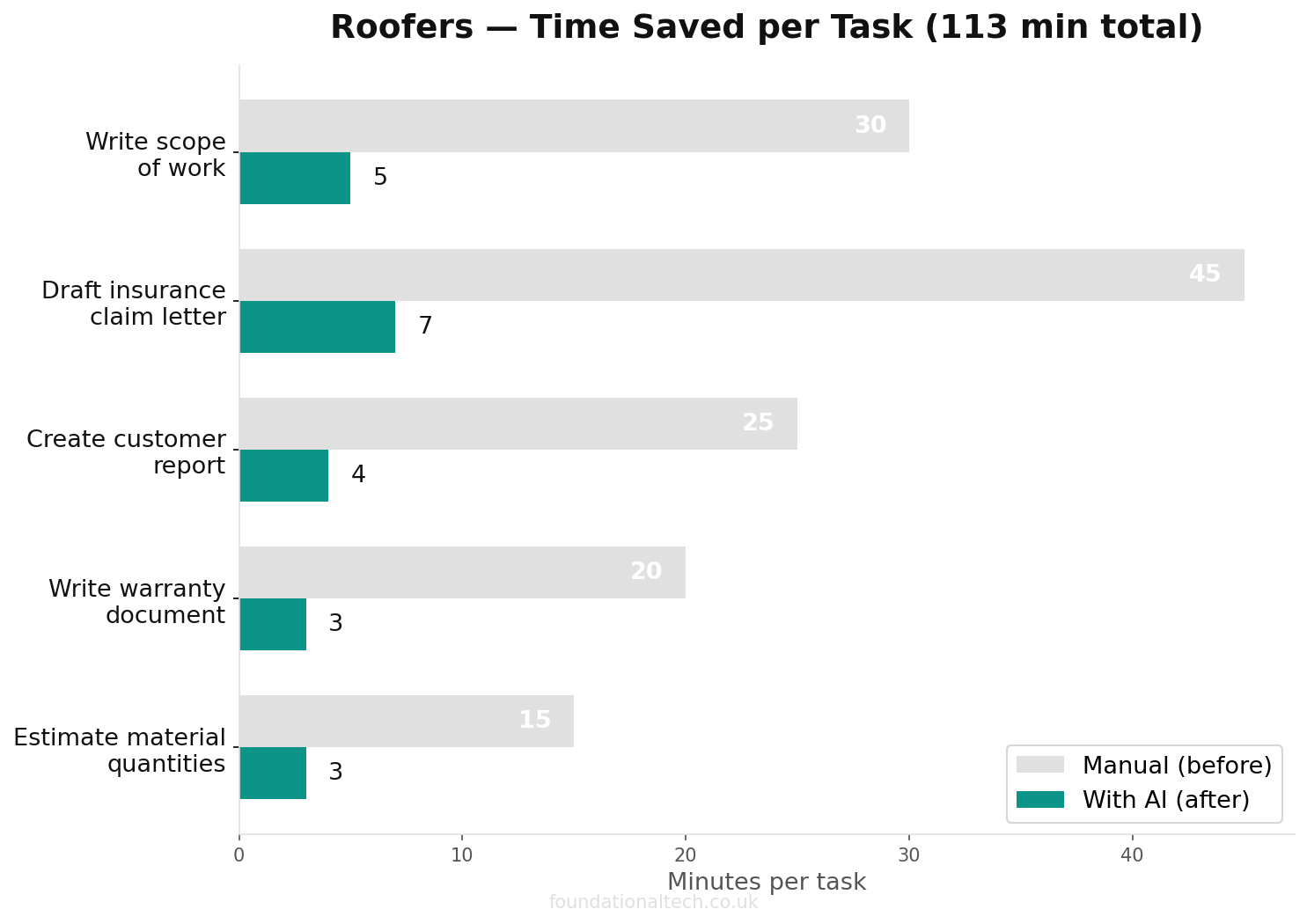
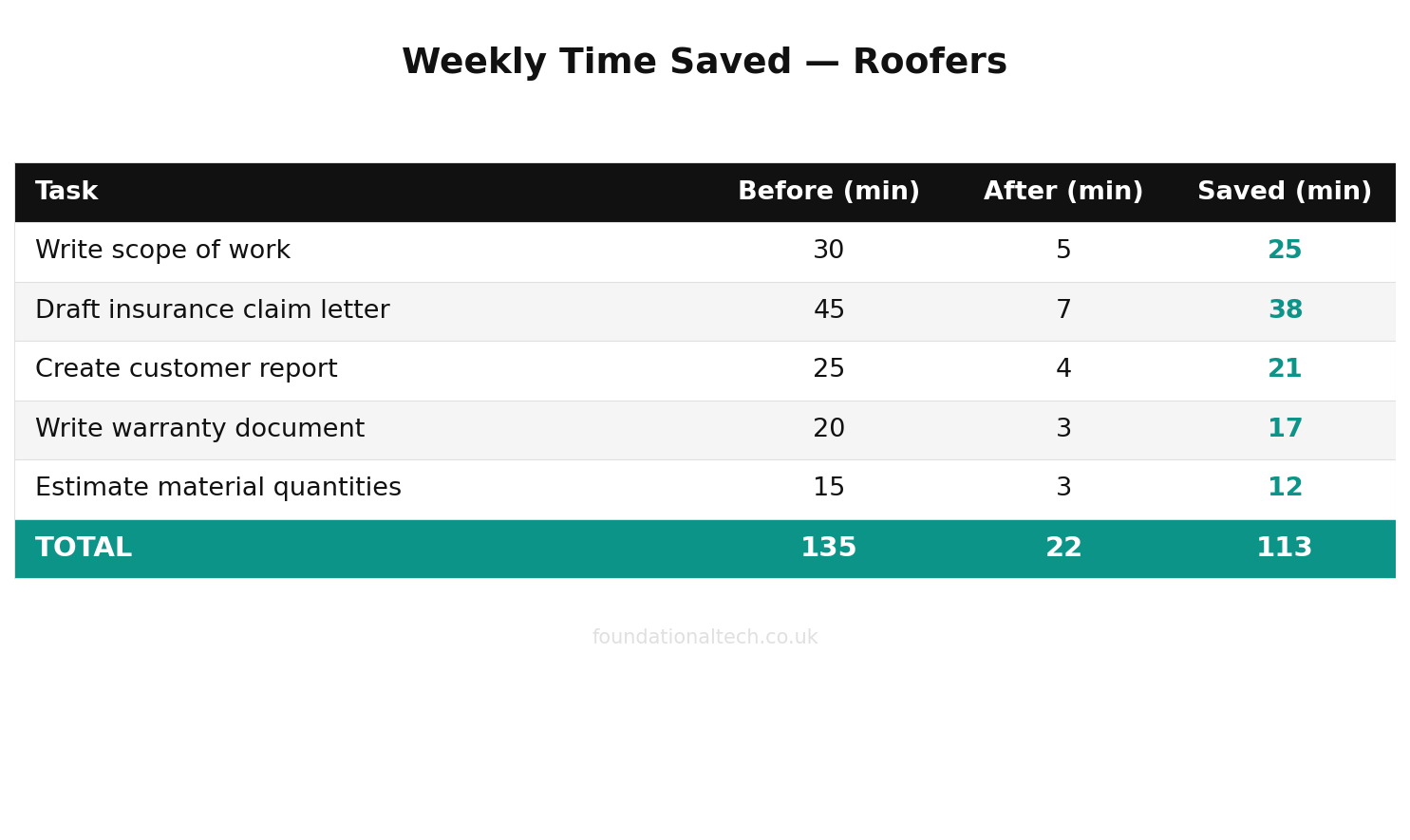
35 min → 3 sec
Average time to draft a professional roofing contractor document — manual vs AI-assisted