Key Takeaway
Newcastle roofing firm went from maxed overdraft to 27 storm conversions. Full automation case study with software stack, real costs, and implementation.
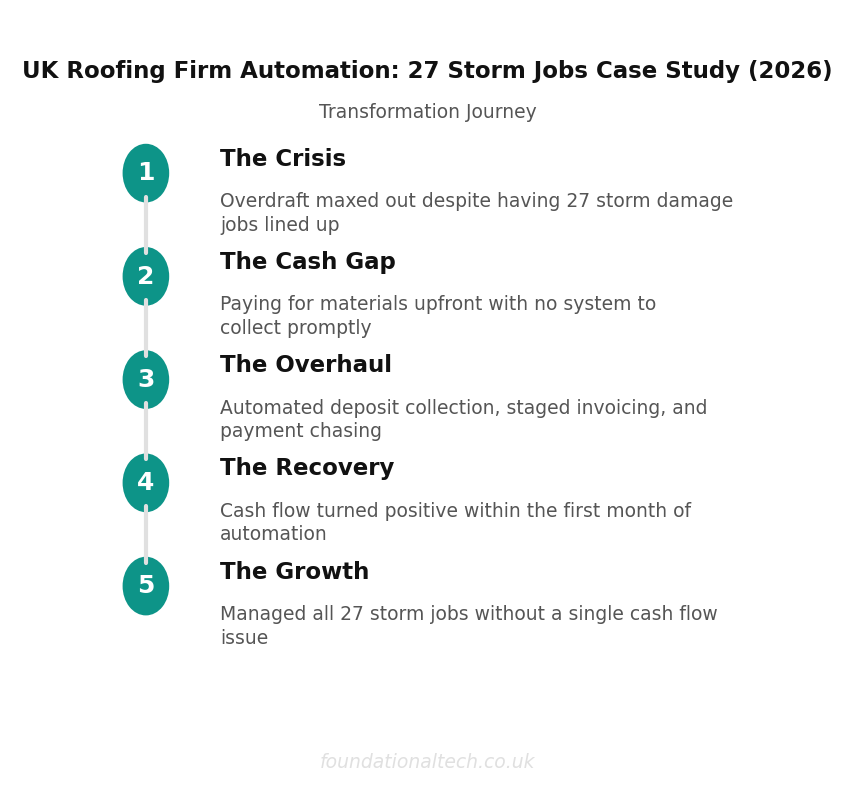
Three scaffolds up across Newcastle on a Friday afternoon in March, and Gareth Pryce is sitting in the van watching the Met Office app refresh. Rain from Sunday through Wednesday. Four days, minimum.
He does the maths without needing a calculator because he's done it too many times. Three scaffold hires running at £150 to £200 a week each. That's £450-plus in dead hire before anyone lifts a tile. The strip on the Jesmond job is half done — exposed felt, no tiles — so that scaffold can't come down. The Gosforth re-roof hasn't started because the materials delivery was late on Thursday, and now there's no point stripping into a wet weekend. The flat roof in Byker needs two dry days for the torch-on, and it's not getting them.
He checks his phone. Two texts from Claire. The Gosforth customer's 30% stage payment is eight days overdue. The insurance loss adjuster on a Heaton job has sent another letter requesting "further photographic evidence of pre-existing deterioration" — the third request on the same claim. The overdraft is at £14,800. The limit is £15,000.
The business turned over £420,000 last year. Gareth has six people: himself, Claire running the office and accounts, two employed roofers, two regular subbies. They're NFRC members, CompetentRoofer registered, and every job gets a proper handover pack. By any measure, they're a good firm doing good work.
But the cash position feels like a startup on its last round.
The Problem Isn't the Work
Gareth's pain wasn't revenue. He had plenty of work — domestic re-roofs, storm damage, insurance jobs, flat roofing, a handful of commercial maintenance contracts. Referrals came steadily. The Google profile sat at 4.8 stars with 90-odd reviews.
The pain was structural. Five interlocking problems, each making the others worse.
Scaffold cost management. Gareth was spending £3,200 a month on scaffold hire. Not because he needed that much scaffolding, but because jobs overlapped badly. Weather delays on one job meant the scaffold sat there while the crew moved to another — except the other job's scaffold wasn't always up yet, because he'd staggered bookings to manage cash flow. The Working at Height Regulations 2005 don't care about your cash flow: if the scaffold's up, it needs inspecting every seven days and after every adverse weather event. That's more cost, more coordination, more admin.
Weather delays. Eleven working days lost to weather in a single quarter. Every one of those days, scaffold hire ticked over. He couldn't dynamically shift crews between jobs based on weather windows because the diary was a paper system backed by WhatsApp groups, and by the time he'd coordinated a switch, half the day was gone.
Staged payment chaos. Gareth was self-financing £10,000-plus re-roofs. The standard practice was deposit on acceptance, then stage payments at strip, tile, and completion. But "deposit on acceptance" sometimes meant the scaffold went up before the money cleared. Claire chased payments by text, manually, from a list on the kitchen table. The overdraft was the business's shock absorber, and it was fully compressed.
Insurance admin. Thirty per cent of turnover came from insurance work. Higher ticket value, reliable payers — eventually. But 60 to 90 day payment terms meant Gareth was funding every insurance job out of cash flow for two to three months. Meanwhile, Claire was drowning in loss adjuster correspondence. Letters requesting additional scope breakdowns, supplementary estimates, photographic evidence. She'd spend three hours composing a single response, then file the paperwork against the wrong job because she had fourteen jobs running simultaneously on a spreadsheet that hadn't been updated since Tuesday.
Quote turnaround. Five days, average. Every quote required a site visit because Gareth needed to see the roof — pitch, area, access, condition, whether the property was pre-2000 (asbestos risk on soffits, fascias, and some cement tiles). He was driving across Tyneside to look at roofs he could have assessed in ten minutes from his desk. Meanwhile, a competitor with a faster turnaround was picking up the impatient customers.
Month 1: The Foundation
Gareth started with two things: AccuLynx and Xero.
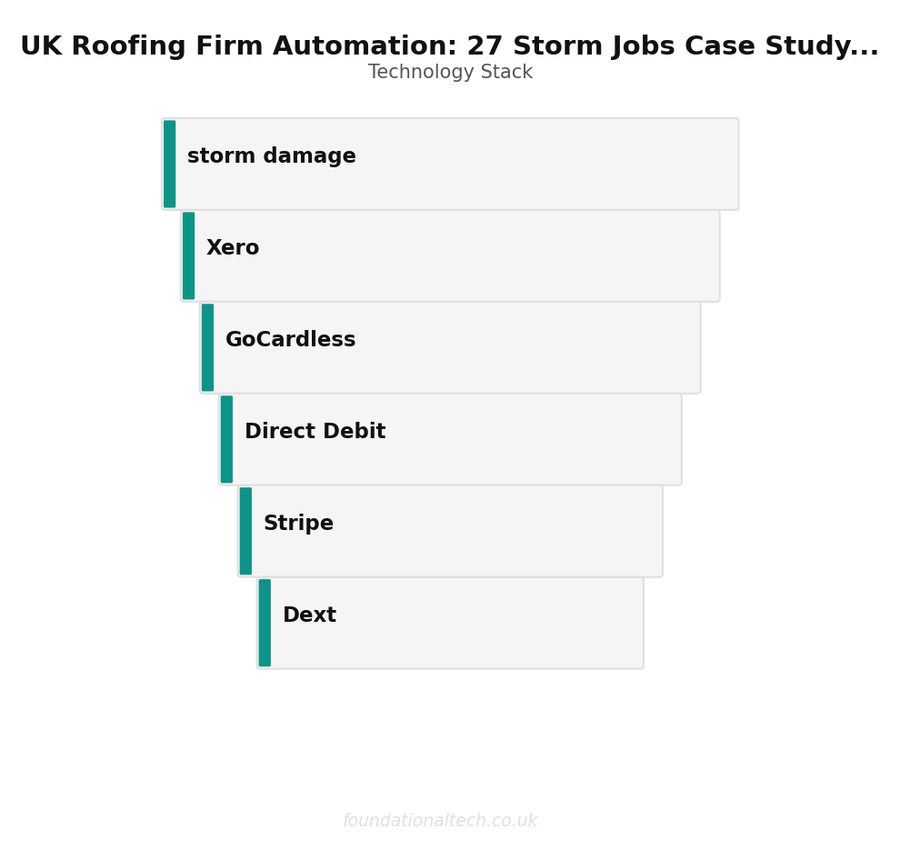
AccuLynx is roofing-specific project management software. Not a generic CRM with a construction template bolted on — it's built for the workflow of a roofing company. Jobs move through stages (lead, quoted, accepted, scheduled, in progress, complete, invoiced). Every job has a single record: photos, measurements, documents, correspondence, payments.
It replaced the paper diary, the WhatsApp groups, the spreadsheet, and the list on Claire's kitchen table.
Xero handled the accounts, connected to AccuLynx so that job data flowed into the bookkeeping without Claire retyping everything.
Then the staged payment templates. Gareth standardised on four stages:
25% deposit on acceptance — before anything happens
30% on completion of strip and felt
30% on completion of tiling or slating
15% completion balance on handover
GoCardless Direct Debit collected the payments automatically at each stage. Stripe handled card payments for customers who preferred that.
And then the rule that saved more money than any software: no scaffold is booked until the deposit has cleared.
That single rule changed the cash dynamics of every job. No more scaffold going up on Monday while Gareth hoped the deposit would land by Wednesday. No more dead hire on jobs where the customer was slow to commit. The deposit cleared, the scaffold went into the booking system, the job was real.
AccuLynx cost roughly £165 a month for three users (Gareth, Claire, and the lead roofer). Xero Growing was £37 a month. GoCardless and Stripe charged transaction fees, no monthly subscription.
For £200 a month and a process change, the overdraft started to breathe.
Month 2: Aerial Quoting and the End of Unnecessary Windscreen Time
This was the month that changed the shape of the business.
EagleView and RoofSnap integration gave Gareth aerial measurement reports — roof pitch, total area, ridge length, hip length, valley length, eave length, complexity rating — derived from satellite and aerial imagery. He could assess a standard domestic roof from his desk in ten minutes.
This didn't replace site visits. It replaced unnecessary site visits. A straightforward re-roof on a post-2000 detached house with clear access and a simple hip-and-ridge layout? Gareth could quote it from aerial data, send the quote same day, and only visit the property if the customer accepted and he needed to confirm details before scheduling.
Complex jobs still got a proper survey. Valley gutters, anything with multiple abutments, properties with restricted access, dormer work, anything pre-2000 where there was an asbestos risk on the existing roof coverings — all of those required boots on the ground. Gareth wasn't cutting corners. He was cutting windscreen time.
Quote turnaround went from five days to same day for roughly 60 per cent of enquiries.
The same month, Dext went in for receipt capture — every merchant receipt, every materials invoice, photographed and coded automatically into Xero. No more shoeboxes. The Xero CIS add-on handled subcontractor deduction statements for the two regular subbies, and Xero Payroll processed the two employed roofers. Claire stopped doing manual payroll calculations.
Monthly cost added: EagleView reports at roughly £20-30 per report (used selectively, not on every job), Dext at £24 a month, Xero CIS at £5 a month, Xero Payroll included in the plan.
Month 3: The AI Layer
This is where the pieces compound.
Gareth set up Claude Pro as the firm's AI assistant, loaded into a project workspace with:
His standard tone and phrasing (professional but not corporate — he's a Newcastle roofer, not a London consultancy)
NFRC membership details and CompetentRoofer registration info
Standard scopes of work for common job types
Insurance correspondence templates — the exact format loss adjusters expect
CompetentRoofer self-certification documentation (saving homeowners £300-plus on local authority building control fees)
Wired through Make (automation platform, roughly £16 a month for the plan he needed), Claude handled two critical workflows:
Insurance correspondence. A loss adjuster letter arrives. It's forwarded into the system. Claude reads the request, cross-references the job file in AccuLynx, drafts a professional response with the specific information requested, attaches the relevant photos from the job record, and presents the draft for Claire's approval. What used to take Claire three hours of composing, cross-referencing, and second-guessing now takes her five minutes of reviewing and clicking send.
The human approval step is non-negotiable. Gareth learned this early: anything going to a customer or an insurer gets human eyes before it leaves the building. The AI drafts; a person sends. Every time.
Storm enquiry triage. When severe weather hits and the phone starts ringing, enquiries come in by phone, email, web form, and social media. Claude triages every enquiry by urgency — active leak requiring emergency tarp versus missing ridge tile versus cracked flashing. It drafts acknowledgement responses, flags active leaks for same-day callback, and creates lead records in AccuLynx with the aerial assessment data already attached where available.
Monthly cost: Claude Pro at £18 a month, Make at roughly £16 a month.
The Storm Test
November brought the real test. A sequence of low-pressure systems hammered the North East with sustained 60mph winds and driving rain over six days.
Fifty-two enquiries came in.
The previous November, a comparable storm event had generated roughly the same volume of enquiries. Gareth converted eleven of them into jobs. The rest went to competitors, went unresponded to for too long, or fell through the cracks of a paper-based system that couldn't handle surge demand.
This time, every enquiry was triaged within minutes. Active leaks were flagged for same-day callback. Standard storm damage enquiries received acknowledgement responses within the hour, with a realistic timeline for assessment. EagleView provided immediate aerial data for initial scoping on properties where satellite imagery was current enough to be useful. AccuLynx tracked every lead through to job or declined.
Gareth converted twenty-seven.
Claire didn't work a single weekend during the storm surge. The year before, she'd done admin from Saturday morning through Sunday evening both weekends, and the correspondence still fell behind.
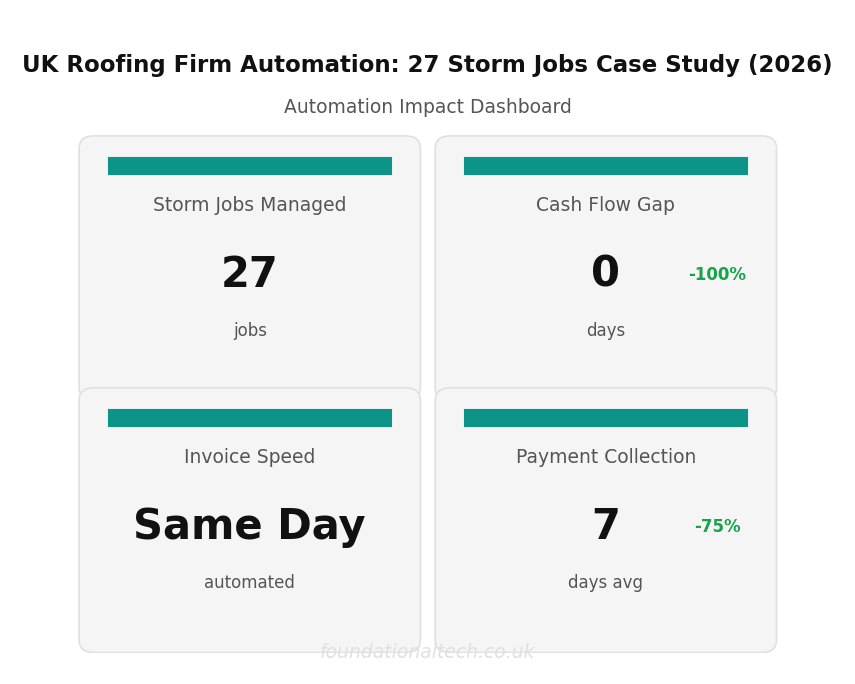
Twenty-seven storm conversions from fifty-two enquiries. That's a 52 per cent conversion rate on inbound storm work, up from 21 per cent the previous year with comparable demand. Each storm job averaged £3,500-£4,500 in revenue.
The Numbers
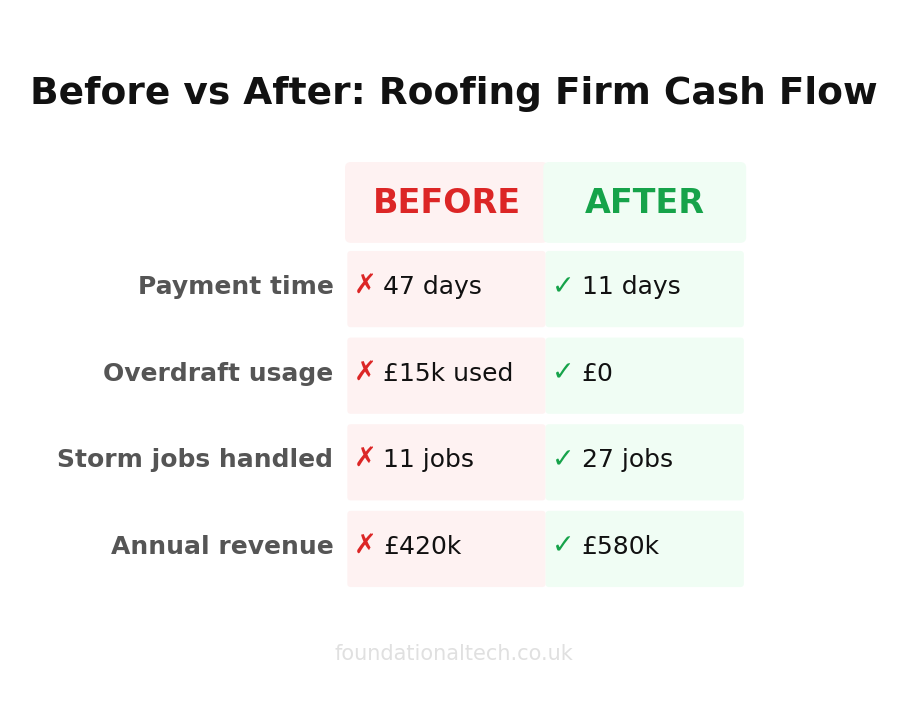
Days-to-payment is the headline number. Forty-seven days to eleven. That's not an accounting trick — it's the direct result of staged payments collected by Direct Debit, deposits cleared before work begins, and insurance correspondence handled fast enough to keep claims moving through the insurer's process instead of stalling in a pile on Claire's desk.
The scaffold waste reduction came from two sources: the deposit-before-booking rule (no more scaffold up on uncommitted jobs) and better weather coordination through AccuLynx's scheduling view, which let Gareth shuffle crews between active jobs based on which sites had weather windows.
The Stack
Annual total: approximately £2,800, excluding per-transaction fees and per-report EagleView costs. Including typical EagleView usage (roughly 8-10 reports a month at an average of £25), the all-in annual cost sits around £5,500-£6,000.
Against that: scaffold waste reduction alone saved roughly £15,000 a year. The cash flow improvement from 47-day to 11-day payment cycles freed up working capital that Gareth previously funded through the overdraft at 8.9 per cent interest. The insurance work — 30 per cent of turnover, roughly £126,000 — went from barely profitable (once you accounted for Claire's time and the cash flow drag) to genuinely worthwhile.
What Gareth Would Do Differently
Build in order. AccuLynx and Xero first. Live with them for two weeks. Get the job stages right, get the team using the mobile app on site, get Claire comfortable with the dashboard. Then add staged payments. Then aerial quoting. Then the AI layer last. Each piece builds on the one before. Trying to install everything simultaneously would have been chaos.
The scaffold rule mattered more than the software. No scaffold booked until the deposit clears. That single process change — which costs nothing — saved more money than any tool in the stack. Software enables good processes. It doesn't replace them.
Keep humans in the loop on everything external. Claude drafts the insurance letters. Claire sends them. Claude triages the storm enquiries. Gareth or the lead roofer confirms the callbacks. The AI handles volume; people handle judgement. A loss adjuster who receives a poorly judged response will make the next three months of that claim significantly harder.
Aerial quoting has limits, and you need to respect them. It didn't replace site visits — it replaced the site visits that weren't adding value. Any property built before 2000 gets a proper survey because of asbestos risk in cement-based roofing products, soffits, and fascia boards. Complex roof geometry — multiple valleys, intricate lead work, chimney rebuilds — needs eyes on it. The aerial data is brilliant for a standard re-roof on a modern estate house. It's not a substitute for competence on anything complicated.
The biggest surprise was insurance work. Before the automation, insurance jobs were a cash flow burden that Claire subsidised with her time. The 60 to 90 day payment wait, the interminable correspondence, the paperwork overhead — all of it made insurance work feel barely worth the effort despite the higher ticket values. Once the admin was under control, the correspondence handled efficiently, and the claims moving through the insurer's process without stalling, insurance work became the most profitable segment of the business. The revenue was always there. The profit was hiding behind the admin.
27 storm jobs in one season
handled without cash-flow crisis after automating staged payments
The Compound Effect
This is article ten in this series, and it's the last. The pattern should be familiar by now: no single tool transforms a trade business. It's the connections between them.
AccuLynx on its own is a better diary. Xero on its own is better bookkeeping. EagleView on its own is a clever measurement tool. Claude on its own is a fast writer.
Together, connected through Make, with GoCardless collecting payments and Dext capturing receipts and every piece of data flowing into a single job record — that's when a six-person roofing firm starts operating like it has a back office of twenty.
Gareth still gets on roofs. The two employed lads and the two subbies still strip, felt, batten, and tile in the Northumberland rain. Claire still answers the phone and makes the decisions that matter.
But the business around them is different now. When the next storm hits, they won't be scrambling. When the next loss adjuster letter arrives, it won't sit in a pile for a week. When the next customer wants a quote, they won't wait five days and go to someone else.
The overdraft sits at zero. It's been there since February.
A & Y Financial Services builds these exact automation stacks for roofing businesses across the UK. If you've read the architecture and want someone to implement it — that's what we do.
Considering Tradify? Get 50% off for 3 months.