Key Takeaway
How UK roofers are using Claude and ChatGPT to win more work in 2026. Practical AI use cases for specifications, quotes, and compliance documents.
Last October, a roofer in Wolverhampton climbed a ladder to survey hail damage on a semi-detached bungalow. While still on the roof, he dictated a voice note into his phone: ridge tiles cracked in three places, valley gutter split at the junction, felt perished across six square metres of the rear pitch. By the time he had climbed back down, his AI assistant had turned that voice note into an insurer-ready scope of work — itemised, priced against his rate card, formatted to match what loss adjusters expect. He emailed it from the van. The homeowner's insurer approved the claim within forty-eight hours. His competitor, who had surveyed the same street that morning, was still typing his scope at nine o'clock that night.
That gap — between the roofer who uses AI and the one who does not — is no longer theoretical. It is measured in jobs won and lost.
This guide is written for roofers running crews of three to eight people. Not tech companies. Not software developers. Roofers who strip roofs, lay tiles, weld lead, and chase payments. If you can dictate a text message, you can use everything in this article.
What AI Actually Does for a Roofing Business
Strip away the noise and AI does one thing well for roofers: it handles the paperwork that wraps around the physical work.
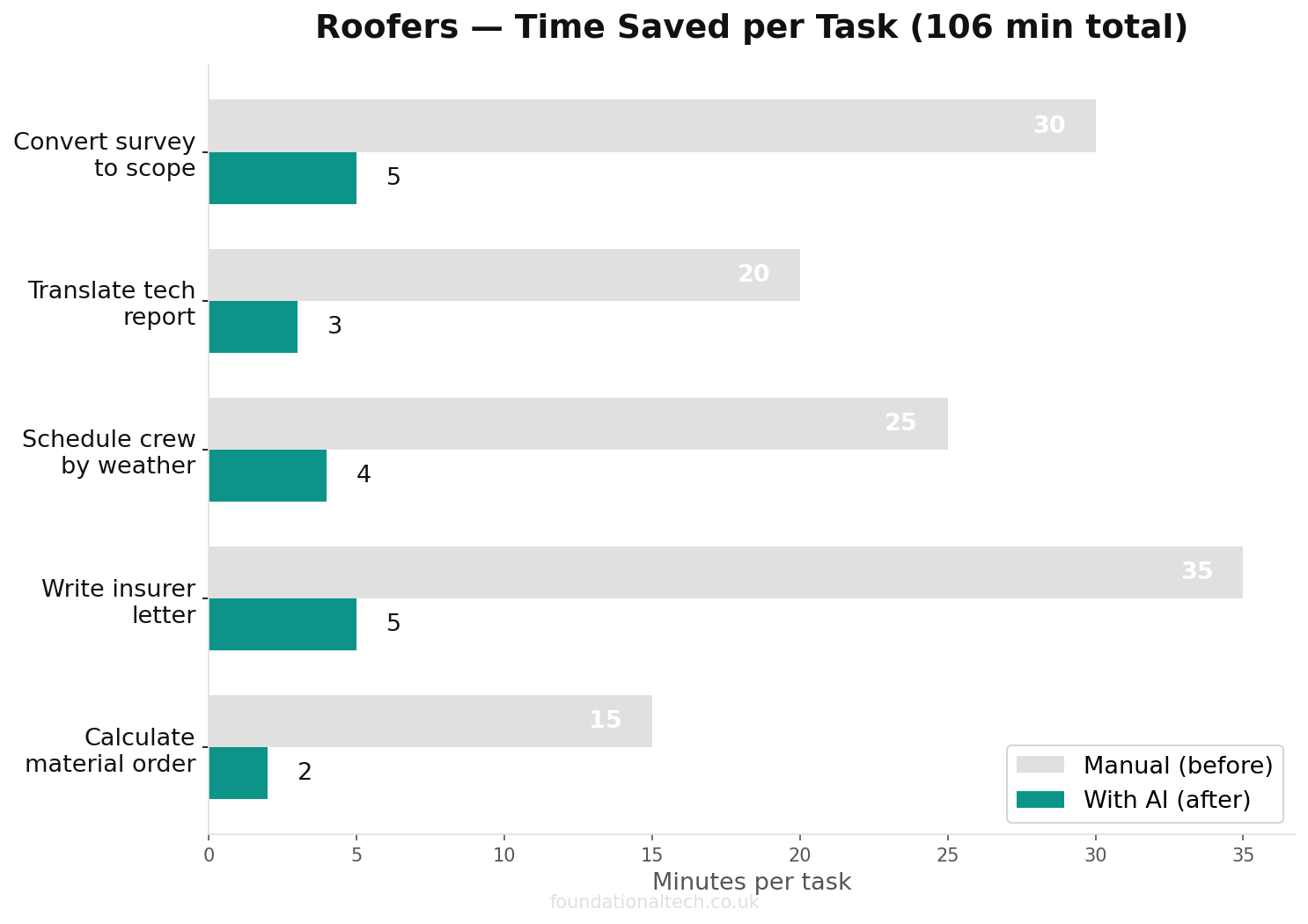
Every re-roof generates a document trail that would choke a solicitor's office. Survey notes. Scopes of work for insurers. Customer quotes. Loss adjuster correspondence. Scaffold notifications. CompetentRoofer self-certification letters. Building Regs Part L compliance documentation. Guarantee registrations. Material orders. Staged payment invoices. Weather delay notifications. Post-completion maintenance letters. A roofer running three or four jobs simultaneously might spend two hours a night on this admin. AI compresses that into minutes.
But AI is not magic, and it is not a roofer. The trick is knowing exactly where it helps and where it will land you in serious trouble.
Storm-Damage Surveys to Insurer-Ready Scopes
This is where AI earns its subscription cost back in a single afternoon.

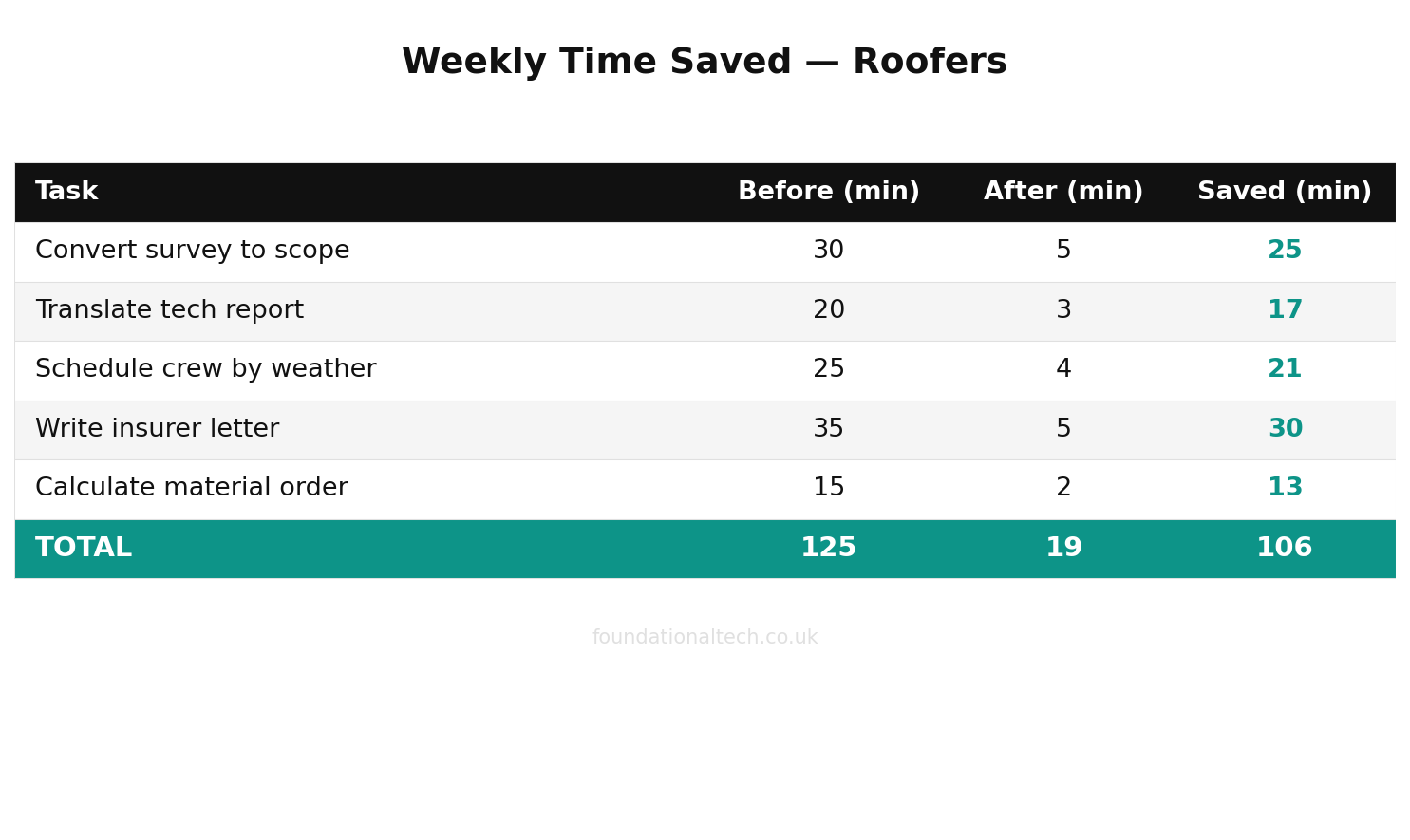
85% faster scopes
when AI turns storm-damage survey notes into insurer-ready scopes with BS 5534 references
After a storm, you might survey five or six properties in a day. Each one needs a scope of work that satisfies the loss adjuster — and loss adjusters are precise people. They want itemised descriptions, not "roof needs doing." They want quantities, unit rates, and a clear distinction between storm damage and pre-existing wear. Bundle both together and they will reject the scope and you will lose a fortnight.
Here is the workflow spreading through roofing firms across the Midlands and the North West:
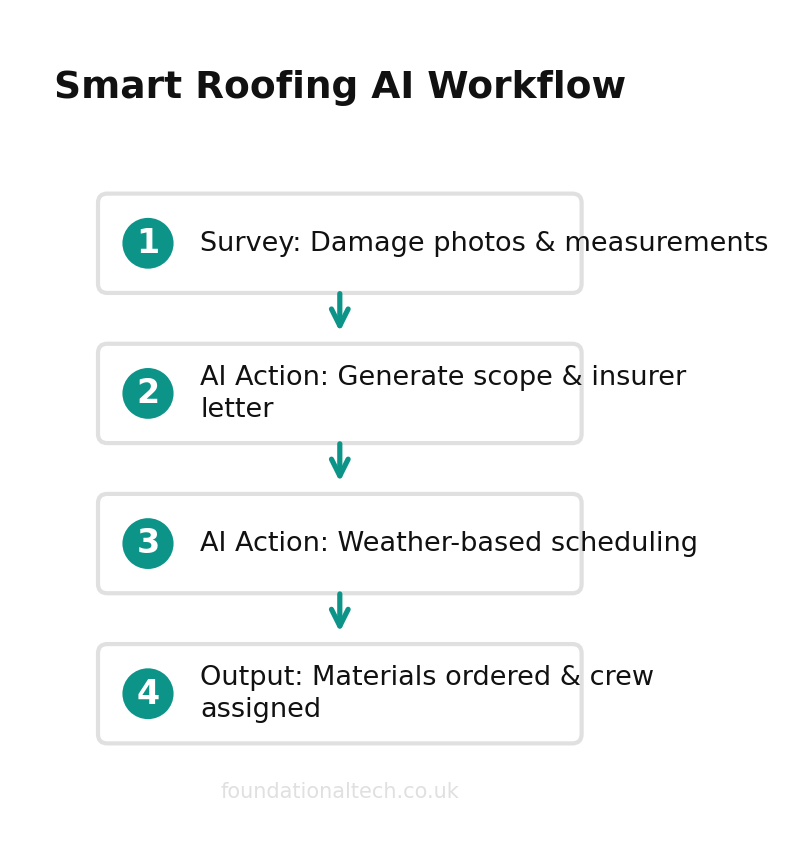
On the roof, dictate a voice note describing every defect you can see. Be ruthlessly specific: "Three ridge tiles cracked at the apex, north-east elevation. Valley gutter split approximately 400mm at the junction with the main roof pitch. Felt perished across roughly six square metres of the rear pitch, south-west side. Existing flashing to the chimney stack appears sound — not storm-related."
In the van, feed that transcription to your AI. Tell it to produce an insurer-ready scope of work: itemised, with your standard day rates and material costs applied. Instruct it to separate storm damage from pre-existing deterioration in distinct sections, because that separation is what the loss adjuster will look for first.
Review for ten minutes. The AI will produce something that is 85% to 90% right. You are checking that it has not invented measurements you did not state, has not confused two elevations, and has not included work you did not describe. This review is non-negotiable. Skip it and you will submit a scope that contradicts your own photographs.
Email to the loss adjuster from site. Attach your photos. The scope reads as though your office manager spent an hour formatting it at a desk.
Speed matters here more than in almost any other part of roofing. The contractor who gets a professional, well-structured scope to the loss adjuster first has a genuine advantage. Insurers want claims processed quickly. Loss adjusters appreciate contractors who reduce their workload. The first clean scope on the adjuster's desk often sets the benchmark against which later submissions are judged.
Translating EagleView and RoofSnap Reports for Customers
You have pulled an EagleView aerial measurement report. It tells you the roof has 14 facets, a total area of 127 square metres, a dominant pitch of 35 degrees, 42 linear metres of ridge, and 23 linear metres of hip. This is essential data for your estimate. It is meaningless to your customer.
Feed the EagleView or RoofSnap data to your AI and ask it to produce a customer-facing summary in plain English. The homeowner gets a document that says something like: "Your roof covers approximately 127 square metres of tiled surface across 14 separate sections. The ridges total 42 metres and the hipped edges total 23 metres. The dominant angle of your roof is 35 degrees, which is standard for properties built in the 1960s and 1970s, and is well-suited to concrete interlocking tiles or natural slate."
This is not a quote. It is context. It demonstrates that you have measured the roof accurately using professional tools, and it builds the kind of trust that makes homeowners comfortable spending £10,000 or more. Customers who understand the scope of work are far less likely to haggle over the final invoice.
If you use iRoofing on site, the same principle applies. Export the measurement data, feed it to AI, and let it produce the plain-English translation. The customer sees professionalism. You save thirty minutes of composition.
Weather-Based Crew Scheduling
Every roofer checks the weather forecast. The difference AI makes is turning that check from a reactive glance at the phone into a structured weekly plan.
Set up a Sunday evening routine. Feed your AI the five-day Met Office forecast for your working postcode alongside your current job list and each job's weather sensitivity. A flat roof GRP lamination in Solihull cannot happen in the rain — the resin will not cure properly. A scaffold-dependent strip and re-tile in Walsall should be stood down if gusts exceed 35mph. But the loft conversion trim work in Edgbaston is entirely internal and weather-proof.
AI processes these constraints and produces a recommended schedule for Monday to Friday. It flags conflicts: "The GRP flat roof (Job 4) requires two consecutive dry days. Tuesday and Wednesday show the best window. Recommend prioritising this job early in the week and moving the Walsall strip to Thursday-Friday when winds drop below 20mph."
You already make these decisions intuitively. AI simply makes them on Sunday evening instead of Tuesday morning, which means your customers get advance notice of schedule changes rather than a frantic call at seven o'clock.
Connect this to AccuLynx or JobNimbus and you can update job statuses and notify customers directly from the scheduling output. The crew knows the plan before Monday's alarm goes off.
Insurance Correspondence That Reads Like a Surveyor Wrote It
Loss adjusters communicate in a specific register: formal, precise, slightly archaic. Many roofers — superb tradespeople, every one — find this correspondence exhausting. The language feels alien. The stakes feel high. A poorly worded email can stall a claim for weeks or, worse, give the insurer grounds to reduce the settlement.
AI writes in that register as its default mode. Feed it the facts — what damage you found, what remedial work you propose, what the insurer has queried — and it produces correspondence that matches the adjuster's expectations precisely. Phrases like "consequential storm damage to the weathering surface" and "remedial works limited to restoring the pre-loss condition of the roof covering" flow from AI naturally. They do not flow naturally from most people, and there is nothing wrong with admitting that.
Two firm cautions. First, never allow AI to invent facts about damage you did not observe. If the adjuster raises a query you are unsure about, say so honestly. A truthful "I would need to re-inspect to confirm" is always better than a fabricated certainty. Second, never allow AI to make structural assessments. "The ridge tiles are cracked and displaced" is a factual observation. "The roof structure is compromised" is an engineering judgement that AI is not qualified to make, and neither are most roofers without a structural engineer's report.
Material Ordering Calculations
You have a RoofSnap measurement: 94 square metres of main roof at 30 degrees, plus an 18 square metre lean-to at 15 degrees. You are using Marley Edgemere interlocking tiles at 9.7 tiles per square metre. AI does the arithmetic you would otherwise do on a calculator, but wraps it in context:
Main roof: 94 x 9.7 = 912 tiles. Lean-to: 18 x 9.7 = 175 tiles. Subtotal: 1,087 tiles. Waste allowance at 7.5% for cut hips: 82 tiles. Total tile order: 1,169 tiles. At approximately £1.10 per tile (confirm with your merchant — AI does not know today's price), that is roughly £1,286 in tiles.
Then it reminds you: order ridge tiles separately (42 linear metres at two tiles per metre = 84 ridge tiles). Order hip tiles separately. Check lead flashing requirements for the chimney stack. Confirm batten quantities based on gauge spacing for your chosen tile.
The value is not in the multiplication. It is in the checklist. AI catches the items you might forget at 9pm when you are tired and want to stop working. But always — always — verify the quantities against your own measurements and confirm pricing with your merchant before committing to an order. AI training data on material prices may be six months out of date, and in roofing six months can mean a 15% swing on slate.
CompetentRoofer and Building Regulations Documentation
If you hold CompetentRoofer registration, you self-certify that your work complies with Building Regulations. For re-roofs where more than 50% of the covering is replaced, this principally means Part L — conservation of fuel and power. You must document the U-value achieved, the insulation specification, and confirmation of compliance.
AI drafts the covering letter and the supporting schedule. Feed it the property details, roof construction build-up, insulation type and thickness, and the U-value you have achieved. It produces a CompetentRoofer self-certification letter referencing the correct edition of the Building Regulations, stating the U-value, and confirming the work meets the required thermal performance standards.
This is documentation, not certification. You remain the competent person making the assessment and signing the certificate. AI ensures the paperwork matches the format that your CompetentRoofer scheme and local Building Control expect to see, so it does not bounce back for reformatting.
The same logic applies to CDM 2015 documentation for larger projects, F10 scaffold notifications to the HSE, and asbestos awareness notifications for pre-2000 properties where a CAT A survey has identified or suspected asbestos-containing materials. AI drafts. You review and sign.
Claude, ChatGPT, and Gemini: A Roofer's Comparison
All three major AI platforms will handle roofing admin. Here is how they compare in mid-2026, priced for the UK market:
Claude (Anthropic) — Pro: £18/month
Strongest at long, structured documents. If you regularly produce multi-page scopes of work or insurance correspondence with twelve line items, Claude tracks every detail without drifting. Follows complex system prompts reliably, which matters when you have loaded it with roofing terminology, your rate card, and formatting preferences. Weakest at voice input — you will need a separate transcription step.
ChatGPT (OpenAI) — Plus: £20/month
The most widely used AI. Its mobile app voice input is polished and practical for dictating survey notes on site without a separate transcription step — speak into the app and it converts your words into text directly. The Custom GPT feature lets you build a dedicated roofing assistant preloaded with your rate card and preferred formatting. Broadest plugin ecosystem if you want to experiment with add-ons. Slightly weaker than Claude at maintaining consistency across very long documents, but perfectly capable for most roofing admin.
Gemini (Google) — Pro: from £5.90/user/month on Google Workspace, or free tier available
Tightly integrated with Google Workspace. If your business already runs on Gmail, Google Drive and Google Calendar, Gemini reads across all three — it can pull a customer address from an email thread and drop it into a schedule entry without you copying and pasting. The free tier is surprisingly capable for short tasks like drafting a quick email reply or summarising a supplier quote. The paid tier adds longer context and better reasoning. Weakest of the three at following detailed system prompts, so less suited to complex scopes of work with specific formatting requirements.
Which one? If you dictate a lot on site, start with ChatGPT for the voice input. If you write long insurance correspondence and detailed scopes, Claude is the better tool. If your business already lives inside Google, Gemini will slot in with the least friction. All three cost less than a day's scaffolding hire per month. Try the free tiers first, then commit to whichever one you find yourself reaching for.
Where AI Will Get You in Trouble
AI does not know what it does not know, and in roofing that gap can be expensive.
Structural assessments. AI will confidently write that a roof structure is "sound" or "compromised" if you ask it to. It has no basis for either statement. Structural assessments require a qualified structural engineer. If a loss adjuster asks whether storm damage has affected the structural integrity of the roof, the correct answer is always "a structural engineer's inspection is required" — never a guess from an AI.
Asbestos identification. AI cannot identify asbestos from a description. If you are working on a pre-2000 property and suspect asbestos-containing materials, you need a CAT A survey from a UKAS-accredited laboratory. AI can draft the notification and the safe working method statement once you have the survey results. It cannot replace the survey.
Pricing. AI training data on material prices is always months out of date. Use it for the structure and arithmetic of a quote, never as the source of unit prices. Always confirm costs with your merchant before committing a number to paper.
Regulations. Building Regulations change. AI may reference an earlier edition of Approved Document L or cite superseded guidance. Cross-check any regulatory claim against the current edition on the Planning Portal or the relevant industry body's website before including it in a compliance document.
The rule is simple: AI drafts, you check, you sign. If you would not put your name to it without reading it, do not send it because an AI wrote it.
Getting Started This Week
You do not need to overhaul your business. Start with one task — the one that irritates you most at nine o'clock at night — and hand the writing to AI.
For most roofers, that is quotes. The next job you survey, dictate your notes on site, feed them to whichever AI you choose, and ask it to produce a customer-ready quote. Review it, fix the prices, and send. Time the difference. If it saves you twenty minutes on one quote, it will save you three hours across a week of quoting.
Once quoting feels natural, add insurance correspondence. Then material ordering checklists. Then weather-based scheduling. Build the habit one task at a time, the same way you would train an apprentice — start with the simple work and add complexity as confidence grows.
The roofer in Wolverhampton did not start by automating his entire business. He started by dictating one voice note in the rain.
Related guides: If you found this useful, see our guide on 12 AI Prompts Every UK Roofer Needs: Copy-Paste Templates for Scopes, Insurance Claims, and Customer Letters and From Maxed Overdraft to 27 Storm Conversions: How a Newcastle Roofing Firm Automated Everything (2026 Case Study).