Key Takeaway
Stop chasing late payments as a UK roofer. UK average: 53 days. Set up automated invoicing, reminders, and Direct Debit with GoCardless and Xero.
The Cash Flow Gap
The scaffold is down, the ridge line is perfect, the customer shook your hand — and six weeks later you're still £6,000 out of pocket, texting a polite reminder for the third time. Britain's roofers now wait an average of 53 days to be paid, and construction accounts for almost one in five UK insolvencies, more than any other sector. The work isn't what kills roofing firms. The wait is.
53 days
average wait for payment — tying up £14,000 in unpaid invoices
Here's the part that stings: most of that wait is self-inflicted. Not because roofers are lazy about invoicing, but because invoicing is the job you do at nine at night after the actual roofing, when you're tired and it's the last thing you want to open. The invoice goes out late. The chaser never goes out at all. The customer forgets. And a business that's turning over decent money runs out of cash anyway, because the money is sitting in other people's accounts instead of yours.
Automation fixes this by taking the invoice, the chase and the collection out of your hands entirely. Set it up once and the money moves on its own — while you're on the next roof, not at a laptop at midnight. Here's how the engine works.
The Automated Billing Architecture
Roofing bills in stages, and that's the first thing the system has to respect. A £14,000 re-roof isn't one invoice at the end. It's a deposit to book the slot, a progress payment when the scaffold's up and the old covering's off, and a balance on completion. Automating that means each stage fires its own invoice, its own reminder and its own collection — automatically, against one job.
Automated Invoice Generation
The invoice should never be a separate task. In a job management tool like Powered Now or Tradify, you build the quote once with the materials and labour priced in, the customer approves it, and the software already holds everything it needs to bill. When you mark a stage complete — deposit due, scaffold up, job finished — the invoice generates itself from the quote and lands in the customer's inbox within seconds, with your logo, your VAT number and your payment terms already on it.
That speed matters more than it sounds. The single biggest lever on getting paid is invoicing the day the stage completes, not the following weekend. Every day you delay the invoice is a day added to the wait at the far end — and manual invoicing delays it every time, because it competes with actual roofing for your evenings. Automating generation closes that gap to zero.
Set your payment terms tight while you're at it. Seven days, not 30. Roofing customers who've just had a good job done pay quickly if you ask quickly; the 30-day default on most invoices is a habit, not a rule, and it's costing you three weeks of cash on every job.
Payment Gateways
An invoice the customer can pay in two taps gets paid faster than one that asks them to log into online banking and type your sort code. Two gateways cover roofing, and you want both.
GoCardless collects by direct debit. The customer authorises once, and you pull the payment — the deposit, the stages, the balance — on the date it's due, without them lifting a finger. Pricing is 1% + 20p per transaction, capped at £4, plus a small 0.3% fee on the portion of any Direct Debit above £2,000 (ex VAT), with no monthly fee. Split a £14,000 re-roof into three staged payments of around £4,600 each and each stage costs roughly £12 to collect — under £40 for the whole job. It's still the cheapest way to move serious money, and because you're pulling rather than waiting to be paid, it's also the most reliable.
Stripe handles card payments for customers who won't set up a direct debit — often the one-off domestic job or the insurance-funded repair. It's roughly 1.5% + 20p per UK card transaction. On that same £14,000, a card payment costs you around £210 in fees versus roughly £40 across three staged direct debit payments. That gap is exactly why you route everything you can through GoCardless and keep the card button for the customers who insist on it.
The rule of thumb: direct debit for anything staged or sizeable, card as the fallback. Both connect natively to Powered Now, Tradify and Xero, so the "pay now" button on your invoice actually collects money rather than just displaying your bank details and hoping.
Automated Follow-Ups
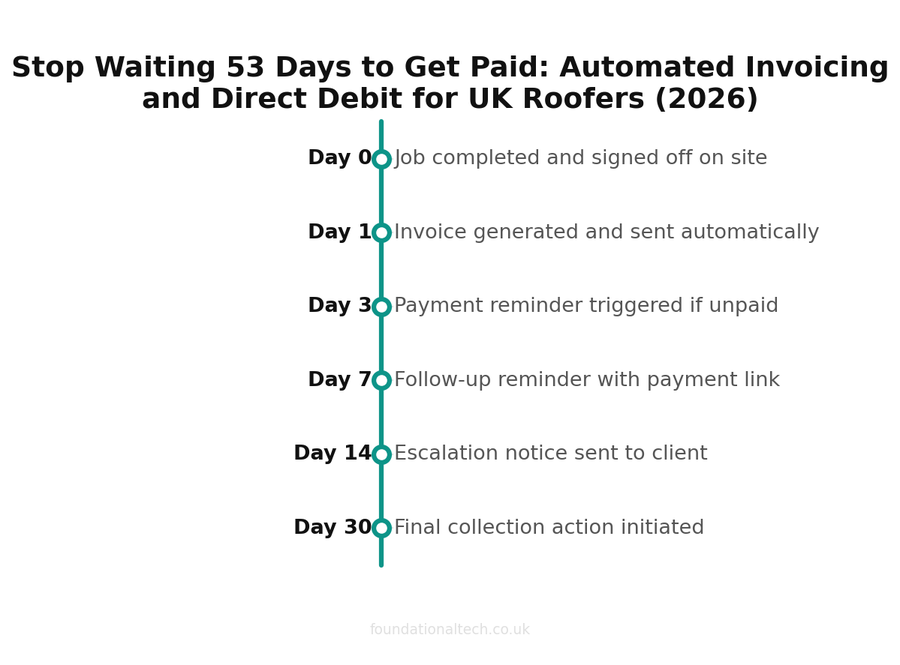
This is where most roofers leak the most cash, because chasing is awkward and easy to skip. Automated reminders remove the awkwardness — the software sends them, not you, so there's no relationship to protect and no evening lost to it. A sequence that works for roofing:
Day 0, the day the stage completes: invoice sent, payment link included. Day 3: a friendly nudge — "just confirming you received the invoice for the work at [address]." Day 7, the due date: a firmer reminder that payment is now due. Day 14: a direct message noting the invoice is overdue and asking them to pay or call. Day 30: a final notice referencing your terms and, where it applies, your right to statutory interest.
You write these four messages once. After that, every overdue invoice chases itself on schedule, in a consistent tone, without you deciding each time whether today's the day you nag a customer. The firms that get paid on time aren't tougher — they've just automated the awkward part.
The tone is worth getting right, because a chaser that reads like a threat costs you the repeat work and the referral. Keep the early ones warm and assume the best — "just making sure this didn't slip through" — and let them firm up only as the days pass. Because the software sends them on a fixed schedule, the customer never feels singled out, and you never have the awkward internal debate about whether ringing on day nine makes you look desperate. The system is polite and persistent in a way a tired human at 9pm rarely manages, and persistence is what actually gets the invoice paid.
Reconciliation
The last piece is matching the money to the invoice, and it should be invisible. When Xero is connected to your job software and your bank feed, a payment landing in your account matches itself against the open invoice, marks it paid, and updates your books — no spreadsheet, no ticking things off, no month-end catch-up. Because GoCardless and Stripe both feed the reference straight through, the match is automatic even across staged payments on the same job.
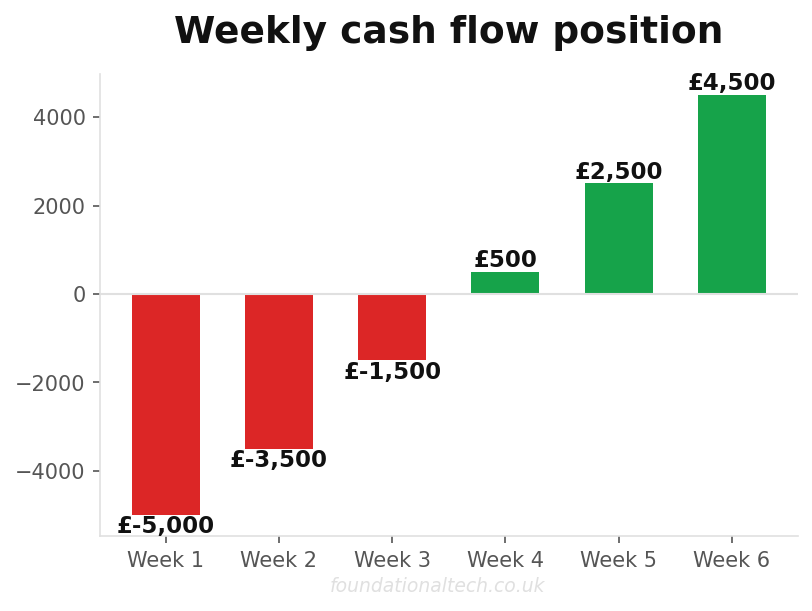
That means at any moment you can open Xero and see exactly what's owed, what's overdue and what's landed — the live cash position most roofers only reconstruct painfully once a month, if at all.
The Deposit Rule
If you take one thing from this piece, take this: get the deposit before the scaffold goes up. A roofing job is unusual among trades in how much cash you lay out before you've earned a penny — scaffolding hire, a skip, the first drop of materials from the merchant. If you fund all of that yourself and only bill at the end, you're bankrolling the customer out of your own working capital, which is exactly how 20% of UK construction firms end up financing projects they can't afford to.
An automated deposit closes that hole. Build a standard deposit percentage into your quote template — a third is common for domestic re-roofs — so every quote the customer approves already commits them to it. The moment they accept, the deposit invoice fires and the GoCardless mandate or card link goes with it. No separate conversation, no "I'll sort the paperwork later," no starting a job on a promise. The materials and the scaffold are then paid for by the customer's money, not yours, and your exposure on the job drops to almost nothing.
The same logic runs through the middle. Bill the progress payment the day the old covering is off and the new one's going on — the point of no return for the customer — rather than saving it for the end. Staggering the cash to match the spend is what keeps a busy roofing firm solvent, and automation is what makes staggering it effortless rather than another thing to remember.
Walk a real £14,000 re-roof through the automated version and the difference is obvious. The customer accepts the quote on a Monday; the moment they do, the system fires a £4,600 deposit invoice with the direct-debit mandate attached, and that lands before you've booked the scaffold. Ten days later the scaffold's up and the old covering is off. You mark the stage complete on your phone, and a £4,600 progress invoice collects itself on the due date — the materials and the hire are now paid for out of the customer's money, not your overdraft. The £4,800 balance fires the day the ridge line's finished and the scaffold comes down, and reconciles against the bank feed without you touching a thing. Three payments, three taps, no chasing, and your exposure on a fourteen-grand job never rises above a few days of materials. Run the same job the old way — one invoice at the end, emailed on a Sunday, chased when you remember — and you've funded the whole project yourself for six weeks while hoping the customer pays.
Retention and the Bigger Jobs
On larger or commercial work you may face retention — a slice of the money, often 5%, held back for months after completion against defects. It's a long-standing drag on construction cash flow, and reform is finally underway: in March 2026 the government set out plans including a mandatory 60-day payment cap and statutory interest of 8% above base rate on overdue invoices. Until the rules bite, your defence is the same automation — track retained sums as their own scheduled invoice in the system so the release date is diarised and chased automatically, rather than forgotten and written off, which is what happens to retention money more often than anyone admits.
The Numbers
Put it together and the shift is stark. Before: you invoice at the weekend, days after the job; there's no chaser sequence, so overdue invoices sit until you find time to ring; payment terms are a vague 30 days; and you're waiting the sector-average 53 days for money that's rightfully yours. After: invoices fire the day each stage completes, direct debit pulls the money on the due date, four automated reminders chase anything that slips, and Xero reconciles it all without you touching a spreadsheet.
The realistic result for a firm that switches: days-to-payment falling from the high-40s or 50s toward 14, the share of invoices paid on time climbing well past nine in ten, and — the part you actually feel — a couple of evenings a week handed back, because the job that used to eat them is now running itself.
The tools cost little against that. GoCardless runs a few pounds a transaction — 1% capped at £4, plus a small 0.3% fee above £2,000 — Stripe is pay-as-you-go, and the invoicing and chasing sit inside the job software you're already paying for. The return isn't a feature — it's the difference between a profitable roofing firm that's always short of cash and one that isn't.
Related guides: If you found this useful, see our guide on The Roofing Business That Runs Itself: How UK Roofers Automate Quoting, Scheduling and Getting Paid in 2026 and The Roofer Who Paid for Every Roof Himself — and Didn’t Realise It.
What's your average days-to-payment right now? Be honest — the number usually shocks people, and it's the single best measure of whether your billing is working or bleeding.