Key Takeaway
The full automation blueprint for UK roofers in 2026. Quoting, scheduling, invoicing, and compliance connected end to end with Xero and GoCardless.
Rain stops play, and with it stops your paperwork. A roofer's admin doesn't happen in an office — it happens at 8pm on the sofa, quoting the survey you did that morning, chasing the customer whose new roof went on three weeks ago and still hasn't paid, and trying to remember which merchant invoice belongs to which job. Most roofing firms lose a full working day every week to this. Not on the roof. At the kitchen table.
This is the first article in a ten-part series on building a roofing business that handles its own admin. Here's the whole map before we start filling it in.
The Problem Nobody Talks About
Roofing is the hardest trade to systemise, and it's not close. A plumber's job is a call-out. An electrician's is a rewire. A roofer's job is a £14,000 project that depends on the weather, needs scaffolding booked before you can start, gets paid in three stages, uses materials whose price moved since you quoted, and falls under the Construction Industry Scheme so half your labour needs verifying with HMRC before you pay it.
Now run five of those at once, across two crews, with a storm forecast on Thursday.
The single most expensive habit in UK roofing isn't underquoting — it's the lag between finishing a job and getting paid for it. The average small trade waits over a month for final payment, and roofing is worse because the sums are bigger and the "it's not quite finished" objection is easier to make. Every week that £14,000 sits unpaid is a week you've funded the customer's roof out of your own pocket, while the merchant's payment terms tick down on the materials you already bought.
The fix isn't working later. It's building a stack where the quote, the schedule, the invoice, the payment and the bookkeeping talk to each other — so the admin happens once, automatically, the moment the work does.
The Full Automation Stack
Five layers. Each one removes a job you currently do by hand.
Job Management Software — The Production Engine
This is the centre of gravity. One app that holds every quote, job, photo, certificate and invoice, and syncs from your phone on the roof to the office in real time. For UK roofers the two front-runners are Powered Now and Tradify.
Powered Now runs from £28 per user/month on its Business plan, £32 on Professional (the tier that adds Xero integration and team features), and £40 on Premium (which adds the customer portal, drag-and-drop scheduling and automatic quote and invoice chasing). Annual billing gives you two months free. Prices are per user and exclude VAT. It's built in the UK, works offline when you've got no signal on a roof, and handles deposits and part-payments natively — which matters enormously for staged roofing jobs.
Tradify starts around £34 per user/month (Lite, 1–3 users) and drops to about £28 per user/month on Pro for larger teams. It's the slicker quoting-and-scheduling tool and integrates cleanly with Xero and Stripe.
Either one replaces the paper diary, the Word quote template, the separate invoicing app and the "where's that job photo" WhatsApp scroll. We compare them properly — plus Joblogic for firms doing maintenance contracts — in the next article in this series.
Xero — The Financial Backbone
Your job software runs the work; Xero runs the money. It's the accounting hub every other tool plugs into. Plans are £16/month (Ignite), £37/month (Grow) and £50/month (Comprehensive), excluding VAT, with payroll at £1.50 per employee/month on top.
When Powered Now or Tradify pushes an invoice into Xero, the bank feed matches the incoming payment automatically, and your VAT return builds itself in the background — which you'll need, because Making Tax Digital for VAT is now mandatory and MTD for Income Tax has started rolling in for sole traders over £50,000. Most roofers on Grow with a couple of staff land around £40–45/month all-in. We cover the setup later in this series.
Dext — Plugging the Cash Leaks
Every roofing job bleeds cash through the van window: merchant receipts, fuel, skip hire, plant and tool hire, the pallet of tiles paid for on trade account. Lose the receipt and you lose the VAT and the tax deduction on it.
Dext photographs a receipt, reads it, and files it straight into Xero against the right job. It runs from roughly £24/month for a sole trader and about £30/month for a small business (250 documents, five users). Dext doesn't publish its GBP prices directly — they're the sterling equivalent of its US pricing, so the exact figure at signup moves slightly with the exchange rate. The payoff is that no receipt ever gets lost in a footwell again, and your accountant stops charging you to type them in.
Xero Payroll + CIS — The Workforce Layer
Roofing labour lives under the Construction Industry Scheme. If you use subcontractors, you're legally required to verify them with HMRC and deduct the right tax (20% for registered subbies, 30% for unverified) before you pay them, then file a monthly CIS return.
Xero Payroll handles PAYE for your employed staff, and CIS-capable software verifies subcontractors and produces their deduction statements automatically. This is the layer that quietly keeps you out of trouble with HMRC — miss a CIS return and the penalties start at £100 and climb fast. We break down the whole back office, including timesheets and pensions auto-enrolment, later in this series.
Customer Portal + Enquiry Forms — The Front Door
Leads arrive at all hours — a storm rips off a ridge tile and someone's Googling "emergency roofer near me" at 7am. If that lead lands in a form that creates a job automatically, you never lose it to a missed call. Powered Now's Premium tier and Tradify both offer enquiry forms and a customer portal where clients accept quotes, see appointment reminders and pay online without you lifting a finger.
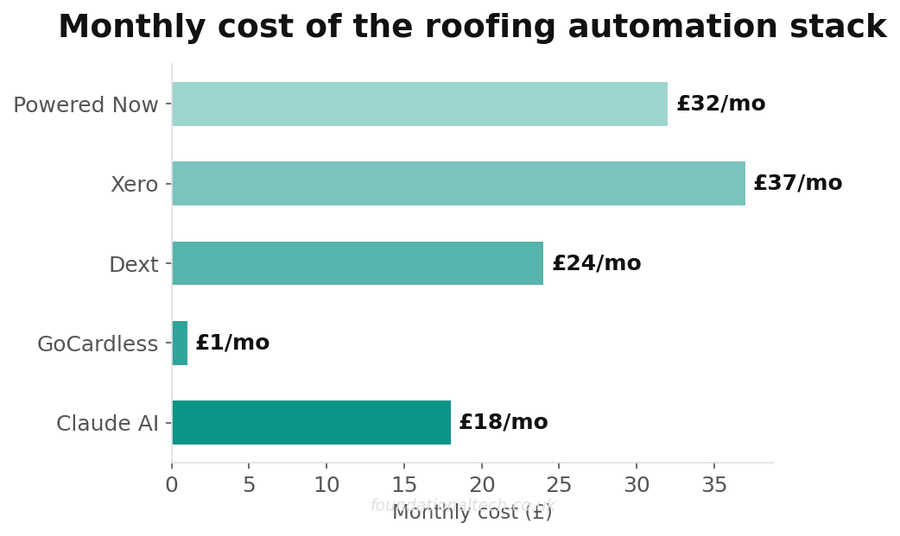
| Tool | Purpose | Monthly Cost |
|---|---|---|
| Powered Now | Job management, quoting and invoicing | £32/mo |
| Xero | Accounting and bank feeds | £37/mo |
| Dext | Receipt capture and expense tracking | £24/mo |
| GoCardless | Direct Debit staged payments | 1% + 20p/txn |
| Claude AI | Quote drafting and client emails | From £18/mo |
| Total monthly cost | ~£130/mo | |
How It All Connects
The flow runs one direction, and nothing gets typed twice:
A lead comes in through the enquiry form → becomes a job in your job management software → you quote it from your phone, the customer accepts it in the portal → you schedule the crew and book scaffolding around the weather → on completion the app raises the invoice → the invoice syncs to Xero → GoCardless or Stripe collects the payment → the bank feed reconciles it → Dext files the merchant receipts against the same job → the whole lot rolls up into your VAT return and, at year end, your accounts.
Powered Now and Tradify both connect to Xero natively — no middleware. Payments run through GoCardless (1% + 20p, capped at £4, plus a small 0.3% fee above £2,000 per transaction, no monthly fee) for direct-debit staged payments, or Stripe (around 1.5% + 20p per UK card) for one-off card payments. Where two apps don't talk natively, Make or Zapier bridges them; we draw the full wiring diagram in a later article.
What This Means in Practice
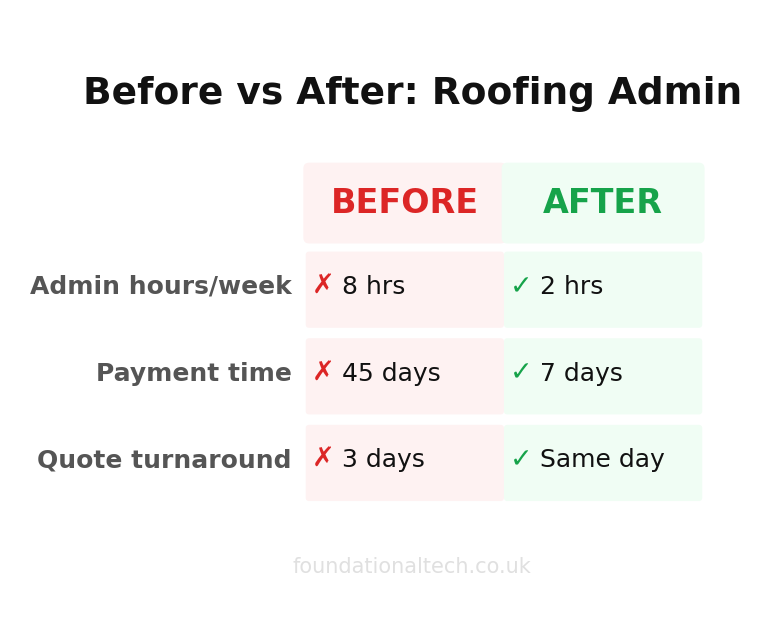
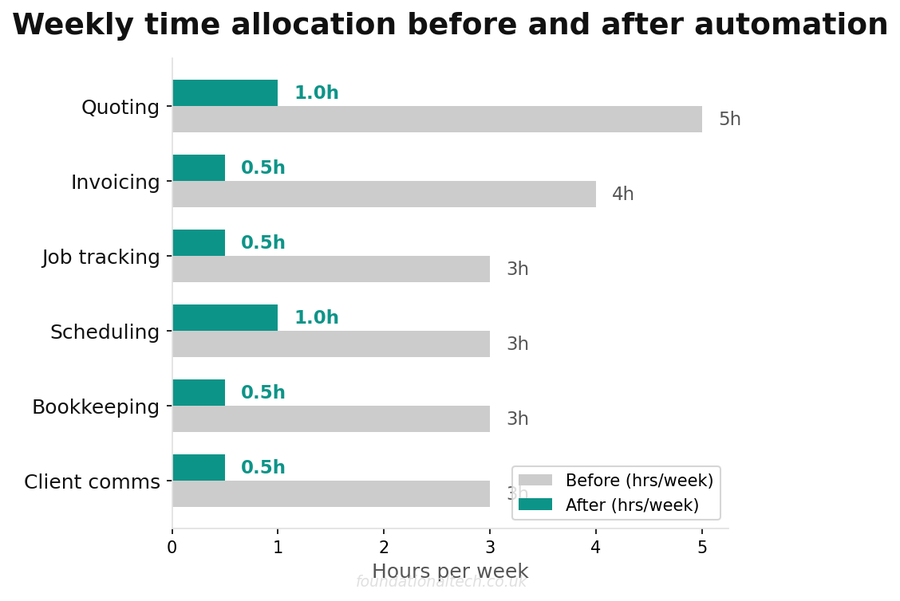
Put numbers on it. A two-crew roofing firm running this stack typically claws back 6–8 hours a week of evening admin — the quoting, invoicing and receipt-chasing that used to happen after tea.
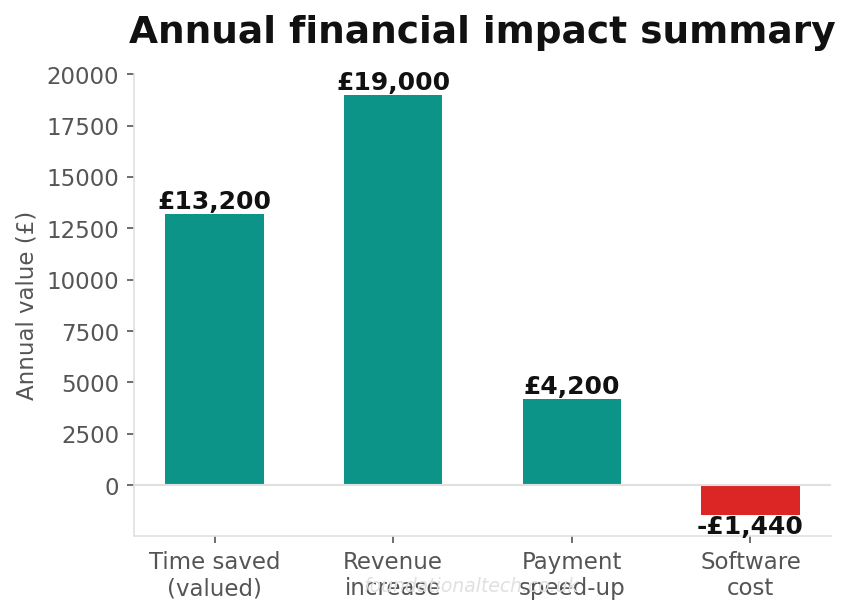
The bigger win is cash. Staged payments collected by direct debit on completion, instead of an invoice emailed and forgotten, routinely pull the wait for final payment down from 30-plus days to under a week. On a firm turning over £400,000 a year, shortening that lag doesn't just feel better — it's the difference between funding your next job from the bank's money or your own.
And the errors disappear. No lost receipts, no missed CIS deadline, no quote that undercharged because the tile price moved and nobody updated the template.
1 full day/week recovered
by automating quoting, scheduling, invoicing and CIS compliance for roofers
What Comes Next in This Series
Nine more articles, each taking one layer apart and showing you exactly how to build it:
The Core Workflow — Powered Now vs Tradify vs Joblogic: which job management software actually fits a roofing firm.
Cash Flow — Deposits, staged payments and direct debit: how to stop funding your customers' roofs.
The Back Office — CIS, payroll, timesheets and receipts without the Sunday-night data entry.
The Integration Map — Every tool, every connection, drawn out in one map.
The AI Pillar — How UK roofers are actually using AI right now (without it sounding like a robot).
The Prompt Playbook — Copy-and-paste prompts for quotes, chase-ups and reviews.
The AI Worker — Setting up an AI assistant that drafts your admin for you.
AI Automation — Wiring AI into the tool stack so it runs on its own.
The Case Study — One firm, start to finish, with the real before-and-after.
Build it once, and the business stops needing you at the kitchen table every night.
What's the one manual process in your roofing business that steals the most hours every week — quoting, chasing payment, or filing receipts? Hit reply and tell me which, and I'll show you the exact fix in this series.