Key Takeaway
Automate timesheets, payroll, CIS for your UK roofer business in 2026. Step-by-step guide using Dext, Xero, and payroll tools to cut admin hours.
The Hidden Cost
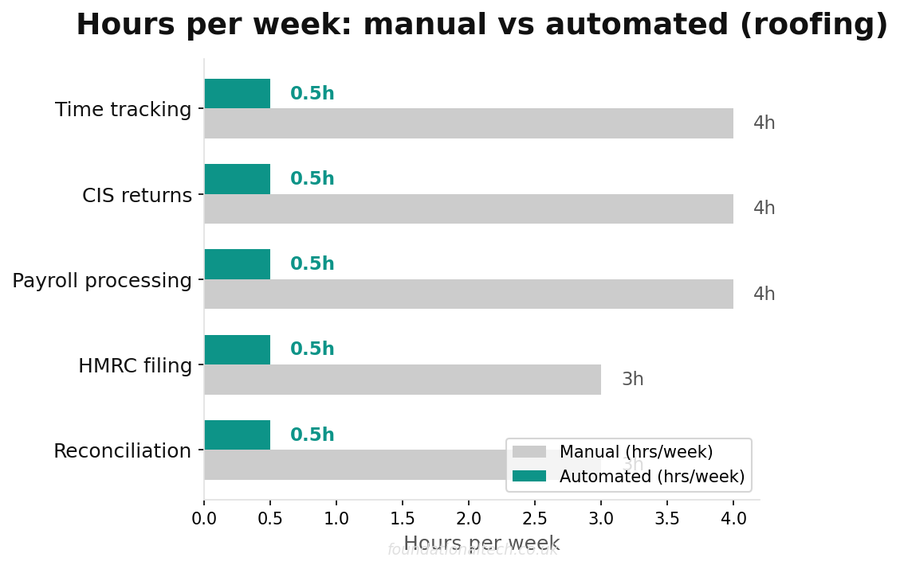
Ask a roofer what their business costs to run and they'll tell you about vans, materials, scaffolding and insurance. Nobody costs the Sunday afternoon spent working out who was on which job, how many hours, what the CIS deduction is on each subbie's invoice, and which crumpled merchant receipts still need typing into the accounts before the VAT return. Yet that afternoon happens every week, and it's the most expensive hour in roofing —because it's unbillable, it's exhausting, and it's the one that gets done badly when you're tired.
20–30%
of a roofer’s working week lost to back-office admin
For roofing the back office is heavier than most trades, because roofing sits inside the Construction Industry Scheme. Every subcontractor you pay needs verifying with HMRC, deducting at the right rate —usually 20%, sometimes 30% —and reporting on a monthly CIS return. Get it wrong and you're either short-paying your subbies or facing HMRC penalties. Do it by hand and it eats a day a month you don't have. This is the part of the business that automation was made for, because it's rules-based, repetitive and unforgiving of small errors —exactly what software does better than a tired human on a Sunday.
The Automation Stack
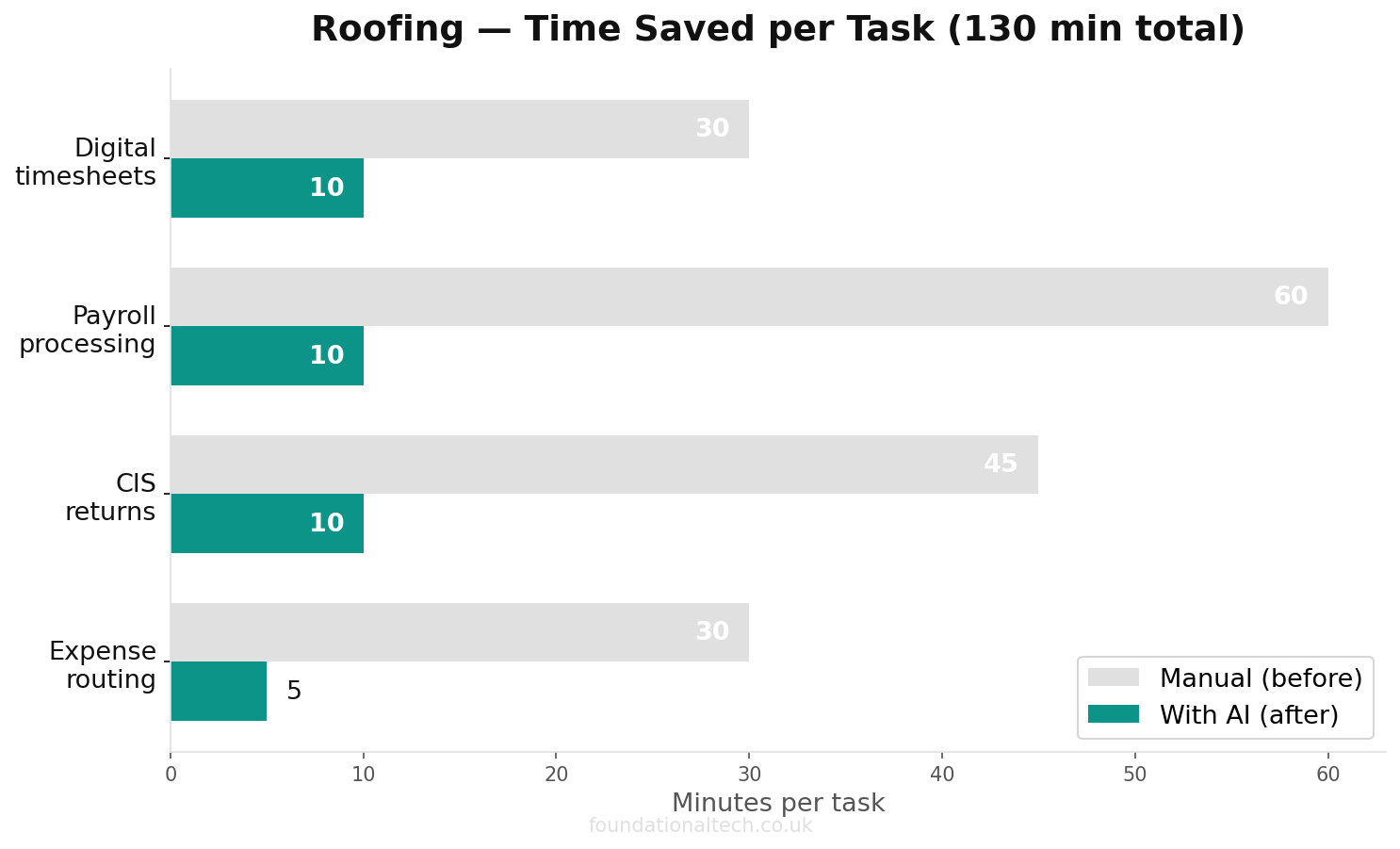
The goal is a chain where hours worked flow into payroll, payroll handles CIS and pensions, and every receipt files itself —so the Sunday admin session shrinks to a ten-minute review rather than a half-day slog.
The Primary Back-Office Tool: Digital Timesheets
Start where the data starts: who worked, where, and for how long. Your job management software —Powered Now or Tradify —already knows which crew is assigned to which job. Adding digital time capture means each roofer clocks on and off from the phone in their pocket, tagged to the actual job, with the hours landing in one place instead of on the back of a fag packet in the van.
That does two things at once. It gives you accurate labour costs per job, so you finally know whether that awkward Victorian re-roof actually made money. And it gives payroll clean numbers to work from, without you transcribing anyone's scrawled hours. For crews that move between sites in a day, GPS-tagged clock-ins confirm who was where —useful both for costing and for the occasional dispute over hours.
The costing side is worth dwelling on, because it's where roofers lose money without ever seeing it. Quote a re-roof at three days for two men and you've priced 48 labour hours into the job. If the tricky valley and the rotten timber quietly turn it into four days, that's 64 hours —and if your only record is memory, you'll bank the loss and quote the next awkward Victorian terrace exactly the same way. With hours captured against the job, the overrun shows up in black and white the moment you look, so the next quote carries the real number instead of the hopeful one. Do that across a year and the difference between guessing and knowing is a margin you can actually plan around.
The hours capture sits inside the job software you're already paying for on most plans, so there's rarely a separate bill here. Where you want heavier scheduling and shift management, a dedicated tool like Deputy plugs in at roughly £4–6 per user/month (with a minimum monthly spend of around £20) —but for most two-to-four-crew roofers the built-in timesheet is enough.
Connecting to Payroll
This is the step that pays for itself. Xero Payroll takes the hours from your timesheets and runs the pay run —calculating PAYE, National Insurance, submitting Real Time Information to HMRC on payday, and handling pension auto-enrolment for your employed staff. It's an add-on to a Xero subscription at £1.50 per employee per month on the Grow and Comprehensive plans (£1 per employee on the top Ultimate plan). The Xero plans themselves run from £16/month (Ignite) through £37 (Grow) and £50 (Comprehensive) to £65 (Ultimate), ex VAT —and note Xero has flagged a price change from 1 September 2026, so confirm the current figure when you sign up.
For roofing, the piece that matters most is CIS. Xero's CIS add-on —around £5/month —verifies your subcontractors with HMRC, applies the correct deduction to each subbie's invoice automatically, produces the deduction statements they need, and files your monthly CIS return. That's the day-a-month job turned into a review-and-submit. If you work as a subcontractor yourself, it also tracks the CIS deducted from your own invoices, so at year end you can reclaim what you're owed rather than losing track of it.
Put a number on why the rate matters. Say a verified subbie invoices you £2,000 for labour on a re-roof. At the 20% registered rate you deduct £400 and pay him £1,600, then hand that £400 to HMRC on his behalf. Get him wrong —treat him as unverified and deduct 30% —and you've held back £600, short-paid him by £200, and started the sort of argument that costs you a good roofer. The software checks his status with HMRC before the first payment, so the right rate is applied automatically and the deduction statement he needs lands in his inbox without you writing it out by hand.
The deadlines are where manual CIS quietly bites. Your monthly return covers the tax month to the 5th and must reach HMRC by the 19th, every month, whether or not you paid any subcontractors —miss it and the penalty starts at £100, climbs to £200 after two months, and keeps rising from there. A tired roofer juggling five jobs forgets the 19th; software that files on a schedule does not. That single automated return is often the piece that pays for the whole stack the first time it saves you a penalty.
The RTI side matters just as much as CIS, and it's the bit most roofers don't realise they're getting wrong. Every time you run payroll, an RTI submission has to reach HMRC on or before the day you pay your staff —not the week after, when you finally sit down with the figures. File it late and you're into HMRC's monthly late-filing penalties, which start around £100 for a small employer and repeat every month you slip. Because Xero builds and sends the RTI as part of the pay run itself, the deadline is met automatically the moment you approve wages, so the compliance happens as a by-product of paying people rather than a separate task you have to remember on top of everything else.
Auto-enrolment pensions run on the same rails: once an employee qualifies, Xero enrols them, calculates contributions and files with your pension provider, so you stay compliant without diarising anything.
Holiday pay is the other roofing headache this quietly solves. Roofing hours swing with the weather and the season, so working out accrued holiday for someone whose week ranges from 20 hours to 55 is exactly the sort of sum that gets fudged by hand. With hours flowing from the timesheets, the payroll works entitlement out on the actual hours worked, so a rained-off week and a flat-out August both feed the right holiday accrual automatically —and nobody's short-changed, which is where employment disputes tend to start.
Expense Routing
Roofing generates receipts everywhere —the builders' merchant, the fuel station, the tool hire, the scaffolding firm. Left to pile up, they become the worst part of the VAT return and the easiest way to lose money you could have claimed. Dext fixes this: snap a photo of the receipt on the merchant's forecourt, and it reads the supplier, date, net, VAT and total, then posts it straight into Xero against the right account. No shoebox, no typing, no lost VAT.
Dext runs from roughly £24–30/month for a small-business plan (around 5 users and 250 documents), with annual billing bringing it down about 20%. Dext doesn't publish its GBP prices directly —they track its USD list price, so the exact figure at signup moves slightly with the exchange rate. For a firm claiming back VAT on every load of tiles and every tank of diesel, it pays for itself in recovered claims alone, never mind the hours.
The VAT alone justifies it. A roofer VAT-registered on the standard scheme reclaims the 20% on every material load, and roofing eats materials —a single re-roof might pull £4,000 of tiles, felt, battens and lead across three or four merchant runs, carrying roughly £800 of reclaimable VAT. Lose two of those receipts to the footwell and you've quietly handed HMRC a couple of hundred pounds you were entitled to keep. Multiply that across a year of jobs and the leak runs into the thousands —far more than the software costs. Because Dext files the receipt against the job the moment you snap it, the VAT is captured while the receipt is still legible, not reconstructed from a faded thermal-paper smudge at quarter-end.
Mileage is the quiet win here. Between sites, merchants and surveys, a roofer covers serious miles, and logging them through the same system —or a linked mileage app —turns fuel and travel into a proper, claimable expense instead of a vague guess at year end.
Implementation Timeline
You don't do this all at once. Three weeks, one layer at a time:
Week 1 —Set up. Turn on digital timesheets in your job software and get the crew clocking in for real jobs. Connect Xero if it isn't already, and add the Payroll and CIS modules. Enter your employees and verify your subcontractors with HMRC through Xero's CIS tool.
Week 2 —Test. Run one pay period in parallel with however you do it now. Check the hours flow through cleanly, the CIS deductions match what you'd calculate by hand, and the RTI submission goes to HMRC without errors. Set up Dext and photograph a week's receipts to confirm they post to the right accounts.
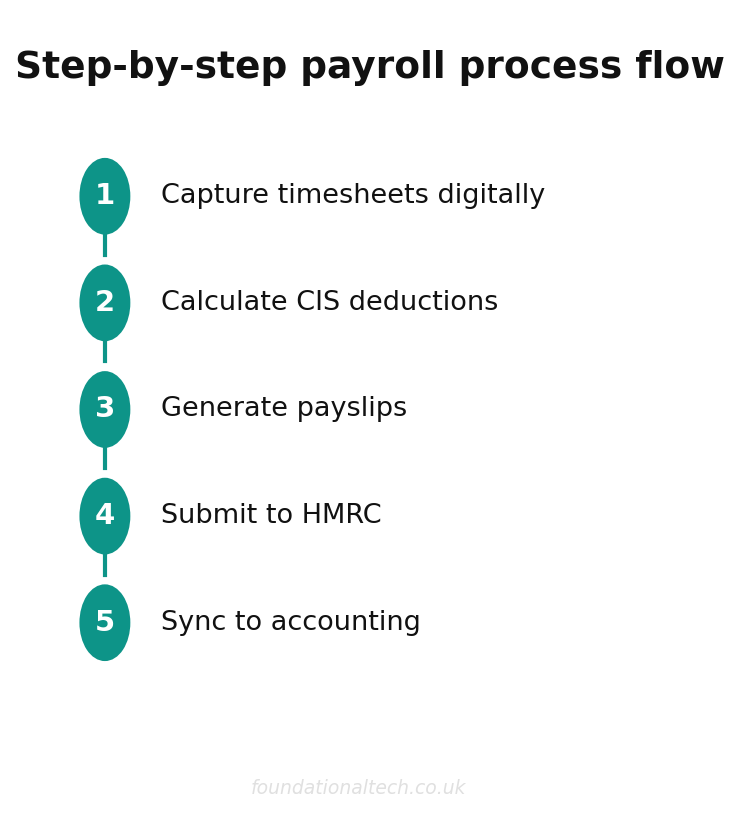
Week 3 —Go live. Drop the old method. Payroll runs from the timesheets, CIS files itself monthly, receipts post as you snap them, and your Sunday session becomes a Monday-morning ten-minute check that everything reconciled. From here the back office runs itself, and the day-a-month you used to lose to admin goes back into the business —or back to your family.
What It Actually Costs to Run
Add the pieces up honestly so there are no surprises in month two. A typical employed-staff roofing firm on Xero's Grow plan (£37/month) with, say, four people on payroll (roughly £6 at £1.50 a head) plus the CIS add-on (£5) and Dext (around £24–30) lands at roughly £73–78 a month for the whole back office, ex VAT —before the job software you're already running. That's less than an hour of a bookkeeper's time, and it replaces most of what a bookkeeper was doing. For a firm that's been paying an accountant to untangle a shoebox of receipts and a spreadsheet of hours every quarter, the software usually costs less than the mess it removes.
The real return isn't the fee, though —it's the errors you stop making. A CIS deduction applied at the wrong rate, a subbie paid without verification, an RTI submission filed late: each of those carries an HMRC penalty, and each is the kind of slip a tired person makes on a Sunday and software doesn't make at all. Automating the back office isn't only about time. It's about never getting the fine.
| Task | Manual | Automated |
|---|---|---|
| CIS verification | 30 min/sub | Instant lookup |
| CIS deduction calc | Spreadsheet | Auto-calculated |
| Monthly CIS return | 2–3 hours | 10 minutes |
| Payroll run | Half a day | 30 minutes |
The Trap of Doing It "When There's Time"
The reason roofing firms carry this cost for years is that the back office never feels urgent. The roof has to go on today; the timesheets can wait; the receipts can pile up; the CIS return can be a mad scramble on the 19th of the month. So it's always the thing you'll systemise "when there's time" —and there's never time, because the admin itself is eating the time. The only way out is to set the system up once, in three quiet weeks, so it runs whether or not you get round to it. The firms that never fix this aren't busier than the ones that do. They're just still doing at midnight what software would do for £70 a month.
Related guides: If you found this useful, see our guide on Stop Waiting 53 Days to Get Paid: Automated Invoicing and Direct Debit for UK Roofers (2026) and The Roofing Business That Runs Itself: How UK Roofers Automate Quoting, Scheduling and Getting Paid in 2026.
How many hours does your admin and bookkeeping take per week? Reply with the number —I'm building a benchmark across UK roofing firms, and the range so far is wider than you'd think.