Key Takeaway
A UK roofer was funding every job from his own cash flow without realising it. How automated deposits and staged invoicing fixed a hidden finance gap.
Dave slid his phone across the table so I could see the calendar. Every week booked solid into September. Two crews, both flat out. A £22,000 re-roof starting Monday, another the week after.
"So what's the problem?" I asked.
He turned the phone back over and said, quietly, "I couldn't pay the van finance last month. First time in nine years."
I've had a lot of these conversations now, in a lot of kitchens. But roofing has a particular version of this pain, and Dave was living the middle of it. Busiest he'd ever been. Most money he'd ever turned over. And skint. Genuinely, lying-awake-at-3am skint, while sitting on the healthiest order book of his life.
It makes no sense until you look at when the money moves. And then it makes total, horrible sense.
The thing he couldn't see
Here's what was actually happening, and Dave couldn't see it because he was too close.
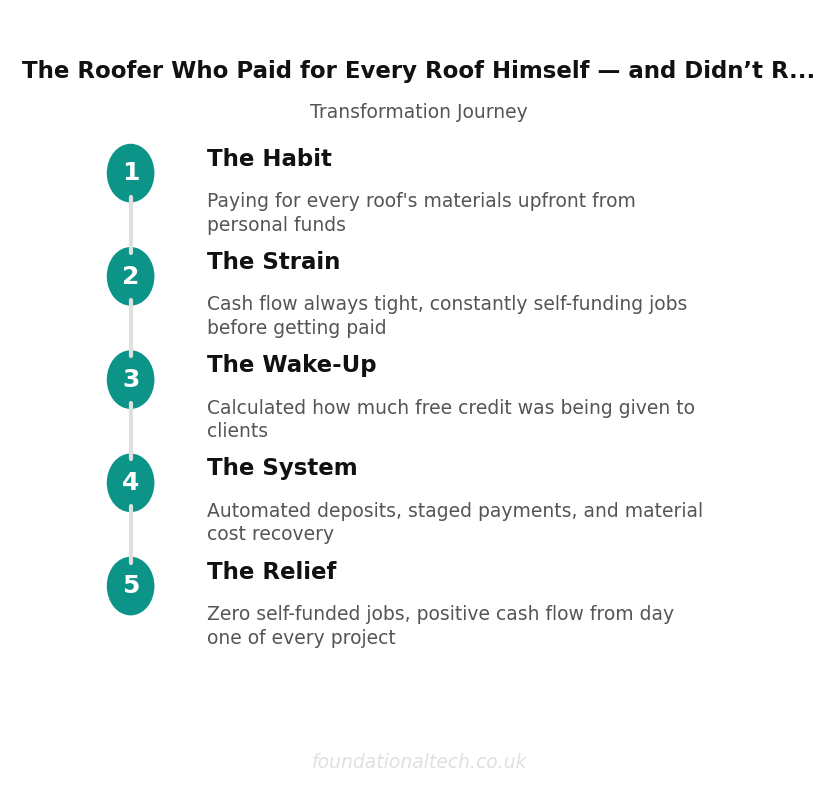
Every job he took on, he paid for first. Out of his own pocket. Before he'd earned a penny.
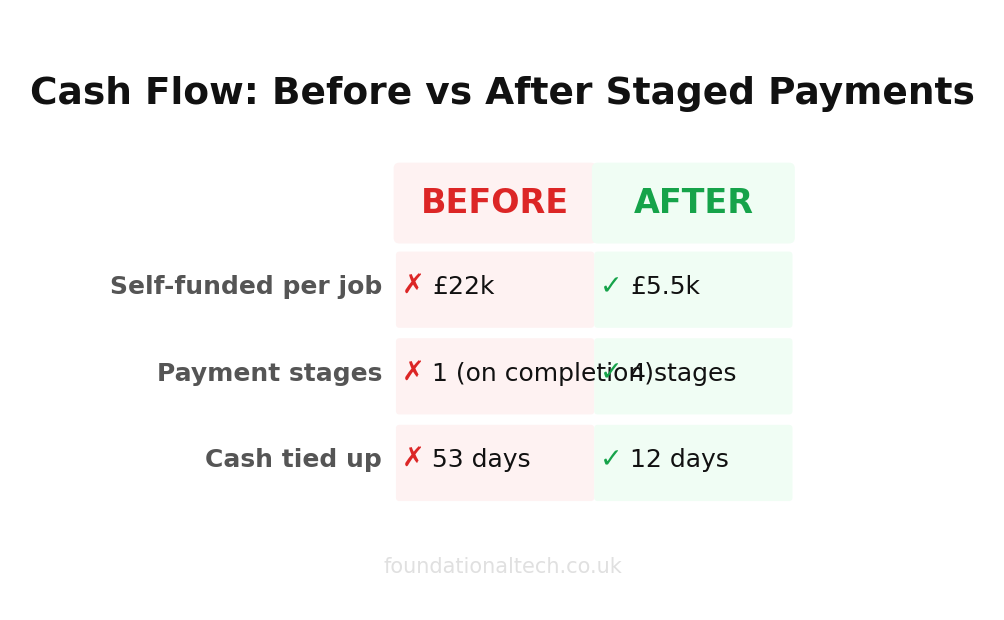
Think about a £22,000 re-roof. Before a single tile goes on, Dave is laying out for scaffolding hire, a skip, the first big drop of materials from the merchant, and a week of wages for two crews. That's thousands of pounds gone, from his account into everyone else's, days before the customer owes him anything.
Then the job runs. Then it finishes. Then he does the invoice — at nine at night on a Sunday, because when else. Then the customer sits on it. The average builder in this country now waits fifty-three days to get paid. Fifty-three days. (I wrote the full breakdown in Stop Waiting 53 Days to Get Paid.)
So the shape of Dave's business was this: money out immediately, money in nearly two months later. Multiply that across five or six jobs running at once and you get a man who is, in effect, lending tens of thousands of pounds to his own customers, interest-free, to fund the roofs they'll eventually pay him for. The busier he got, the more he was lending. The more he was lending, the tighter the account.
He wasn't bad at roofing. He wasn't even bad at business. He'd just built a machine that quietly ran on his own cash, and nobody had ever drawn him the picture.
Why this one landed for me
I understood Dave better than he knew, because I made a version of his mistake — just with my own career instead of a roof.
A couple of years back, when I decided to actually pivot the practice toward automation and AI rather than dabble, there was a moment I've not really talked about. To build the new thing properly, I had to start turning down the old work. The safe, boring, reliable compliance work that paid the mortgage. You can't learn a whole new craft in the evenings forever; at some point you have to give the daytime to it.
And I remember sitting there with the maths in front of me, exactly like Dave with his van finance. Money going out — the time, the tools, the courses, the income I was choosing not to earn — long before any money came back. I was funding my own transition out of my own pocket, on faith, with no invoice at the end that I could point to.
It is a genuinely frightening place to stand. Everything says stop, this is reckless, go back to the safe work. I nearly did, more than once. What got me through wasn't confidence. It was finally understanding the timing of it — that the gap between spending and earning was temporary and finite, not a hole with no bottom. Once I could see the shape of the gap, I could survive standing in it.
That's the exact thing Dave couldn't see. He thought he was failing. He was actually just standing in a cash-flow gap he'd never had drawn out for him.
What we actually changed
We didn't reinvent his business. We changed when the money moved. That's all.
Deposit before the scaffold goes up. A third, built straight into every quote, so the customer commits to it the moment they say yes — not a separate awkward conversation, but automatic. A progress payment the day the old roof comes off, the point where the customer's fully in. The balance on completion, invoiced the same day the job ends, not the following Sunday.
And critically, none of it chased by Dave. The system raises the invoice the second a stage is marked done, sends the payment link, and nags politely on its own schedule if it's late — so there's no relationship for Dave to protect and no evening lost to it.
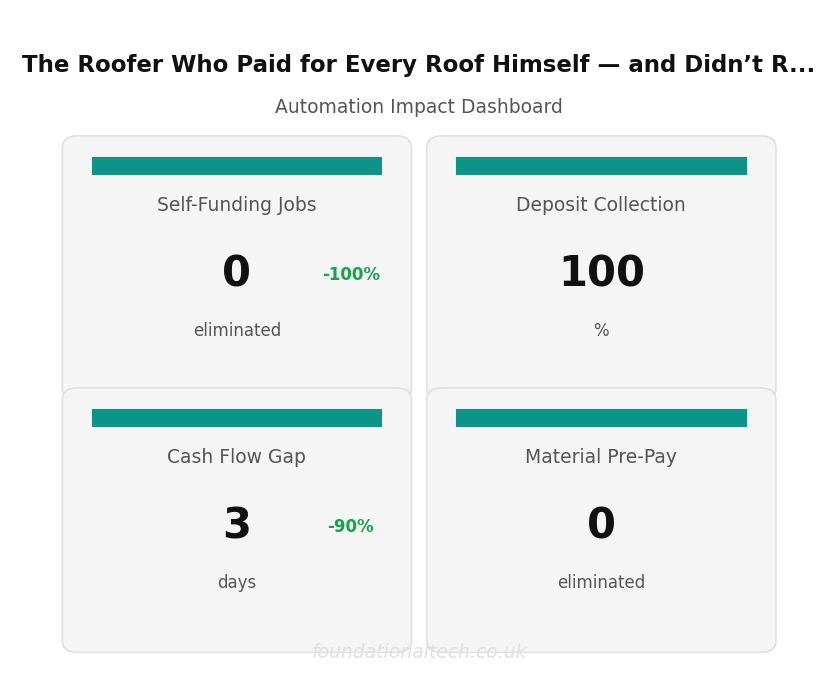
The change wasn't the size of the jobs or how many he took. It was that the customer's money now paid for the customer's roof, instead of Dave's money paying for it and waiting seven weeks to be reimbursed. His exposure on each job dropped from thousands to almost nothing. Same work. Same crews. Completely different bank balance.
He rang me six weeks later, weirdly emotional about a direct debit. "It just... comes in now," he said. "I'm not doing anything."
How to Fix This: The Practical Playbook
The principle is simple: stop funding your customers' roofs with your own money. The mechanism is staged payments, and the structure matters more than most people think.
Start with a deposit. Twenty-five to thirty percent of the total job value, collected the moment the customer accepts the quote. This is completely standard practice in UK roofing and perfectly legal. The deposit covers your initial outlay — scaffolding hire, skip, the first materials order — so that money is leaving the customer's account at the same time it is leaving yours. You are no longer the bank.
Then tie progress payments to visible milestones. The beauty of roofing is that progress is physically obvious to the customer. They can see the scaffold go up. They can see the strip. They can see the felt and batten. They can see the new tiles or slate going on. Each of these is a natural payment trigger, because the customer can look up and confirm you have done what you said you would do.
Here is an example payment schedule for a £22,000 re-roof that works in practice:
- £5,500 deposit on acceptance of the quote, before any work begins
- £5,500 on completion of the strip (old roof off, timber exposed)
- £5,500 on completion of felt, batten, and any timber repairs
- £5,500 on completion — tiles or slate on, flashings done, scaffold down
Four equal payments, each tied to something the customer can physically verify. No ambiguity, no awkward conversations about percentages, no guesswork about when to send the invoice.
Why do customers actually prefer this? Because it proves you are progressing. A roofer who asks for staged payments is telling the customer, implicitly, that they plan to hit milestones, that they will be on site consistently, and that they are running a professional operation. The customer gets reassurance that they are not paying for a finished roof before the first tile goes on. In practice, most homeowners are far more comfortable with this than with a single invoice for £22,000 landing on the doormat after the job is done.
Tools That Automate the Chasing
Knowing the right payment structure is half the battle. The other half is making sure the invoices actually go out at the right time, without Dave sitting at his kitchen table on a Sunday night doing it manually. This is where software earns its keep.
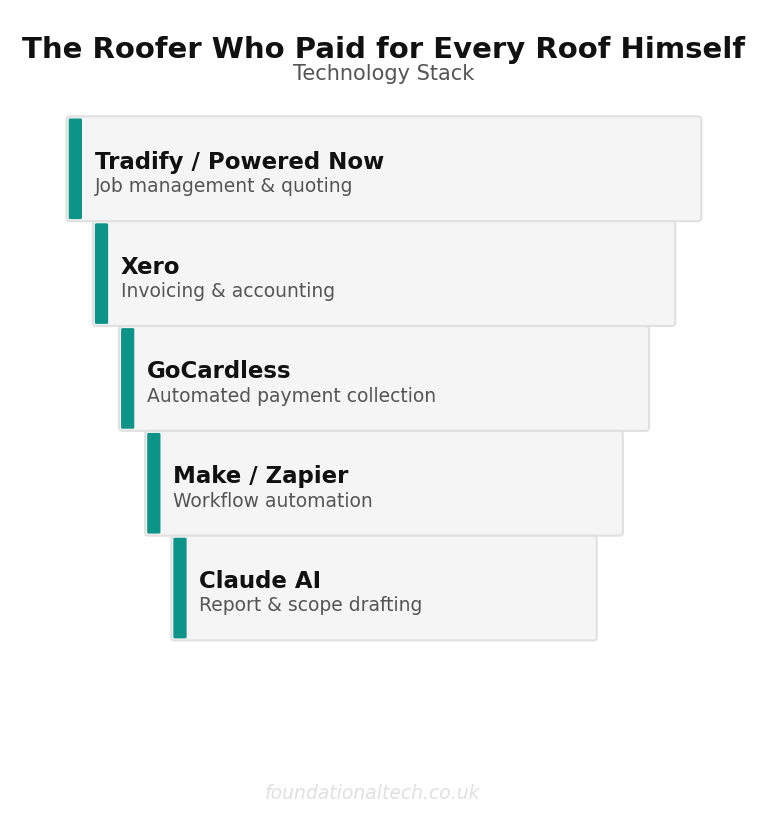
Tradify (from £29.50 per user per month) lets you build payment schedules directly into your quotes. When the customer accepts, the staged invoices are already set up. When you mark a stage as complete in the app, the invoice fires automatically. No typing, no forgetting, no Sunday nights.
Xero (from £15 per month) sits underneath as the accounting hub. Every invoice Tradify sends gets pushed to Xero automatically, and Xero reconciles the payments against your bank feed. You can see at a glance which stages are paid and which are outstanding across every live job.
GoCardless (1% plus 20p per transaction, capped at £4) is the option that makes money just arrive. You set up a Direct Debit instruction for each stage payment, and when the milestone hits, the money pulls from the customer's bank account automatically. No chasing, no payment links, no waiting for the customer to remember. For roofers doing larger residential work, this is genuinely transformative — the money simply shows up in the account two to three days after the stage is marked complete.
Stripe (1.5% plus 20p per transaction) provides payment links that you can embed in every invoice. The customer gets an email, clicks a button, pays by card or Apple Pay, and the money is in your account within two working days. It is less automatic than GoCardless but easier to set up and more familiar to customers.
Payaca (from £49 per month) is worth mentioning for roofers who want polished, branded proposals with built-in deposit collection. The customer receives a professional proposal document, accepts it, and pays the deposit all in one flow. It is popular with roofers and landscapers who want their quotes to look as professional as the big national firms.
For a sole trader, the total cost of this stack comes in under £100 per month: Tradify Lite at £29.50, Xero Starter at £15, and Stripe or GoCardless on a per-transaction basis. Compare that to the thousands of pounds sitting in the gap between finishing a roof and getting paid for it, and the maths is not even close.
The Deposit Conversation: How to Have It Without Losing the Job
The biggest reason roofers do not collect deposits is not that they do not know they should. It is that they are afraid of the conversation. They worry the customer will think they are being ripped off, or that they cannot be trusted, or that they will just go with the other roofer who did not ask for money upfront.
Here is the thing: the way you frame it determines how the customer hears it.
Build it into the quote, not a separate request. The deposit should never feel like an afterthought or an additional demand. It is simply how you work. Your quote document should list the total price, the payment schedule with stage amounts and triggers, and a line at the bottom that says "25% deposit due on acceptance." It is not negotiable because it is not being presented as negotiable — it is just part of the professional process, like the guarantee terms or the insurance certificate.
Frame it as professional, not defensive. The words you use matter enormously. Do not say "we need a deposit because we've been stung before." Instead, say something like: "We collect staged payments to ensure uninterrupted progress on your project. This covers materials and scaffolding costs upfront so there are no delays once work begins." You are telling the customer that the deposit exists to protect their project timeline, not your bank balance. Both are true, but one sounds professional and the other sounds desperate.
Get proper terms and conditions drafted. A one-page document setting out your payment terms, cancellation policy, guarantee, and complaints procedure costs £200 to £300 as a one-off from a solicitor, and it transforms how customers perceive your business. When the deposit request comes with a properly drafted terms document, the customer reads it as established practice, not a personal demand. Several online legal services like Rocket Lawyer or LawBite offer templates for trade contracts from around £30 to £50, though a bespoke version from a local solicitor is worth the investment if you are doing regular jobs above £10,000.
Know the law. Under the Consumer Rights Act 2015, deposits for service contracts are perfectly lawful as long as the terms are made clear upfront, before the customer commits. You cannot spring a deposit on someone after they have accepted a quote with no mention of it. But if your quote clearly states the payment schedule and the customer signs it, you are on completely solid legal ground. There is no maximum deposit percentage set by law for domestic roofing work — 25% to 30% is industry standard and well within what courts would consider reasonable.
What if a customer refuses? This happens, and it is actually useful information. In our experience, the customers who refuse to pay a reasonable deposit are disproportionately the same ones who will cause payment problems later. A customer who balks at a 25% deposit on a £22,000 job — that is £5,500, less than the cost of the scaffolding — is telling you something about how they view the financial relationship. You are not obligated to take every job, and walking away from a customer who will not agree to standard payment terms is usually the right call. The roof you did not do for free is the most profitable roof of the year.
Funding every roof himself
a roofer who did not realise he was lending £22,000 at a time to his own customers
Where this connects
This week's articles are all roofing — and the one I'd point Dave's fifteen-year-younger self to is the full guide to automating a roofing business, because roofing is the trade where this bites hardest. Bigger jobs, bigger lay-out, bigger wait. It's the difference between funding your next roof with the bank's money or your own.
But the real lesson isn't about roofing, or even about money. It's that a lot of what feels like personal failure — I should be better at this, everyone else seems to cope — is really just a badly designed system running exactly as designed. Dave wasn't weak. His cash flow was upside down. Once you can see the shape of the problem, you stop blaming yourself and start fixing the thing that's actually broken.
That's true of a roofer's deposits. It was true of my own leap. It's probably true of whatever's keeping you up at night too.
Have you ever been busier than ever and worse off for it — in a business, a job, a whole career? What did you finally see that changed it? Tell me below. I read every one.