Key Takeaway
UK Shopify seller cut 63-hour weeks to 35 by automating their entire operation. Real case study with full software stack, costs, and step-by-step setup.
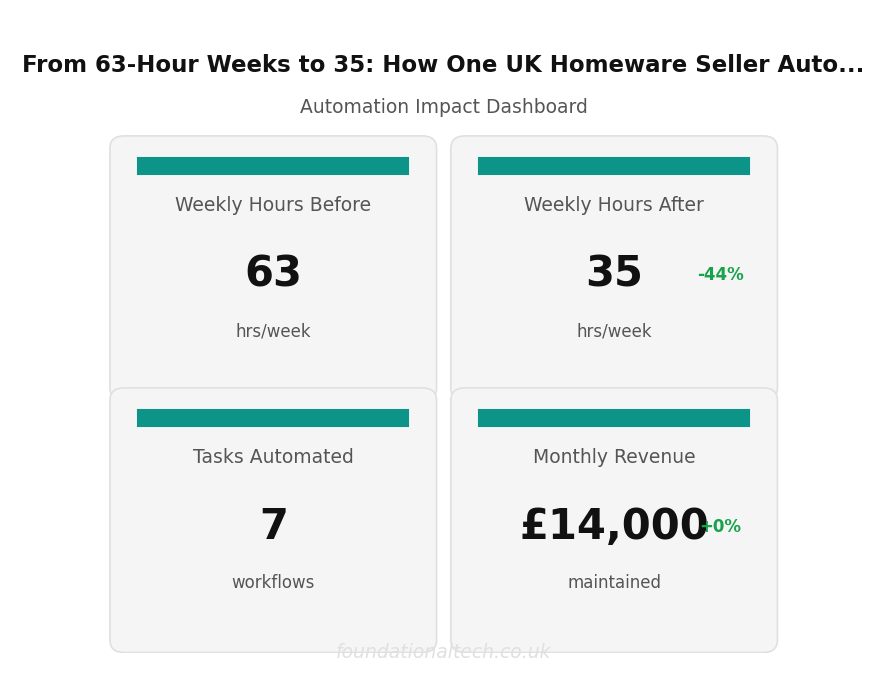
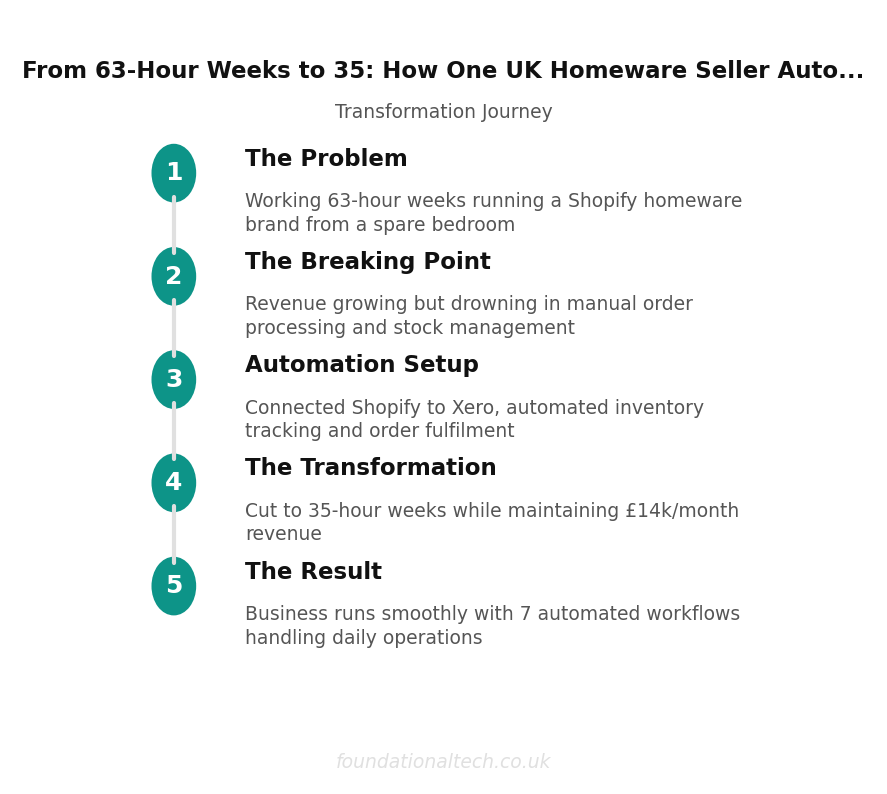
Rachel ran a homeware brand from her spare bedroom in Bristol. Scented candles, linen throws, ceramic planters — the kind of curated lifestyle products that photograph beautifully and sell steadily on Shopify. Revenue had grown to £14,000 a month. The problem was everything behind the photos.
She was working 63-hour weeks. Not making candles or sourcing new products — that was maybe 12 hours. The other 51 were admin: answering the same customer questions, manually entering invoices into Xero, reconciling Stripe payouts that never quite matched, chasing late wholesale payments, and updating spreadsheets that were already out of date by the time she saved them.
She’d tried hiring a VA. They lasted six weeks before the training overhead made the maths worse, not better. She’d tried “just being more organised.” That added a colour-coded planner to her desk and zero hours back to her week.
Then she automated. Not all at once — over three months, one layer at a time. Here’s exactly what she did.
Month 1: The Foundation
Rachel started with the operational backbone — the tools from articles 1 through 5 in this series.
Shopify → Xero via A2X (£19/month). Every Shopify sale, fee, refund, and payout started syncing to Xero automatically. She stopped manually reconciling Stripe. The daily 40-minute spreadsheet ritual disappeared on day one.
Xero for invoicing and bank feeds (£37/month, Growing plan). She switched from spreadsheet invoicing to Xero’s automated invoices with payment links. Wholesale customers started paying faster because the “pay now” button removed every friction point.
Klaviyo for email (free up to 500 contacts, then ~£35/month). She set up three automations: abandoned cart, post-purchase follow-up, and a restock reminder for repeat buyers. No manual email campaigns — the system ran itself.
GoCardless for wholesale (1% + 20p per transaction, capped at £4). She connected GoCardless to Xero for her 12 wholesale accounts. Direct Debit meant payment on the agreed date, every time. She stopped chasing invoices entirely.
Month 1 result: 14 hours per week saved. Weekly hours dropped from 63 to 49.
Month 2: The AI Layer
With the operational tools running, Rachel added AI — following the approach from articles 6 through 9.
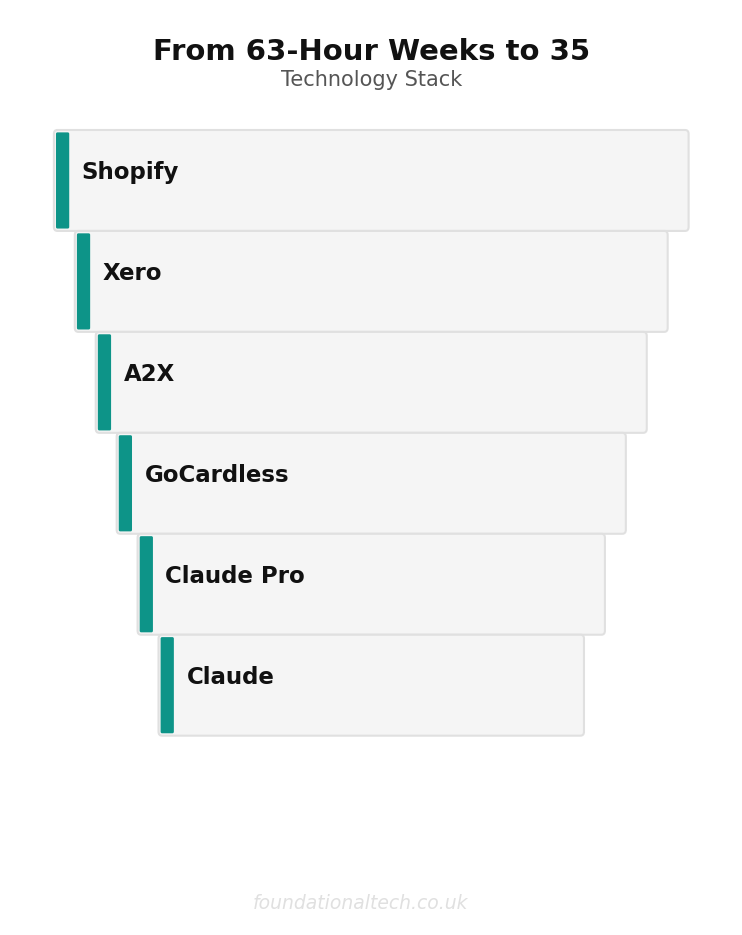
Claude Pro for daily operations (£18/month + VAT). She set up a Claude Project with her brand voice, product catalogue, returns policy, and FAQ document uploaded. Every morning she pasted the overnight customer emails in a batch: “Draft replies to each in our voice.” Ten emails, three minutes instead of forty.
Make.com + Claude API for bookkeeping (£12/month total). Supplier invoices arriving by email were automatically extracted, categorised, and drafted as Xero bills. Her bookkeeper — who she paid £150/month for 6 hours of work — now spent 2 hours reviewing AI-drafted entries instead of 6 hours doing manual data entry. The bookkeeper’s invoice dropped to £60/month.
Shopify Flow for order triage (free). High-value orders flagged for review. Gift wrap requests auto-tagged. International orders triggered customs documentation. She stopped scanning every order manually.
Month 2 result: Another 9 hours per week saved. Weekly hours dropped from 49 to 40. And the bookkeeper saving added £90/month back.
Month 3: The Compound Effect
This is where the stack stopped being a collection of tools and started being a system. Everything connected. Data flowed without Rachel touching it.
A customer places an order → Shopify processes payment → A2X syncs the sale to Xero → Klaviyo sends the confirmation and tracks engagement → Shopify Flow flags anything unusual → If the customer emails a question, Claude drafts the reply in Rachel’s voice → If a supplier invoice arrives, Make.com and Claude categorise it and draft the Xero bill → GoCardless collects wholesale payments on schedule → Xero reconciles everything automatically.
Rachel’s morning routine became: open laptop, scan the “needs approval” queue (5–8 items), approve or tweak, close laptop. Thirty minutes.
She used the freed-up hours to source two new product lines and negotiate better supplier terms — the kind of work that actually grows revenue but never got done when she was buried in admin.
The Numbers
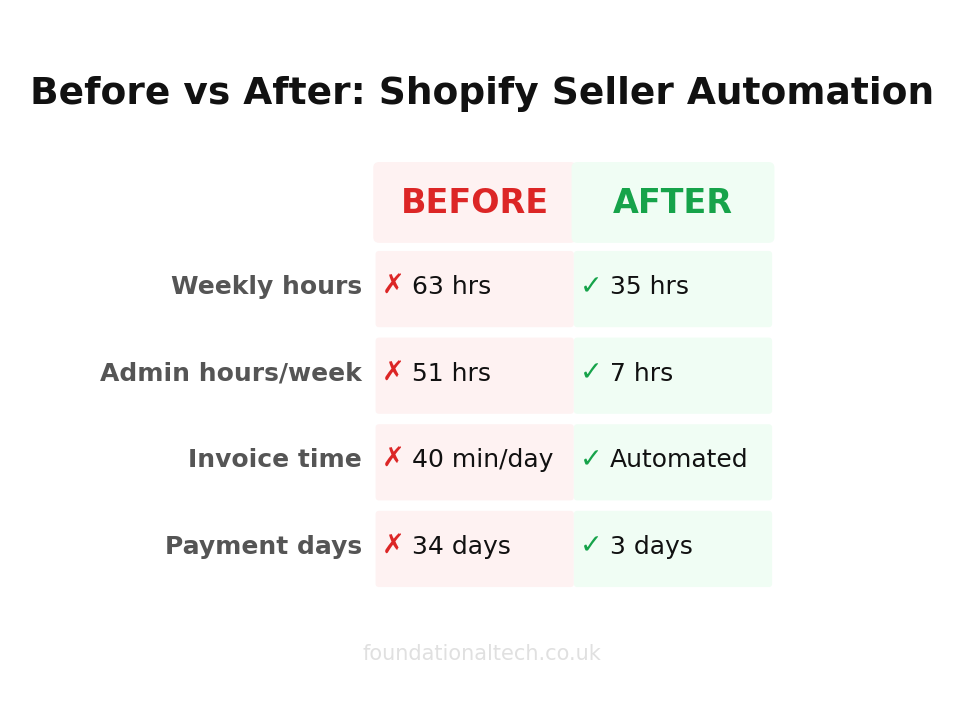
Hours worked per week: 63 → 35 (44% reduction)
Revenue: £14,000/month → £19,200/month over 6 months (37% increase — from the time reinvested in sourcing and wholesale)
Days to wholesale payment: 34 average → 3 (GoCardless Direct Debit)
Customer reply time: 8 hours average → 47 minutes
Bookkeeper cost: £150/month → £60/month
Monthly admin errors (mis-categorised transactions, wrong replies): ~12 → 1–2
Annual Cost of the Full Stack
| Tool | Role | Monthly cost |
|---|---|---|
| Shopify Basic | Storefront + Flow | £25 |
| A2X | Shopify → Xero sync | £19 |
| Xero Growing | Bookkeeping + invoicing | £37 |
| Klaviyo | Email automation | £35 |
| GoCardless | Direct Debit collection | ~£14 |
| Claude Pro | AI writing + operations | £18 |
| Make.com Core | Workflow automation | £7 |
| Claude API | Bookkeeping AI | £5 |
| Total | £160/month (£1,920/year) | |
ROI: The stack costs £1,920/year. It saves 28 hours per week (worth £17,763 at minimum wage), reduced the bookkeeper bill by £1,080/year, and freed the time that generated £62,400 in additional annual revenue. The return isn’t a percentage — it’s a different business.
The Five Automations That Made the Biggest Difference
Rachel's stack had dozens of moving parts by the end, but five specific automations delivered the vast majority of her time savings. If you're building a similar setup, these are the ones to prioritise.
1. A2X → Xero Daily Sync: 6 Hours Per Week Eliminated
This was the single biggest win and the one Rachel wishes she'd done first. Before A2X, she was manually reconciling Shopify payouts in Xero every evening. The problem is that Shopify doesn't pay you per order — it bundles everything into a single payout every few days. That payout includes sales revenue, minus Shopify's commission, minus payment processing fees, minus any refunds issued, minus VAT collected. Trying to match a £2,847.63 bank deposit against thirty-seven individual orders is the kind of work that makes you question your life choices at 10pm on a Tuesday.
A2X sits between Shopify and Xero and does one thing brilliantly: it takes each Shopify payout and breaks it down into proper accounting entries. Sales income goes to one account, Shopify fees to another, refunds to another, shipping charges to another. Every line is separated and coded correctly. The daily sync means Rachel's Xero was always up to date — no more end-of-month scramble trying to figure out why the bank balance didn't match the sales reports.
At £19 per month for the basic plan (which handles up to 200 orders per month), this is the most obviously worthwhile subscription in the entire stack. Rachel was spending roughly 40 minutes per day on manual reconciliation. That's over 6 hours a week, gone overnight.
2. Klaviyo Abandoned Cart and Post-Purchase Flows: £800/Month Recovered
The industry average for abandoned cart recovery is somewhere between 5% and 10% of abandoned carts, depending on your product type and price point. Rachel's homeware products — averaging £35 per item — sat nicely in the sweet spot where customers abandon carts because they got distracted, not because they can't afford it. That makes recovery emails particularly effective.
She set up a three-email abandoned cart sequence. The first email fires one hour after abandonment — just a gentle reminder with the product image and a direct link back to the cart. The second goes at 24 hours with a slightly different angle, often highlighting the product's bestseller status or limited stock. The third arrives at 72 hours and includes a small incentive — Rachel uses free shipping rather than a discount, which protects her margins better.
The post-purchase flow was simpler: a thank-you email at day one, a "how to care for your product" email at day seven (genuinely useful content that reduces returns), and a cross-sell suggestion at day 21. This sequence drove repeat purchases from about 12% of first-time buyers — not earth-shattering, but it runs entirely on autopilot.
Combined, these flows recovered roughly £800 per month in revenue that would otherwise have been lost. Setup took two evenings — one for the abandoned cart sequence and one for the post-purchase flow.
3. Make.com Stock Alert Workflow: 3 Stockouts Per Month Prevented
Before this automation, Rachel checked inventory manually twice a week. She'd log into Shopify, scan the stock levels, and if anything was running low she'd email the supplier. The problem was that popular items could sell through between checks — particularly during a promotional period or when an Instagram post drove unexpected traffic.
She built a Make.com scenario that monitors Shopify inventory levels. When any product drops below its reorder threshold (she set these individually — 15 units for fast-moving candles, 5 for slower ceramic pieces), the workflow does two things: it creates a draft purchase order in a Google Sheet with the supplier details, reorder quantity, and estimated cost pre-filled, and it sends a Slack notification to Rachel's phone. She reviews the PO, adjusts if needed, and emails it to the supplier — a two-minute job instead of a twenty-minute stock audit.
This prevented an average of three stockouts per month. Each stockout on a bestselling product cost Rachel roughly £200-£400 in lost sales over the 3-5 days it took to restock. That's potentially £600-£1,200 per month in protected revenue, from a Make.com scenario that took an afternoon to build.
4. GoCardless for Wholesale: From 34-Day Payment Terms to 3
Rachel had 12 wholesale accounts — independent gift shops, a garden centre, a few interior designers who bought in bulk. All of them were on 30-day payment terms, invoiced manually through Xero. In reality, "30-day terms" meant she sent the invoice, waited, chased at day 35, chased again at day 42, and received payment around day 50. Two of her accounts were consistently 60+ days late.
Setting up GoCardless through Xero took about 15 minutes per wholesale customer. She sent each one a Direct Debit mandate request by email. The customer clicks a link, confirms their bank details, and authorises the mandate — the whole process takes them about two minutes. Once the mandate is live, Xero automatically collects payment on the invoice due date via Direct Debit.
Average days to payment dropped from 34 to 3 (GoCardless typically takes 2-3 working days to clear). The time Rachel spent chasing late payments — roughly 3 hours per week of emails, phone calls, and awkward conversations — dropped to zero. Every wholesale customer now pays on time, every time, without Rachel lifting a finger.
5. Claude Project for Customer Service: 2 Hours Per Day to 20 Minutes
Rachel was spending nearly two hours every day answering customer emails. Most of them were the same fifteen questions asked in different ways: shipping times, returns policy, product dimensions, care instructions, gift wrapping options, wholesale enquiries. She knew the answers perfectly, but typing them out individually — in the right tone, with the right level of detail — was grinding.
She set up a Claude Project and uploaded her entire product catalogue (with descriptions, dimensions, materials, and care instructions), her shipping policy, her returns policy, and a document she called "Rachel's voice" — a page of example emails she'd written that captured her brand's warm-but-professional tone. She also added common edge cases: what to say when a product arrives damaged, how to handle a customer who wants to return something outside the 30-day window, when to offer a replacement versus a refund.
Each morning, she copies the overnight customer emails into Claude in a batch. Claude drafts responses for each one, using the uploaded context to answer accurately and in her voice. Rachel scans the drafts, tweaks anything that needs adjusting (usually one or two out of ten), and sends them. The entire process takes about 20 minutes instead of nearly two hours. The quality of responses actually improved — they're more consistent and more thorough than what Rachel was writing when she was tired and rushing through the queue at 9pm.
Month-by-Month: What the Transition Actually Looked Like
The summary version of Rachel's transformation — "she automated everything in three months" — makes it sound cleaner than it was. Here's what actually happened, month by month, including the frustrating bits.
Month 1: The Accounting Foundation
Rachel started with A2X and Xero because the bookkeeping chaos was causing the most stress. She signed up for A2X (£19/month for the Shopify plan), connected it to her Shopify store and Xero account, and mapped the account codes. The initial setup took about two hours, including figuring out where Shopify fees and refunds should sit in her chart of accounts.
The payoff was immediate. From day one, her Shopify payouts were broken down and reconciled automatically. The 40-minute evening reconciliation ritual disappeared overnight. She also switched her wholesale invoicing to Xero's built-in invoicing with payment links, which was a smaller change but removed the spreadsheet she'd been using to track who owed what.
Hours saved in month 1: approximately 6 per week. Cost: £49/month (A2X plus the Xero plan upgrade she needed). Stress reduction: enormous — this was the change that made her feel like the project would actually work.
Month 2: Revenue Recovery
With the accounting running smoothly, Rachel turned to Klaviyo. She spent two evenings building the abandoned cart and post-purchase email sequences. The Klaviyo interface is reasonably intuitive if you've ever used an email marketing tool, though she found the segmentation options overwhelming at first and kept it simple — abandoned cart emails go to everyone, no fancy segmentation.
She also set up GoCardless for her wholesale accounts during month 2. This was surprisingly quick — the Xero integration is native, so it's really just connecting the two accounts and then sending mandate requests to each wholesale customer. Two of her twelve accounts grumbled about switching to Direct Debit but agreed when Rachel explained it meant they'd never have to remember to pay an invoice again.
Revenue impact: roughly £800/month in recovered abandoned carts within the first full month. Wholesale payment times started improving immediately as mandates went live. Time to set up: two evenings for Klaviyo, one afternoon for GoCardless.
Month 3: Workflow Automation (The Hard Month)
This was the month Rachel nearly gave up. She tackled Make.com, and the learning curve was steeper than anything else in the stack. Make.com's visual workflow builder looks simple until you need to handle error cases, conditional logic, and API connections that don't behave as documented.
The stock alert workflow took a full weekend to build and test properly. She broke it twice, sent herself 47 false alerts on the first day, and had to rebuild the Shopify inventory trigger from scratch after discovering it was checking the wrong variant. But once it worked, it worked reliably — and the three stockouts per month it prevented more than justified the pain.
She also started using Claude during month 3, though the first week was largely wasted. She used it like a generic chatbot — typing in individual questions and getting generic responses. It was only when she set up a dedicated Project with her product catalogue and brand voice uploaded that the output quality jumped to the point where she could actually use the drafts with minimal editing.
Hours saved: another 8-10 per week once everything was working. Emotional cost: high. This was the month where the "just automate everything" advice from the internet met the reality of debugging webhook connections at midnight.
Months 4-6: Refinement
The big setup was done. Months 4 through 6 were about refinement — tweaking Klaviyo email subject lines based on open rates, adjusting stock reorder thresholds as she learned her actual sell-through rates, improving her Claude Project with better example responses as edge cases came up.
She also hired a part-time VA during month 5, but this time the VA had clear systems to follow rather than trying to shadow Rachel's chaotic manual processes. The VA handles the daily Claude review queue, processes returns, and manages the stock reorder POs. Because every process is documented in the automation tools, training took two days instead of six weeks.
Key lesson: the total transformation took three months of active setup, not three days. Anyone who tells you that you can automate an entire e-commerce operation in a weekend is selling you something. But three months of part-time evening work for years of compound returns is a trade most business owners would take — if they knew upfront that month 3 would be the hard one.
What Rachel Would Do Differently
Start with A2X, not Klaviyo. “The bookkeeping sync saved more stress than anything else. I should have done that first instead of fiddling with email sequences.”
Set up the Claude Project properly from day one. “I spent the first week using Claude like a generic chatbot. The moment I uploaded my catalogue and wrote a real system prompt, the output quality jumped completely. That setup guide should be step one.”
Don’t try to automate everything in week one. “I nearly burned out trying to wire up Make.com before I’d even got Xero working properly. One tool per week. Let each one settle before adding the next.”
28 hours/week saved
by automating admin across Shopify, Xero, Klaviyo and GoCardless
The Full Stack Summary
The stack Rachel built is not unique to homeware. Swap “candles” for “tools” or “clothing” or “supplements” and the architecture is identical. Every UK Shopify seller processing 10+ orders a day and spending more than half their time on admin is running the same broken workflow Rachel was.
The fix isn’t a single magic tool. It’s the stack — operational automation first, AI on top, human approval on every loop that matters. Three months of setup for years of compound returns.
Could your e-commerce business hit similar numbers? Reply with your current weekly hours and biggest admin bottleneck — I’ll tell you which tool to set up first and what you should realistically expect in month one.
This is exactly what A & Y Financial Services does. We take UK e-commerce businesses from manual chaos to automated clarity — choosing the right tools, wiring them together, and making sure the numbers actually flow. Let’s talk.