Key Takeaway
UK landscaper gained 14 extra jobs a month by automating Sunday-night admin. Full case study with Tradify, Xero, GoCardless, real costs, and setup steps.
The day Mark nearly packed it in, he was sitting in his van at 9:40 on a Sunday night, headlights off, engine cold, doing quotes on his phone because it was the only time the kids were asleep. He had turned over £142,000 the year before and felt poorer than when he was employed. The work was there. The time was not. This is the story of how a two-van landscaping firm in the West Midlands went from drowning in paperwork to taking on fourteen extra jobs a month — without hiring a single person — by wiring together the exact stack this series has spent nine articles describing.
Mark is a composite, built from the real numbers landscaping firms report and the pricing verified across this series. But every figure here is grounded in what these tools actually cost and actually do in 2026. Nothing below requires a budget Mark did not have, or a tech skill he did not learn in an afternoon.
The Starting Point
Mark's firm, on paper, was healthy. Two vans, three full-time lads in summer dropping to one in winter, a steady book of maintenance customers and a regular flow of one-off landscaping projects — patios, fencing, planting, the occasional full garden redesign. Revenue sat around £142,000. He was busy from March to November and panicking about cash from December to February.
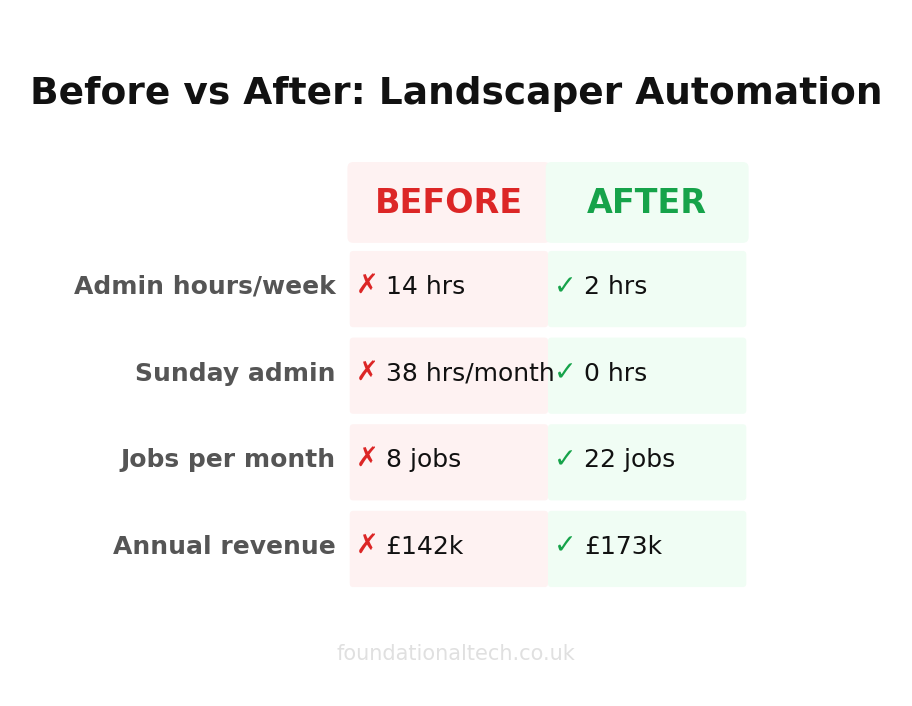
The problem was never the work. It was everything around the work. Quotes were scribbled in a notebook and typed up at night, which meant a two- to three-day lag before a customer heard back — and in that gap, perhaps one in three went cold and hired someone quicker. Invoices went out in a weekly batch on Sundays, if he had the energy, which meant some jobs were billed a fortnight after completion. Payment then took another month: his average was 38 days, and at any moment he had four or five thousand pounds sitting in other people's bank accounts. Receipts lived in the footwell of the van until his bookkeeper chased him, then went into a carrier bag once a quarter. Timesheets were texts and memory.
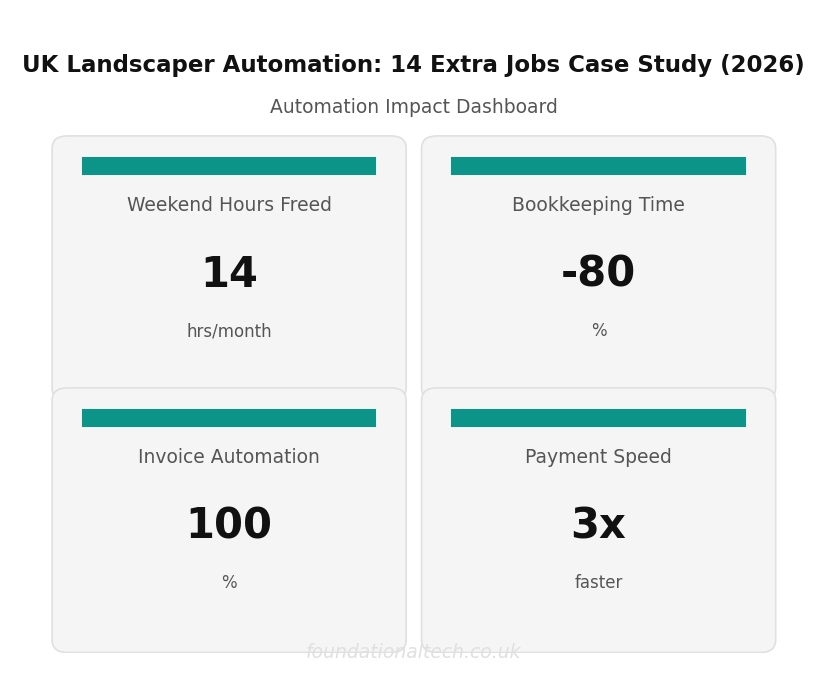
Add it up and Mark was spending the best part of fourteen hours a week on admin — most of it at night, all of it unpaid, and the cash-flow stress was doing more damage than the hours. He had turned down a £9,000 redesign in February because he could not face the paperwork it would generate. That was the moment he decided something had to change.
Month 1: The Foundation
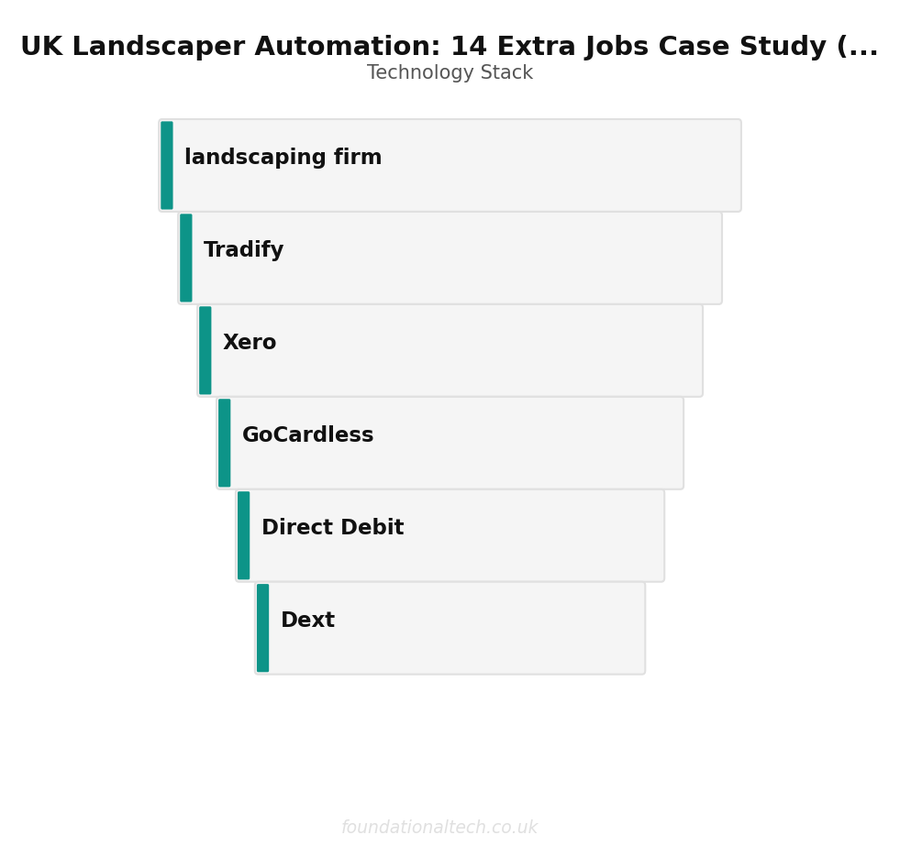
Mark started where this series starts: with the operational spine. He moved everything into Tradify to run the jobs and Xero to keep the books, and connected the two with their native, two-way link so an invoice raised on site appears in his accounts on its own.
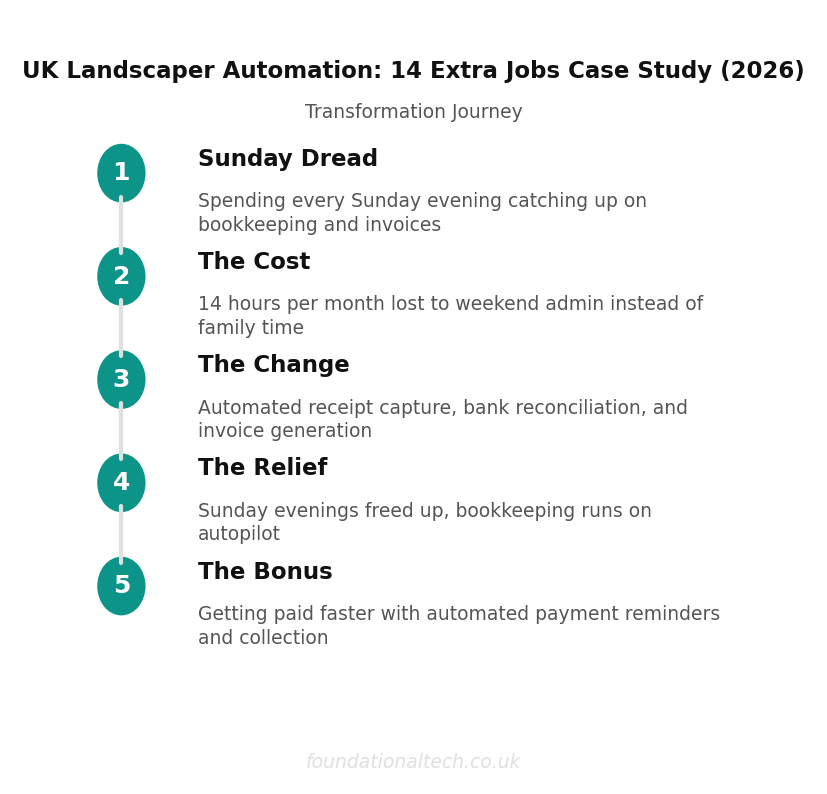
The change was immediate and almost embarrassing in its simplicity. Quotes now got built on his phone in the customer's garden, on the spot, from saved templates — a five-minute job instead of a notebook entry and a late-night retype. The lag between a customer asking and a customer hearing back collapsed from three days to about twenty minutes. His quote-to-win rate climbed, because he was now the landscaper who replied first.
He set Tradify to raise the invoice the moment a job was marked complete, pushing it straight to Xero. The Sunday invoicing batch — the single most hated hour of his week — simply stopped existing. Tradify runs from £34 a month per user; Xero's Growing plan is £37 a month. For the price of a weekly takeaway, the two jobs he hated most were gone by the end of week one. (Pricing web-verified June 2026.)
Month 2: The Cash and the Crew
With the spine in place, Mark went after the thing actually keeping him up at night: money owed. He put his maintenance customers — the predictable, recurring ones — onto GoCardless Direct Debit, collecting automatically on each invoice's due date through Xero's built-in Direct Debit feature. For one-off project customers he added a Stripe "Pay now" button to his Xero invoices so they could settle by card from their phone the day the work finished.
The effect on cash flow was the single biggest change in the whole story. His average days-to-payment fell from 38 to 6. The maintenance round, worth a steady few thousand a month, now collected itself with no chasing, no "just following up on that invoice" texts, no awkwardness. GoCardless charges 1% plus 20p per transaction, capped at £4 — a few pounds a month against the thousands it freed up and the hours of chasing it ended.
He cleaned up the back office in the same month. The crew started clocking hours against jobs from their phones in Tradify, which flowed into Xero Payroll at £1.50 per employee a month, ending the Friday-night guesswork of "how many hours did you do on the Hendersons'?" And he put Dext on his phone — around £24 to £29 a month — to photograph every merchant receipt at the till, where it became a coded bill in Xero automatically. The carrier bag of receipts, and the quarterly row with his bookkeeper, were finished.
Month 3: The AI Layer and the Compound Effect
By month three the admin was already tamed. What Mark added next is what turned a tidy business into a growing one. He set up an AI worker — a Claude Pro on an £18-a-month plan — loaded with his price list, his service descriptions and his tone of voice, so it drafted quotes, customer replies and maintenance updates that sounded like him from the first word.
Then he wired it in with Make, on the cheap end of its plans, building the three workflows from the previous article: enquiries drafted into priced replies for his approval, weekly transactions pre-sorted before reconciliation, and completed jobs turned into warm, specific "we've been today" messages to his maintenance customers. Each one ran on its own. None of them touched a customer or his accounts without his sign-off.
Everything now compounded. Faster quotes won more work. Automatic collection meant the cash to take that work on was actually in the bank. The freed evenings meant he had the headspace to say yes. And the automatic customer updates meant his maintenance round stopped churning over winter — the months that used to terrify him.
The Numbers
Hours saved per week: around 12, recovered from roughly 14 hours of admin down to 2
Days to payment (before to after): 38 days to 6 days
Extra jobs taken on per month: 14, with no new hire — purely from faster quoting and reclaimed time
Revenue increase: roughly 22% over the year, lifting turnover from £142,000 toward £173,000
Annual cost of the full stack: approximately £1,500–£1,700, including Tradify, Xero with payroll, Dext, GoCardless fees, an AI subscription and a cheap Make plan
ROI: the stack paid for itself inside the first fortnight of recovered evenings, before a single extra job was counted
The Full Stack Summary
(All pricing web-verified June 2026. AI and Make subscriptions are billed in USD, so the GBP figure moves with the exchange rate.)
The Winter That Used to Hurt
The clearest proof that the stack worked was the following December — the month that, every previous year, had emptied his bank account and his confidence in equal measure.
In the old model, winter was a cliff. The one-off projects dried up, the maintenance round was his only income, and that round leaked. Customers he never spoke to between visits would email in November to "pause until spring," and because he had no easy way to stay in front of them, he let them go. By January he was carrying two vans and a wage bill on a third of his summer revenue, dipping into an overdraft he then spent the spring repaying. It was the part of the year that made him wonder whether the whole thing was worth it.
The automated stack changed the shape of that winter in two ways. First, the Direct Debit round no longer leaked, because the automatic "we've been today" messages kept customers feeling looked after through the quiet months — churn over the winter fell sharply, and the recurring income held. Second, with cash collecting in six days instead of thirty-eight, he went into December with money already in the bank rather than scattered across other people's accounts. He did not touch the overdraft once. For the first time in five years, January was a month he planned in, not survived.
That is the quiet power of the compound effect. No single tool saved his winter. The stack did — by holding onto customers, collecting faster, and giving him the breathing room to think a season ahead instead of a week behind.
14 extra jobs per month
after eliminating Sunday-night admin with automated quoting and scheduling
What He'd Do Differently
Mark's advice to anyone starting is blunt: do not try to build it all in one weekend. He nearly gave up in week one because he tried to connect five tools at once and could not tell which join had broken when something did not sync. The order matters. Get Tradify and Xero talking first, live with just that for a fortnight, and only then add payments, then receipts, then — last of all — the AI layer on top.
His second lesson is to keep a human on the approve button for anything a customer reads or anything that touches the accounts. The AI drafts brilliantly and sorts transactions well, but a landscaping quote depends on access, slope and what is already in the ground — judgement a model cannot fully see. The firms that get burned are the ones who let the robot send and post on its own. The ones who thrive use it to remove the typing, not the thinking.
His last reflection is the one that surprised him most. He expected the stack to save him time, and it did. What he did not expect was that it would make him a better landscaper, because the fourteen hours it gave back went into the actual gardens — and the work, finally, got the attention the admin used to steal.
Could your landscaping business achieve similar results? Reply with the single task that eats the most of your week — quoting, chasing payments, or customer updates — and I'll tell you exactly which part of this stack to build first.
A & Y Financial Services builds these exact automation stacks for landscaping businesses across the UK. If you've read the architecture and want someone to implement it — that's what we do.