Key Takeaway
Stop chasing late payments as a UK landscaper in 2026. Set up automated invoicing, payment reminders, and Direct Debit with GoCardless and Xero.
The average UK small business waits more than five weeks to get paid, and a landscaper chasing forty £40 invoices a month is in a worse spot than most. The money is owed, the work is done, and the only thing standing between you and your cash is admin you never bid for.
This is the article that fixes it. Not with a stern email template, but with a billing system that raises the invoice the moment a job is finished, collects from your regulars by Direct Debit without you lifting a finger, and chases the stragglers on a schedule so you never have to send another awkward "just following up" message. Here are the tools, the current 2026 UK prices, and the exact order to set them up.
The Cash Flow Gap
Landscaping has a billing problem that other trades don't, and it comes down to the shape of the work.
5+ weeks
average time UK small businesses wait to get paid
A maintenance round is dozens of small invoices. Forty fortnightly cuts at £35 to £50 each is a healthy £1,600 a month — but only if all forty actually get raised, sent and paid. Chase a £40 invoice and you spend more in time and goodwill than the invoice is worth, so most owners don't bother until three of them have stacked up. Multiply that hesitation across a season and you're carrying hundreds of pounds in quiet, unbilled or unpaid work at any given moment.
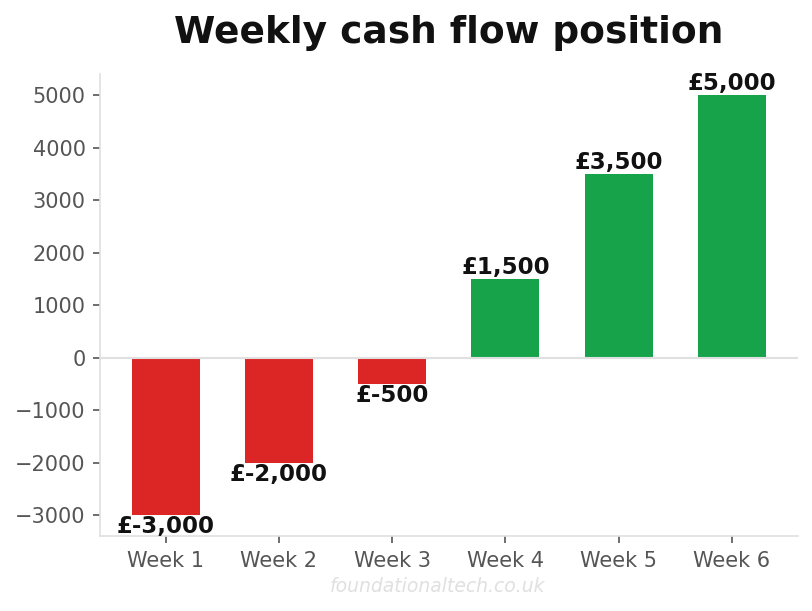
Then there's the seasonality. Cash floods in from April to September and slows to a trickle from November to February, while the van, the insurance and the wages cost the same every month. Late payment in October — when work is already tailing off — is the difference between covering January and not. The slower your money moves in autumn, the harder winter bites.
And the design-and-build side has the opposite problem: a £14,000 project where you've laid out for materials, plants and labour weeks before the customer settles up. One slow payer on a job that size can empty the account.
So the goal isn't just "send invoices faster." It's to make billing automatic for the small recurring work, instant for the one-offs, and predictable for the big jobs — so cash arrives on a rhythm you can plan around.
The Automated Billing Architecture
Four moving parts, each plugging into the next: invoices that generate themselves, a way to collect without asking, a chaser sequence for everything else, and reconciliation that closes the loop in your accounts.
Automated Invoice Generation
The invoice should never be a separate job you sit down to do. It should fall out of the work.
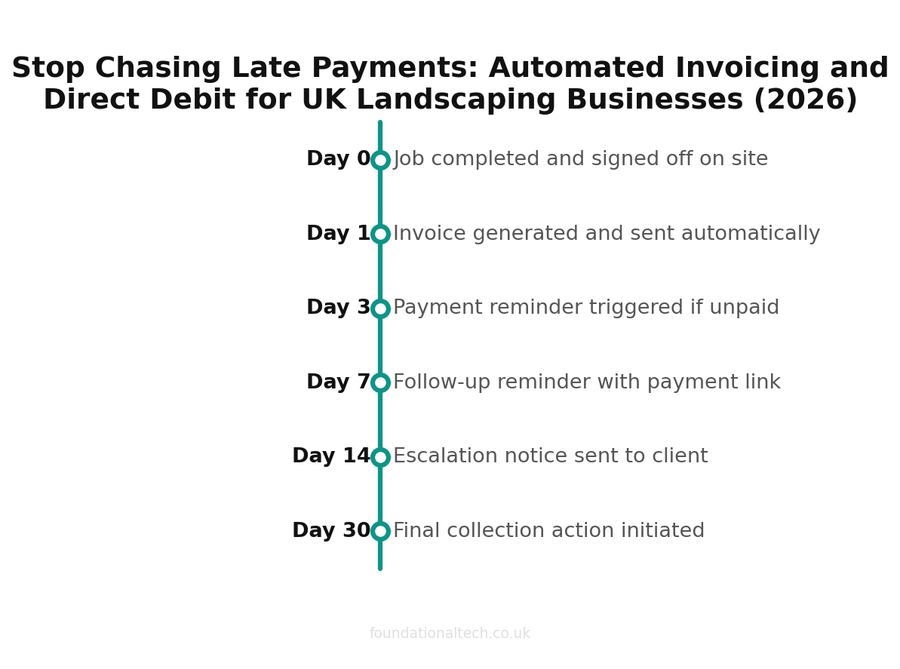
In Tradify — the job-management app at the centre of this stack — an invoice is generated the moment a job is marked complete, pulling in the agreed price, any materials and the logged labour. For maintenance rounds, it's better still: set a recurring job once and Tradify raises the visit, the worksheet and the invoice on schedule, fortnight after fortnight, until you cancel. The forty small invoices that used to go out late now go out on their own, the morning the cut is done.
Every invoice syncs straight to Xero, your accounting layer, with no re-typing. That sync is what makes everything downstream possible: the payment collection and the chasing both work off the invoice sitting in Xero.
The detail that decides whether this saves real time is the recurring invoice. On a maintenance round, the same customer is billed the same amount on the same cycle — the most automatable transaction in the business, and the one most landscapers still do by hand. Build it once in Tradify: customer, price, frequency, payment method. From then on the visit appears on the schedule, the worksheet prints for the crew, and the invoice is raised and synced without a keystroke. A hundred fortnightly customers cost exactly the same billing admin as one. That is the whole game on the maintenance side — turn your most repetitive invoice into one you never touch again.
Payment Gateways
Raising the invoice is half the battle. Getting the money in is the other half, and the trick is to stop relying on the customer to act.
For your weekly and fortnightly customers, the answer is GoCardless Direct Debit. You agree an amount once, the customer authorises it, and from then on GoCardless pulls the payment automatically on the due date — no app, no card, no reminder. Pricing is 1% + 20p per transaction, capped at £4, with no monthly fee. On a £40 cut that's 60p. On a £400 invoice you hit the £4 cap. For maintenance work, this single change does more for your cash flow than anything else in this article: the £40 invoice that wasn't worth chasing now collects itself, on time, every time.
For one-off jobs and design work, give the customer a way to pay the invoice instantly by card. Stripe charges 1.5% + 20p per UK card transaction, also with no monthly fee — add a "Pay now" button to the invoice and a £14,000 project can be settled from a phone the evening it lands. (A card surcharge on large jobs adds up, so many landscapers keep card payments for smaller one-offs and put larger projects on bank transfer or staged Direct Debit.)
For project work, take a deposit before you buy a single plant. Tradify lets you attach a deposit or staged payments to a quote, so a £14,000 design job can ask for 40% up front, a stage payment at the halfway point, and the balance on completion. That's the difference between funding the customer's garden out of your own account for a month and being cash-positive on the job from day one. Stage the payments to the materials run and the big jobs stop being the ones that empty the bank.
Both card and Direct Debit feed payment status back into Xero automatically.
Automated Follow-Ups
Some invoices will still slip — a one-off customer who forgets, a new client testing the water. This is where a fixed chaser sequence replaces the job of remembering who owes you.
Xero's built-in invoice reminders are included at no extra cost and handle the bulk of it. Xero watches your bank feed, knows which invoices are still unpaid, and emails the customer automatically on a schedule you set. A sensible sequence:
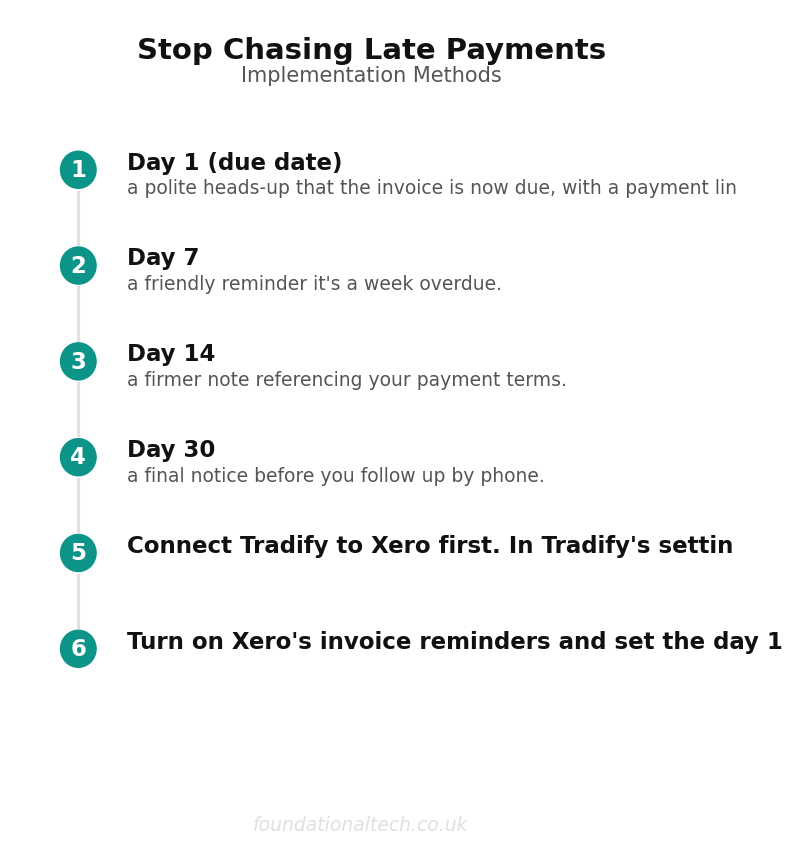
Day 1 (due date): a polite heads-up that the invoice is now due, with a payment link.
Day 7: a friendly reminder it's a week overdue.
Day 14: a firmer note referencing your payment terms.
Day 30: a final notice before you follow up by phone.
The wording matters as much as the timing, so write the four templates once and let them run. The day-1 note should be warm and assume the best: "Just a quick note that invoice #1042 for the June maintenance visits is now due — you can pay in one tap using the link below. Thanks for being a great customer." The day-7 nudge stays friendly but adds the figure and the link again. The day-14 message references your terms directly: "Our payment terms are 14 days, and this invoice is now at that point." The day-30 note is short, factual and signals a phone call is next. Set them up once in Xero's reminder settings, attach the pay-now link to each, and the entire sequence runs on every overdue invoice for every customer without you writing another word. The point is that the chasing happens whether or not you're in the mood to chase — which, after a ten-hour day on site, you never are.
Two honest limits worth knowing. Xero won't escalate on its own — you write the four stages yourself, and once set they don't adapt to how a particular customer is behaving — and they come from a Xero address, so the customer can tell it's automated. For most landscaping debts that's fine. If you reach the point where serial late payment is genuinely hurting you, dedicated credit-control tools like Chaser add escalating tone and send from your own address — but Chaser now starts at £199 a month, which is overkill for almost any landscaping business. Start with the free Xero reminders; only pay for more if the numbers justify it.
Reconciliation
The last piece is invisible when it works and infuriating when it doesn't: matching money received to invoices raised.
Because GoCardless, Stripe and your bank feed all report into Xero, a payment that arrives is matched to the invoice it settles automatically, and the invoice flips to "paid" without you opening a statement. Direct Debit collections reconcile themselves; card payments do too. What's left is a live, accurate list of exactly who still owes you — the single most useful number in the business, and one most owners only ever guess at.
This matters more for landscaping than for most trades. With dozens of small recurring invoices and a handful of large project payments moving at once, manual reconciliation is where errors hide: a £40 cut marked unpaid when it actually cleared, a deposit logged against the wrong job, a duplicate that quietly inflates your turnover near the £90,000 VAT threshold. When the matching is automatic, the books stay right without a monthly catch-up, and the figure that decides whether February hurts stays accurate every morning rather than once a quarter.
The practical payoff is the aged debtors view in Xero. Open it and you see, on one screen, every unpaid invoice sorted by how overdue it is — the new client testing the water at seven days, the commercial contract drifting past thirty. That list is what your chaser sequence runs on, and it's only trustworthy because the reconciliation beneath it happens on its own.
The Legal Backstop
There's one tool most landscapers never use, and it's free: the law. For business-to-business invoices — a managing agent, a commercial grounds contract, a developer — the Late Payment of Commercial Debts Act lets you charge statutory interest of 8% above the Bank of England base rate, plus a fixed recovery charge of £40 on debts under £1,000, £70 up to £9,999, and £100 above that. It applies automatically the day after the invoice falls overdue, even if you never mentioned it on the invoice, and the interest is simple, not compounded.
You won't use it on a domestic £40 cut, and you may rarely invoke it at all — but stating your right to it in your terms, and on the day-30 reminder, changes how a slow-paying commercial client treats your invoice. It moves you up their queue. (For consumer customers — ordinary homeowners — this Act doesn't apply; there you rely on clear terms and the chaser sequence above.)
The Setup, in Order
Build it in the sequence the money actually flows, and each step makes the next one work.
Connect Tradify to Xero first. In Tradify's settings, link the accounting integration and map your invoice and payment accounts once. Now every invoice you raise lands in your books automatically — the foundation everything else reads from.
Turn on Xero's invoice reminders and set the day 1 / 7 / 14 / 30 schedule. Five minutes, free, and your chasing is now on autopilot.
Open a GoCardless account and link it to Xero. Then, customer by customer, invite your maintenance round onto Direct Debit. Start with your ten biggest regulars — that's where the chasing hurts most.
Add a Stripe pay-now link to your one-off invoices so card payment is one tap for the customer.
Set deposit terms on your quote templates for project work, so the up-front payment is automatic, not a conversation.
Do step one and two this week; you'll feel the difference inside a fortnight. Roll the Direct Debit migration out over a month so you're not chasing authorisations all at once.
The Numbers
Put it together and the change is measurable, not vague.
A two-van maintenance and landscaping firm running forty recurring customers plus a handful of projects a month is, on the old way, raising invoices by hand, posting some late, and chasing a rolling backlog that eats an evening a week. Average days-to-payment on that mix routinely runs past 30, and a slice of small invoices never gets billed at all.
Move the recurring customers to Direct Debit and those payments land on the due date — days-to-payment on that chunk drops to near zero, and the chasing for it stops completely. Put a pay-now button on the one-offs and a good share settle within 48 hours instead of three weeks. Let Xero chase the rest on a schedule and the evening you spent on debtors goes back in your pocket. The realistic prize: most invoices paid on or near time, an end to chasing £40 by hand, and an autumn where the cash you're owed actually arrives before winter.
Work one month through it. Say you bill £6,500 across forty Direct Debit maintenance customers and a dozen one-off jobs. The Direct Debit collections — most of your volume — cost roughly 60p each and land on the day they're due, so that £1,600-odd of recurring revenue is in the bank without a single chase or a single late payer. The card payments on the one-offs run 1.5% and most clear inside two days. The handful that drift get chased by Xero on autopilot, and the one commercial client who always pays late now sees your statutory-interest terms on the day-30 notice and bumps you up their list. Total fees on the month: a small fraction of one maintenance visit. Total chasing time: close to zero.
Look at what that does to the winter. The maintenance income that used to arrive whenever customers got round to paying now lands on fixed dates through autumn, so the money you earned in October is in the account in October — not in December, when you've stopped being able to wait for it. Predictable collection doesn't make the winter dip disappear, but it means you reach the quiet months with the autumn's cash already banked and visible, instead of still chasing it while the work dries up. For a business whose survival turns on the shape of the year's cash, that shift from "owed" to "in the bank, on schedule" is the whole point of the exercise.
The running cost is small — a percentage of what you collect, with no fixed subscription on the payment tools themselves. You're not paying to send invoices. You're paying a few pence to make sure they get paid.
Related guides: If you found this useful, see our guide on The Landscaping Business That Runs Itself: How UK Landscapers and Gardeners Automate Quoting, Scheduling and Invoicing in 2026 and AI Automation for Landscapers: 3 No-Code Workflows That Connect ChatGPT to Tradify, Xero and Your Inbox (UK 2026).
What's your average days-to-payment right now? Count from the day the job's done to the day the money clears — be honest, because the number usually shocks people, and it's the first thing this stack moves.