Key Takeaway
The full automation blueprint for UK landscapers in 2026. Quoting, scheduling, invoicing, and compliance connected end to end with Xero and GoCardless.
In July a busy landscaper can turn over £18,000 a month. In February the same business can struggle to cover the van lease. The work isn't the problem —the rhythm of it is, and so is the second shift of admin that nobody bid for.
This article maps the exact software stack that flattens both: the tools, the current UK prices, and how they wire together so a quote accepted in someone's garden becomes a scheduled job, an invoice, a collected payment and a reconciled ledger entry without you opening a laptop at 9pm. It's the pillar piece for this cluster —the nine articles that follow each take one layer apart in detail.
The Problem Nobody Talks About
Landscaping doesn't lose money on the grass. It loses it in the gaps around the grass.
Picture the week. Monday's rained off, so three maintenance rounds shunt to Thursday, which was already full. A garden design quote sits half-written on the seat of the van for a fortnight while a competitor sends theirs in two days. Twenty domestic invoices for £40 grass cuts go out late, or not at all, because chasing £40 feels like more effort than it's worth —until you add up forty of them. A glovebox of fuel receipts and a nursery's plant invoice fade in the sun, and with them goes the VAT you could have reclaimed.
Then there's the seasonality, the thing that quietly kills landscaping businesses that are otherwise busy. Cash floods in from April to September and trickles from November to February, but the van, the insurance, the phone and the staff cost the same every month. A business can be fully booked all summer and still run out of money in winter, purely because the money arrived in a lump and left in a drip.
On top of all that sits a layer of admin most other trades don't face. If you cart green waste or hard-landscaping rubble off site, you need to be a registered waste carrier with the Environment Agency. A gardener removing their own grass cuttings needs at least a free lower-tier registration; a firm carrying waste it didn't produce, or shifting construction and demolition material from patios and driveways, needs upper-tier registration —currently around £191 to register, renewable every three years. Skip it and you're carrying waste illegally.
Layer on the tax calendar. The VAT registration threshold is frozen at £90,000 of turnover, and a growing landscaper crosses it faster than they expect once materials are passing through the books. And from 6 April 2026, Making Tax Digital for Income Tax forces every sole trader with qualifying income over £50,000 to keep digital records and file with HMRC four times a year instead of once. The paperwork isn't shrinking. It's compounding.
Most owners answer all this by working later. The ones who pull ahead answer it by building a system. Here's what that system looks like.
The Full Automation Stack
Five layers. Each removes a category of manual work, and —this is the part that matters —each one feeds the next.
Tradify —The Production Engine
The job-management app is the centre of gravity. It holds your enquiries, quotes, schedule, recurring maintenance rounds, timesheets, job photos and invoices in one place, on the phone in your pocket. Tradify is built for exactly this reader: gardeners, grounds-maintenance crews and landscapers running teams of one to fifteen.
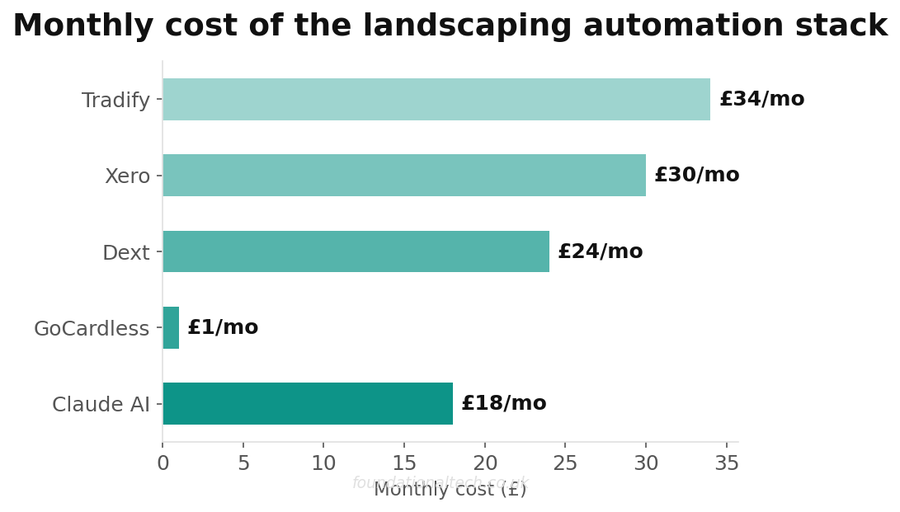
UK pricing is per user, per month, with a 14-day free trial and no lock-in: Lite £34, Pro £37, Plus £44. Lite covers quoting, scheduling, invoicing and accounting sync. Pro adds the parts a growing round actually needs —recurring jobs, job costing, bill tracking and quotes that chase themselves. Plus layers on AI tools that read a supplier bill and draft job descriptions for you.
The single most valuable thing it does for a maintenance business is the dullest-sounding: recurring jobs. Set a weekly or fortnightly cut once, and Tradify generates the visit, the worksheet and the invoice on schedule, forever, until you cancel it. The forty small invoices that used to go out late now go out automatically.
Xero —The Financial Backbone
Everything Tradify produces needs somewhere to land. Xero is the accounting layer, and it's where the seasonality problem becomes manageable, because for the first time you can see the whole year's cash shape instead of guessing at it.
Current UK pricing (per month, excluding VAT): Simple £7, Ignite £15, Grow £30, Comprehensive £42, Ultimate £65. Most landscapers want Ignite or Grow —both handle MTD for Income Tax, VAT returns to HMRC, bank reconciliation and document capture. Payroll for seasonal staff is £1.50 per employee per month on the Grow plan. Bank feeds connect directly, so money moving through your account reconciles against the invoices you raised, and the loop closes.
Tradify syncs to Xero natively (also QuickBooks and Sage if you prefer), so an invoice raised on a doorstep appears in your books without re-typing.
Dext —Plugging the Cash Leaks
The faded fuel receipt and the nursery's plant invoice are unclaimed VAT and unrecorded cost —pure margin leaking away. Dext stops it. Photograph a receipt at the till, forward a supplier email, and Dext reads the line items and pushes them into Xero, coded and ready.
UK pricing runs from roughly £24 a month for a sole trader to about £30 a month for a small team, with a 14-day trial. Dext sets these figures from its US pricing, so the exact pound amount moves with the exchange rate —confirm it at sign-up. For a firm spending hundreds a month at nurseries, builders' merchants and the fuel pump, capturing every receipt automatically pays for itself in reclaimed VAT alone.
Xero Payroll & Tradify Timesheets —The Workforce Layer
Landscaping runs on seasonal and casual labour, which makes hours the hardest thing to track and the easiest place to overpay. Staff log time against jobs in Tradify on their phones; that time both costs the job and feeds the invoice, so you can finally see which maintenance rounds actually make money and which ones you're subsidising. Wages run through Xero Payroll at £1.50 per person per month, handling PAYE, pensions and the RTI submissions HMRC expects each payday. Take a worker on for the summer and off for the winter, and the system follows without a spreadsheet in the middle.
GoCardless —Getting Paid Without Asking
The fastest way to fix late payment on a maintenance round is to stop relying on the customer to act. GoCardless collects an agreed amount by Direct Debit automatically —1% + 20p per transaction, capped at £4, no monthly fee. Put your weekly and fortnightly customers on Direct Debit and the money for every cut arrives on time, every time, without a single chase. The £40 invoice that wasn't worth chasing collects itself. Payments feed straight back into Xero and mark the invoice settled.
| Tool | Purpose | Monthly Cost |
|---|---|---|
| Tradify | Job management and scheduling | £34/mo |
| Xero | Accounting and VAT returns | £30/mo |
| Dext | Receipt capture and expense tracking | £24/mo |
| GoCardless | Direct Debit payment collection | 1% + 20p/txn |
| Claude AI | Quote drafting and client emails | From £18/mo |
| Total monthly cost | ~£124/mo | |
How It All Connects
The stack only earns its keep because the layers talk to each other.
A customer accepts a quote in Tradify. The job lands on the schedule —once for a one-off design, or on repeat for a maintenance round. Crew log their hours against it on the app. When the visit's done, Tradify raises the invoice and syncs it to Xero automatically. For Direct Debit customers, GoCardless collects on the agreed date; for one-off jobs, the customer pays the invoice online. The payment posts back to Xero, the bank feed reconciles it, and Dext quietly files the day's receipts against the right expense codes.
Tradify-to-Xero and GoCardless-to-Xero are native connections —no middleware. The data flows in one direction, quote to cash, and you touch it once at the start instead of five times along the way. Where you do want something custom —a text to the office when a high-value quote is accepted, say —a tool like Zapier or Make can bridge the gap, and later articles in this series show exactly how.
What This Means in Practice
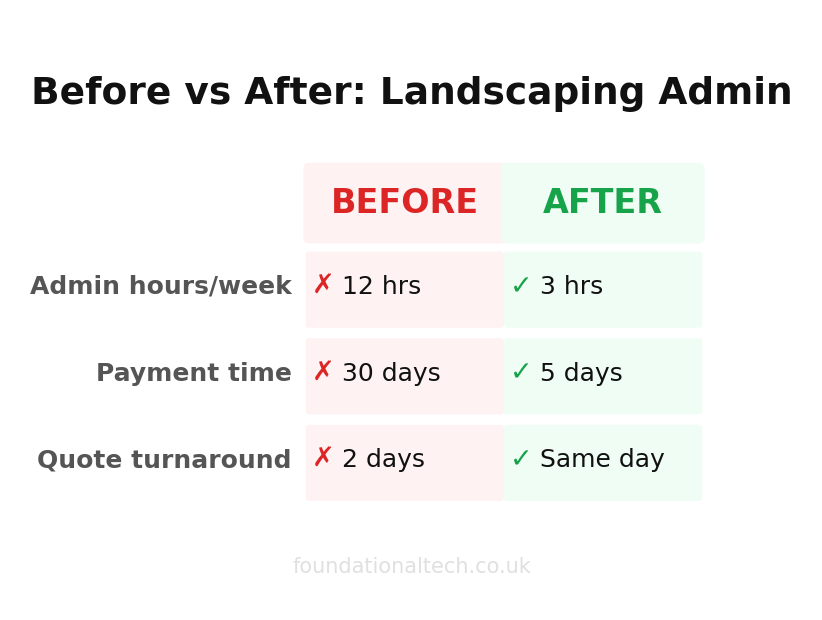
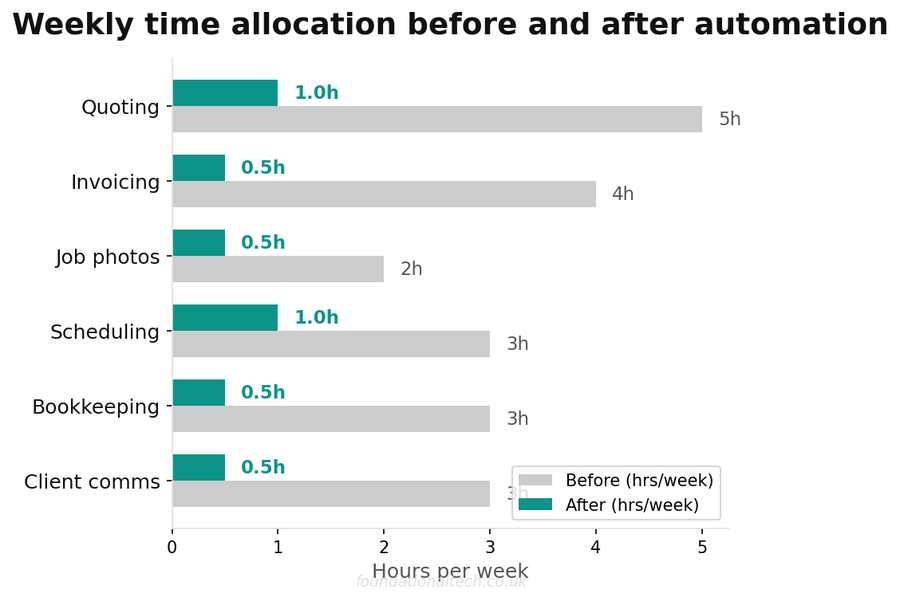
Put numbers on it. A two-van maintenance and landscaping firm doing fifteen hours of evening and weekend admin a week —quoting, invoicing, chasing, bookkeeping —is giving up the better part of two working days every week to paperwork. The stack above doesn't trim that. It removes most of it.
Recurring invoices that used to be raised by hand go out on their own. Direct Debit collection drops the average wait for payment from weeks to days and ends the chasing entirely. Receipt capture turns a shoebox into a tax return. And the year's cash shape —the thing that decides whether February hurts —finally sits on one screen, early enough to do something about it. The realistic prize is most of those fifteen hours back, faster cash, and a winter you can see coming.
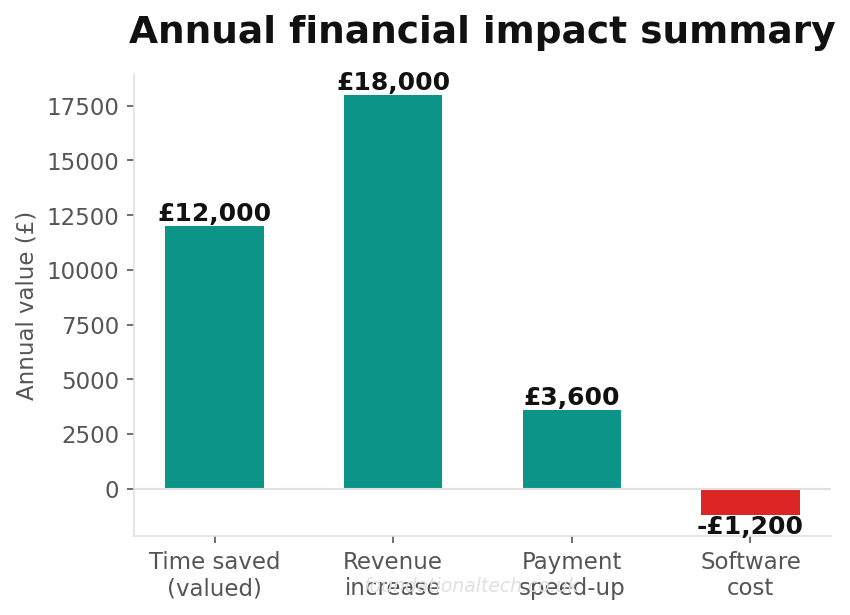
The running cost of all this, for a small firm, is roughly the price of a single maintenance visit a week. The thing it buys back is your evenings.
£18,000/month peak turnover
managed without admin overload once quoting, invoicing and waste compliance are automated
What Comes Next in This Series
This is the overview. The nine articles that follow each take one layer apart, with setup steps and current prices.
The Production Engine. Tradify, Jobber and Powered Now compared head-to-head —which job-management app actually fits a UK landscaping business, and why the answer changes with your size.
Getting Paid. How to put a maintenance round on Direct Debit and never chase a £40 invoice again.
The Back Office. Timesheets, seasonal payroll and receipts, automated.
The Integration Map. Every app wired to Tradify and Xero, with the exact connection steps.
The AI Layer. How UK landscapers are using AI to cut admin time without losing the personal touch customers pay for.
The Prompt Playbook. Copy-and-paste prompts for quotes, follow-ups and customer messages.
The AI Assistant. Setting up an AI worker that drafts your replies and answers questions about your own numbers.
The Automations. No-code workflows that connect your inbox, your schedule and your books.
The Proof. One firm's full before-and-after, with the stack and the figures.
What's the one manual job in your landscaping business that steals the most evenings each week —the quoting, the invoicing, the chasing, or the books? Hit reply and tell me which one, and I'll point you to the article in this series that kills it first.