Key Takeaway
Automate timesheets, payroll, receipts for your UK landscaper business in 2026. Step-by-step guide using Dext, Xero, and payroll tools to cut admin hours.
A landscaper can tell you to the penny what a job costs in plants and fuel, and have no idea what it costs in admin. The grass gets cut, the customer pays, and somewhere in the background a second business — payroll, timesheets, receipts, RTI filings — runs on the owner's evenings for free.
That hidden business is where landscaping firms quietly lose the most time, because it scales with the very thing that makes them money: more crew, more rounds, more receipts, more wages. This article takes the back office apart — timesheets, seasonal payroll and expenses — and shows how to automate it with tools you may already be paying for, at current 2026 UK prices.
The Hidden Cost
Ask a landscaper how long admin takes and you'll usually get an under-estimate, because the time is scattered. Twenty minutes working out who worked which days. An hour on a Sunday running wages. Ten minutes hunting a fuel receipt that's gone through the wash. None of it feels like work. All of it adds up.
£5,000+/yr
hidden cost of manual payroll admin for seasonal landscaping businesses
For a firm with even three or four seasonal staff, the back office can swallow the better part of a day a week — and it lands at exactly the wrong moments. Payroll is due on payday whether or not you've had time to total the hours. The casual labourer you took on for a big July job needs paying correctly, with the right tax and pension treatment, or HMRC notices. And every week, receipts from nurseries, builders' merchants and the fuel pump pile up as unclaimed VAT and unrecorded cost — margin leaking straight out of the business.
The reason landscaping suffers worse than most trades is the workforce. Crews are seasonal and casual: on for the summer, off for the winter, sometimes paid by the day. That churn turns payroll from a fixed monthly chore into a constantly moving one — and moving things are exactly what spreadsheets handle badly.
Put a rough figure on the leak. A firm with four seasonal crew might lose five to six hours a week to it, most of that after a full day on the tools. At a modest £20 an hour for the owner's time, that's over £100 a week of unpaid administration — more than £5,000 across a year, before you count the cost of a single mistake: a missed RTI submission, an underpaid casual who doesn't come back next season, or a VAT return built from a carrier bag with half its receipts missing. The hidden business isn't just tiring. It's quietly expensive, and it scales up exactly when the firm does.
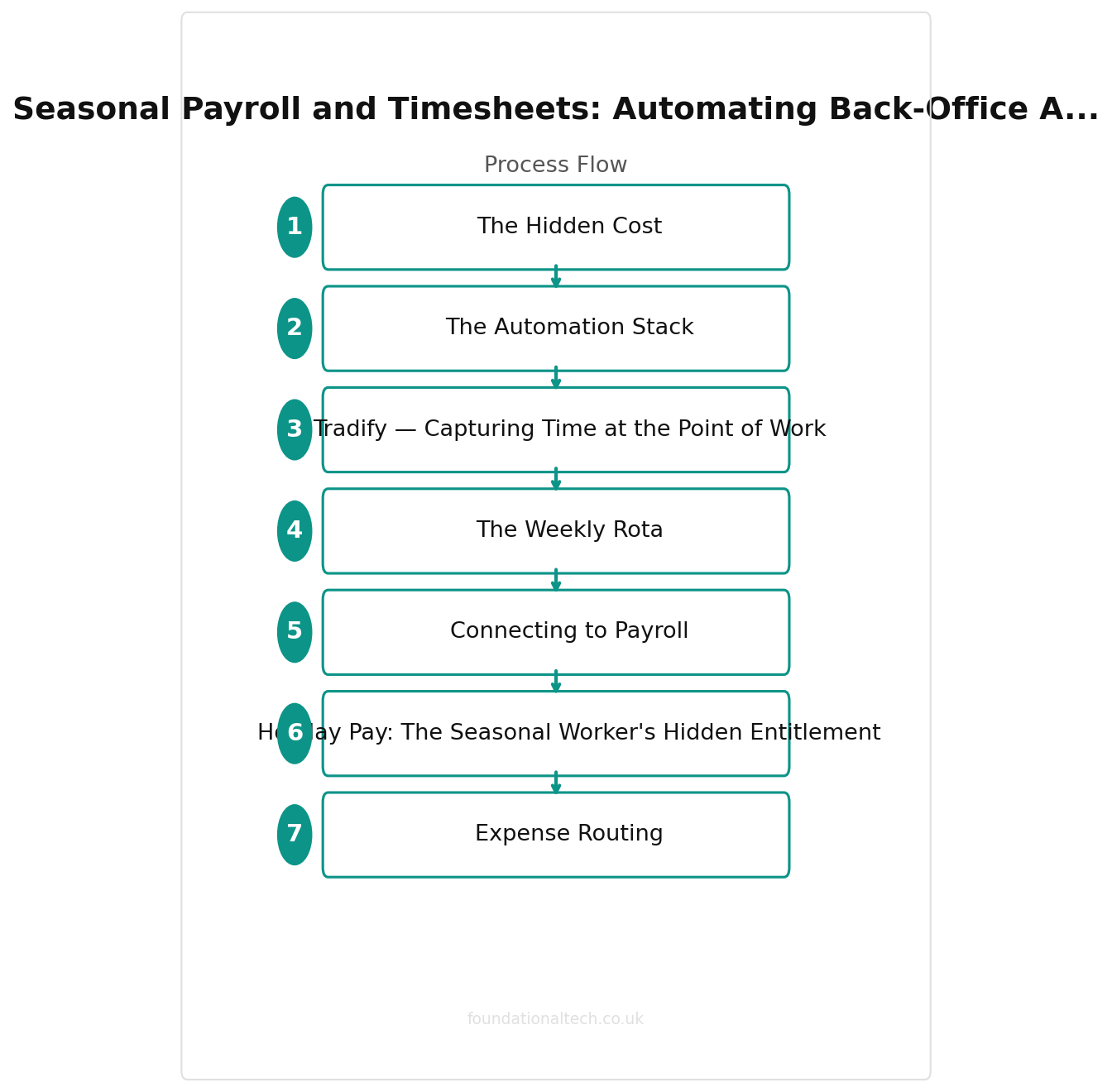
The Automation Stack
The fix is to make the back office a by-product of work that's already being recorded, rather than a separate pile of jobs. Three layers do it: time captured on the tools, wages run from that time, and receipts that file themselves.
Tradify — Capturing Time at the Point of Work
The back office starts in the garden, not at the desk. If your crew logs hours where they actually are, half the admin disappears before it's created.
In Tradify, staff clock time against specific jobs from their phones, on site, as they work. That single action does two things at once: it costs the job (so you finally see which maintenance rounds make money and which you've been quietly subsidising) and it feeds the payroll run (so you're not reconstructing the week from memory and texts). UK pricing is per user, per month, billed in pounds, with a 14-day trial and no contract: Lite £34, Pro £37, Plus £44. Job costing and the richer timesheet features sit on the Pro plan, which is the one most growing crews want.
The point isn't the clock-in button. It's that the hours are captured once, accurately, at the source — and everything downstream reads from that instead of from a Sunday-night guess.
There's a second prize here, and it's the one that quietly changes how you price. Because every hour is tagged to a job, a month-end report shows the true labour cost of each maintenance round — not the cost you assumed when you quoted it two years ago. The fortnightly cut you've been charging £35 for, that now takes a crew of two forty minutes plus travel, may be losing money on every visit. Without captured time you'd never see it. With it, your next price review is grounded in what the work actually costs — which, on thin per-visit margins, can be worth more than the software costs all year.
The Weekly Rota
The other back-office job that eats a landscaper's evening is building next week's schedule and telling everyone where to be. Done in your head and relayed by text, it breaks the first time it rains.
In Tradify the schedule is a drag-and-drop board: assign jobs to crew and days, and each person sees their own run on the app — addresses, access notes, what the job is — without a single group message. When Monday washes out, you drag the affected jobs to a free slot later in the week and everyone's view updates at once. The recurring maintenance rounds populate themselves, so most of the week is already laid out before you start; you're only ever placing the one-offs and the reshuffles around a fixed backbone.
That matters for the back office because the rota and the timesheet are the same data. The job you scheduled is the job the crew clocks against and the job that gets costed and invoiced. Build the week once and you've also set up the hours, the job costs and the billing — three chores collapsed into one, and the Sunday-night ritual of working out who goes where stops being a task you own.
Connecting to Payroll
Once hours are recorded, wages should be a short review, not a rebuild.
Xero Payroll runs PAYE, pensions auto-enrolment and the Real Time Information (RTI) submissions HMRC expects on or before every payday — the legal filings that catch out firms running wages off a spreadsheet. It costs £1.50 per employee, per month, added to a Xero plan. On the Grow plan (£37/month) one person's payroll is included; Comprehensive (£50/month) includes five, with extra staff at £1.50 each. So a landscaping firm paying five seasonal crew runs full, compliant payroll for around £50 a month all in.
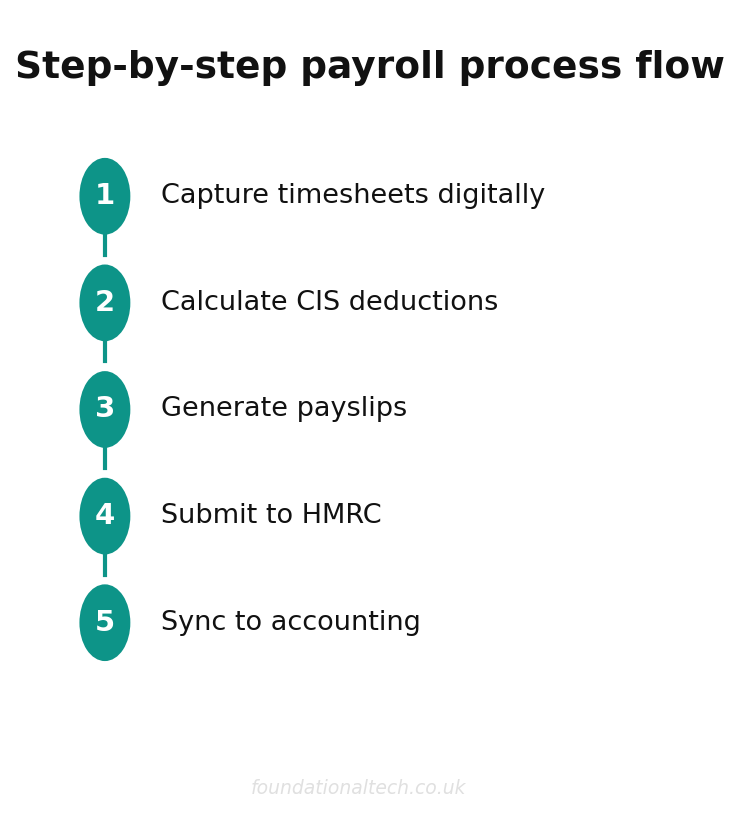
The seasonal pattern is where this earns its keep. Take a worker on for the summer and Xero handles their starter details, tax code and pension assessment; take them off in autumn and it processes the leaver correctly, with the right final pay and filing. No fiddling with HMRC's own tools, no missed submissions, no penalty letters in November. Hours flow from Tradify into the pay run, you check the totals, you approve, payslips go out and the RTI files itself. The same crew often come back the following April and the cycle simply repeats — so the churn that makes seasonal payroll painful on paper becomes a short review at each end of the season.
Watch the pension trap that catches seasonal employers. Workplace pension auto-enrolment duties don't disappear because someone is casual or short-term — once a worker earns over the threshold and meets the age criteria, you have duties towards them, and seasonal staff who leave and return can trigger assessment again. Xero Payroll runs that assessment automatically each pay run, enrols anyone who qualifies, calculates the contributions and reports to your pension provider, so you're not manually working out who's eligible every July. It's the kind of obligation that's invisible until The Pensions Regulator writes to you about it; automating the assessment is how you stay on the right side of it without thinking about it.
Holiday Pay: The Seasonal Worker's Hidden Entitlement
There's one part of seasonal payroll that catches even careful landscaping owners out, and it's holiday pay. A casual labourer taken on for the summer still builds up paid holiday — and working it out by hand, for someone whose hours change every week, is exactly the sort of fiddly calculation that goes wrong.
The rule changed in your favour in April 2024. For irregular-hours and part-year workers — which describes most seasonal landscaping crew — UK law now lets you pay "rolled-up" holiday pay: an extra 12.07% added to each payslip, instead of trying to bank up days a seasonal worker will never take before they leave in October. It must be shown as a separate line on the payslip, but once it's set up it simply rides along with every pay run. On a labourer earning £600 in a busy week, that's roughly £72 of holiday pay landing on the same payslip — small per week, but the kind of sum that, multiplied across a four-month summer and several crew, adds up to real money you're legally on the hook for whether or not you remember it.
This is where doing payroll in a spreadsheet quietly creates a liability. Skip the holiday pay on a casual worker and you've underpaid them — a debt still owed even after they've left, the kind of thing that turns a cheap summer hire into an expensive dispute the following spring. Xero Payroll handles the rolled-up calculation automatically once you mark the worker as irregular-hours, so the 12.07% is added, itemised and recorded without you reaching for a calculator — one less obligation to remember.
Expense Routing
The last leak is the smallest-looking and the most persistent: receipts.
Dext closes it. Photograph a receipt at the till, or forward a supplier's email invoice, and Dext reads the line items — date, amount, VAT, supplier — and pushes them into Xero, coded to the right expense account and ready to reconcile. UK pricing runs from roughly £24 a month for a sole trader to about £30 a month for a small team, with a 14-day trial. (Dext sets these from its US pricing, so the exact figure moves with the exchange rate — confirm it at sign-up.)
For a firm spending hundreds a month across nurseries, merchants and fuel, this ends the shoebox, the lost paperwork and the frantic dig through the van before the VAT return is due. The receipt is filed the moment you take the photo, which is the only moment you'll reliably remember to.
Run the maths on the leak. A VAT-registered landscaper spending £2,000 a month on standard-rated materials and fuel is carrying roughly £333 of reclaimable VAT in that spend. Lose one receipt in ten to fading, washing or the bin, and you're quietly handing HMRC £30-odd a month — close to £400 a year — for nothing. Dext at around £24 a month doesn't just save admin time; on those numbers it pays for itself purely on the receipts you'd otherwise have lost. And from April 2026, with Making Tax Digital for Income Tax forcing quarterly digital records for sole traders over £50,000, having every receipt already captured and coded stops the quarterly filing becoming a scramble.
The CIS Trap Most Landscapers Miss
There's a payroll-adjacent rule that catches landscapers who do hard-landscaping, and getting it wrong is expensive. If you pay subcontractors for work that's part of a construction project — site preparation, groundworks, or landscaping done as the finishing stage of a build — that work falls under HMRC's Construction Industry Scheme (CIS). As the contractor, you'd need to register, verify each subcontractor with HMRC, deduct tax from their payments (20% for registered subbies, 30% for unregistered), and file a CIS return every month.
The line that matters: routine garden maintenance and horticultural work on existing properties is outside CIS. Mowing rounds, planting, pruning and upkeep don't count. But the moment your work is tied to a construction job — landscaping a new housing estate, groundworks before a patio build — CIS can apply to what you pay your subbies. If any part of your business does construction-linked landscaping with subcontractors, check your status with HMRC before the next job, not after. Xero supports CIS deductions once you know you're in scope, so the filing itself can be automated — but only once you've correctly worked out whether the rule bites.
Implementation Timeline
You don't need to switch it all on at once. Three weeks, one layer at a time, keeps it manageable around a full workload.
Week 1 — Set up. Get your crew into Tradify and have them clock time against jobs from day one. Connect Tradify to Xero (Settings — accounting integration — connect — map your accounts once). Turn on Xero Payroll and load your employees' details, tax codes and pension settings. Install Dext and start photographing receipts immediately — it learns your suppliers as you go.
Week 2 — Test. Run a full week with hours logged on Tradify, then do a trial payroll run in Xero against those hours without filing it. Check the totals match what you'd have paid manually. Forward a week of receipts through Dext and confirm they land in Xero coded correctly. This is where you catch a wrong tax code or a mis-mapped account — cheaply, before it matters.
Week 3 — Go live. Run real payroll from the captured hours and let the RTI submission file. Reconcile the Dext expenses against the bank feed. From here the back office runs as a by-product of work already being done: hours captured on site, wages reviewed and approved in minutes, receipts filed at the till. The day a week you were losing comes back.
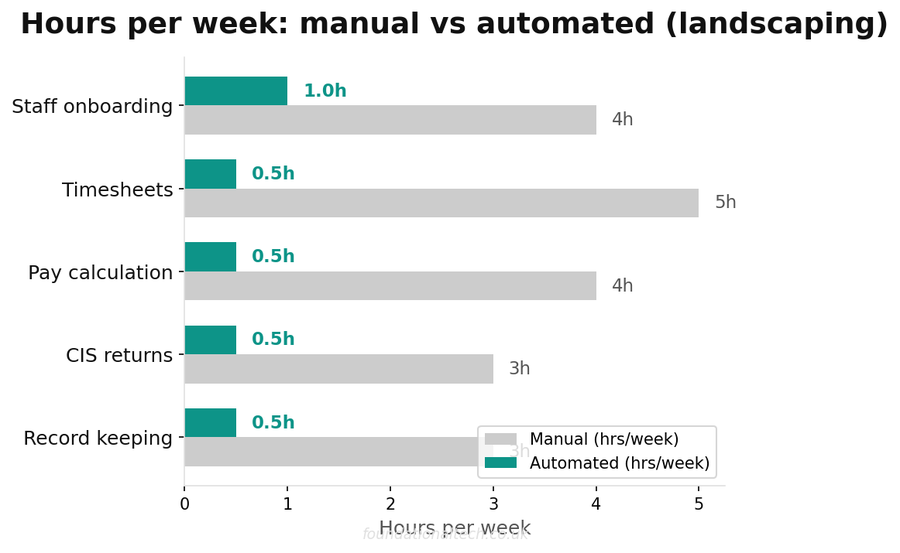
| Task | Manual | Automated |
|---|---|---|
| Timesheet collection | 2–3 hrs/week | 10 min/week |
| Payroll processing | 3–4 hrs/week | 30 min/week |
| HMRC submissions | 1 hr/month | Automatic |
| Error rate | 5–10% | Under 1% |
What You Actually Get Back
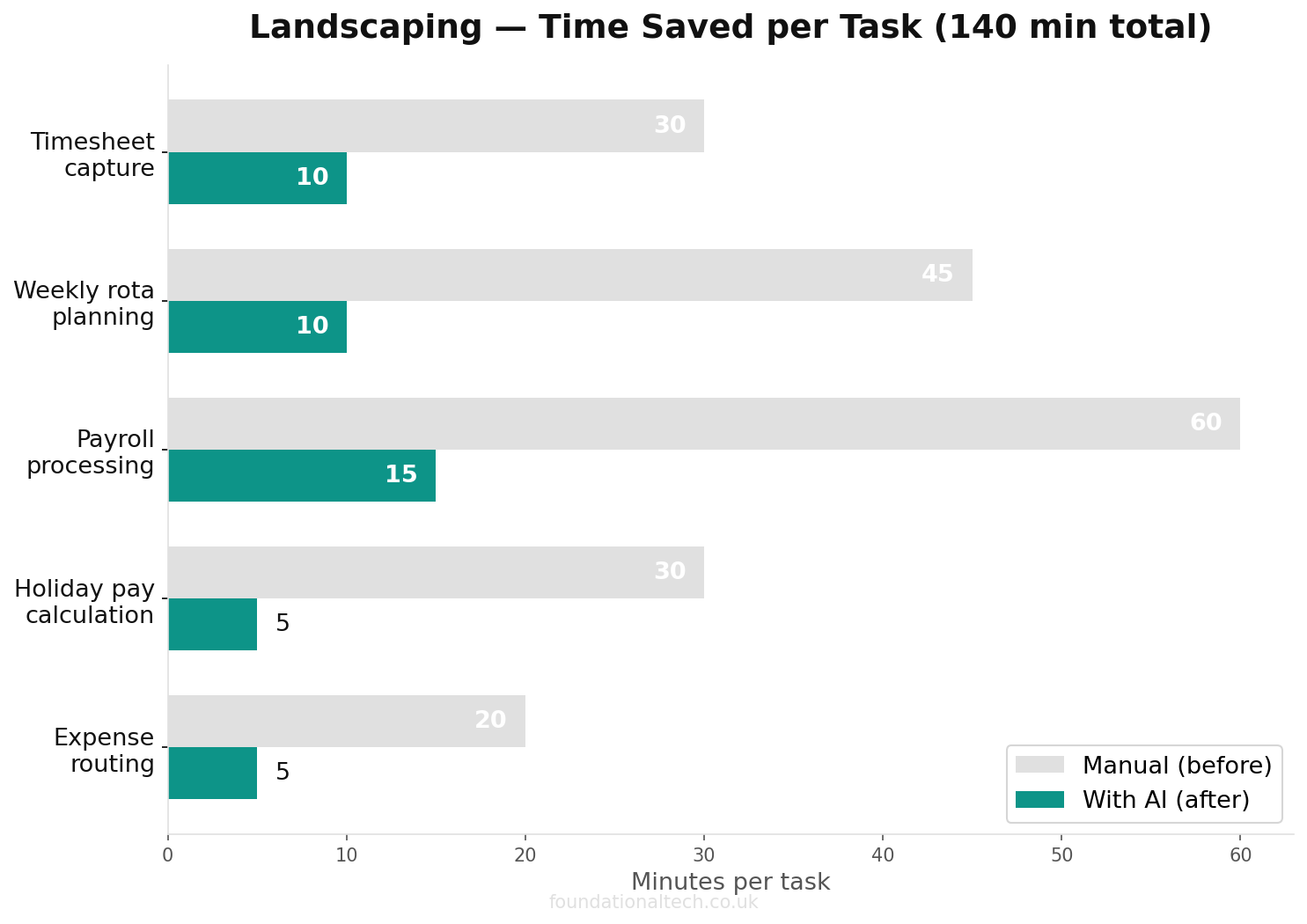
Put a figure on it. The firm of four seasonal crew was losing the better part of a working day every week — half a day reconstructing hours, an hour or two on wages, another hour chasing receipts — most of it in the evenings.
After the switch, the hours are already captured on the tools as the crew works. Payroll becomes a review-and-approve job measured in minutes, with the HMRC filing and the pension assessment handled for you. Receipts are filed at the till and coded into Xero before you've left the car park. The day a week becomes under an hour — and the things that used to keep you up stop being your job to remember.
The combined cost is modest: Tradify from £34 a user, Xero Payroll at £1.50 a head, and Dext from around £24. That's roughly the price of one maintenance visit a week — to buy back the better part of a working day and a clean compliance record. The back office stops being a second job you do for free.
Related guides: If you found this useful, see our guide on Stop Chasing Late Payments: Automated Invoicing and Direct Debit for UK Landscaping Businesses (2026) and AI Automation for Landscapers: 3 No-Code Workflows That Connect ChatGPT to Tradify, Xero and Your Inbox (UK 2026).
How many hours does your admin and bookkeeping take per week right now? Reply with the number — I'm building a benchmark of where landscaping firms actually lose their back-office time, and which layer wins the most of it back.