Key Takeaway
How UK landscapers are using AI to cut admin time in 2026. Real examples for quoting, invoicing, and client communications — without sounding robotic.
A landscaper in Surrey now writes a week's worth of quotes in the time it used to take to write one, and his customers have no idea a machine helped. That's the honest state of AI for landscaping in 2026: not robots cutting grass, but a writing-and-thinking assistant that clears the desk work you do after the tools are down — quotes, emails, chasing, scheduling headaches — so you get your evenings back.
This is the part of the series where we leave the automation plumbing behind and talk about AI specifically. No hype, no "the future is here." Just what real UK landscaping businesses are using these tools for today, which tool to pick, what it costs, and — just as importantly — what it still can't do. If you've never typed a word into ChatGPT or Claude, start here.
AI in Landscaping: What's Actually Working Right Now
Forget the headlines about artificial intelligence designing gardens or robot mowers. For a working landscaping business, the value of AI in 2026 is mundane and large: it writes and reads for you.
Think about where your unpaid hours actually go. Not the cutting and planting — that's the job. The drain is everything around it: turning a site visit into a priced, professional quote; replying to the fifteenth "can you also do my hedge" email of the week; writing the polite-but-firm message to the customer who's three weeks late paying; drafting the spring email to your maintenance list; working out how to fit a rained-off Tuesday into the rest of the week. That's desk work, and it's exactly what a large language model is good at.
The breakthrough isn't intelligence in the science-fiction sense. It's that these tools now write clear, natural English in seconds, in your tone, from a one-line instruction — and they read messy text (a rambling customer email, a supplier's quote, a page of notes) and pull out what matters. A landscaper doesn't need AI to be clever. They need their admin to take ten minutes instead of two hours. That's what's working, today, in real firms.
5 AI Use Cases for Landscaping Owners
1. Turning a site visit into a professional quote
You walk a garden, scribble notes — "remove old decking, level, turf approx 60m², new border, two days, two crew" — and that's where most quotes stall, because writing it up properly is a job for an evening you don't have.
50% less quoting time
when AI drafts detailed landscaping quotes from site notes, plant schedules and measurements
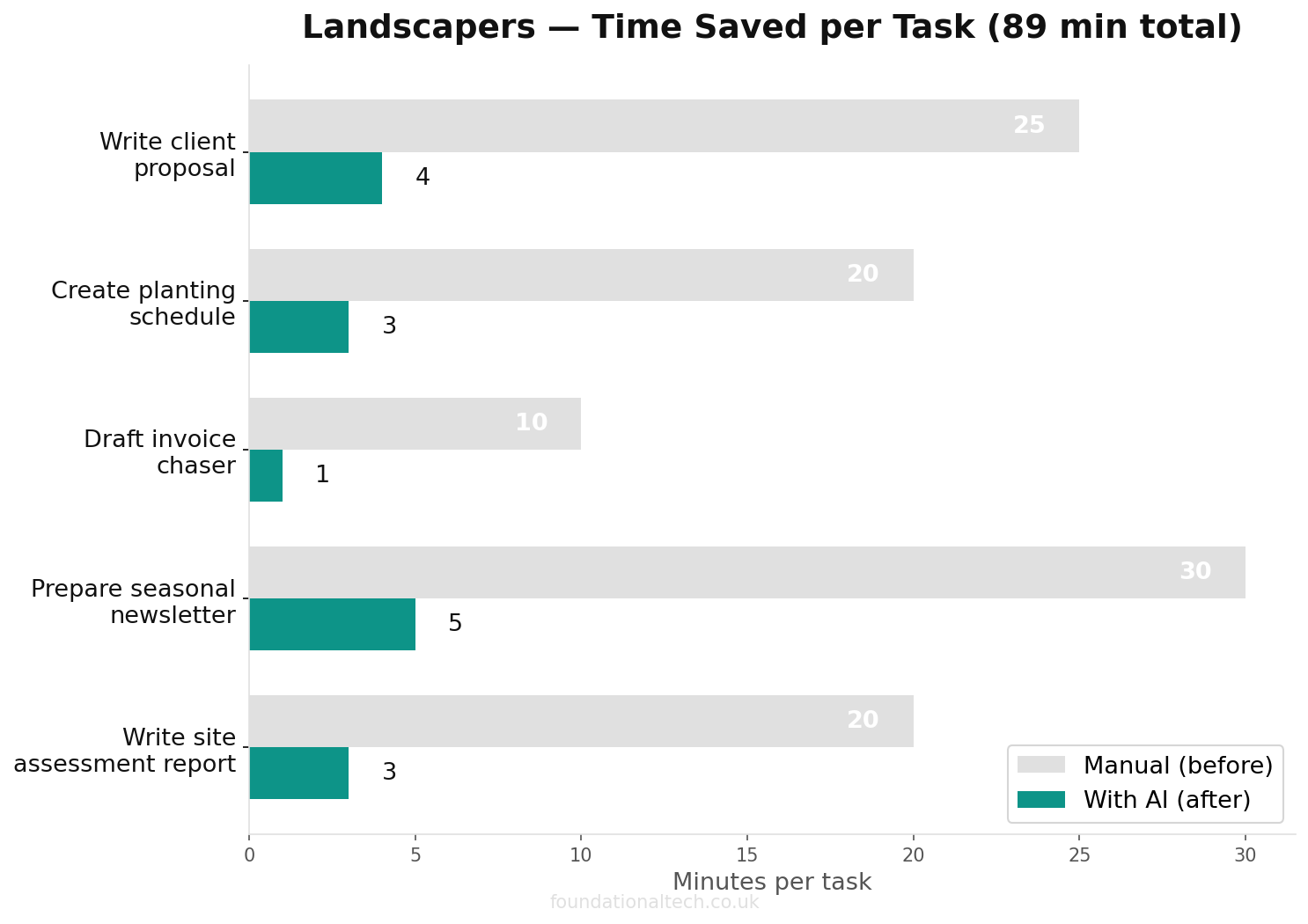
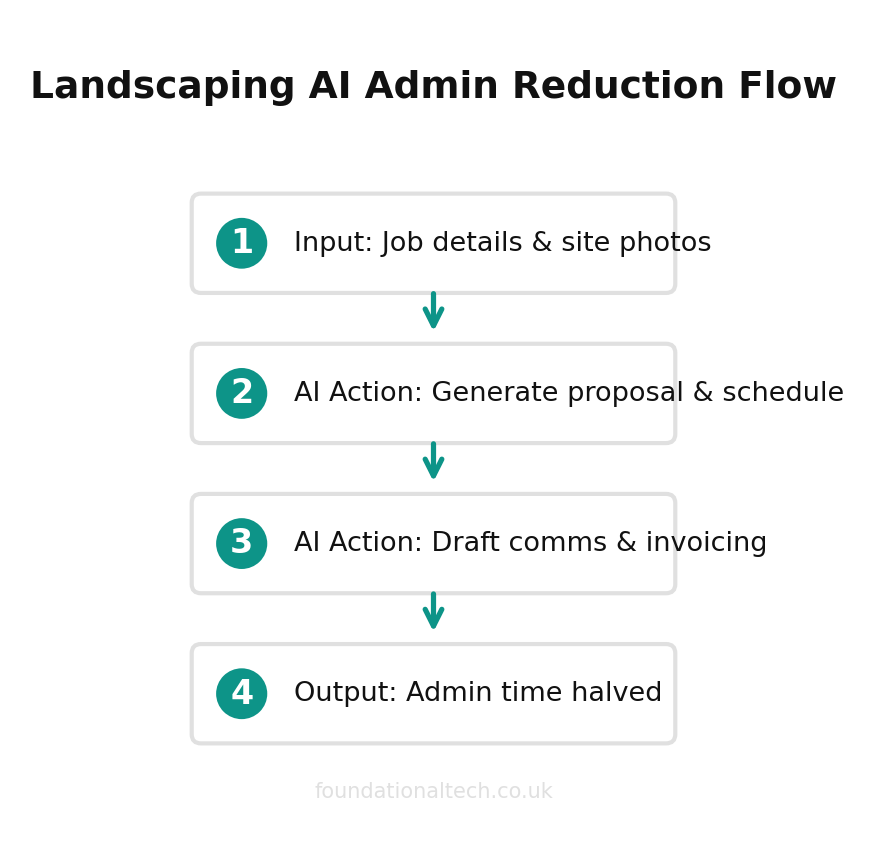
Feed those notes to an AI assistant and ask it to write a clear, itemised quote in plain English, and you'll get a structured draft in seconds: scope of work, what's included, what's not, a professional summary the customer can actually understand. You still set the prices — never let AI guess your numbers — but the writing, the structure and the tone are done. A quote that took forty minutes takes five, and it reads better than the one you'd have rushed at 9pm. For a business that wins work on how quickly and clearly it responds, that turnaround is worth real money.
2. Handling the inbox
The landscaping inbox is relentless and repetitive: availability questions, "do you cover my area," requests to add a job, chasing when you'll come back. Most need a friendly, professional reply that says roughly the same thing.
AI drafts these in your voice. Paste the customer's email, tell it the gist of your answer ("yes, can do it, roughly three weeks out, I'll send a quote"), and it writes a warm, complete reply you can fire off after a glance. The trick — and the reason your customers won't twig — is to give it your style once ("friendly, plain English, no jargon, sign off as Dave") and it'll match it every time. You're not outsourcing the relationship; you're outsourcing the typing.
3. Chasing late payers without the awkwardness
Everyone hates writing the overdue-invoice email. Too soft and it's ignored; too harsh and you risk the relationship. AI is genuinely good at this delicate middle.
Ask it for a polite first reminder, a firmer second, and a final notice that mentions your terms — three messages, escalating in tone, ready to use. (Your automation stack from the earlier articles sends these on a schedule through Xero, but for the awkward one-off, a well-judged AI-drafted message gets the money in without burning the goodwill.) It takes the emotion out of a job most owners put off, which means the chasing actually happens.
4. Decision support: pricing, scheduling and the seasonal squeeze
This is where AI moves from writing to thinking with you. Describe a problem in plain English and it'll reason through it. "I've got forty maintenance customers, two crew, and three rained-off days this week — help me think through how to catch up without dropping anyone." It won't run your business, but it's a sharp sounding board for the planning headaches that usually rattle around your own head.
It's also useful for pricing sense-checks. Paste your costs and ask it to walk through whether a £35 fortnightly cut still makes sense given your crew's time and travel — it'll structure the maths and surface the questions you should be asking. The judgement stays yours; the thinking-out-loud gets faster.
5. The spring marketing push, written in an afternoon
Landscaping lives and dies by the season, and the firms that fill their books are the ones that get in front of customers before the rush. AI makes that outreach quick. It'll draft your "spring is coming, book your first cut" email to the maintenance list, write the Facebook post advertising winter availability for hedge-cutting and clearance, and turn one good before-and-after job into three pieces of content for different platforms. You provide the photos and the offer; it provides the words. The marketing that always slips to the bottom of the list because writing it is a chore suddenly takes an afternoon.
The Tools: Claude vs ChatGPT vs Gemini for Landscaping
Three assistants dominate, and for a landscaper the practical differences are small. Any of them will transform your admin. Here's the honest comparison.
ChatGPT (from OpenAI) is the best-known and the safest first step. The free tier is genuinely useful; the paid Plus plan runs around £19 a month — priced at $20 in US dollars, so the exact pound figure moves with the exchange rate — and gives you the stronger models and higher limits. If you want the option everyone's heard of, with the most how-to guides online, start here.
Claude (from Anthropic) is widely rated the best writer of the three — its drafts tend to sound the most natural and need the least editing, which matters when the whole point is that customers can't tell. Claude Pro is priced similarly, around £19 a month (also $20 in US dollars). If your main use is quotes, emails and customer messages, Claude is a strong pick.
Gemini (from Google) is the one to consider if you live in Gmail and Google Workspace, because it's built into them — it can draft replies right inside your inbox. Gemini Advanced sits at roughly the same price point — £18.99 a month, and billed in pounds rather than dollars. If your business already runs on Google, the convenience is real.
The honest answer: don't agonise. Pick one, use the free tier for a fortnight on real quotes and emails, and only upgrade when you hit the limits. They're close enough that fluency with one beats indecision across three. Most landscapers settle on whichever they tried first.
One firm rule across all three: never paste a customer's bank details, full card numbers or anything you wouldn't want stored. Treat these tools like a clever assistant you've just met — helpful, but not yet trusted with the safe.
A Real Week, Before and After
Numbers make the case better than promises, so picture a typical two-van maintenance firm and one ordinary week.
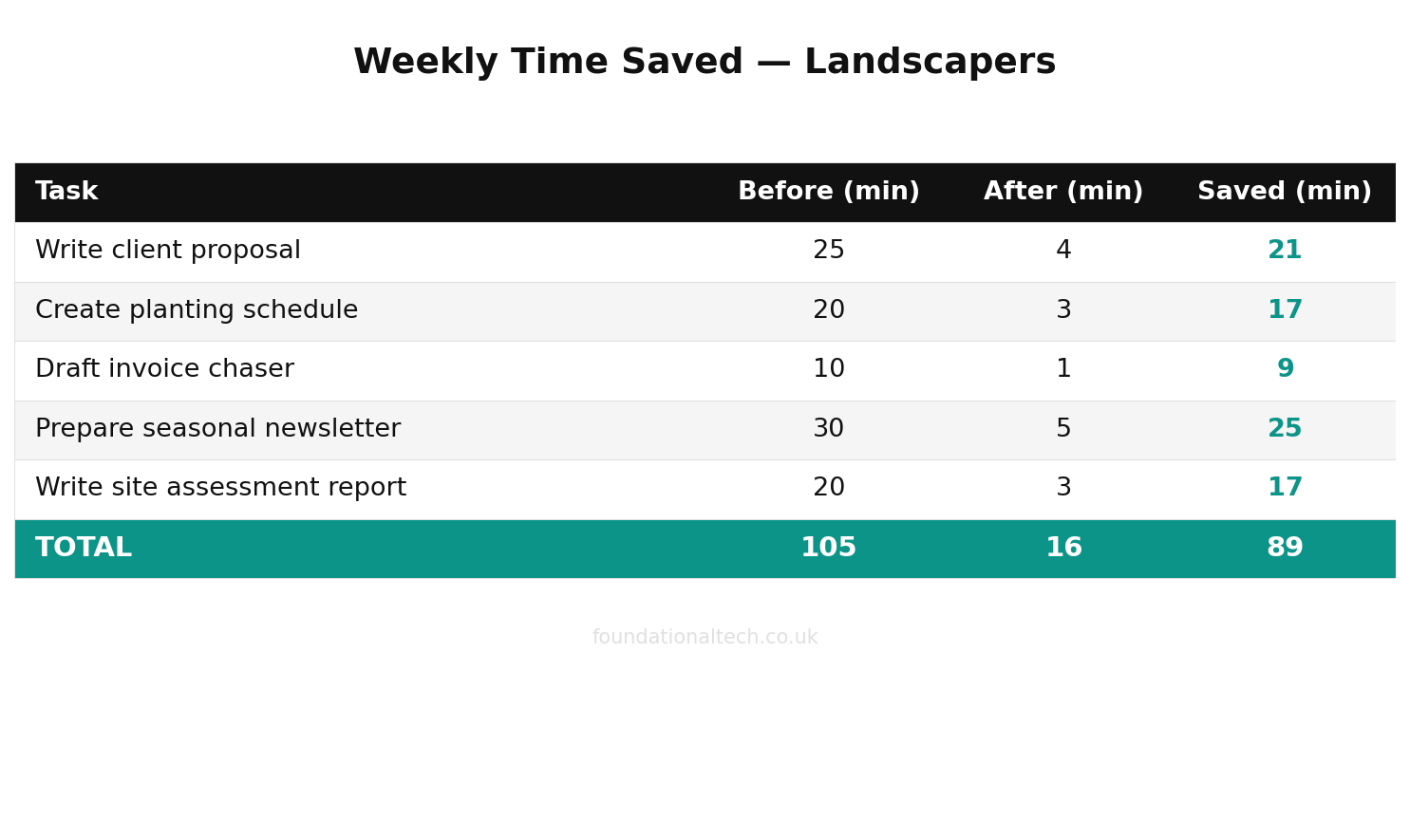
Before: Monday's rain throws the schedule out, and you spend twenty minutes texting customers and reshuffling in your head. Three new enquiries come in over the week; you reply to each one properly on Wednesday evening, twelve minutes apiece. Two site visits need writing up into quotes — that's an hour and a half after dinner on Thursday. One customer is four weeks late, and you put off the awkward email for three days before finally drafting it. Sunday, you write the spring "book your first cut" message to the maintenance list — another forty minutes, because you keep rewording it. Add it up and the desk work has quietly eaten close to four hours, almost all of it in the evening, after a full day on the tools.
After: the same week, with an AI assistant doing the typing. The rained-off reshuffle, you still decide yourself, but the customer texts are drafted in two minutes. The three enquiry replies take a glance each instead of twelve minutes — the assistant writes them in your voice from a one-line steer. The two quotes go from ninety minutes to fifteen, because you feed it your site notes and your prices and it builds the structure. The late-payer email is written, judged just right, in the time it takes to read it. The spring email is drafted in five minutes from a single instruction. The four hours becomes well under one — and the quality goes up, not down, because nothing was rushed at 9pm. That hours-back-per-week figure, repeated across a season, is the whole reason landscapers are bothering with this at all.
The point isn't that AI did anything you couldn't. It's that the writing — the slow, repetitive, evening-stealing part — stopped being yours to do.
What AI Can't Do (Yet)
Being straight about the limits is how you avoid an expensive mistake.
It can't price your work. AI doesn't know your costs, your local market or your margins. Ask it to "quote a garden" and it'll invent plausible-looking numbers that could lose you money on every job. You set the prices; AI writes them up.
It can't see the garden. It has no idea that the "small border" is on a one-in-three slope, that access is through a neighbour's gate, or that the soil is solid clay. The judgement that comes from standing in the space is yours alone — AI only works with what you tell it.
It gets facts wrong with total confidence. These tools occasionally state something false as if it's certain — a made-up regulation, a wrong figure. Never rely on AI for a fact that matters (a CIS rule, a VAT threshold, a chemical's legal status) without checking it. Use it for words and structure, not as your source of truth.
It can't replace the relationship. Customers hire a landscaper they trust. AI can draft the message, but the rapport, the reliability and the standing in someone's garden working out what they actually want — that's the business, and it isn't automatable. The goal is to free you for that part, not to fake it.
And it won't set itself up. There's a learning curve, small but real: knowing how to ask, how to give it your tone, how to refine a draft. That's exactly what the next articles in this series cover.
What's Coming Next
This piece is the overview. The next two articles get practical and go deeper.
The Prompt Playbook is a set of copy-and-paste prompts built for landscaping — the exact wording to turn site notes into a quote, to draft the spring marketing email, to chase a late payer, to sense-check a price. No guesswork: paste, tweak, send. It's the shortcut past the learning curve.
Then the AI Worker Setup walks you through building a proper AI assistant for your business — one that knows your services, your tone and your standard answers, so it drafts in your voice from the first word. That's the step that turns AI from a clever toy into something that genuinely feels like a part-time office hand.
Both go further than this free overview, and they're where the real time-saving lives. For now, the move is simple: open the free version of any one of these tools this week, and write your next quote with it. Ten minutes will tell you more than any article can.
Related guides: If you found this useful, see our guide on AI Automation for Landscapers: 3 No-Code Workflows That Connect ChatGPT to Tradify, Xero and Your Inbox (UK 2026) and From Sunday-Night Admin to 14 Extra Jobs a Month: How One UK Landscaper Automated His Whole Business (2026 Case Study).
Have you tried using AI in your landscaping business yet? What for — quotes, emails, chasing, marketing? Reply and tell me; I'm collecting real-world examples from UK landscapers and the best ones will shape the Prompt Playbook.
Considering Tradify? Get 50% off for 3 months.