Key Takeaway
An accountant spent 10 years selling hours before a fire alarm engineer showed him recurring revenue. The lesson every UK practice needs to hear in 2026.
Col asked me a question I wasn’t expecting on a Thursday afternoon in June.
Not “can you do my year end.” Not “am I paying too much tax.” He said: “If I wanted to sell this in five years, what’s it actually worth?”
He runs a fire and security firm in Leicestershire. Six people, two vans, alarms and CCTV and fire panels, mostly small commercial — corner shops, a couple of care homes, a distribution unit, a few hundred sites that all need touching on a schedule. He’d been trading nineteen years. He’d never once asked anyone that question.
I said I’d need to see how the contracts were billed before I could answer.
He looked at me like I’d changed the subject.
What I found took about forty minutes
He had 214 live maintenance agreements. Almost all of them invoiced annually, in a lump, on the anniversary of the install. Roughly a third of them clustered in April, because he’d had a strong spring four years running and never thought about it again.
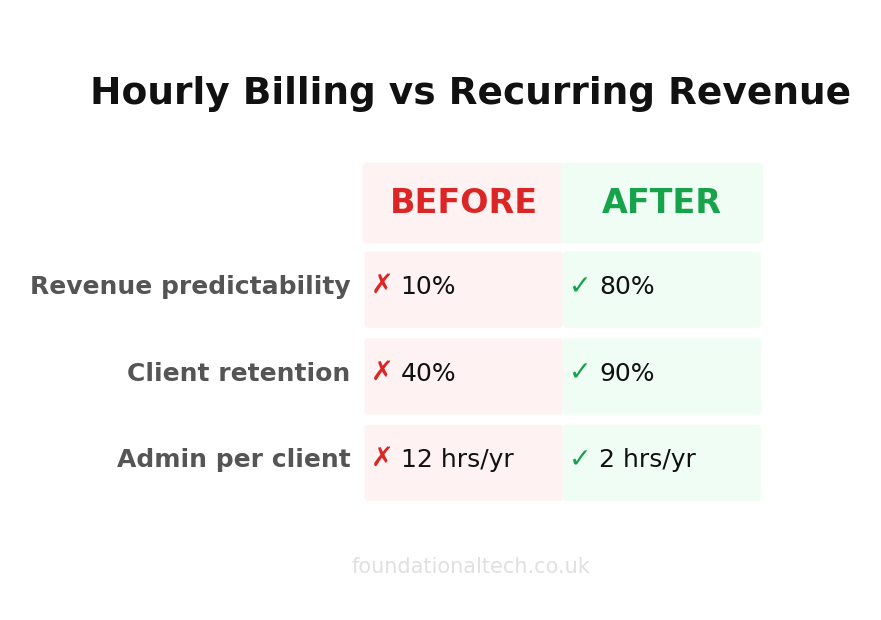
Which meant April was flush and November was frightening. He knew this. He’d built his whole year around it — big supplier orders in spring, hold your nerve through autumn. He thought that was just what the business was like.
It wasn’t what the business was like. It was what his invoicing was like.
Two things were happening. The first is a cash flow problem, and it’s the obvious one: his costs — wages, vans, monitoring fees — ran flat across twelve months, and his income didn’t. The second is the one that actually mattered, and it’s the reason I asked about billing before I answered his question.
Every annual invoice puts a decision in front of a customer once a year. They open an email asking for £480 for a system that hasn’t gone wrong in twelve months, and for the first time since they signed, they think: do I need this?
A monthly Direct Debit at £40 puts that decision in front of them once. On the day they sign. After that, nothing happens.
Same money. Completely different business.
I’ll be straight about the valuation bit, because I was straight with Col: I don’t have filed UK transaction data on what small alarm firms sell for. The 30-to-50-times-monthly-recurring-revenue figures you see quoted come from advisory firms with something to sell, and the small independent deals I’m aware of settle nearer an earnings multiple with the contract book driving it. So I didn’t give him a number. What I told him was the direction. Whatever his firm is worth, the recurring, non-cancellable, boringly collected portion of it is worth several times more per pound than the same pound arriving once a year, in a lump the customer has to decide to send.
He’d been running a genuinely valuable asset: a book of legally-mandated inspection obligations, the kind of work nobody cancels because BS 5839-1 doesn’t care about their budget review. And he’d been billing it like a series of one-off favours.
The bit where I recognised myself
I sat in the car afterwards for longer than I needed to.
Because I did the same thing for over a decade.
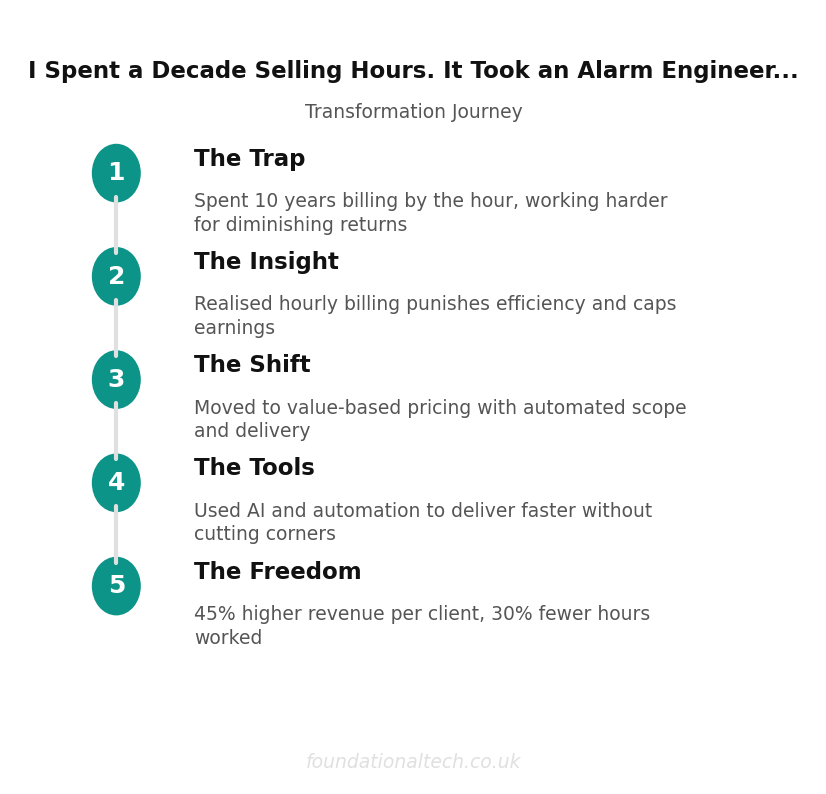
I was an accountant. I was a good one. And every single pound I earned had to be preceded by an hour I personally sat down and worked. Year end done, invoice out, back to zero. January was brutal and July was quiet and I thought that was just what the job was like.
Nobody ever told me it wasn’t. Nobody in accountancy tells you that, because the whole profession is built on the assumption that your time is the product. You get better, you charge more per hour, that’s the ladder. I climbed it for years without ever asking whether it was leaning against anything.
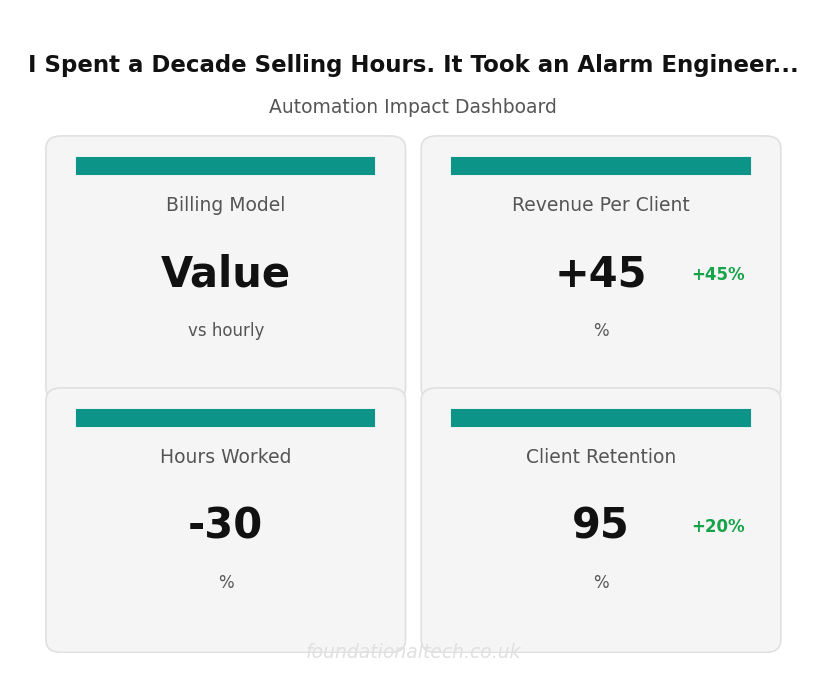
The thing that actually changed my career wasn’t learning AI. That’s the tidy version and it’s not quite true. What changed it was a much less impressive realisation, sometime in early 2025. I was sitting at a kitchen table after a full day of client work, building an automation for the fourth time that month, because I kept rebuilding the same thing for different clients.
Fourth time. And it hit me that I’d been paid four separate times for solving one problem once, badly, from scratch, at eleven at night.
That was the shift. Not “AI is coming for my job.” More like: I have been doing repeatable work and charging for it as if it were bespoke, and that’s a choice I’ve been making without noticing.
The AI and automation stuff — the evenings learning Make, the months of prompt engineering, the systems I built and threw away and rebuilt — all of that came after that realisation, not before it. The tools were how. The question was why.
Software for Managing Monitoring Contracts
Col was running his contract book on a spreadsheet when I met him. A spreadsheet. Two hundred and fourteen contracts, each with different start dates, service intervals, and monitoring requirements, tracked in a colour-coded Excel file that he updated manually every Monday morning. It worked — in the sense that nothing had gone catastrophically wrong yet — but it was a liability waiting to happen.
If you're managing fire and security contracts in the UK, there are purpose-built tools that handle this properly. Here's what's actually worth considering.
Alarm Master (from ~£50/month) is the UK-specific option that most independent alarm firms end up on. It's built for fire and security from the ground up — not a generic field service tool with security bolted on. It handles engineer scheduling, contract management, and crucially, compliance documentation for BS 5839 (fire detection) and BS 8418 (CCTV monitoring). If you need to produce compliance certificates and track inspection schedules against British Standards, this is the tool that understands your world. The interface isn't pretty, but it does the job reliably.
Tesseract (from ~£40/user/month) is the step up for larger firms. It's a full field service management platform with contract billing, engineer dispatch, and asset tracking. Several of the bigger security firms with 20+ engineers use it. The per-user pricing makes it expensive for small teams, but the contract management features are more sophisticated than Alarm Master — better reporting, better integration options, and a proper mobile app for engineers in the field.
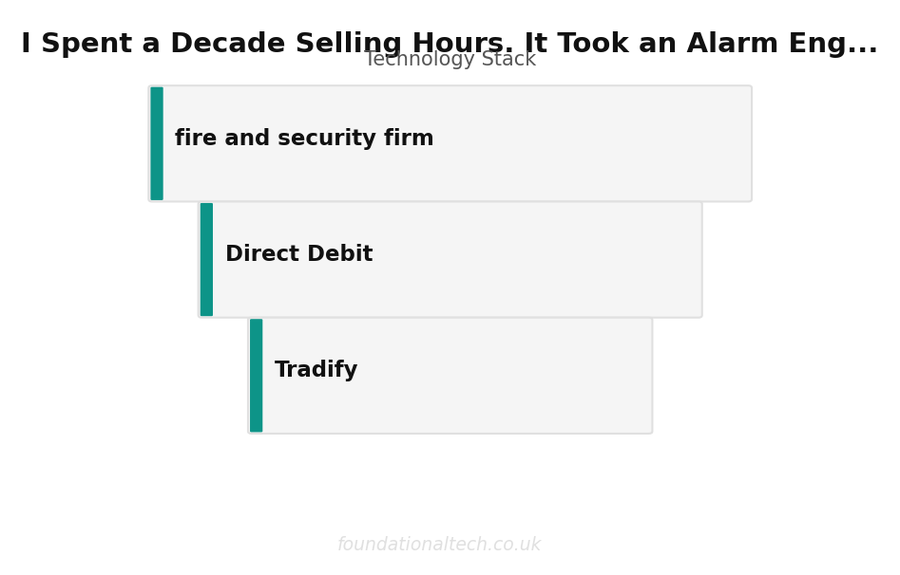
Tradify (from £34/user/month) is the lighter option and works well for smaller firms that want job scheduling and invoicing without the complexity of a security-specific platform. The trade-off is clear: Tradify doesn't know what BS 5839 is. It won't track compliance certificates or generate inspection schedules. But if your firm is primarily installation-focused with a growing contract book, it's a good starting point that's easy to learn and connects natively to Xero.
SimPRO (from ~£40/user/month) sits somewhere between Tradify and Tesseract. It's popular in the fire and security sector because it handles contract management, quoting, scheduling, and compliance documentation reasonably well. The asset management module is particularly useful — you can track every panel, detector, and camera you've installed, link them to maintenance contracts, and schedule engineer visits based on the asset's service requirements. It also integrates with Xero and handles recurring invoicing.
Xero + GoCardless is the billing backbone regardless of which job management tool you choose. Xero handles your accounts, generates invoices, and manages the chart of accounts. GoCardless plugs into Xero to collect monthly Direct Debit payments automatically. This is the combination Col uses, and it's the one I recommend for any firm transitioning from annual to monthly billing. Together they cost about £36-£50/month depending on your Xero plan.
Whatever you choose, there's one non-negotiable requirement: the system must track contract renewal dates, engineer visit schedules, and produce compliance certificates. If it can't do those three things, it's not fit for purpose in fire and security. A missed service visit isn't just poor customer service — it's a compliance failure that could invalidate your customer's insurance and expose your firm to liability.
Pricing Models: How to Structure Recurring Revenue
Col's original pricing was simple: charge for the install, invoice annually for the maintenance. It worked, but it left money and stability on the table. Here's how to think about pricing when you're building a recurring revenue model.
Monthly monitoring fees are the foundation. For a residential intruder alarm connected to an Alarm Receiving Centre (ARC), the typical UK range is £15-£30 per month depending on the level of response — police response commands a premium over keyholder-only. Commercial systems sit higher, typically £25-£50 per month, reflecting the more complex monitoring requirements and higher-value sites.
Annual maintenance contracts are the second revenue stream. A residential annual service visit typically runs £120-£180 per year. Commercial maintenance is higher — £200-£400 per year — because the systems are larger, the compliance requirements are stricter, and the visits take longer. Fire alarm maintenance under BS 5839-1 requires quarterly inspections for most commercial premises, which pushes the annual contract value higher than intruder-alarm-only maintenance.
The hybrid model that actually works is bundling monitoring and maintenance into a single monthly Direct Debit. This is what Col moved to, and it's the model I'd recommend for any firm starting the transition. Take a customer who's paying £240/year for ARC monitoring plus £180/year for annual maintenance — that's £420/year, or £35/month. Bundle it into a single £35/month Direct Debit and the customer sees one simple payment instead of two separate invoices at different times of the year. Some firms price the bundle slightly below the sum of the parts — say £32/month instead of £35 — as an incentive to consolidate. The margin difference is negligible and the retention benefit is significant.
The upselling path is where the recurring model really pays off. Once a customer is on monthly Direct Debit for their intruder alarm, the progression is natural: maintenance-only → add monitoring → add CCTV maintenance → add access control. Each addition increases the monthly payment by £10-£25, and because it's a small incremental change to an existing Direct Debit rather than a large new invoice, customers rarely push back. Col added CCTV monitoring to 40% of his existing alarm customers within the first year of switching to monthly billing. On annual invoicing, the cross-sell rate had been under 10%.
The margin comparison is the number that should make every fire and security business owner pay attention. A one-off installation — a four-camera CCTV system or a Grade 2 intruder alarm — typically delivers 15-25% net margin after labour, materials, and overheads. It's decent work, but it's a one-time payment. A recurring maintenance and monitoring contract, once the initial setup cost is absorbed (usually within the first year), runs at 60-80% net margin. The engineer visit costs you maybe £50-£80 in labour and travel. The monitoring costs you £5-£8/month wholesale from the ARC. On a £35/month contract, that's a 70%+ margin that repeats every single month without you having to win a new customer.
The Transition: Moving Existing Customers Without Losing Them
The biggest fear most fire and security firms have about switching to monthly billing is losing customers in the transition. Understandably so — if you've got 200 contracts and 30 of them cancel during the migration, that's a serious hit. Here's how to do it without that happening.
Do it at renewal, not in bulk. This is exactly what Col did, and it's the approach I recommend every time. Don't send 200 letters in one go saying "we're changing how you pay." That invites 200 people to think about whether they still need your service, all on the same morning. Instead, as each contract comes up for its annual renewal, present the monthly option as the new default.
Get the script right. The conversation (or letter, or email) should be simple and emphasise the benefit to the customer, not to you. Something like: "We're moving all maintenance customers to a simple monthly plan. Same service, same engineers, spread across the year so you don't get a large annual bill. It's collected by Direct Debit so you don't need to think about it — the payment happens automatically on the same date each month." Notice what this doesn't say: it doesn't say "we're increasing your price," it doesn't say "this is better for our cash flow," and it doesn't ask them to make a decision. The monthly plan is the default. The annual invoice is still available if they prefer, but you don't lead with it.
Price it right. The monthly amount should be slightly less than the annual divided by 12. If the annual contract is £360, don't charge £30/month (which is exactly the same). Charge £28/month (£336/year). The customer feels like they're getting a small discount for the convenience of monthly payments, and you're trading £24/year in revenue for dramatically better retention, smoother cash flow, and a higher business valuation. That trade is worth it every single time.
GoCardless setup is straightforward. When the customer agrees to the monthly plan, you send them a Direct Debit mandate request from GoCardless (which integrates directly with Xero). The customer receives an email, clicks a link, enters their bank details, and authorises the mandate. The whole process takes them about two minutes. Payments then start automatically on the agreed date each month. You don't chase, you don't remind, you don't send invoices. The money arrives.
Expect 5-10% pushback. Some customers will want to stay on annual billing, and a few will use the transition as an opportunity to cancel. In Col's experience, the customers who pushed back hardest were almost exclusively the ones who were already considering cancelling — the ones who hadn't had a fault in years and were questioning whether they needed the service. Losing them at renewal is not meaningfully different from losing them when the next annual invoice landed. The customers who stay — and switch to monthly Direct Debit — are locked in far more securely than they ever were on annual billing.
Timeline: 12 months to migrate a full book. If you're doing it at renewal, and your contracts renew on their anniversary dates throughout the year, it takes a full 12 months to migrate everyone. This is fine. In fact, it's better than fine — it means your cash flow transition is gradual rather than sudden. Each month, a few more contracts switch from annual lumps to monthly recurring, and by the end of the year your income is smooth, predictable, and largely self-collecting.
10 years selling hours
before an alarm engineer showed how recurring revenue changes everything
What I’d say to anyone who’s still selling hours
You don’t need to blow up your business. Col didn’t.
We didn’t migrate 214 contracts in a batch — that’s just an invitation for 214 people to think about your invoice on the same morning. We moved them at renewal, one anniversary at a time, monthly Direct Debit as the default option and the annual invoice priced slightly higher with an honest explanation of why. Twelve months to migrate the whole book, no single alarming moment.
We also fixed the accounting, which took about ten minutes. A £480 annual payment received in April is not £480 of April revenue — on the last day of April you’ve earned about £40 and you owe the customer eleven months of work. Post it to a deferred income account, release a twelfth each month with a repeating journal, and suddenly your management accounts show a smooth recurring line you can actually read. Is the book growing or shrinking? Before, he genuinely could not tell you. Now it’s the first number he looks at.
The practical version of this for anyone, in any trade: find the thing you do repeatedly and ask whether you’re charging for it like it’s repeatable. Not “can I automate it.” Just — is this a one-off, or have I been pretending it is?
This week’s articles cover exactly this for fire and security firms. The contract book as the actual asset, the deferred income fix, the migration that doesn’t spook your customers, and the four separate competence registers nobody is tracking. There’s a scaffolding cluster too, on hire ledgers and the money that quietly stops being charged when a structure comes down and nobody tells accounts.
Col’s still doing the same work he was doing in June. Same vans, same engineers, same sites. He just stopped asking 214 people a year whether they still want him.
Related guides: If you found this useful, see our guide on AI Automation for Electricians: 3 No-Code Workflows That Connect ChatGPT to Tradify, Xero and Your Inbox (UK 2026) and Fire and Security Software UK: How Alarm and CCTV Installers Automate Maintenance Contracts, BAFE Paperwork and Recurring Billing (2026).
Where in your business are you charging one-off prices for work that happens over and over? What’s the one contract, retainer or recurring arrangement you’ve been meaning to set up and haven’t?