Key Takeaway
How UK fire & security installers are using Claude and ChatGPT to win more work in 2026. Practical AI use cases for specifications, quotes, and compliance.
A distribution centre in the Midlands activated eleven times in fourteen months. Every visit was logged. Every visit was charged. Nobody ever put the eleven side by side.
When someone finally did, nine of them were the same zone, and seven of those nine landed between 06:50 and 07:25 on a weekday. It was the shift change. Roller shutter, dust, one detector in the wrong place since 2019.
That analysis took four minutes. It had been sitting in an ARC portal for over a year, in a format nobody had time to read.
This is the honest case for AI in a fire and security business. Not writing your marketing. Reading the things you already own and cannot get through.
Fourteen Months of Activations, Read in Ten Minutes
Your ARC portal will export activation history. So will most addressable panels. What comes out is a few hundred rows of timestamps, zone numbers and event codes — technically complete, practically unreadable.
Paste twelve months of it into Claude or ChatGPT and ask for clustering by zone, by hour of day, by day of week, and by event type. Ask it to flag any zone appearing more than twice, and any pattern that correlates with a time window.
What comes back is a paragraph that says: zone 4 accounts for 60% of activations, concentrated 07:00–07:30 on weekdays, consistent with a scheduled human activity rather than a fault.
You still have to go and look. But you go and look at zone 4 on a Tuesday morning, instead of standing in a plant room at 3am hoping it repeats.
One rule before you paste anything. Strip site names, addresses and access details first, or use a paid business tier with training on your data switched off. A list of premises with alarm zones and activation timings is exactly the sort of information you have contractual and regulatory obligations to protect. Replace the customer name with "Site A" — the analysis does not need it.
The commercial return is direct. Three false calls in a rolling twelve months and the NPCC policy costs your customer their police response. Finding the pattern at activation two turns a URN suspension into a chargeable preventative visit and a customer who thinks you are watching their building.
Turning a Fire Risk Assessment Into a Defensible Category
A fire risk assessment lands as a PDF. Somewhere in it is the information that determines whether the system you specify is an L2, an L3 or a P1.
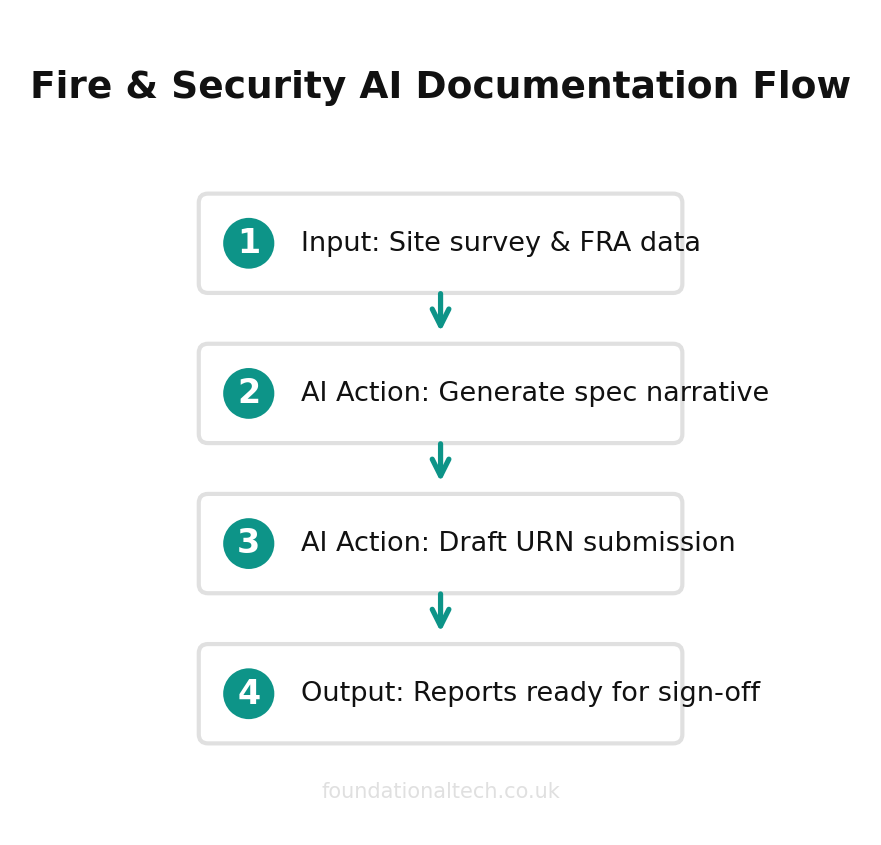
AI is genuinely good at reading that document and pulling out the findings that bear on the category decision: sleeping risk, escape route configuration, high-risk rooms, phased evacuation requirements. It then lays them out against the BS 5839-1 category definitions.
It is not good at making the decision. Nor should it. Category selection is a design judgement that sits with a competent person, and under BAFE SP203-1 that competence is audited against named individuals, not against software.
Use it the right way round. You choose the category. It drafts the two paragraphs explaining why, with the FRA findings cited, in language a facilities manager can take to their board.
The Specification Narrative Nobody Has Time to Write
Here is where quotes are actually lost in this trade.
You survey a building and produce a device schedule: 96 detectors, 14 call points, 22 sounders, a networked panel. Your competitor produces a schedule with 61 detectors. The customer compares two numbers and one of them is smaller.
What is missing from your quote is not detail. It is the two paragraphs explaining that the 96 reflects an L2 specification, driven by the sleeping risk identified in section 4 of their own fire risk assessment. The 61-device alternative is a different category altogether — one they are entitled to choose, but should choose knowingly.
Nobody writes those paragraphs, because they take twenty minutes and you have four quotes out. This is precisely the task AI does well: you give it the schedule, the category, and the FRA reference, and it produces the argument. You edit it for accuracy.
Pricing a Retrofit Without Losing the Argument at Variation Stage
Retrofit is where fire and security estimating gets punished. Cable routes through occupied buildings, asbestos surveys, out-of-hours access, phased handover — none of it appears on a device schedule and all of it appears on the invoice.
Record a voice note walking the building. Transcribe it, then ask for two outputs, separately: a priced structure from your rate card, and a standalone list of every assumption the price depends on.
The second list is the valuable one. Assumptions written down at quote stage are what turn an argument about a variation into a five-minute conversation. Assumptions carried in your head become goodwill discounts.
The URN Reinstatement Submission, and the Conversation After It
When a URN goes, two pieces of writing have to happen, and they cannot be the same document.
The submission to the force needs to be factual and evidenced: cause identified, remedial action taken, date, engineer, confirmation the system now meets the confirmation requirements under BS 8243. Short. Unemotional.
The customer letter has to explain what happened without blaming the customer, even in the common case where the cause was a cleaner with a new fob and no induction. That is a tone problem, and tone under commercial pressure is one of the things AI is measurably better at than a tired operations manager at 6pm.
Give it both jobs from the same set of facts. Read both before either leaves the building.
Two Versions of Every Service Report
The engineer's notes from a six-monthly BS 5839-1 service serve two audiences who need entirely different documents.
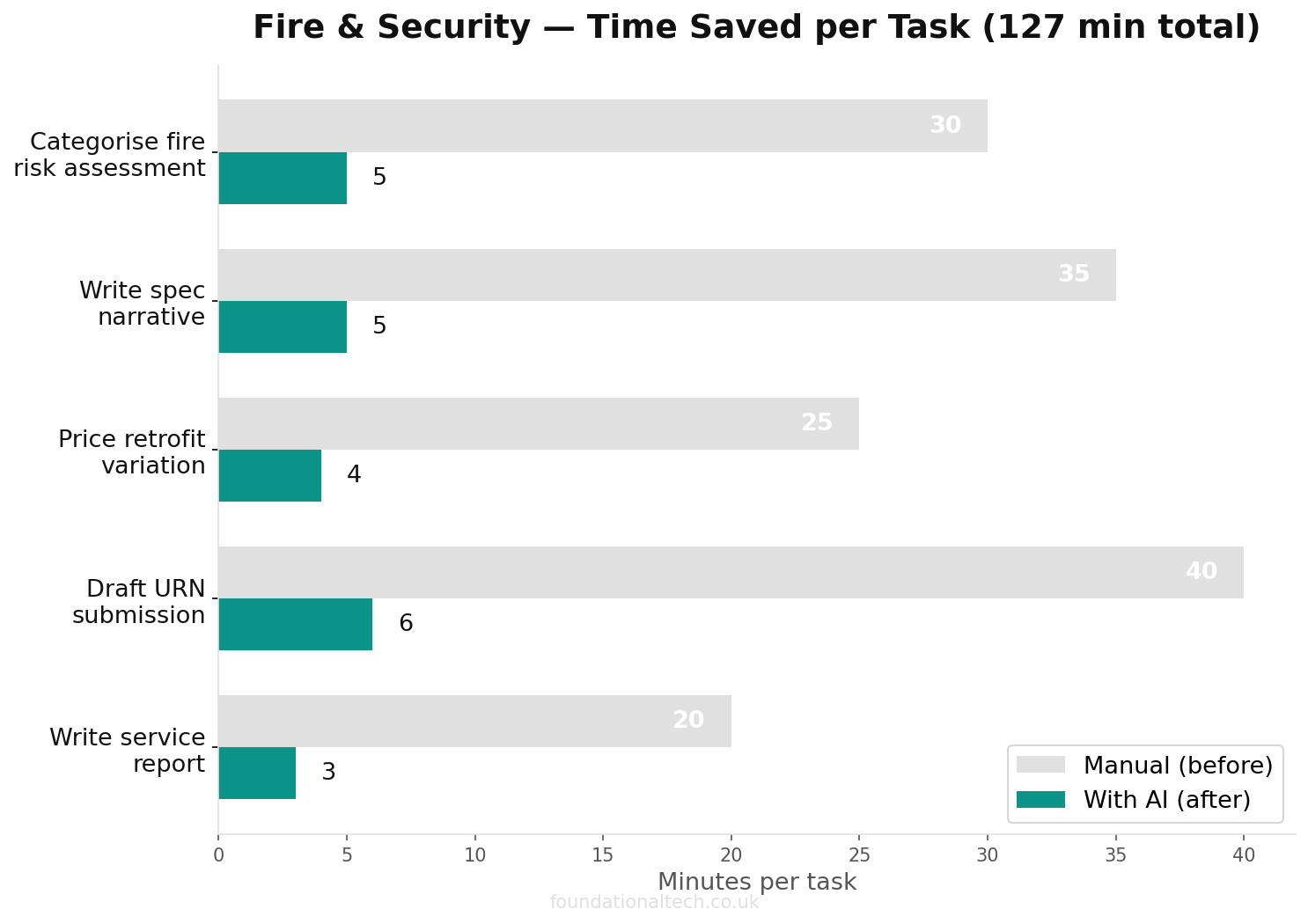
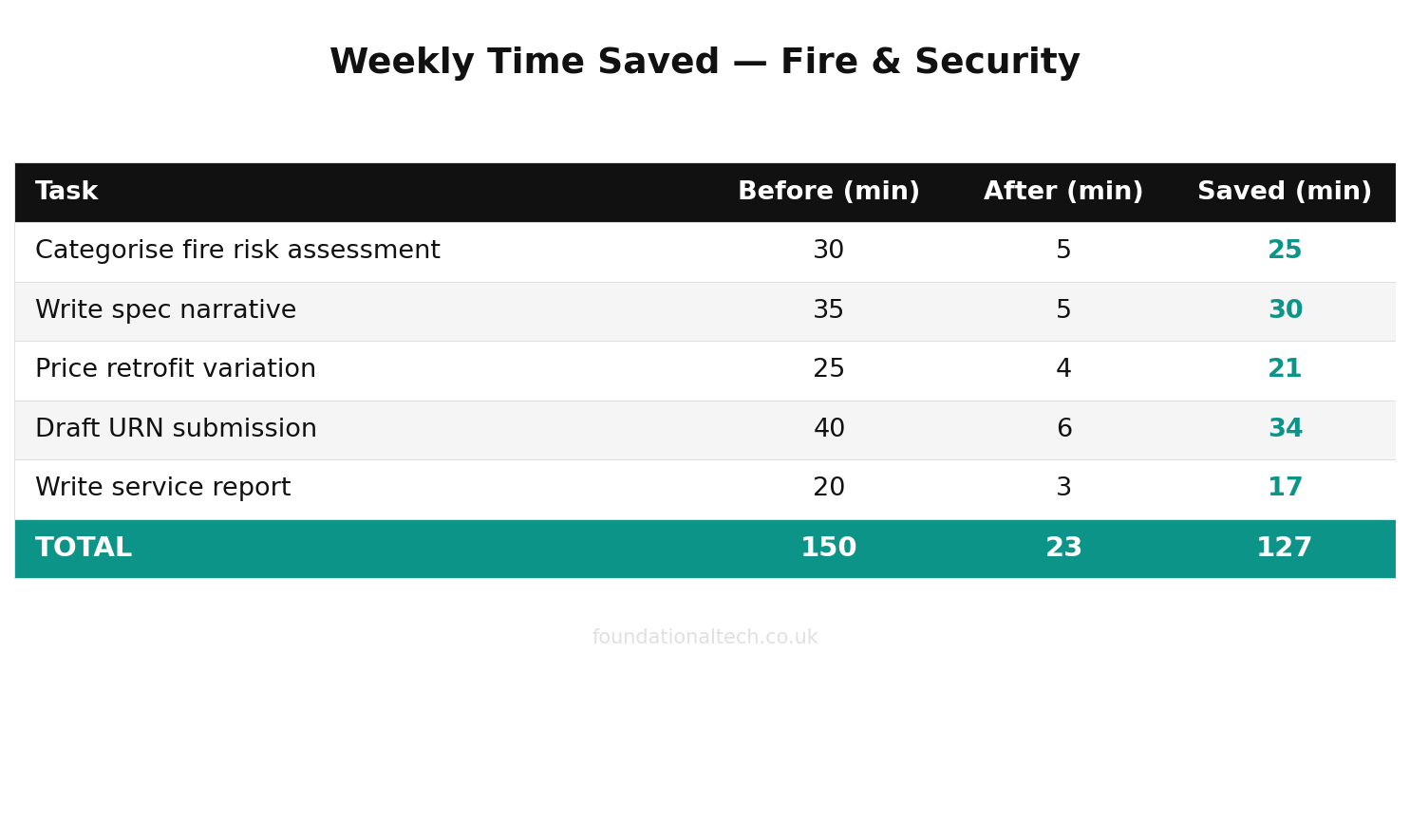
60% less writing time
on fire risk categorisations, spec narratives and service reports when AI handles the first draft
The facilities manager needs to know what was tested, what failed, what was replaced, and what they must budget for. The insurer or the building owner's risk adviser needs to know whether the system remained compliant and continuously covered.
Same source data, two summaries, ninety seconds of work instead of two separate write-ups nobody does. Over a 400-site book at two visits a year, that is the difference between a report pack that goes out and one that gets promised.
The Tender Document You Have Been Meaning to Read Since Tuesday
Commercial work in this trade arrives as a PQQ or an FM framework tender, and it arrives as sixty pages of which nine matter.
Buried in those sixty pages are the things that decide whether you can bid at all: the required third-party certification scheme, the vetting standard for engineers attending site, response time commitments and the insurance limits. Then there is the one that catches small firms — whether those response times are contractual with liquidated damages attached, or merely aspirational.
Give the document to Claude and ask three questions in order. What certification, vetting and insurance thresholds does this impose? What response times are specified, and are they contractual? What in this document would prevent a six-engineer firm from delivering it?
You get a qualify-or-decline answer in ten minutes rather than an evening. Firms that do this bid on fewer tenders and win a higher proportion of them, which is the only sensible direction for a business where every bid costs a day of the owner's time.
The same trick works on the contract itself once you win. Ask what the exit provisions are, what happens to the asset register on termination, and who owns the certification records. That last question has consequences you would rather discover before signing than during handover.
Will That Detector Talk to That Panel?
Every firm has a version of this. An engineer rings from site because a customer wants to extend a system installed by somebody else in 2014. The answer depends on protocol compatibility across two manufacturers' documentation.
Upload both datasheets and ask specifically what is stated about protocol, loop compatibility and any addressing limits — and tell it to answer only from the documents provided, quoting the line it relied on.
That last instruction is the whole technique. Ask these tools to recall a specification from memory and they will produce something plausible and occasionally wrong. Give them the datasheet and require a citation, and they become a fast index into documents you own but cannot search.
Choosing Between Claude, ChatGPT and Gemini in a Fire and Security Office
Claude Pro, roughly £18 a month, handles long documents best. Fire risk assessments, standards extracts, multi-page service histories — this is the one to give a 40-page PDF to. It also holds a consistent written tone across a batch of customer letters, which matters more than it sounds when you are sending forty renewal notices.
ChatGPT Plus, around £20 a month including VAT at UK checkout, is the better field tool. Voice input on site, and image handling that copes with a photograph of a panel display or a handwritten commissioning sheet. If your engineers are going to touch it, this is the one they will actually use.
Gemini through Google Workspace is the pragmatic choice if you are already on Workspace. Business Standard sits at £11.80 per user per month and puts Gemini inside Gmail, Docs and Sheets, where your service reports already live. Weaker on long-document reasoning; considerably cheaper per head across a six-person office.
Most firms this size land on one office subscription and one field subscription rather than licensing everyone. Start there.
Where the Standard Still Requires a Named Human
No AI output goes on a certificate. Ever.
Commissioning certification, design responsibility, and the competence declarations behind your BAFE, NSI or SSAIB registration all attach to individuals whose qualifications and CPD your assessor will inspect. There is no version of a third-party certification audit where "the model drafted it" is a defence.
There is also a practical limit. These tools will confidently mis-state a clause of BS 5839-1 or BS 8243 if you ask them to recall it from memory. Give them the text you want them to work from. Do not ask them what the standard says.
Treat everything they produce as a first draft written by a capable new starter who has never been on site. Useful, fast, and never signed off unread.
A First Month That Touches No Live System
Week one. Take your last three service reports. Ask for facilities-manager versions. Compare against what you actually sent. You will learn more about the tool from this than from any tutorial.
Week two. One site's twelve-month activation history, anonymised. See whether it finds something you already knew — that is your calibration test.
Week three. One live quote. Write your specification narrative the normal way, generate a second version, and send whichever is better. Note which one you picked.
Week four. Take whatever worked and write it down as a reusable instruction with your house tone, your rate card conventions, and your standard assumptions baked in.
That fourth step is where the compounding starts, and it is the subject of the next two articles in this cluster. First, twelve prompts written specifically for fire and security work. Then a step-by-step build of an assistant that permanently holds your contract terms, your engineer competence rules and your certification language. Both are for paying subscribers.
Related guides: If you found this useful, see our guide on How to Connect Tradify, Xero, GoCardless, Stripe and Dext: The Complete Electrical Integration Map (2026) and How to Get Paid Faster as an Electrician: Automated Invoicing and Direct Debit for UK Sparks (2026).
Which site in your contract book has the activation history you already suspect is a pattern — and has anyone ever actually counted it?
For the backstory on why hourly billing fails alarm engineers, read I Spent a Decade Selling Hours.
Considering Tradify? Get 50% off for 3 months.