Key Takeaway
Stop chasing late payments as a UK electrician in 2026. Set up automated invoicing, payment reminders, and Direct Debit with GoCardless and Xero.
The Cash Flow Gap
You did the work weeks ago. The board is in, the certificate is signed, the customer is happy. So why is the money still not in your account?
This is the quiet problem at the centre of most electrical businesses. The wiring gets finished on time. The invoice does not get raised on time, and once it is raised, it does not get paid on time. UK tradespeople are owed an average of more than £6,000 in late payments at any given moment, and the typical small business owner spends around 86 hours a year — more than two full working weeks — chasing money that is already theirs. Construction has the worst late-payment record of any major sector in Britain, and electricians, who subcontract into it constantly, sit right in the firing line.
The gap between finishing a job and being paid for it has a name in accounting: days-to-payment. For a lot of electricians it sits in the high 40s. That means every job you do funds the customer's cash flow for six or seven weeks before it funds yours. You buy the cable, you pay the apprentice, you fuel the van — and then you wait. The work was always going to be paid. The cost is the waiting, and the Sunday nights spent typing invoices and sending "just chasing this up" emails.
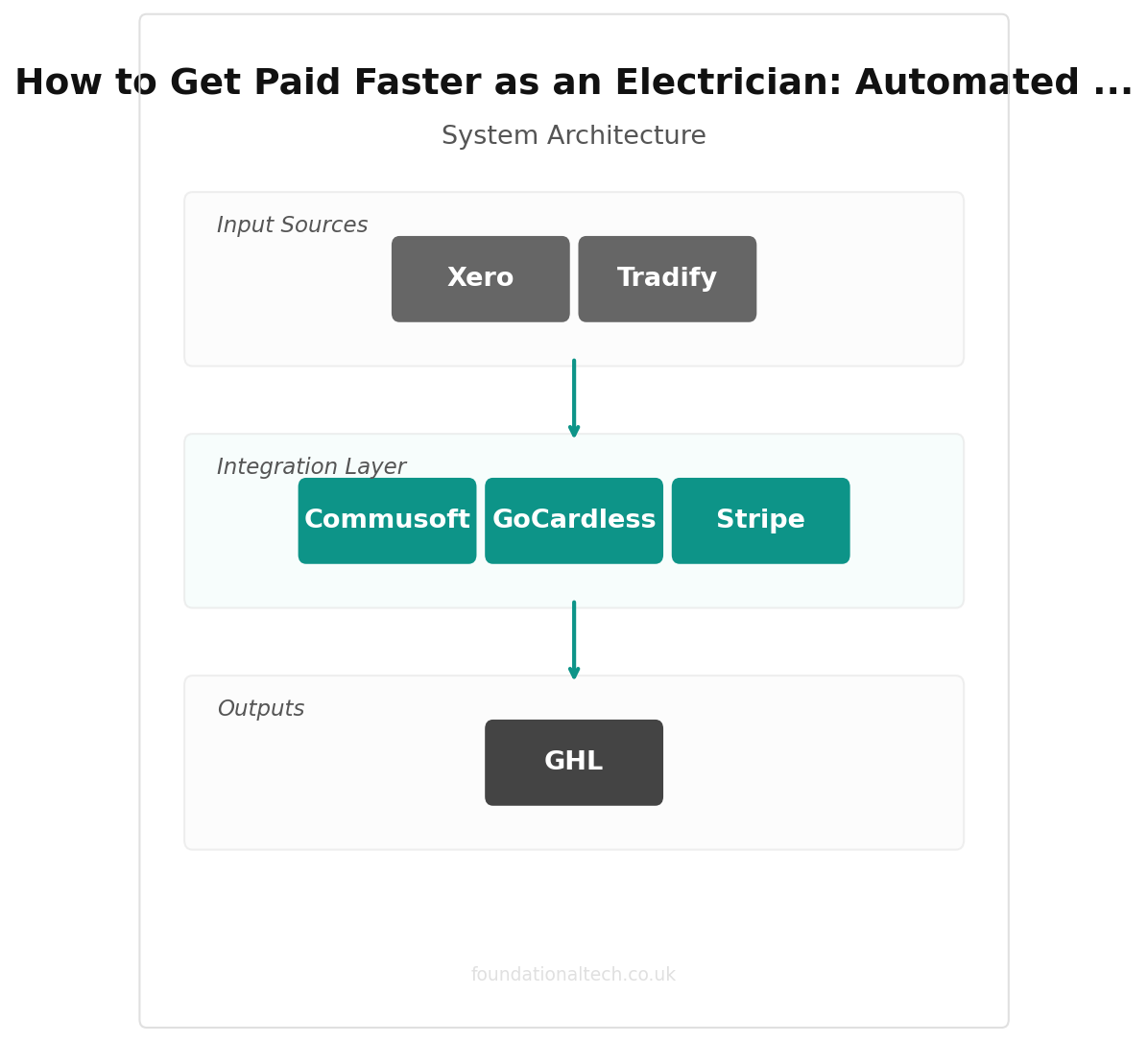
Almost all of that is fixable with four tools that already talk to each other. Here is the architecture.
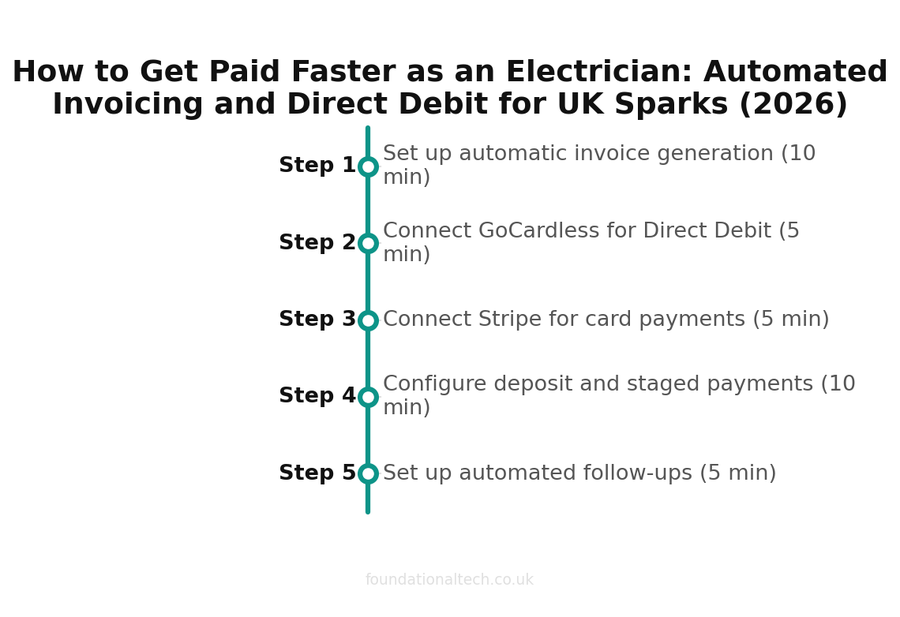
| Step | Action | Time |
|---|---|---|
| 1 | Set up automatic invoice generation | 10 min |
| 2 | Connect GoCardless for Direct Debit | 5 min |
| 3 | Connect Stripe for card payments | 5 min |
| 4 | Configure deposit and staged payments | 10 min |
| 5 | Set up automated follow-ups | 5 min |
The Automated Billing Architecture
Automated Invoice Generation
The single biggest cause of slow payment is slow invoicing. An invoice you send four days after the job is an invoice that gets paid four days later — at best. The fix is to raise it the moment you down tools, on site, from your phone.
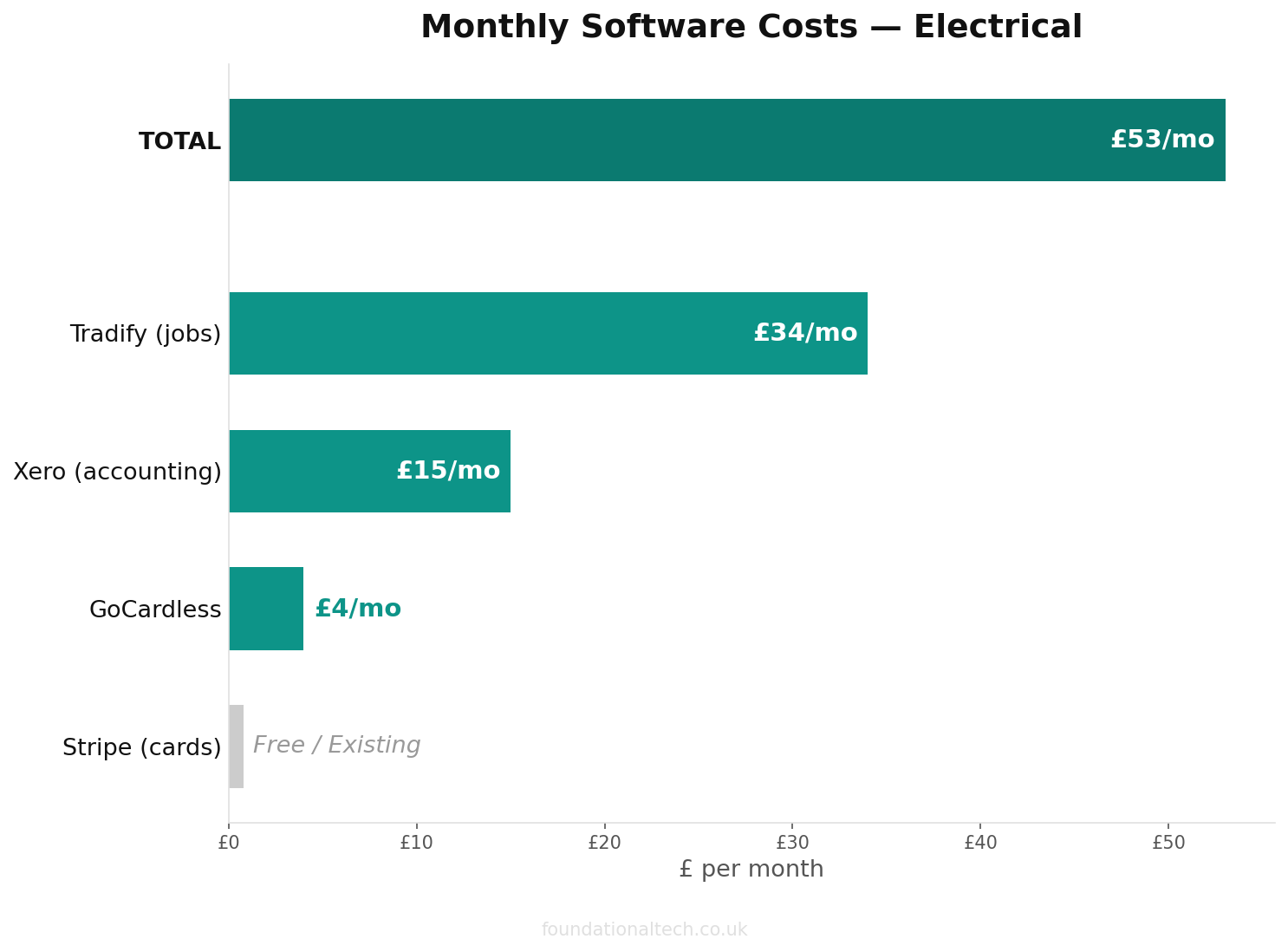
If you read the first two articles in this series, you already have the engine for this: your job management software. Tradify (£34 per user per month on Lite, £44 on Plus, 14-day free trial with no card) turns a completed job into an invoice in a couple of taps. The customer's details, the labour, the materials and the certificate reference are already in the system because you quoted from it. You are not retyping anything. You finish the consumer unit swap, mark the job complete, and the invoice is in the customer's inbox before you have packed the van.
This one change — same-day invoicing instead of end-of-week invoicing — typically pulls a week off your days-to-payment on its own, before you have automated anything else.
Payment Gateways
A PDF invoice with your bank details at the bottom asks the customer to do work: log in, set up a payee, type a sort code, remember to actually press send. Every step is a chance to forget. A payment link removes the work. The two that matter for UK electricians are GoCardless and Stripe, and they do different jobs.
GoCardless collects by Direct Debit. The customer authorises it once, and you pull the payment automatically on the due date. There is no monthly fee on the Standard plan — you pay 1% plus 20p per transaction, capped at £4. So collecting a £900 EICR-and-remedial invoice costs you the full £4 cap; collecting a £200 minor-works bill costs £2.20. Direct Debit is the quiet hero of trade cash flow, because it flips the default: instead of hoping the customer remembers to pay you, the money moves on the date you agreed unless they actively stop it. It is ideal for landlords, letting agents, facilities clients and anyone on a maintenance contract.
Stripe handles card payments — the "pay now" button on the invoice for one-off domestic jobs. UK card transactions cost 1.5% plus 20p, with no monthly fee. A homeowner who has just had a fault fixed will tap a card link and pay in seconds; the same homeowner will leave a bank-transfer invoice sitting for a fortnight. For a £180 callout, the Stripe fee is about £2.90 — cheaper than the cost of you chasing it twice.
Most electricians want both: GoCardless for recurring and commercial work, Stripe for one-off domestic. Both connect natively to Xero, so a collected payment shows up reconciled against the right invoice without you touching it.
Deposits and Staged Payments
For anything bigger than a callout — a full rewire, a consumer unit upgrade, a commercial fit-out — waiting until the end to bill is a cash-flow mistake. You buy the materials up front and carry the cost for the whole job. The fix is to split the money the way you split the work.
A sensible structure on a large domestic job is a deposit to cover materials before you start, a stage payment when first fix is done, and the balance on completion and certification. Tradify lets you raise these as separate invoices against the same job, and a deposit request can carry a Stripe link so the customer pays before you order a single reel of cable. You are no longer banking the job; the customer is funding it as it progresses, which is exactly how it should be. It also weeds out the time-wasters early — a customer who will not pay a materials deposit is a customer who was always going to be slow at the end.
Automated Follow-Ups
Some invoices still go unpaid. The difference between a business that gets paid and one that does not is usually nothing more than persistence — and persistence is exactly the kind of dull, repeatable job software should do for you.
Xero sends invoice reminders automatically on a schedule you set once. A sensible sequence for trade work looks like this. On the due date, a polite nudge: the invoice is now due, here is the payment link again. Seven days later, a firmer note: the invoice is now a week overdue, please arrange payment. At fourteen days, a direct message that mentions you may apply interest. At thirty days, a final notice before the matter goes further. You write these four emails once. From then on, every overdue invoice gets chased on time, in the same professional tone, whether you remember it or not — and crucially, without you having the awkward conversation yourself.
It is worth knowing your legal backstop. Under the Late Payment of Commercial Debts legislation, on commercial jobs you are entitled to charge statutory interest of 8% above the Bank of England base rate, plus a fixed recovery charge per invoice. You will rarely need to enforce it. Simply having the reminder mention it tends to move a slow payer to the front of their own to-do list.
Reconciliation
The last manual job most electricians do not even notice is matching payments to invoices — opening the bank app, seeing £900 land, working out which invoice it was, ticking it off. Multiply that across a month of jobs and it is hours.
Xero's bank feed imports every transaction automatically. Because GoCardless and Stripe tell Xero which invoice each payment relates to, those reconcile themselves the moment the money lands. Bank transfers are matched by amount and reference with one click. Your books stay current without a bookkeeping session, which means the VAT position you see is the real one — and when Making Tax Digital wants a quarterly VAT return filed straight to HMRC, the figures are already correct rather than something you reconstruct in a panic.
"My Customers Won't Pay That Way"
The most common objection to all of this is that customers will resist. In practice they rarely do, because the system asks less of them, not more. A card link is easier than logging into online banking and setting up a payee. A Direct Debit, once authorised, asks nothing of them at all. The friction you are removing is mostly theirs, and people pay faster when paying is effortless.
Where you do meet resistance, it is usually on Direct Debit for one-off domestic work, and the answer is to match the method to the job. Offer the card link to the homeowner who wants a fixed fault fixed today, and reserve Direct Debit for the landlords, letting agents and maintenance clients who bill repeatedly and actively prefer not to think about it each month. Nobody is forced onto a method that does not suit the work. You are simply replacing the slowest option — a printed invoice and a hopeful wait — with two faster ones, and letting the customer pick the lane that fits.
2 payment gateways
Direct Debit via GoCardless and card payments via Stripe for maximum collection speed
The Numbers
Take an electrician turning over £90,000 a year, raising around 20 invoices a month across domestic callouts, EICRs and a couple of landlord contracts.
Before: invoices raised a few days late, paid on average at 45 days, with a couple of hours a week lost to billing and chasing — roughly 100 unpaid hours a year, and a bank balance nobody can forecast.
After: invoices raised same-day on site, domestic jobs paid by card link within days, contract work collected automatically by Direct Debit, chasers running themselves, and reconciliation happening on the bank feed. Days-to-payment typically falls from the mid-40s into the low 20s.
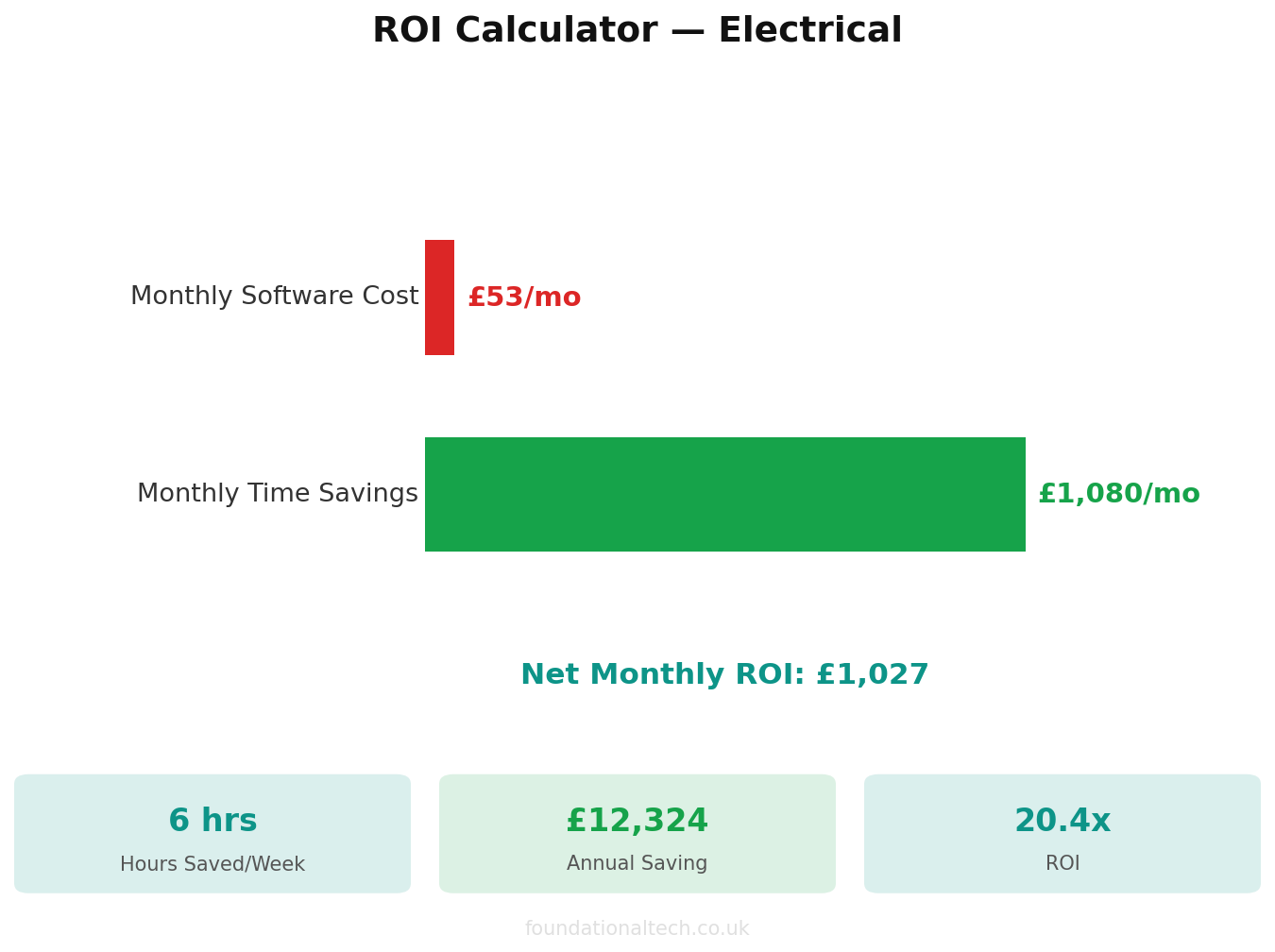
Put a number on that movement. Pulling days-to-payment from 45 to 22 on £90,000 of turnover frees up roughly £5,700 of cash that was permanently stuck in the gap between doing the work and being paid for it — money you can use to buy materials for the next job instead of putting it on the card. That is not extra profit. The work was always going to be paid. It is the difference between controlling your cash and being controlled by it.
The whole system — Tradify, Xero, GoCardless and Stripe — costs well under £100 a month for a one-van firm, and most of that is transaction fees you only pay when money actually moves. Set against thousands of pounds routinely trapped in unpaid invoices, automated billing is one of the cheapest problems in the business to fix, and the only one that pays you back in working capital rather than just saved hours. Build the loop once and it keeps paying you back on every job for as long as the business runs.
What's your average days-to-payment right now — from signing the certificate to the cash actually clearing? Be honest; the number usually shocks people, and it's the single best measure of whether your billing is quietly costing you.