Key Takeaway
Stop chasing late payments as a UK fire & security installer. Set up automated invoicing and direct debit in 2026.
When someone eventually offers to buy your firm, they will not open your profit and loss account first. They will ask for a contract schedule: every PPM scheduling and monitoring agreement, its start date, its renewal term, its annual value, and — the question that decides the price — how it is collected.
Almost every other trade in this series is bought on a multiple of profit. Fire and security is not. Acquirers in this sector value the recurring book, and the shorthand they use is a multiple of monthly recurring revenue. Advisory firms active in the market quote broad ranges of roughly 30 to 50 times MRR. Fire and integrated commercial accounts sit at the higher end, because inspection demand is written into legislation rather than into a customer's discretionary budget.
Treat those multiples as a direction of travel rather than a price. They come from advisers' published guidance, not from filed UK transaction data, and small independent deals in Britain more often settle on an EBITDA multiple with the contract book as the underlying driver of it.
Take the low end and the arithmetic still stops you. A contract billed at £40 a month is not £480 a year of revenue. It is somewhere between £1,200 and £2,000 of enterprise value, sitting on a wall in a corner shop. Which means the way you invoice it is not a bookkeeping preference. It is a decision about what your firm is worth.
Annual Invoice Versus Monthly Mandate Is a Valuation Decision
An annual maintenance invoice puts a decision in front of your customer every twelve months. They open an email asking for £480, they look at a system that has not gone wrong all year, and they wonder — for the first time in twelve months — whether they need you.
£480
deferred income per site — cash banked but not yet earned
A monthly Direct Debit at £40 puts that decision in front of them once, on the day they sign. After that, nothing happens. There is no annual moment of reappraisal, no purchase order to raise, no finance director asking what this is for.
The churn difference between those two models is the largest single lever on the value of your business, and it does not require you to sell anything, service anything or hire anyone.
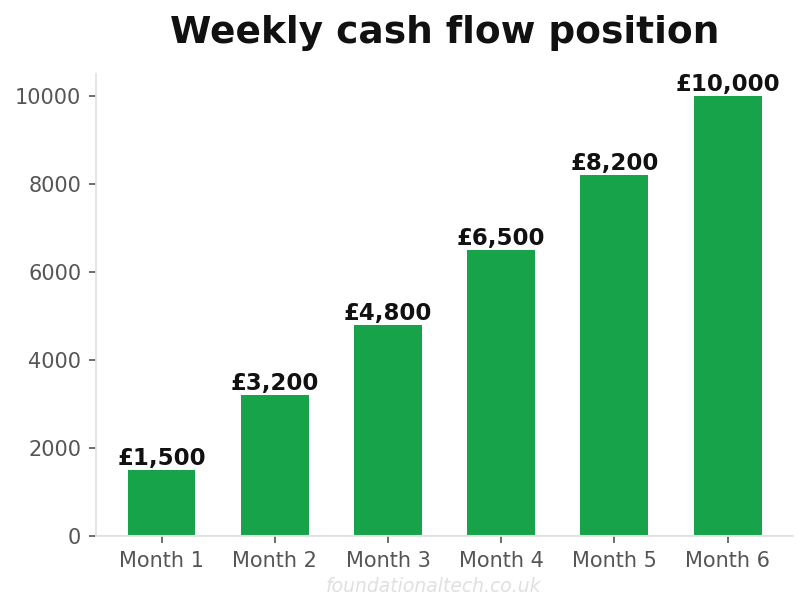
There is a second effect that shows up faster. An annual-invoice book is lumpy. Suppose a third of your contracts renew in April, because that is when you had a good year four years ago. April is then flush and November is frightening. Meanwhile the monitoring costs, the vehicles and the engineers' wages run flat across all twelve months. A monthly book flattens the income line to match the cost line. That is the whole argument for the migration, before any question of what a buyer might pay.
The £480 You Have Banked and Have Not Earned
Here is the accounting mistake that quietly ruins a fire and security firm's numbers.
A customer pays £480 in April for twelve months of monitoring and two BS 5839-1 service visits. Booked naively, that is £480 of April revenue. It is not. On the last day of April you have earned roughly £40 and you owe the customer eleven months of obligation. The remaining £440 is a liability.
Firms that get this wrong show a spectacular spring, a bleak autumn, and no reliable way of answering the only question that matters: is the contract book growing or shrinking? Revenue that arrives in one lump tells you nothing about the underlying annuity.
The fix is ten minutes in Xero. Create a liability account — Deferred Maintenance Income — and post contract receipts there rather than straight to a revenue code. Then set a repeating journal that releases one twelfth to revenue each month. Xero's repeating manual journals will do this without anyone touching it.
The moment that runs, your monthly management accounts start showing recurring revenue as a smooth line. You can see, month on month, whether the book is up or down. You can also finally answer the profitability question per site, because contract income and the material and labour costs of servicing that site now land in the same period.
If you are on Xero, the UK plans sit at £33 a month for Standard and £37 for Growing, both excluding VAT. A price rise is scheduled from 1 September 2026. Repeating journals require a plan that includes them — check before you commit.
Migrating Two Hundred Sites Without Losing Fifteen of Them
This is where most firms stall. The idea is obvious; the migration is what frightens people. A mass email saying "we are changing how we bill you" is an invitation for two hundred customers to think about your invoice on the same morning.
So do not send one.
Migrate at renewal, not in a batch. Every contract has an anniversary. On the day the renewal goes out, the mandate request goes with it as the default option. The customer is already making a decision about that contract; you are changing the mechanics inside a conversation they expected, not starting a new one.
Price the two options differently and say so plainly. The monthly rate should be the headline. If you want to keep an annual invoice option, price it at a small premium, and be honest about why: it costs you more to administer and to finance. Most customers will take the cheaper option without further thought.
Handle the overlap deliberately. A customer moving from an April annual invoice to monthly collection has already paid to March. Their first collection is 1 April. Get that wrong once and you will spend an hour on the phone explaining a double charge, and they will remember it at the next renewal.
Do the managing agents and facilities managers last. Multi-site commercial customers often cannot pay by Direct Debit at all — some have procurement rules that require purchase orders and BACS on 60-day terms. Do not burn goodwill trying. Take those on invoice, get them onto a portal so they can self-serve certificates, and put the collection effort into the several hundred small commercial sites where it actually moves the number.
Run at renewal, a two-hundred-site book migrates in twelve months with no single alarming moment.
The Uplift That Has to Fire Without Anyone Remembering It
Contract indexation is the most commonly abandoned money in this trade.
Three per cent applied across a £180,000 maintenance book is £5,400 a year for no additional work, no additional van and no additional engineer. It falls straight through to profit — and because the book is valued on recurring revenue, it also adds to the sale price at whatever multiple applies.
It is almost never collected, for a simple reason: applying it manually means repricing two hundred agreements by hand, and the person who would do that is the same person answering the phone.
Two things have to be true for it to happen automatically. The contract has to contain an indexation clause that permits the increase without renegotiation — state the mechanism plainly, whether that is a fixed percentage or a published index. And your service management platform has to apply it at renewal as a scheduled event, not as a task on someone's list. Uptick, Joblogic and AlarmMaster Pro all handle scheduled uplifts on contract billing; if the one you are trialling cannot, that is a reason not to buy it.
One operational trap. Under the Bacs scheme rules, changing the amount you collect by Direct Debit requires advance notice to the payer. The scheme default is ten working days ahead of the collection, plus postal time if you notify by letter. A shorter period is allowed, but only if your sponsoring bank or provider has agreed it and your Direct Debit Guarantee states it. Your uplift letter is therefore not a courtesy. It is a scheme requirement, and it needs to go out on a schedule that clears the notice period before the first uplifted collection.
Mandates Fail. A Book Leaks Quietly.
Direct Debit fails far less often than people expect, and far more often than nothing.
GoCardless publishes an average first-attempt success rate of 97.3 per cent across its UK base, a failure rate of about 2.9 per cent. Card payments fail at roughly 10 to 15 per cent, where expiry dates and reissued cards do most of the damage. Its Success+ retry product recovers a large share of the failures that do occur.
Three per cent sounds like nothing. On a two-hundred-contract book it is six failed collections a month, seventy-two a year. Left alone, a proportion of those quietly become cancelled mandates. A cancelled mandate on a monitoring contract is a site still connected to the alarm receiving centre, still generating a cost to you, and no longer paying.
That is the leak. It is invisible in the P&L because the numbers are small and monthly, and it is only obvious eighteen months later when someone asks why the book has not grown.
Build the response as a sequence, not a phone call:
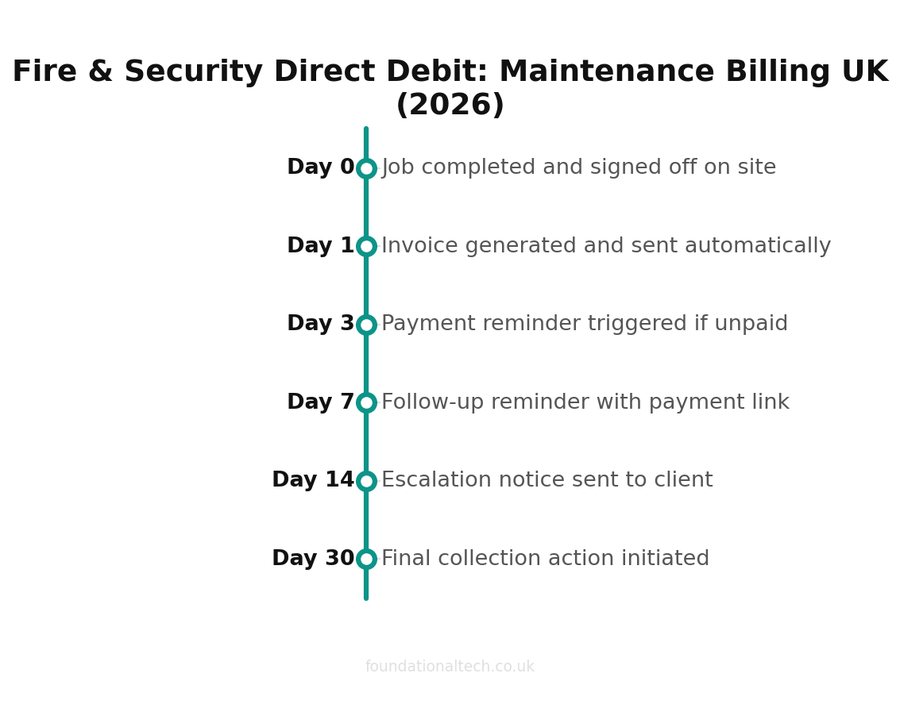
Day 0 — collection fails. Automatic retry. Most bounces are timing, not intent.
Day 3 — retry fails. A short automated message naming the site and the amount. Not a demand: a notification that the bank rejected the collection, with a one-click link to fix the mandate.
Day 10 — still unpaid. A human. Someone in the office rings, because at this point you are no longer chasing money, you are diagnosing a relationship.
Day 21 — no mandate. This is the decision point, and it needs a policy rather than a mood. If the site is monitored, you are paying the ARC every month for a customer who is not paying you. Suspension terms have to be written into the contract, notified properly, and applied — otherwise you are running an unfunded monitoring service for whoever shouts least.
On collection costs, GoCardless Standard charges 1 per cent plus 20p per transaction with no monthly fee, capped at £4. On a £40 monthly maintenance collection that is 60p. On a £1,200 annual payment the cap means £4 rather than £12.20 — which is a small argument for keeping large annual payments on Direct Debit too, where the customer will accept it.
The Reactive Ledger Runs on a Completely Different Clock
Everything above concerns the annuity. The other half of your revenue behaves nothing like it.
A three-in-twelve-months false activation suspends a customer's police response under the NPCC Security Systems Policy. The customer rings, an engineer attends, the cause is found, remedial work is done and the URN reinstatement application goes in. That is chargeable work, generated by an incident, invoiced once, and it can be several hundred pounds.
The same pattern applies to out-of-hours callouts, panel failures, storm damage to external cameras and every signalling migration off legacy infrastructure.
The mistake is to run this money through the same process as the contract book. Contract billing is a scheduled batch. Reactive work is a same-day event. The further it drifts from the day the engineer left site, the harder it is to collect, because the customer's memory of urgency fades faster than your invoice does.
So separate them. Reactive work should invoice from the completed job record on the day, with payment taken by card at the point of completion or on a short-term link, not added to next month's Direct Debit. Card processing costs more per pound than Direct Debit, and on one-off work that is the correct trade: you are paying a fee to remove a thirty-day gap and a chasing conversation.
Keep the two streams on separate income codes in Xero. Recurring and reactive have different margins, different seasonality and different meaning. Blend them into one revenue line and you lose the ability to see either.
The ARC Invoice Does Not Wait for Your Customer
One more asymmetry, and it is the one that catches growing firms.
If you are reselling monitoring, your alarm receiving centre bills you monthly per connection regardless of whether the end customer has paid. The same is true of roaming-SIM signalling devices and most cloud video platforms. On a growing book, that is a real working capital cost: you fund a month of connection charges across every site, permanently, and the faster you grow the more of it you fund.
There is a straightforward defence. Align the collection date to the front of the month rather than the end, so customer money lands before the ARC invoice does. And run a monthly reconciliation between the ARC's connection list and your live contract list. Those two lists drift. Sites get decommissioned, customers move premises, buildings change hands — and connections that no longer have a paying contract behind them keep billing you until somebody compares the two spreadsheets.
Firms routinely find one to three per cent of their connection base in that state. It is not a large sum, but it is pure margin, and finding it takes one reconciliation a month.
| Method | Cash collected | Revenue recognised | Admin load |
|---|---|---|---|
| £1,200 upfront annual | £1,200 upfront | Over 12 months | High |
| Monthly DD | £100/month | Each month | Low |
| Quarterly invoice | £300/quarter | Over 3 months | Medium |
Twelve Months In
A contract book on the system above does five things it did not do before.
Income arrives in twelve even instalments instead of clustering around historic renewal dates. Recurring revenue appears as a real, comparable monthly figure in your management accounts, because deferred income is released properly rather than banked as a lump. Annual uplifts apply themselves, adding several thousand pounds a year to a book of moderate size. Failed mandates surface within three days rather than eighteen months. And the connection list matches the contract list.
None of that requires a new salesperson or a fourth van. It requires a chart of accounts set up correctly, a billing engine that runs on a schedule, and a dunning sequence nobody has to remember.
What you get at the end is not just steadier cash. It is a documented, indexed, Direct Debit-collected annuity — which is a different asset from the same revenue collected by annual invoice with gaps in the history. You cannot build that in the quarter before someone asks to see it.
Of your maintenance contracts, how many are collected by monthly Direct Debit today? And when you last reconciled your ARC connection list against your live contract list, how many connections were you paying for with no contract behind them?
Related reading: I Spent a Decade Selling Hours.
Considering Tradify? Get 50% off for 3 months.