Key Takeaway
Automate timesheets, payroll, receipts for your UK electrician business in 2026. Step-by-step guide using Dext, Xero, and payroll tools to cut admin hours.
The Hidden Cost
100+ hours/yr
spent on manual payroll and receipt admin for electrical businesses
Ask an electrician what their job is and they will say wiring, testing, certificates. Ask where their evenings go and the answer is different: working out who did what hours this week, running the apprentice's pay, and emptying a glovebox of crumpled receipts into a spreadsheet before the accountant's deadline.
This is the back office, and it is the most underestimated cost in the trade. None of it is skilled work. None of it is billable. Yet a small electrical firm with one or two employees can lose a full evening every week to timesheets, payroll and expenses combined —call it 100 hours a year —and that is before you count the money quietly lost to receipts that go missing and VAT that never gets reclaimed. The work feels small because it comes in ten-minute pieces. Added up, it is a part-time job nobody is paying you for.
The fix is to make three streams of information —hours worked, pay owed, and money spent —flow automatically into the same place your books already live: Xero. Here is the stack.
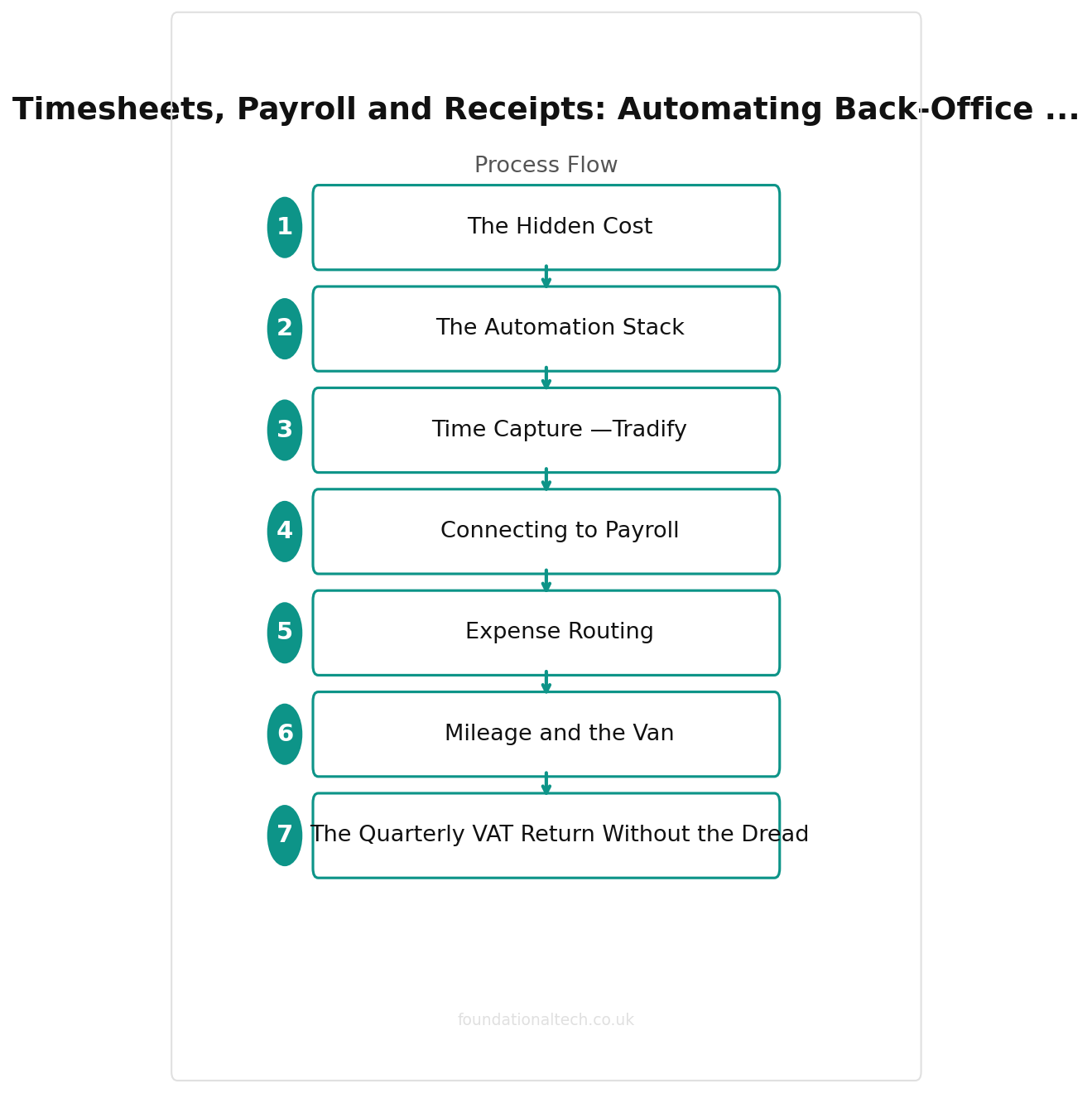
The Automation Stack
Time Capture —Tradify
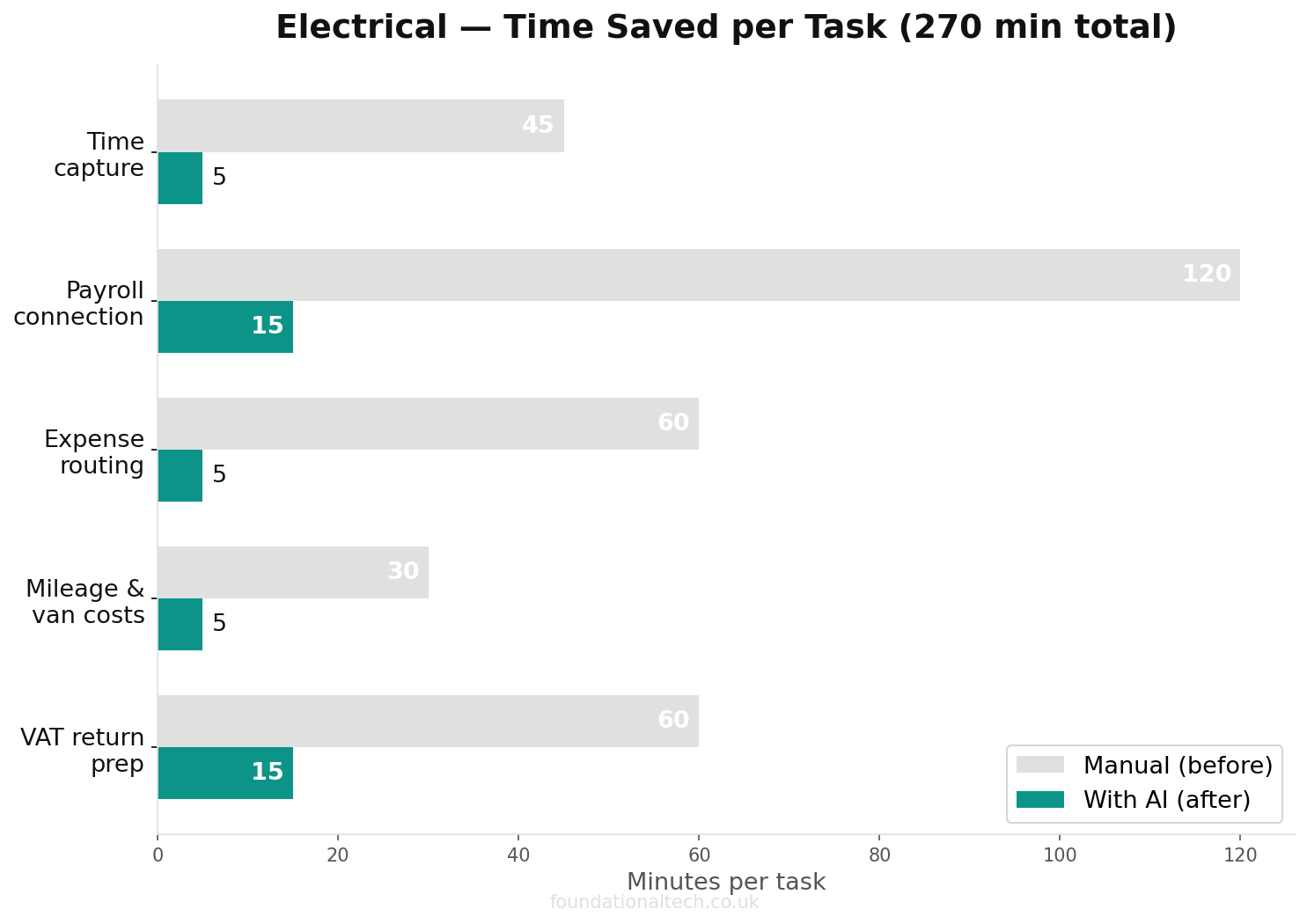
The foundation is already in your business if you followed the earlier articles. Tradify (£34 per user per month on Lite, £44 on Plus) is your job management software, and it captures time as a by-product of doing the work. Your electrician or apprentice starts a job on the app, the clock runs, and the hours attach themselves to that specific job. No paper timesheet, no Monday-morning guessing about whether the Tuesday in Sutton was six hours or seven.
That last point matters for more than payroll. When hours are tagged to jobs, you can finally see which work actually makes money. The landlord who haggled you down on an EICR and then needed three return visits stops being a vague feeling and becomes a number. You quote the next one properly. Time capture is not just an admin tool; it is the cheapest management information you will ever get.
If you run a larger team or need proper rostering, Deputy adds drag-and-drop scheduling and a clock-in kiosk, and exports approved timesheets straight into Xero. Pricing starts at £3.25 per user per month on the annual Lite plan, rising to £4.25 for the Core plan and £6.50 for Pro, with a £20 monthly minimum on the rolling plans. For most one- and two-van firms, Tradify's built-in time tracking is enough on its own, and Deputy only starts to earn its keep once you are juggling shift patterns across four or five people.
Connecting to Payroll
Once hours are captured, payroll should be a review, not a rebuild. Xero Payroll runs inside the accounting software you already use, so there is no second system and no double entry. It is an add-on to the main Xero plans —Grow (£30 a month) or Comprehensive (£42 a month) —at £1.50 per employee per month. For a firm with the owner plus two staff, that is around £3 a month on top of the base subscription.
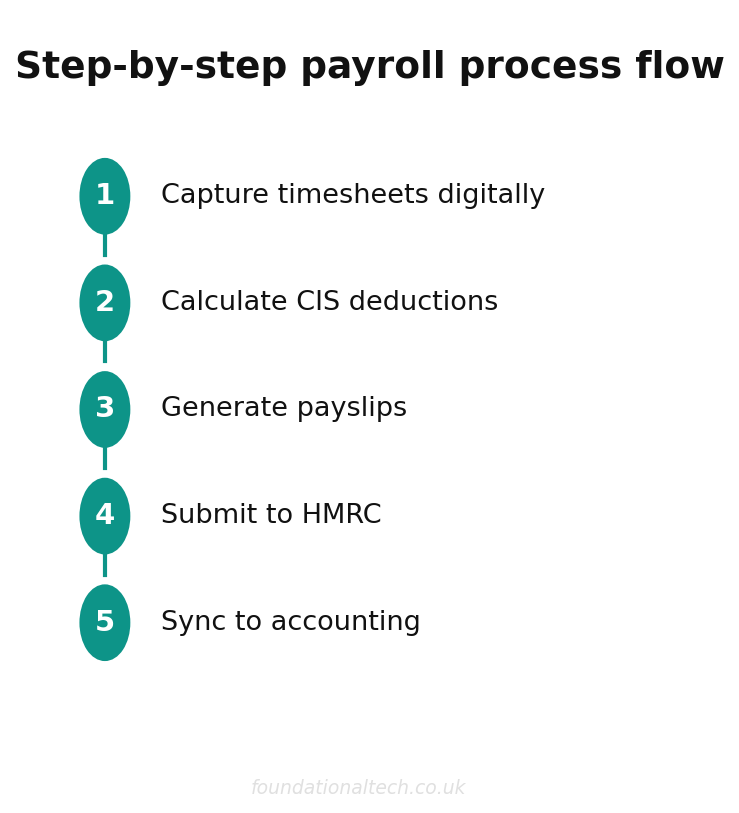
Xero Payroll is HMRC-recognised and handles Real Time Information (RTI) submissions, so every pay run reports itself to HMRC automatically. It deals with PAYE, National Insurance, pension auto-enrolment, holiday pay and payslips. The hours flow from Tradify, you check they are right, you approve the run, and payslips and the HMRC submission happen together. A job that used to mean a calculator, a tax table and a knot in your stomach becomes ten minutes on a Friday.
There is a second legal duty most small firms underestimate: pension auto-enrolment. The moment you employ someone who qualifies, you are obliged to enrol them into a workplace pension and pay employer contributions, and The Pensions Regulator fines firms that miss it. Xero Payroll connects to schemes such as NEST and handles the assessment, the contributions and the re-enrolment cycle automatically, so a duty that catches a lot of first-time employers off guard runs quietly in the background.
One trade-specific note. If you subcontract on construction sites, you are likely inside the Construction Industry Scheme (CIS), which means deducting tax from your subcontractors or having it deducted from you, and filing monthly returns. Xero handles CIS deductions and the monthly return, so the £100 penalty for a late or wrong CIS submission —a tax most subcontracting electricians have paid at least once —simply stops happening.
Expense Routing
The receipt is the smallest unit of admin and the most expensive to lose. Every wholesaler ticket, fuel receipt and parking stub is either VAT you can reclaim or an expense that reduces your tax bill. Lose it and you are paying more tax than you owe. The shoebox method loses plenty.
Dext closes the leak. The Sole Trader plan costs £24 a month and covers up to 150 documents, which is comfortably more than most one-van firms get through, and annual billing trims roughly a fifth off the price. The rule for using it is one line long: photograph every receipt the moment it is in your hand, before it reaches the van. Dext reads the supplier, the date, the amount and the VAT, then posts it into Xero already coded to the right category. Supplier invoices that arrive by email get forwarded straight to your Dext inbox and handled the same way. The glovebox stays empty, the VAT gets reclaimed in full, and your expense figure is real rather than a March guess.
Mileage and the Van
The expense electricians lose most often is the one they never get a receipt for: mileage. Every drive to a wholesaler, a quote, or a job is an allowable cost —45p a mile for the first 10,000 business miles under HMRC's approved rates, then 25p after that. Tracked properly across a year of driving between sites, it adds up to a meaningful deduction that most sole traders simply forget.
The fix is to stop relying on memory. A mileage-tracking app that logs trips automatically by GPS —or a simple logged habit at the end of each day —feeds the figure into your records, and the van's running costs (fuel, insurance, MOT, servicing) flow in through Dext like any other receipt. The principle is the same across the whole back office: if a cost is not captured at the moment it happens, it is a cost you end up paying tax on. Mileage is the easiest one to capture and the easiest one to lose.
The Quarterly VAT Return Without the Dread
The point where the whole back office either pays off or falls apart is the VAT return. If your hours, sales and expenses have all been flowing into Xero as they happen, the return is already three-quarters built before you sit down to it. Under Making Tax Digital, Xero adds up the VAT you have charged on invoices and the VAT you can reclaim on the receipts Dext has posted, shows you the net figure, and files it digitally with HMRC in a couple of taps. No spreadsheet, no nine-box form copied out by hand, no late-filing penalty.
The firms that still dread the VAT quarter are the ones doing the capture in a panic at the end of it —three months of receipts tipped out of a glovebox onto the kitchen table the week before the deadline. The stack moves that work to the moment each cost happens, so the quarter-end becomes a review rather than a reconstruction. Spend ten minutes checking the figures look right, confirm the CIS position if you subcontract, and submit. The dread was never the tax. It was the scramble.
When to Bring in a Human
Automation does not make your accountant redundant; it makes them cheaper and more useful. A bookkeeper paid to type receipts is paid to do work the software now does for nothing. An accountant freed from chasing your paperwork can spend the same fee on advice that actually saves you money —how to draw income tax-efficiently, when to register for the flat-rate VAT scheme, whether your next van should be bought or leased. The rule of thumb is simple: automate the data entry, and pay a human for judgement. Once the books keep themselves current, a year-end that used to take your accountant days takes hours, and the bill tends to follow.
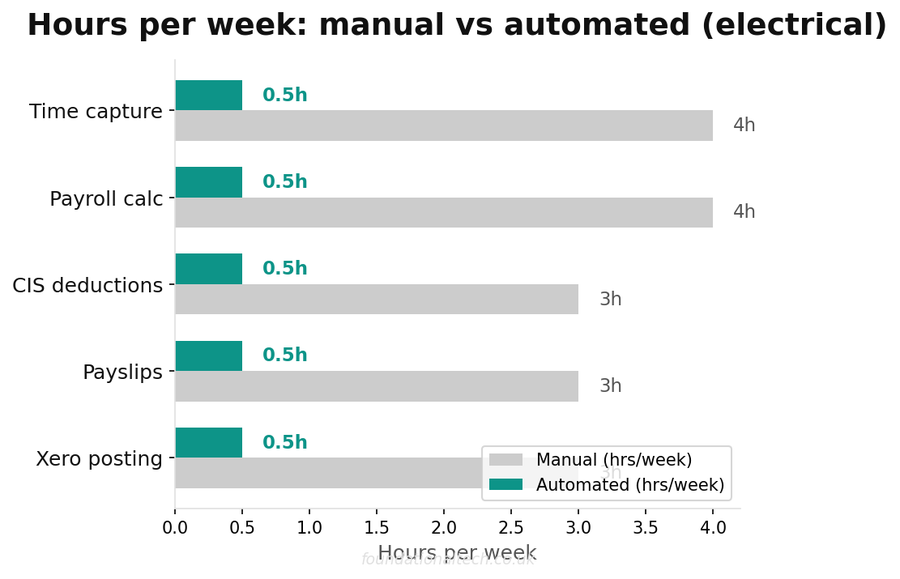
| Task | Manual | Automated |
|---|---|---|
| Receipt processing | 45 min/week | 5 min/week |
| Timesheet collection | 2 hrs/week | 15 min/week |
| Payroll run | 3 hrs/week | 30 min/week |
| Monthly reconciliation | 4 hours | 30 minutes |
Implementation Timeline
You do not roll this out all at once. Layer it over a month so nothing breaks.
Week 1 —Time. Get everyone starting and stopping jobs in Tradify. The only habit to build is tapping the app at the start and end of each job. By Friday you should have a full week of job-tagged hours without a single paper timesheet.
Week 2 —Payroll. Switch on Xero Payroll, load your employees, and run one pay cycle in parallel with however you do it now. Confirm the numbers match, the RTI submission goes through, and the payslips look right. Then retire the old method.
Week 3 —Expenses. Roll out Dext. Photograph every receipt at the point of handover; forward every supplier invoice to the Dext inbox. By the end of the week, receipts should be landing in Xero coded, and the shoebox should be empty for good.
Week 4 onward —Review. With hours, pay and spending all flowing automatically, the back office becomes a fifteen-minute weekly review instead of a Sunday-night marathon. Check the timesheets are complete, approve the pay run, glance at the flagged expenses, confirm the CIS return before filing. Done.
There is a compounding return worth naming. The reclaimed hours are only half of it. Job-tagged timesheets tell you which work makes money, so you quote better. Captured receipts mean you reclaim every pound of VAT you are owed and never overstate your tax bill. Automated CIS and RTI mean you never eat a late-filing penalty. Each of those is a leak the manual back office quietly tolerates, and the stack seals all of them at once.
The total cost —Xero with payroll and CIS, plus Dext, plus Deputy only if you need rostering —sits comfortably under £100 a month for most small electrical firms. A part-time bookkeeper to do the same work by hand costs at least £1,200 a month. The back office is the clearest case in the whole business where the software is not a cost but a replacement for one —and it is the one job most electricians will be glad to never do on a Sunday night again.
How many hours does your back-office admin actually take per week —timesheets, payroll, CIS and receipts combined? Reply with the number. I'm building a UK benchmark, and most electricians have never added it up.