Key Takeaway
Tradify vs Powered Now vs Commusoft for UK electricians. BS 7671 certificates, CIS reverse charge, Xero sync and prices from £15/mo compared in detail.
Why This Choice Matters
Tradify vs Powered Now is the decision most UK electricians wrestle with when they outgrow spreadsheets and paper diaries. Your job management software is the one tool you touch every day — it holds your quotes, your jobs, your certificates, your timesheets, and your invoices — and picking the wrong one costs you far more in wasted time than the subscription ever will.
Which is exactly why getting it wrong hurts. Pick the wrong platform and you will spend a year fighting it, then lose weeks migrating your customer history, your templates, and your half-finished jobs to something else. The switching cost is not the monthly fee — it is the disruption. So it pays to choose deliberately, once.
For UK electricians in 2026, three names come up again and again: Tradify, Powered Now, and Commusoft. They are not really competing for the same business. Each is built for a different size and shape of firm. This guide tells you which one is yours.
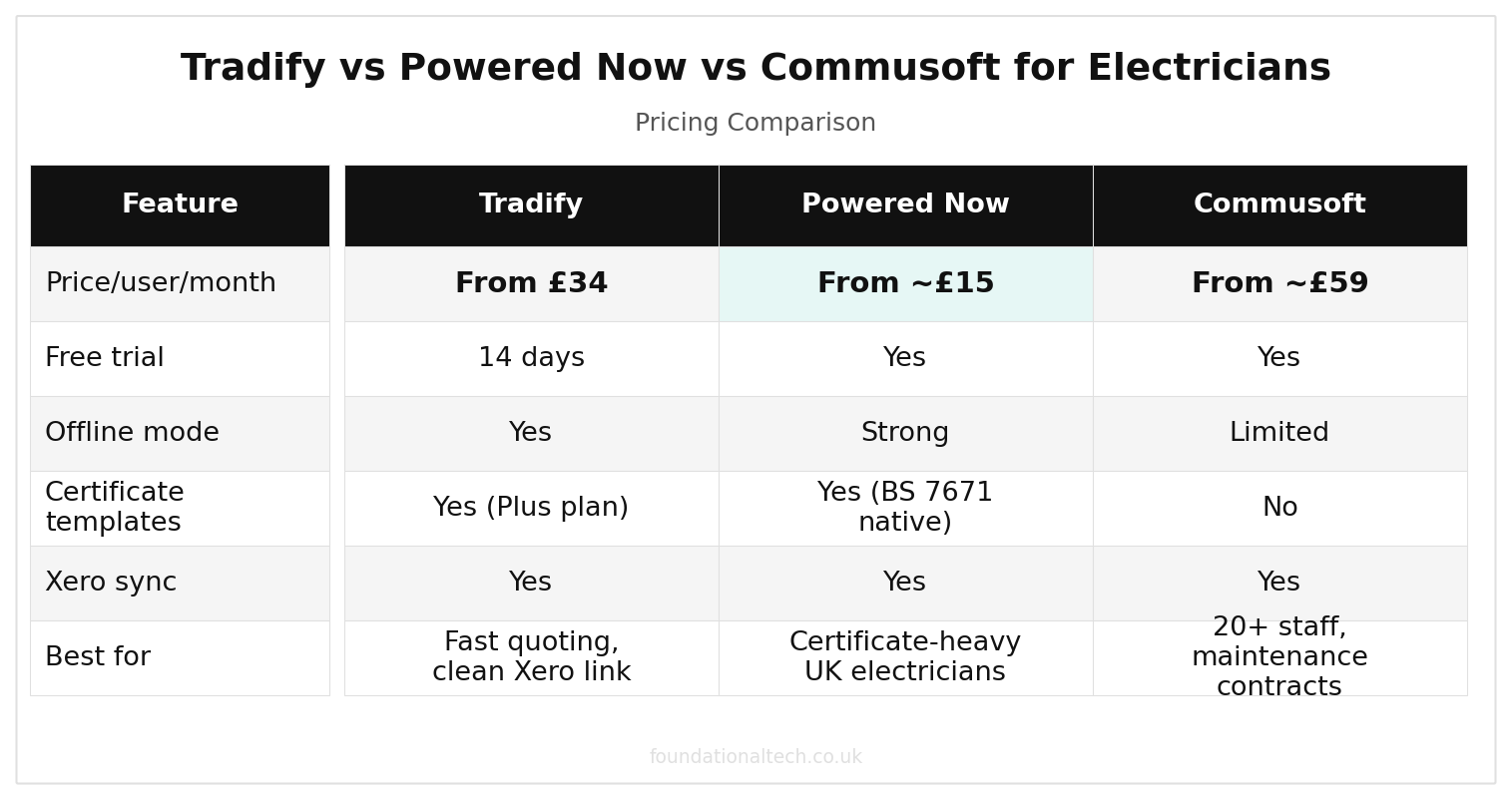
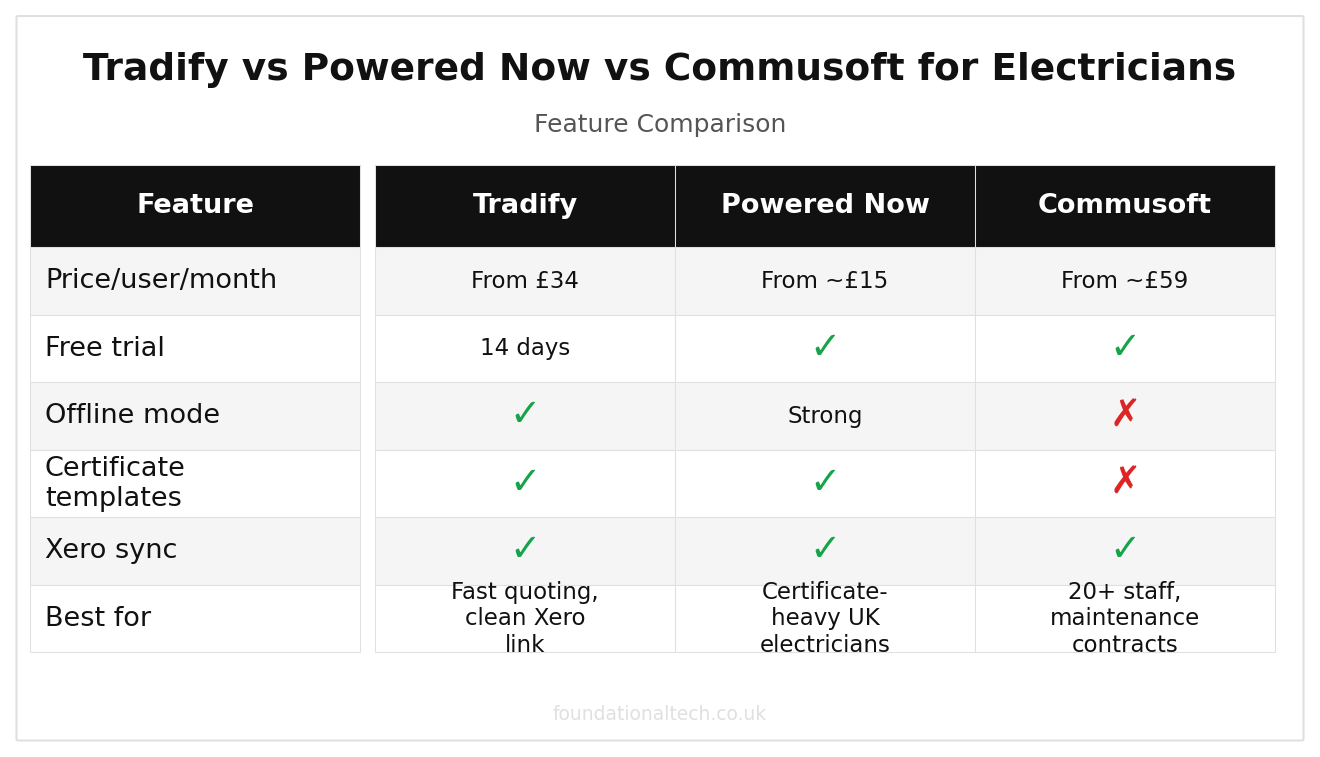
| Feature | Tradify | Powered Now | Commusoft |
|---|---|---|---|
| Price/user/month | From £34 | From ~£15 | From ~£59 |
| Free trial | 14 days | Yes | Yes |
| Offline mode | Yes | Strong | Limited |
| Certificate templates | Yes (Plus plan) | Yes (BS 7671 native) | No |
| Xero sync | Yes | Yes | Yes |
| Best for | Fast quoting, clean Xero link | Certificate-heavy UK electricians | 20+ staff, maintenance contracts |
Monthly pricing comparison (GBP, as of 2026)
The Contenders
Tradify
Best for: Sole traders and teams of up to about ten who want fast quoting and clean accounting.
UK pricing: £34 per user per month (Lite); £44 per user per month (Plus, which adds digital forms and certificates). 14-day free trial, no card required.
Xero integration: Native, and widely rated the cleanest in the category.
Standout feature: The mobile quoting flow. You can build and send a professional quote from the customer's driveway in a few minutes, and turn it into a job and then an invoice without retyping a thing.
Weakness: It is built in New Zealand, not Britain. UK-specific needs like CIS Domestic Reverse Charge VAT and BS 7671 certificate templates are not as deeply native as Powered Now's, though the Plus plan covers forms and certificates.
Powered Now
Best for: UK sole traders and small firms who want everything built for British rules out of the box — especially heavy certificate users.
UK pricing: From around £15 a month for solo traders, scaling to roughly £34 per user per month for teams.
Xero integration: Yes, plus strong standalone invoicing and accounting features.
Standout feature: It is the only fully UK-native platform of the three. It works offline (essential in a plant room with no signal), handles CIS Domestic Reverse Charge VAT automatically, and ships with ready-made BS 7671 certificate templates — EIC, EICR, Minor Works, PAT testing records, fire alarm sign-offs, and emergency lighting reports.
Weakness: The interface feels less polished than Tradify's, and it is less well known, so fewer of your mates will be able to help you set it up.
Commusoft
Best for: Mid-size and larger firms — roughly 20 staff and up — running fleets, maintenance contracts, or work for housing associations and facilities-management clients.
UK pricing: Paid plans start around £59 a month, tiered by modules and users, usually on a custom quote.
Xero integration: Yes, alongside deep job-costing and reporting.
Standout feature: Scale. Asset tracking, planned preventive maintenance (PPM) scheduling, and customer-journey tools are genuinely strong if you manage recurring maintenance across many sites.
Weakness: Overkill and overpriced for a one- or two-van operation. The power comes with complexity you do not need until you are bigger.
Head-to-Head: The Decision Matrix
How Each One Actually Feels to Use
A feature table tells you what a tool can do. It does not tell you what a Tuesday feels like with it in your pocket. Here is the honest texture of each.
With Tradify, the day runs through the quote. You pull up on the customer's drive, open the app, pick the consumer-unit template you saved, adjust the labour and add a couple of materials, and the quote is in their inbox before you have finished your tea. They accept it on their phone; it becomes a job without you touching it. You complete the work, mark it done, and the invoice goes out the same afternoon — already in Xero, already waiting for the bank feed to match the payment. The whole appeal is speed and tidiness: you never feel you are fighting the software, and nothing sits in a notebook waiting to be typed up at night.
With Powered Now, the day runs through the certificate. You finish an EICR, open the matching BS 7671 template, fill in the circuits and observations on site, and email the signed certificate to the landlord before you leave — no exporting to a second app, no retyping the address. CIS Reverse Charge VAT works itself out in the background, which matters if you subcontract on commercial sites. It is less glossy than Tradify, and you will occasionally wish a screen were laid out differently, but for a certificate-heavy firm the fact that everything British is built in, and that it keeps working in a basement plant room with no signal, outweighs the rougher finish.
With Commusoft, the day runs through the contract. If you manage planned maintenance across dozens of sites for a housing association, the software earns its price by remembering what you cannot: which boiler is due its service, which asset failed last time, which engineer is nearest. For a sole trader that intelligence is dead weight you pay for and never use. For a firm with an office manager and several vans, it is the difference between a maintenance contract that runs smoothly and one that quietly loses you money on missed visits.
There is one feeling all three share once they are set up: the quiet relief of a single source of truth. Whichever you pick, the win is that a job lives in one place from enquiry to paid invoice, instead of scattered across a paper diary, a notes app, a separate invoicing tool and your memory. Collapsing those disconnected systems into one is the change you actually feel, and any of these three delivers it.
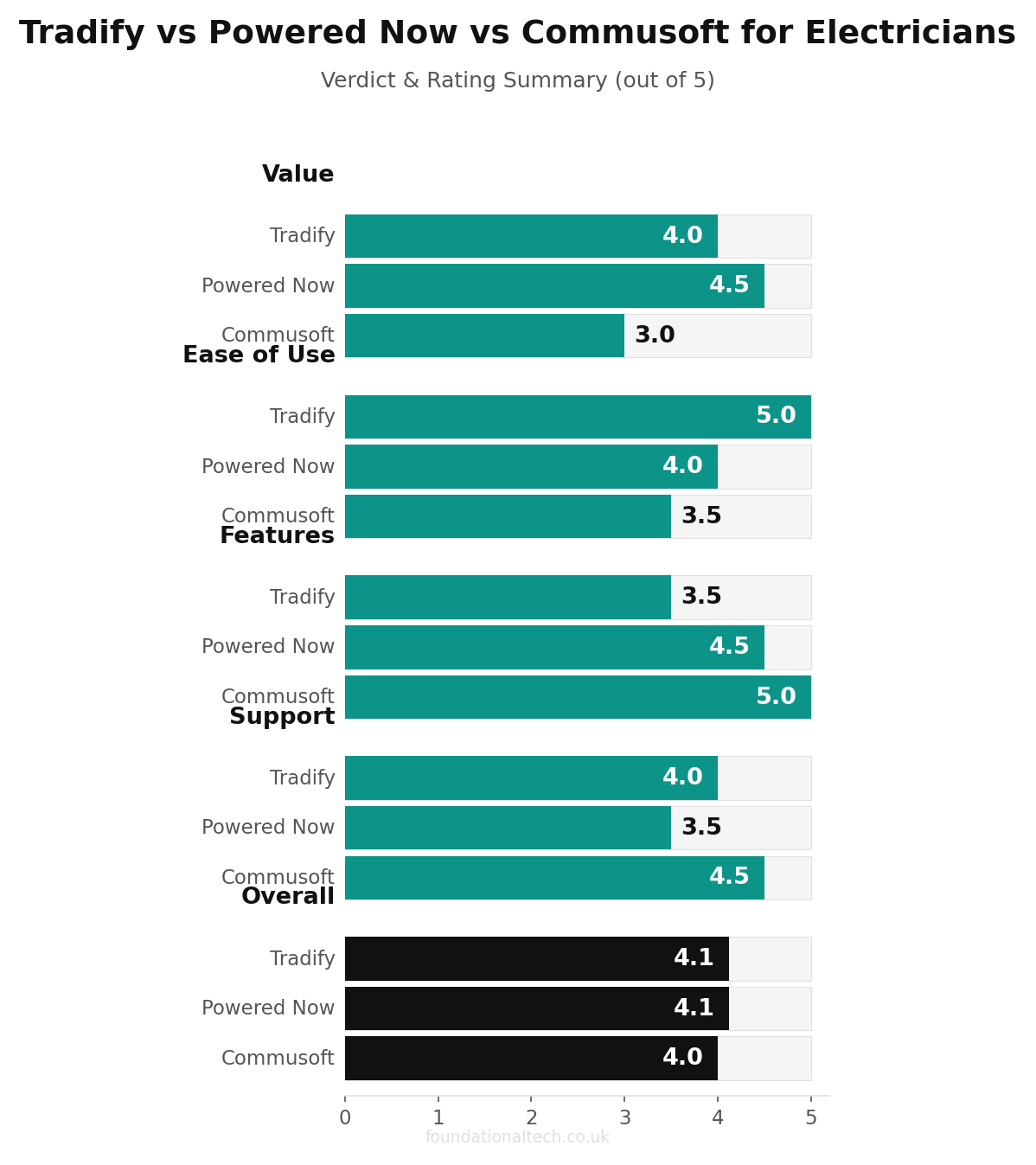
The pattern is clear once you see it. Each tool is shaped around the thing its typical user does most: Tradify around quoting, Powered Now around certifying, Commusoft around maintaining. The right question is not "which has the most features" but "which is built around the part of my week that hurts most." Answer that honestly and the choice usually makes itself.
The Setup: Getting Started in Under an Hour
Whichever you choose, the first hour decides whether you actually stick with it. Here is the path for Tradify, the most common starting point.
First, start the 14-day trial — no card needed. Spend ten minutes adding your business details, logo, and VAT number so quotes and invoices come out looking professional from day one.
Second, build one quote template for your most common job. For most electricians that is a consumer unit replacement or an EICR. Save it as a recurring item so you never rebuild it. This single step is where the time savings start.
Third — and this is the step people skip and regret — connect Xero immediately. In Tradify, go to Settings, then Integrations, choose Xero, and authorise the connection. Map your account codes once: sales, materials, labour. From that moment, every invoice you raise flows into your accounts automatically and your bank feed matches the payments. Reconciliation stops being a job.
Fourth, do one real job through the system end to end before you commit. Quote it on your phone, convert it, invoice it, and watch it land in Xero. If that loop feels smooth — and for most electricians it does — you have found your production engine.
What It Actually Costs Over a Year
The sticker price on the website is rarely the price you pay, so it is worth doing the annual sum before you commit. For a sole trader, Tradify Lite at £34 a month is about £408 a year; the Plus plan, which adds the certificate and forms you almost certainly need, is roughly £528. Powered Now starts nearer £180 a year for a solo licence, which is why it wins on raw cost for a one-van firm. Commusoft rarely lands below £700 a year once you add the modules, and for a small firm that is money spent on capacity you will not use for years.
But the licence is only half the bill. The real cost of the wrong choice is the time you pour into a tool that does not quite fit: the certificate you export to a second app because your job software cannot produce it, the VAT figure you retype because the Xero link is flaky, the quote you rebuild from scratch because there is no template. Reckon a couple of hours a week lost to friction like that and, at £40 an hour on the tools, you have handed back £4,000 a year in time to save £200 on subscriptions. The cheapest tool on paper is often the most expensive one to live with.
There is also the cost you cannot see until you try to leave: your data. Before you sign up, check that the platform lets you export your full customer list, job history, and certificates in a standard format. A tool that holds your history hostage is one you will resent the day you outgrow it. All three platforms here allow a clean export, which is one more reason they beat the cheaper unknowns that turn up in a search.
Three Mistakes Electricians Make Choosing Job Software
The first mistake is buying for the firm you want to be in five years rather than the one you run today. A sole trader does not need Commusoft's asset register. Buy for now, and upgrade when the pain is real, not imagined.
The second is choosing on features instead of fit. Every platform lists fifty things it can do. You will use six of them daily. Work out what those six are — quoting, certificates, invoicing, scheduling, Xero, payment collection — and judge each tool on how well it does those, not on the length of its feature list.
The third, and the costliest, is never connecting the accounting. Plenty of electricians run a job app and a separate accounting system and copy figures between them by hand for years. That manual bridge is exactly the admin you bought the software to kill. Connect Xero on day one, or you have paid for a faster horse and left it in the stable.
What About ServiceM8 and Jobber?
Two other names will land in your search results, so let's deal with them quickly rather than pretend they don't exist.
ServiceM8 is a strong, good-looking app popular with smaller field-service businesses. Its pricing is job-based rather than per-user, which can work out cheap if you do a low volume of high-value jobs and expensive if you do lots of small ones. For a busy domestic electrician churning through many jobs a week, the per-job model can bite. It is worth a trial, but run your real job count through the pricing first.
Jobber is a polished North American platform with excellent client communication tools — automated appointment reminders, follow-ups, and a customer portal. The catch for UK electricians is the same as Tradify's, only more so: it is not built for British compliance. No native CIS Reverse Charge handling, no BS 7671 certificate templates. If client experience matters more to you than certificates, it is a contender. For most UK electricians, the certificate gap rules it out as a primary tool.
The honest summary: ServiceM8 and Jobber are fine software, but for a UK electrician the certificate and CIS requirements push the decision back toward Tradify, Powered Now, or Commusoft.
When to Switch — and When to Stay Put
If you are already on a system that works, do not switch for the sake of a slightly nicer screen. Migration has a real cost: re-entering customers, rebuilding templates, retraining yourself and your team, and the quiet risk of a job slipping through the cracks during the handover. A platform that is merely adequate but fully set up beats a better one that you only half-configured.
Switch when the pain is structural, not cosmetic. The clear triggers: you are paying per job and your volume has made it expensive; you are copying certificates between two separate apps because your job software can't produce them; you have outgrown the tool and it can't handle a second or third van; or your accountant is begging you to connect to Xero and your current system won't.
When you do switch, move at a quarter boundary if you can — it keeps your VAT and accounting periods clean — and run the old and new systems in parallel for two weeks rather than cutting over on a single Monday morning. Export your customer list and your open jobs first, and rebuild your three most common quote templates before you migrate a single live job.
The Verdict
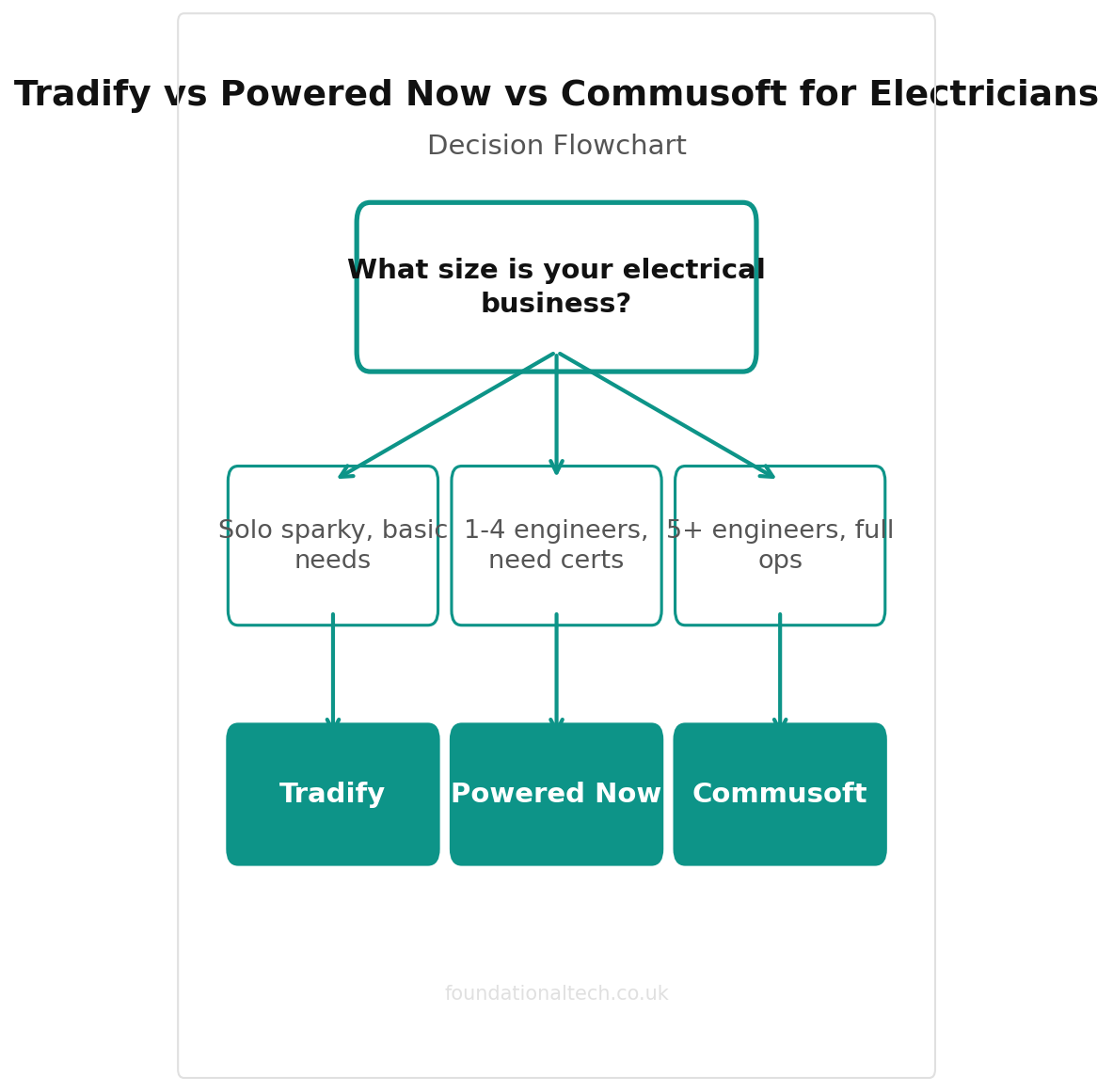
No hedging. Here is the call by business type.
If you are a sole trader or a small team that lives on quoting and wants the slickest experience with the cleanest Xero link, choose Tradify. It is the safe, fast default, and the one most likely to still suit you in two years.
If you write certificates all day and want British rules — CIS Reverse Charge, BS 7671 templates, offline working — handled natively without bolt-ons, choose Powered Now. For a certificate-heavy UK electrician on a budget, it is often the smarter buy, and it is cheaper to start.
If you are running 20-plus staff, fleets, or planned maintenance contracts for housing associations and FM clients, choose Commusoft. The asset tracking and PPM scheduling earn their keep at that scale, and the lighter tools will start to creak.
Whatever you pick, the real win is the same: enter each job once, and let it flow through to a paid invoice in your accounts without you typing it four times. Get that working and you will wonder how you ever ran the business out of a notebook.
Which tool are you running your jobs on right now — and is it actually saving you time, or are you quietly shopping for the alternative? Tell me what you're on and what's frustrating you about it.
Tradify vs Powered Now: Which Is Better for Electricians?
Tradify is better for electricians who prioritise fast quoting and a polished Xero integration. Powered Now is better for certificate-heavy UK electricians who need BS 7671 templates, CIS Reverse Charge handling and offline working built in at a lower price. Choose Tradify for speed and polish, Powered Now for British compliance out of the box.