Key Takeaway
Automate nightly cash-up and restaurant finance for UK hospitality businesses. Connect your EPOS to Xero and payroll in one frictionless stack for 2026.
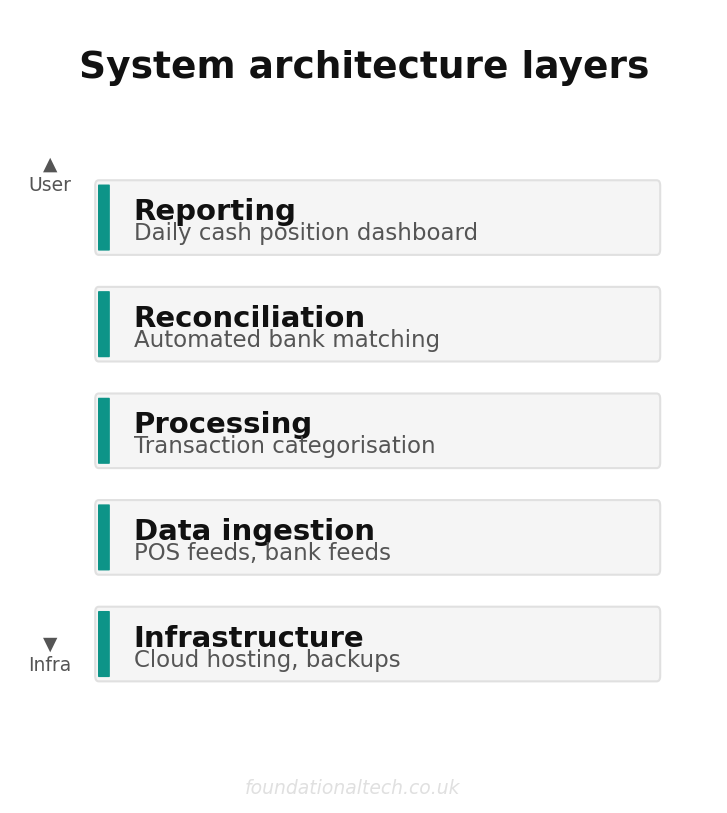
Quick Answer: The legacy restaurant model—where front-of-house sales are trapped in a till and supplier invoices sit in a kitchen drawer—leads to massive financial blind spots. At Foundational Tech, we analyse the highest-performing hospitality operators and find they all deploy a connected software stack. By wiring a smart till (Lightspeed), a receipt scanner (Dext), a central ledger with a live bank feed (Xero), and an inventory manager (MarketMan), operators eliminate manual data entry. This interconnected setup allows managers to track precise food costs and daily profitability in real-time, frequently reducing their Cost of Goods Sold (COGS) and saving hours of administrative work.
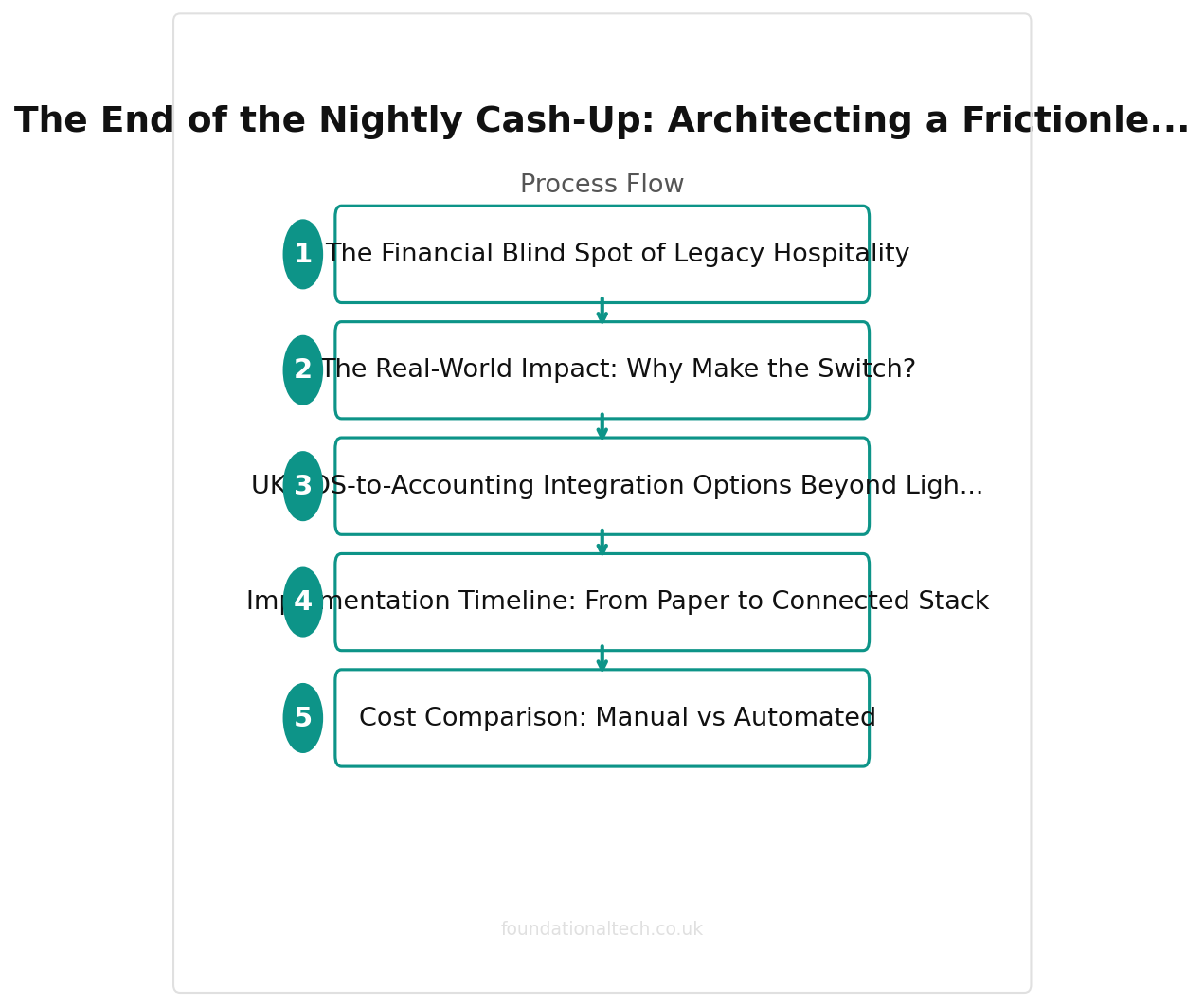
The Financial Blind Spot of Legacy Hospitality
The single biggest problem in traditional hospitality is the delay of information. In a standard setup, a manager rings up sales on a basic till, the chef manages ingredients on a clipboard, and someone eventually types all those numbers into a spreadsheet weeks later.
45 min → 5 min
nightly cash-up time with POS-to-accounting automation
| POS System | Xero Integration | Monthly Cost |
|---|---|---|
| Square | Native app (free) | £0 |
| Epos Now | Built-in integration | From £25 |
| Tevalis | Via middleware (Make/Zapier) | From £39 |
| Lightspeed | Native integration | From £59 |
Because these systems do not talk to each other, the restaurant operates blindly. By the time an accountant manually compares the supplier bills against the monthly sales to calculate food costs, a month has passed. If a supplier quietly increased the price of cooking oil by 15%, the restaurant bled profit for four weeks before anyone noticed.
To gain a true “full restaurant view,” you must stop relying on human data entry and let specialised software pass the information around automatically.
The Connected Restaurant Setup (With Accurate 2026 UK Costs & Verified Reviews)
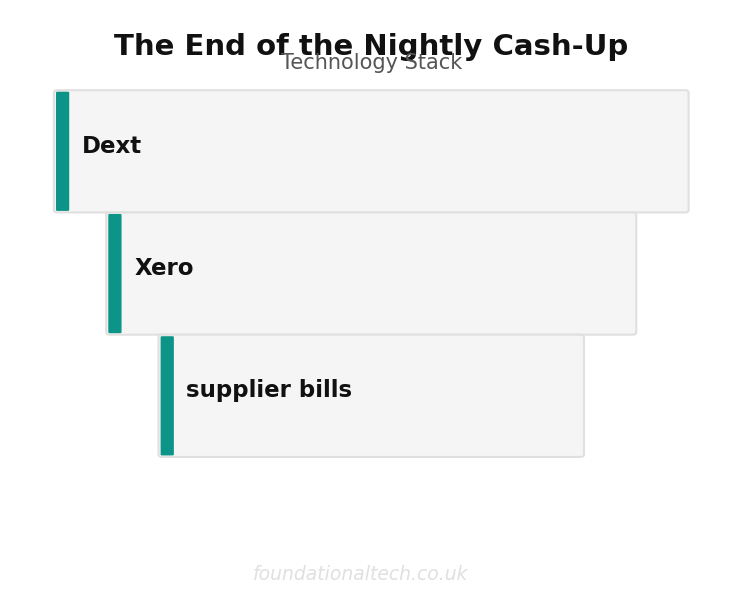
You do not need an IT degree to automate a restaurant. You simply need four specific tools that connect natively. Here is the breakdown of the exact systems, their verified 2026 UK pricing, and how they perform in the real world according to active operators.
1. The Front-of-House Till: Lightspeed EPOS
What it does: Lightspeed handles the customer orders, logging the exact time of day and the specific menu item sold. It automatically sends your end-of-day sales totals straight to your accounting software.
Accurate 2026 Cost: In the UK, Lightspeed software starts at £75 per month for the basic retail/restaurant package. Hardware is quoted separately, but renting hardware (like terminals and kitchen displays) through partners typically adds £30 to £50 per month per terminal.
The Verdict: Lightspeed is highly rated for multi-location retailers and hospitality groups. While it carries a higher monthly fee than basic till systems, operators note it pays for itself by eliminating manual daily sales reports and seamlessly syncing advanced inventory data directly to backend operations.
2. The Kitchen Scanner: Dext Prepare
What it does: Dext completely replaces the need to manually type up supplier bills. When the morning delivery arrives, the head chef takes a photo of the paper bill with their phone, and the platform intelligently extracts the supplier name, date, and VAT breakdown.
Accurate 2026 Cost: For business entities, the paid version of Dext starts at £24.00 per month.
The Verdict: Dext is an absolute powerhouse in the automation space, processing hundreds of millions of documents a year with up to 99.9% data extraction accuracy. It is used by over 700,000 businesses globally, with reviewers consistently highlighting how its AI-driven categorisation saves them hours every week by removing manual data entry from their kitchen operations.
3. The Financial Brain & Live Bank Feed: Xero
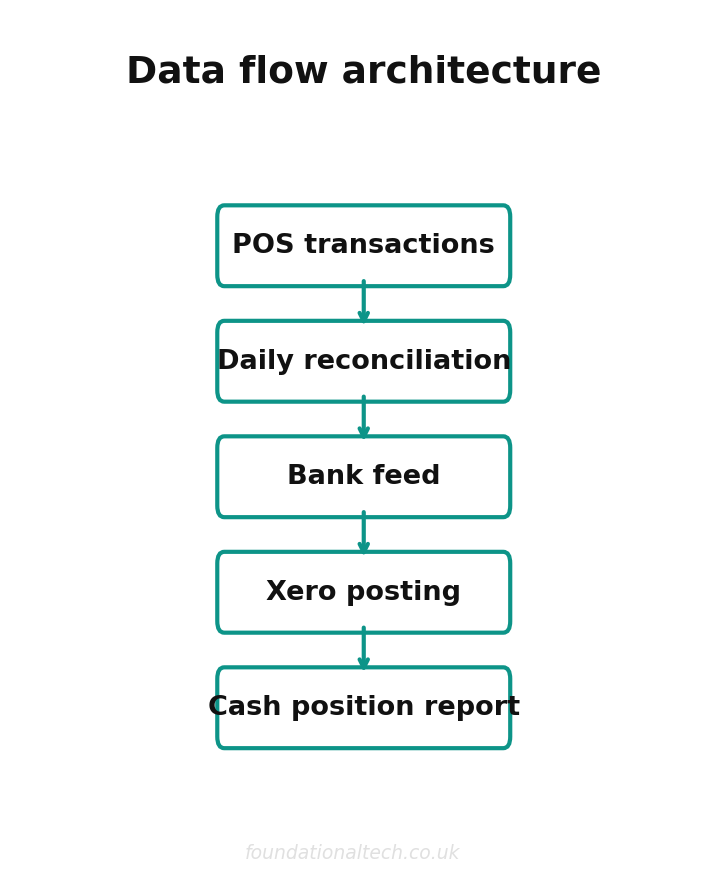
What it does: Xero is the central hub. It collects the daily sales numbers from Lightspeed and the digitised bills from Dext. Most importantly, it connects directly to the business bank account, automatically matching live bank deposits against reported sales and paid bills with zero manual cross-referencing.
Accurate 2026 Cost: For the UK market, standard non-promotional pricing starts at £15 per month for the Starter plan and £33 per month for the Standard plan, which allows for unlimited invoices and bills.
The Verdict: Xero is a standard-bearer for growing businesses needing robust functionality. Users consistently highlight the automated bank feed reconciliation, noting it ensures their cash flow and business stay perfectly aligned with minimal daily effort.
4. The Missing Link for Food Costs: MarketMan
What it does: Knowing your sales and paying your bills is great, but it doesn’t tell you how your kitchen is performing. MarketMan pulls the exact menu items sold from Lightspeed and the exact cost of raw ingredients from Xero/Dext to track your actual inventory and calculate recipe profitability in real-time.
Accurate 2026 Cost: The Starter tier begins at $199 USD per month (roughly £155), with higher tiers like Operator and Professional sitting at $239 and $299 respectively.
The Verdict: MarketMan acts as the operational brain of the kitchen. While it is an added expense, operators view it as a critical investment to catch kitchen waste and vendor price hikes before they impact the bottom line.
The Real-World Impact: Why Make the Switch?
The true power of this automated stack is proven by the operators who have successfully deployed it to reclaim their margins and their time.
Drastically Lowering COGS: Without real-time tracking, food costs frequently spiral out of control. Anne Ng, owner of Bakery Lorraine, reported that deploying MarketMan allowed them to evaluate costs constantly, successfully bringing their Cost of Goods Sold down from around 30%.
Reclaiming Management Hours: Manual inventory and bill entry is an exhausting routine. Carly Lund, Assistant Operations Manager at Pine State Biscuits, noted that deploying the system reduced her daily administrative workload from two or three hours down to just 30 to 45 minutes, allowing her to actually problem-solve with her team in real-time.
Bridging Team Communication: Daniel Cooper, Director of Supply Chain Management at Lovekind, noted that the software helps different teams collaborate, allowing them to instantly log into the platform to see exactly why their food costs were running high on any given week.
Related guides: If you found this useful, see our guide on Architecting for LLMs: Why We Built a Luxury Travel Directory on Sanity and Cloudflare and How to Configure GoHighLevel Missed-Call Text-Back Correctly.
UK POS-to-Accounting Integration Options Beyond Lightspeed
Lightspeed is excellent, but it is not the only game in town. Depending on the size of your operation and what you actually need from a till system, there are several strong alternatives that integrate cleanly with Xero and Dext. Here is how the main contenders stack up for UK hospitality in 2026.
Square for Restaurants is the go-to for operators who want zero upfront software costs. The POS software itself is completely free, and you pay only the card processing fee of 1.75% per transaction. Square connects to Xero through a native integration, and receipts from Square suppliers can be fed through Dext as normal. The catch is that Square's inventory management is basic compared to Lightspeed, so if you need detailed recipe costing, you will still want MarketMan or a similar bolt-on. Square is ideal for food trucks, coffee vans, pop-ups, and single-site cafés doing under £500,000 turnover where simplicity matters more than deep reporting.
Epos Now starts from around £25 per month for software, with hardware bundles available from around £399 upfront or on lease. It has a solid Xero integration and works well with Dext for the purchase side. Epos Now is popular with independent restaurants and takeaways across the UK because the hardware is robust and the system handles table management, kitchen display screens, and delivery platform integrations. It suits single-site restaurants and small groups of two to three locations that want a reliable, no-nonsense EPOS without Lightspeed's price tag.
Tevalis is the enterprise option. You will not find public pricing because it is quote-based, typically starting north of £150 per month per site with bespoke hardware and configuration. Tevalis is used by groups like Dishoom and The Ivy Collection. It offers deep integration with Xero and can push granular data into accounting systems at a level of detail that smaller systems cannot match. If you are running five or more sites, Tevalis is worth a conversation, but it is overkill for a single restaurant.
Goodtill (now SumUp POS) starts from around £29 per month and runs on iPad hardware, keeping upfront costs low. It connects to Xero and handles Dext receipts through the standard workflow. Goodtill is a strong middle-ground option for independent restaurants that have outgrown Square but do not need the depth of Lightspeed or the enterprise scale of Tevalis. It handles table service, takeaway, and basic inventory tracking competently.
The right choice depends on your size and complexity. A food truck doing £3,000 a week should start with Square and spend the savings on MarketMan. A busy independent restaurant turning over £15,000 a week will get good value from Epos Now or Goodtill. A multi-site group should look at Lightspeed or Tevalis. The critical thing is not which POS you pick — it is that whichever you choose connects natively to Xero so your sales data flows automatically without anyone retyping numbers at midnight.
Implementation Timeline: From Paper to Connected Stack
Knowing what to buy is one thing. Actually getting it all running without disrupting service is another. Here is a realistic week-by-week timeline based on what we see working for independent UK restaurants.
Week 1: Set up Xero and connect your bank feed. Start here because Xero is the hub everything else connects to. Sign up for the Standard plan at £33 per month, connect your business bank account (most UK high-street banks connect within 24 hours), and set up your chart of accounts. For hospitality, you want separate nominal codes for food purchases, drink purchases, cleaning supplies, and staff costs at minimum. Your accountant can help with this if you are unsure, and most will do it for free if they are already on Xero.
Week 2: Deploy Dext and train your kitchen team on photo capture. Sign up for Dext at £24 per month, connect it to Xero, and spend one service showing every member of staff how to photograph a delivery note. The key here is making it dead simple: stick a laminated card next to the goods-in door with the three steps (open app, photograph, done). The biggest obstacle is not the technology — it is getting the head chef to stop shoving paper invoices into a drawer. Give it a full week of daily reminders before you consider it embedded.
Week 3: Install your POS and connect it to Xero. Whether you choose Lightspeed, Square, Epos Now, or Goodtill, the Xero integration typically takes under ten minutes to configure. The harder part is setting up your menu correctly in the POS, importing your item list, and training front-of-house staff. Allow a full week for this, ideally going live mid-week so you have quieter days to iron out problems before the weekend rush.
Week 4: Add MarketMan, import your recipes, and connect the final links. MarketMan needs your recipe cards entered with ingredient quantities and your supplier price lists loaded. This is the most time-consuming step, but it is also where the real insight comes from. Start with your top twenty dishes by sales volume — those will cover 80% of your food cost visibility.
Realistically, expect four to six weeks from start to finish for a full deployment. The common gotchas that trip people up include VAT flat rate scheme complications (if you are on the flat rate scheme, your POS will report VAT at standard rates but your Xero needs to apply the flat rate — make sure your accountant configures this correctly from day one) and split payment reconciliation, where customers pay partly in cash and partly by card, which can create mismatches between your POS totals and your bank feed if not handled properly.
Cost Comparison: Manual vs Automated
The question every restaurant owner asks is whether all this software actually saves money compared to doing things the old-fashioned way. The answer, when you run the numbers, is unambiguous.
The manual approach typically involves a bookkeeper spending eight to twelve hours per month on data entry, bank reconciliation, supplier invoice processing, and VAT returns. At £25 to £35 per hour (standard rates for a competent UK bookkeeper in 2026), that is £200 to £420 per month in bookkeeping fees alone. On top of that, you are spending your own time — or your manager's time — on the nightly cash-up, stock counts, and chasing supplier invoices. And then there are the errors: miskeyed figures, missed invoices, and the stock discrepancies that nobody notices until the quarterly accounts look wrong.
The automated stack costs roughly £230 to £270 per month in total: Xero Standard at £33, Dext at £24, a mid-range POS at £25 to £75, and MarketMan from around £155. That sounds comparable to the bookkeeping fees until you factor in what automation actually eliminates. Your bookkeeper's hours drop to two or three per month (they still need to review and file returns), saving £150 to £300. Your own admin time drops dramatically. And critically, the stock accuracy improvements alone typically save 2% to 5% of revenue.
For a restaurant turning over £20,000 a week, a 2% reduction in waste and untracked costs represents £400 a week, or roughly £1,600 a month. That means the entire software stack pays for itself within the first month from reduced Cost of Goods Sold alone, before you even count the bookkeeper savings or the value of your own recovered time.
The hidden cost of manual processes that nobody talks about is stocktake error. In UK hospitality, untracked waste, over-portioning, and supplier invoice discrepancies typically account for 2% to 5% of total revenue. On a £1 million annual turnover, that is £20,000 to £50,000 walking out the door every year. An automated inventory system does not eliminate all of it, but operators consistently report halving those losses within the first quarter of deployment.
By building this exact setup, operators escape the exhausting hustle of manual paperwork. When a customer orders a steak, Lightspeed rings the sale, MarketMan deducts the raw steak from inventory, and the next morning, Xero matches the customer’s payment in the live bank feed. You transform your restaurant from a chaotic, reactive kitchen into a smooth, predictable business where every penny is tracked without a single keystroke.