Key Takeaway
12 Claude AI prompts for UK accountants in 2026. Copy-paste templates for client emails, compliance and advisory.
Forty words separate a useless AI response from a client-ready tax summary. That’s the gap between “write me an email about dividends” and a prompt that specifies the tax year, the client’s position, and the tone you need. One produces waffle. The other produces a draft you’d send after a 30-second review.
45 min → 4 sec
Average time to draft a professional accountancy practice document — manual vs AI-assisted
These 12 prompts are tested against real UK accounting workflows. Copy them. Paste them. Replace the placeholders. Each one includes the exact text, when to use it, and how much time it saves.
Why Generic Prompts Fail for Accountants
Accounting prompts need four elements generic prompts skip: the UK tax context (which year, which rates), the client’s specific position, your firm’s tone, and the compliance boundary. That means specifying formal advisory vs friendly sole practitioner voice and defining what the AI should explicitly not advise on. Build these in, and Claude stops producing generic content and starts producing practice-ready drafts.
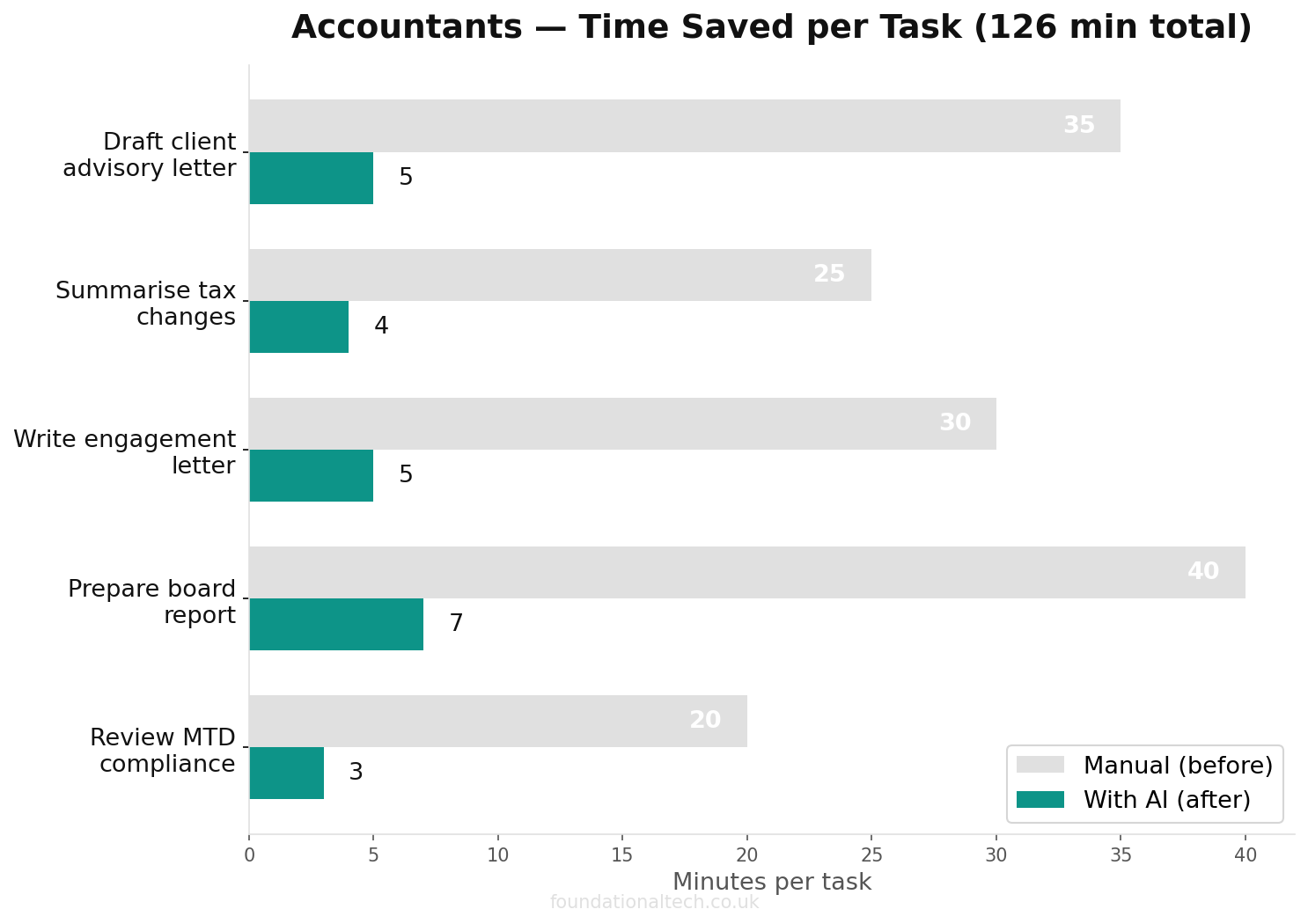
The Prompts
1. Client Tax Position Email
You are a UK chartered accountant writing to a client. Tax year: 2025/26.

Client situation: [PASTE 3-5 BULLET POINTS — e.g., "sole director of Ltd company, salary at £12,570, remaining profits £60,000, no other income, spouse is basic rate taxpayer"]

Write a 200-word email explaining the most tax-efficient extraction strategy. Use plain English — no jargon. Mention the specific allowances and rates that apply. End with a clear next step. Do not give definitive advice — frame as "options to discuss."

Tone: professional but warm, as if writing to a client you've known for three years.
When to use: After reviewing a client’s year-end position, when you need to communicate options before a planning meeting.
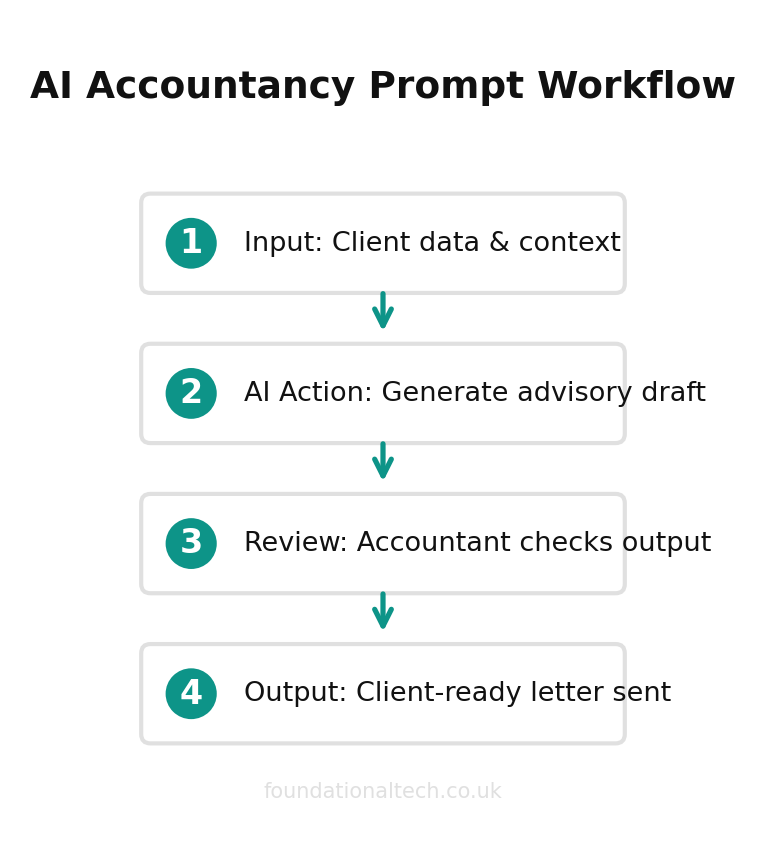
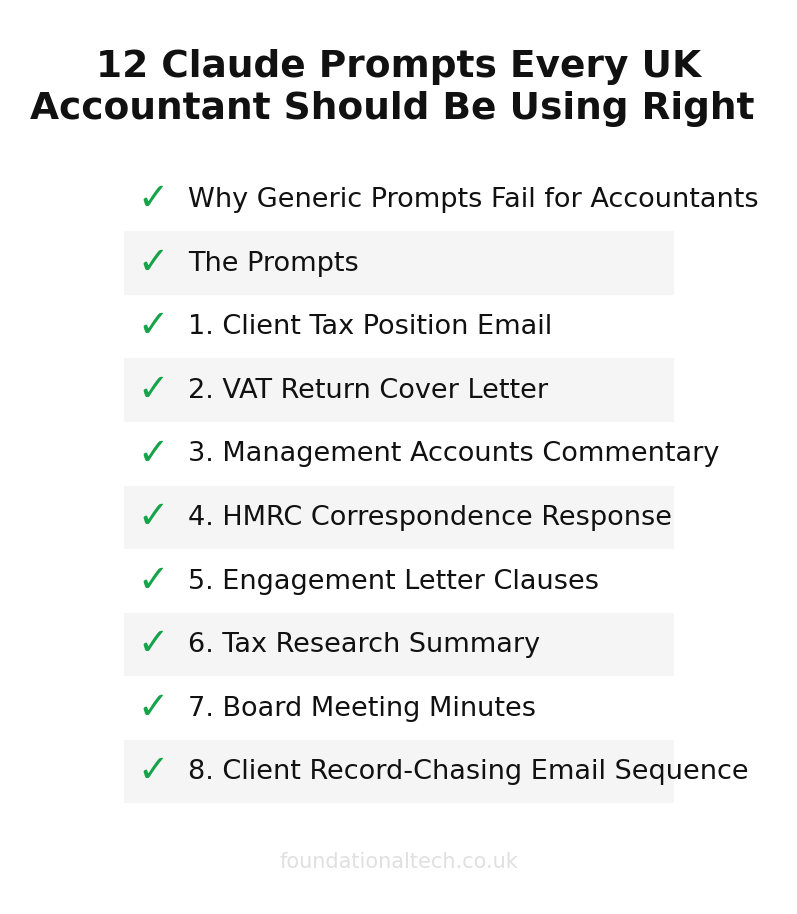
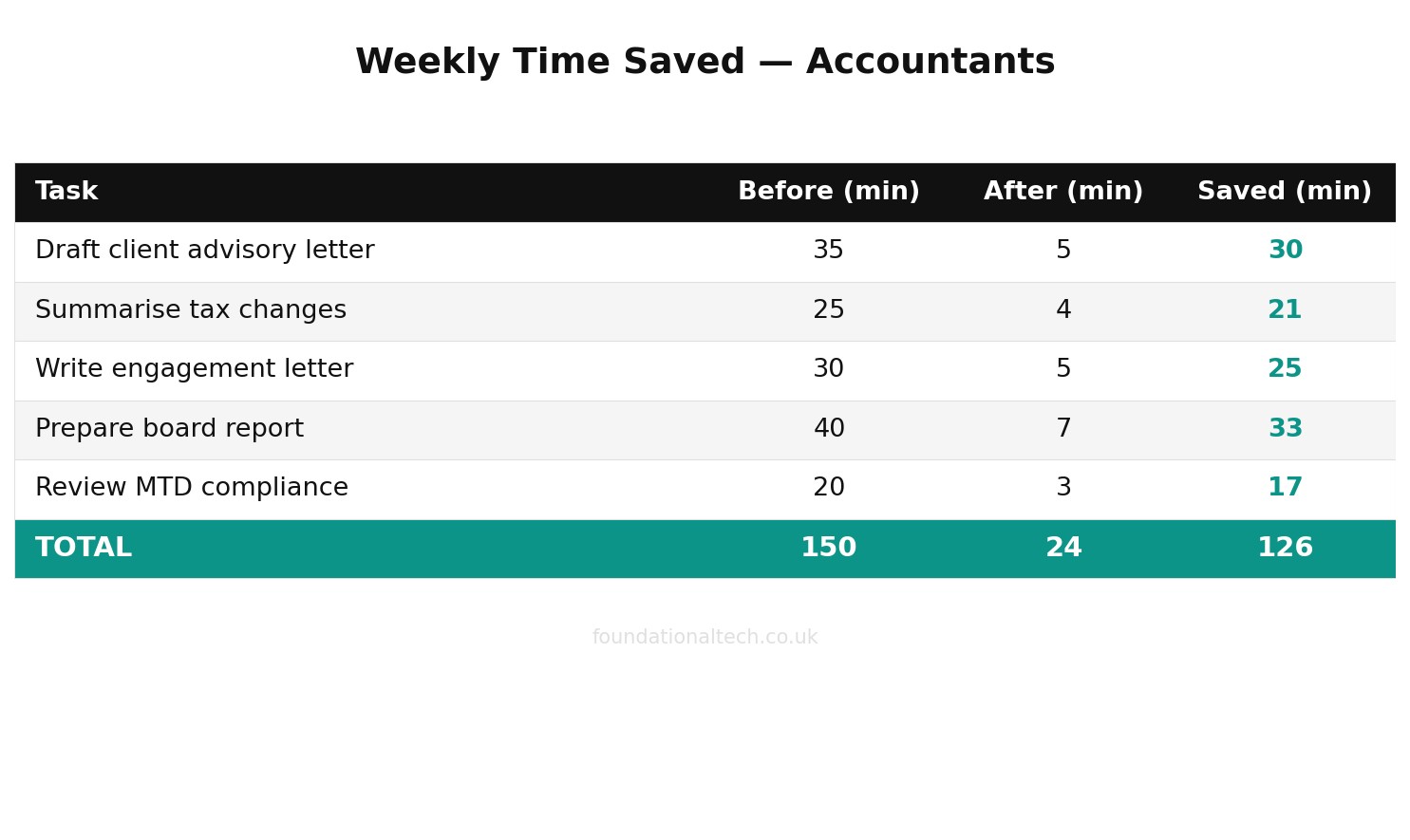
Time saved: 8-10 minutes per email. Across 30 year-end clients, that’s 4-5 hours.
2. VAT Return Cover Letter
Write a cover letter to accompany a UK VAT return for [QUARTER DATES]. The client is a [BUSINESS TYPE — e.g., "construction subcontractor registered for domestic reverse charge"].

Key figures: Output VAT £[X], Input VAT £[X], Net [payment/repayment] £[X].

Include: a plain-English summary of what the figures mean, any unusual items I should flag [LIST IF ANY — e.g., "one large capital purchase of £15,000 for a new van"], and a reminder of the next quarter's deadline.

Format: professional letter, under 250 words. Do not include any VAT advice — this is a factual summary only.
When to use: Every quarter, for every VAT-registered client. Standardises your output without losing the personal touch.
Time saved: 5 minutes per client. For 40 VAT clients, that’s over 3 hours per quarter.
3. Management Accounts Commentary
I'm preparing management accounts commentary for a UK [BUSINESS TYPE] for [MONTH/QUARTER].

Key figures:
- Revenue: £[X] (prior period: £[X])
- Gross profit margin: [X]% (prior: [X]%)
- Overheads: £[X] (prior: £[X])
- Net profit: £[X] (prior: £[X])

Context I know: [2-3 sentences — e.g., "They lost a major contract in February worth £3,000/month. They hired one new employee in March at £28,000 salary."]

Write a 300-word commentary covering: the three most significant variances, what's driving them, and one forward-looking observation. Write for a business owner who understands their business but not accounting terminology.
When to use: Monthly or quarterly management accounts packs. This replaces the blank-page problem — you get a structured first draft in 30 seconds, then add the context only you know.
Time saved: 15-20 minutes per client. For advisory clients receiving monthly packs, this compounds fast.
4. HMRC Correspondence Response
A UK client has received a letter from HMRC regarding [DESCRIBE — e.g., "a compliance check into their 2023/24 self-assessment return, specifically querying property income expenses"].

Draft a response letter from me (their accountant/tax agent) to HMRC. Include:
- Our UTR/agent reference: [REF]
- Client UTR: [CLIENT UTR]
- A professional, cooperative tone
- The specific information HMRC has requested: [LIST ITEMS]
- A request for additional time if appropriate

Format as a formal letter. Keep factual — do not volunteer information beyond what's been asked.
When to use: Any HMRC query, compliance check, or information request. The prompt enforces the golden rule — answer what’s asked, nothing more.
Time saved: 20-30 minutes. HMRC letters cause disproportionate anxiety and tend to get over-drafted. This produces a clean first version immediately.
5. Engagement Letter Clauses
Draft the scope of work section for a UK accountancy engagement letter covering:

Services: [LIST — e.g., "annual accounts preparation for a UK limited company, corporation tax return, VAT returns (quarterly, standard scheme), payroll for 3 employees, auto-enrolment pension administration"]

Include: what's included, what's explicitly excluded, the client's responsibilities (providing records, meeting deadlines), and our limitation of liability. Reference relevant UK standards where appropriate (e.g., FRS 102 Section 1A for small company accounts).

Write in formal but clear English. 400 words maximum.
When to use: New client onboarding, annual engagement letter renewals, or when adding services to an existing client.
Time saved: 15 minutes. Engagement letters are essential but tedious. This generates the substantive clauses — you add your firm’s standard terms around them.
6. Tax Research Summary
I need a summary of UK tax rules for: [SPECIFIC TOPIC — e.g., "Business Asset Disposal Relief (BADR) conditions for a client selling 40% of their shares in a trading company, held for 4 years, where they are a part-time working director"].

Cover: qualifying conditions, current thresholds and rates (2025/26), common pitfalls, and any recent changes or tribunal decisions I should be aware of.

Format as bullet points under clear headings. Flag anything where the rules are ambiguous or where professional judgement is required. End with "VERIFY: [list any specific figures or dates that must be checked against primary HMRC sources]."
When to use: Before advising a client on a specific tax position. This gives you a structured starting point faster than trawling GOV.UK. Always verify the figures — Claude occasionally gets thresholds wrong.
Time saved: 20-30 minutes of research time, reduced to a 2-minute review.
7. Board Meeting Minutes
Draft board minutes for a UK limited company board meeting. Date: [DATE]. Directors present: [NAMES].

Resolutions to record:
[LIST — e.g., "1. Approval of annual accounts for year ended [DATE]. 2. Declaration of final dividend of £[X] per share. 3. Reappointment of [FIRM NAME] as auditors/accountants. 4. Approval of director's loan account balance of £[X]."]

Include standard opening (quorum confirmed, chair appointed), each resolution with proposer and seconder, and closing. Format as a formal minute book entry. Use Companies Act 2006 language where appropriate.
When to use: Annual accounts approval, dividend declarations, any corporate decision requiring a paper trail.
Time saved: 10-15 minutes. Minutes follow a rigid format — this is exactly the kind of template work AI handles well.
8. Client Record-Chasing Email Sequence
Write 3 versions of a client chasing email for a UK accountancy practice. The client hasn't submitted their records for [TAX YEAR — e.g., "2025/26 self-assessment"].

Deadline context: The self-assessment filing deadline is 31 January [YEAR+1]. HMRC charges a £100 late filing penalty.

Version 1 (friendly first reminder, 3 months before deadline): warm, brief, helpful
Version 2 (firmer second reminder, 6 weeks before deadline): professional urgency, mention deadline consequences
Version 3 (final notice, 2 weeks before deadline): direct, mention that we may not be able to file on time, explain penalty implications

Each email: under 150 words. Include a clear call to action. Never threatening — always professional.
When to use: September-January annually. Build these into your practice management system as templates and customise with client names.
Time saved: 30 minutes to create a full sequence. Reusable across all self-assessment clients.
9. Payroll Query Response
A client has asked: "[PASTE THEIR EXACT QUESTION — e.g., 'One of my employees wants to salary sacrifice into their pension. How does this work and will it save me NI?']"

Context: The client is a UK employer with [X] employees. Their payroll runs [monthly/weekly] through [SOFTWARE — e.g., Xero Payroll].

Draft a reply that:
- Answers their specific question in plain English
- Explains the tax/NI implications for both employer and employee (2025/26 rates)
- Mentions any practical steps needed (e.g., varying the employment contract, updating payroll software)
- Flags if this needs formal advice beyond a general explanation

Under 300 words. Professional but conversational.
When to use: Any ad-hoc payroll question from a client. These questions interrupt your workflow — AI gets you back on track in 60 seconds.
Time saved: 10-15 minutes per query.
10. Year-End Tax Planning Checklist
Generate a year-end tax planning checklist for a UK [CLIENT TYPE — e.g., "owner-managed limited company, sole director, spouse holds 50% shares, company turnover £250,000, profit before director's remuneration £120,000"].

Tax year: 2025/26 (ending 5 April 2026).

Cover: salary vs dividends optimisation, pension contributions (annual allowance £60,000), capital allowances on planned purchases, R&D relief eligibility, corporation tax marginal rate planning (£50,000-£250,000 band), ISA and capital gains allowances.

For each item: state the opportunity, the deadline, and the specific saving in pounds where calculable. Flag items requiring action before 5 April vs those that can wait.

Format as a numbered checklist. 500 words maximum.
When to use: January-March for every owner-managed company client. Personalise with their specific figures and use as the agenda for a planning meeting.
Time saved: 25-30 minutes. This replaces the mental exercise of running through every possible planning point.
11. Anti-Money Laundering Risk Assessment
Draft a client risk assessment for AML/KYC purposes for a UK accountancy practice.

Client details:
- Type: [e.g., "newly incorporated UK limited company"]
- Industry: [e.g., "property lettings — 4 residential buy-to-let properties"]
- Beneficial owner: [e.g., "single UK-resident director/shareholder, British national"]
- Source of funds: [e.g., "rental income, original deposits from personal savings and mortgages"]
- Red flags to consider: [e.g., "none identified" or "complex ownership structure, overseas element"]

Assess overall risk as Low/Medium/High with reasoning. Reference the Money Laundering Regulations 2017 (as amended) and CCAB guidance. Include: customer due diligence steps completed, enhanced due diligence triggers, and ongoing monitoring requirements.

Format as a structured risk assessment template. 300 words.
When to use: New client onboarding and annual AML reviews. Produces a documented assessment that satisfies your supervisory body’s requirements.
Time saved: 15-20 minutes per client. Across 10 new clients per year, that’s 3+ hours.
12. MTD for Income Tax Client Briefing
Write a briefing note for a UK client who is affected by Making Tax Digital for Income Tax from April 2026.

Client situation: [e.g., "sole trader plumber, turnover £65,000, currently submits annual self-assessment, uses spreadsheets for record-keeping"]

Cover:
- What MTD for Income Tax requires (quarterly digital submissions)
- When their first quarterly update is due (7 August 2026 for April 2026 starters)
- What software they need (compatible options for their trade)
- What records must be kept digitally
- The penalty regime (note: first four quarterly updates have penalty relief)
- What we as their accountant will handle vs what they need to do

Write in plain English. Under 400 words. End with "If you have questions, call us on [PHONE] or reply to this email."
When to use: Now — if you haven’t briefed your MTD-affected clients yet, this should be going out this week. The first mandatory quarter starts April 2026 for clients with self-employment/property income above £50,000.
Time saved: 20 minutes per briefing. For 30 affected clients, that’s 10 hours.
How to Get the Most from These Prompts
Three rules that apply to every prompt above.
First, always add your specific context. The prompts use placeholders in square brackets — replace every one. The more specific your input, the less editing the output needs. “Client has a Ltd company” produces generic output. “Client is sole director of an IT consulting Ltd, salary £12,570, £80,000 distributable profits, wife holds 25% ordinary shares” produces something you can use.
Second, tell Claude what not to do. “Do not give definitive tax advice” and “do not volunteer information beyond what’s asked” are as important as the positive instructions. Without constraints, AI over-delivers — and in accounting, over-delivering means straying into areas you haven’t verified.
Third, verify every number. Claude gets tax rates, thresholds, and deadlines right about 90% of the time. That remaining 10% will cost you more than the time you saved if it reaches a client. Every prompt above includes a verification reminder for a reason.
Which of these 12 prompts will you try first this week? Reply and tell me — I’m tracking which ones UK practices find most useful, and I’ll publish the results.
A & Y Financial Services trains accounting practices on AI implementation and prompt engineering. That’s what we do.