Key Takeaway
Automate accounting client onboarding with Ignition (from £59/mo) and Karbon. 15-minute sign-to-workflow pipeline. See the full stack breakdown.
I watched a sole-practitioner accountant in Solihull lose a £4,200-a-year client last autumn — not because the work was poor, but because the engagement letter sat unsigned in a desk drawer for eleven days. By the time it was chased, the client had signed with a firm whose proposal arrived by email, collected a direct debit mandate on acceptance, and triggered an anti-money-laundering check before the kettle boiled. Fifteen minutes versus fifteen days.
15 min vs 15 days
Automated onboarding with Ignition + Karbon vs manual engagement letter workflow
The first thirty minutes of a client relationship set the profit margin for the next twelve months. Get it right and you lock in scope, payment terms, regulatory compliance, and workflow handoff before anyone forgets. Get it wrong and you spend the year chasing signatures, absorbing scope creep, and writing off unbilled time.
The Real Cost of Manual Onboarding
Before we talk about tools, it is worth cataloguing exactly what goes wrong when a firm relies on Word-document engagement letters, manual AML checks, and ad-hoc task lists.
- Scope creep from day one. Without a fixed-price proposal that lists every deliverable, clients assume "accounts and tax" includes management accounts, VAT returns, payroll, and ad-hoc tax advice. I have seen firms absorb an extra eight to twelve hours per client per year simply because the engagement letter was vague.
- Unsigned engagement letters. ICAEW's Practice Assurance scheme and ACCA's Global Practising Regulations both require signed engagement letters before work begins. A manual print-post-chase process means firms routinely start work before the letter comes back — a professional standards risk and a commercial one.
- AML/KYC failures. Under MLR 2017, accountancy firms must complete customer due diligence before establishing a business relationship. Manual ID checks — photocopying passports and utility bills — are slow, inconsistent, and difficult to evidence at a HMRC supervision visit.
- Debtor management from the outset. If you raise your first invoice thirty days after onboarding, you are already sixty days from cash. Firms that invoice quarterly in arrears are effectively funding the client's cash flow at their own expense.
- Workflow black holes. Without an automated handoff, details fall through the cracks — year-end dates, VAT scheme elections, authorised signatory details — and someone chases them three months later.
Every one of these problems is a process failure, not a people failure. And process failures respond to automation.
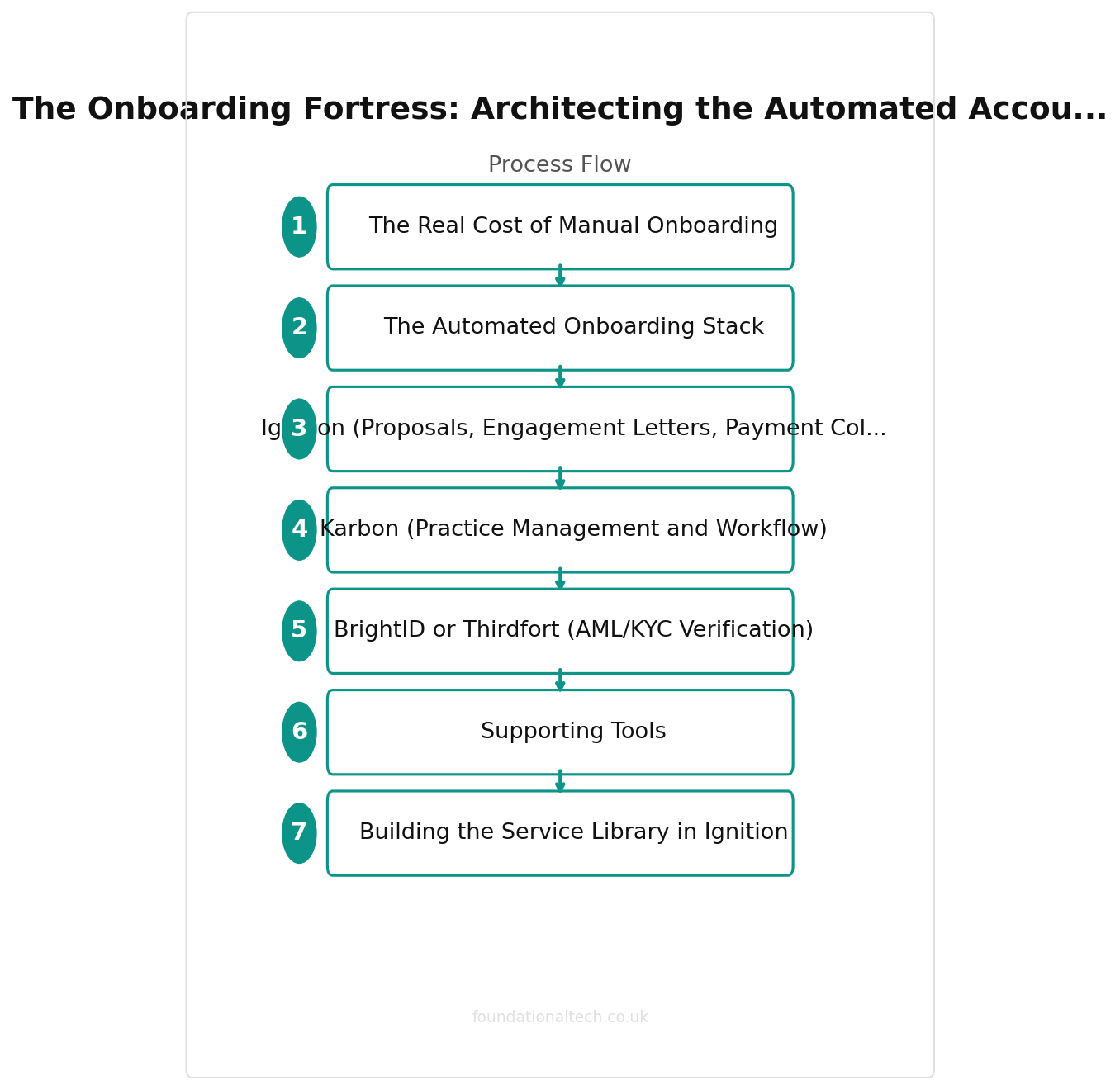
The Automated Onboarding Stack
The stack I recommend to most small and mid-tier UK practices uses three core tools plus two ancillary services:
Ignition (Proposals, Engagement Letters, Payment Collection)
Ignition handles the commercial and contractual side. You build a service library with fixed prices, assemble proposals, attach your engagement letter (templated to ICAEW or ACCA standards), and collect a GoCardless direct debit mandate on acceptance. The client receives a single link, reviews the scope, signs electronically, and sets up payment — all in one flow. From £59/month (Starter) to ~£120/month (Professional).
Karbon (Practice Management and Workflow)
Karbon is the workflow engine. When a client accepts a proposal in Ignition, a webhook fires and creates the client record, assigns work items, populates due dates, and notifies the team member responsible — without anyone lifting a finger. From £49/user/month.
BrightID or Thirdfort (AML/KYC Verification)
Both offer digital identity verification satisfying MLR 2017 requirements. The client completes a biometric check on their phone — passport or driving licence scan plus a selfie — and the platform returns a verified result with an audit trail for HMRC supervision visits. £2–£10 per check depending on provider and volume.
Supporting Tools
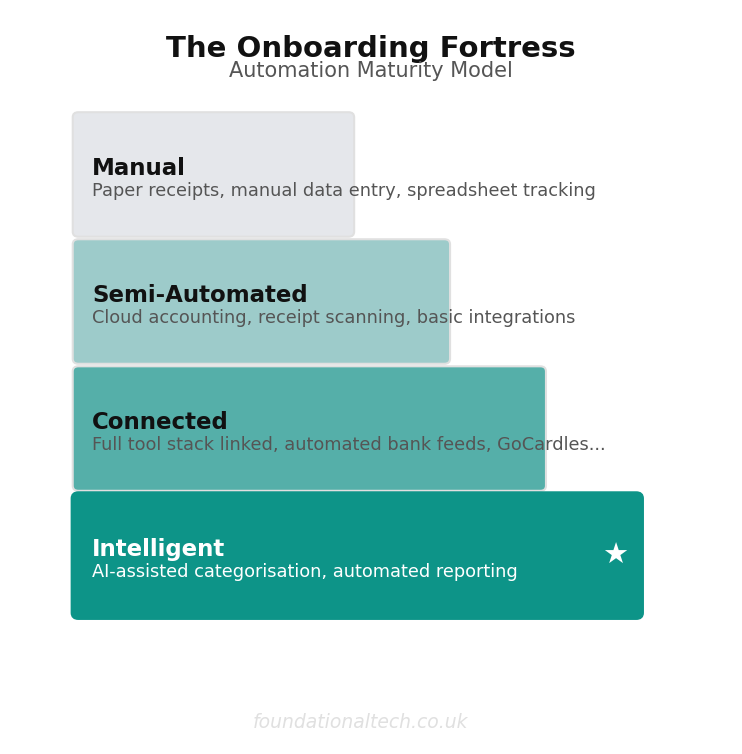
Dext (from £24/month) for receipt capture, Xero (£15–£42/month) for cloud accounting, and GoCardless (1% + 20p per transaction) for direct debit collection round out the ecosystem.
Building the Service Library in Ignition
This is where most firms underinvest. A well-structured service library eliminates scope ambiguity and makes pricing conversations straightforward.
Fixed-Price Service Items
Create individual service items for every deliverable: annual accounts preparation, corporation tax return, personal tax return, VAT return (quarterly), payroll (per employee per month), management accounts (monthly or quarterly), registered office service, confirmation statement filing, and so on. Attach a fixed monthly or annual price to each. Do not use hourly rates — they incentivise inefficiency and terrify clients.
Bundled Packages
Group service items into packages: a Sole Trader Essentials bundle (accounts, tax return, bookkeeping support) at one price; a Limited Company Standard bundle (accounts, CT600, confirmation statement, registered office) at another. Packages simplify the proposal for the client and increase average engagement value for the firm. I typically see a 15 to 25 per cent uplift in average fees when firms move from à la carte pricing to bundles.
Change Orders
Ignition supports change orders — amendments to live engagements that require client re-acceptance. This is critical. When a client asks for management accounts halfway through the year, you do not absorb it; you issue a change order with the additional fee, the client accepts, and the updated scope is contractually locked. This single feature eliminates more scope creep than any conversation ever will.
| Step | Manual Process | Automated Process |
|---|---|---|
| Engagement letter | Print, post, chase (5-15 days) | Digital sign (minutes) |
| Payment mandate | Separate DD form | Collected on signature |
| AML/KYC check | Photocopy passport (days) | Thirdfort digital (minutes) |
| Practice management | Manual entry | Webhook auto-creates |
| Welcome email | Written manually | Auto-triggered |
| First invoice | 30-60 days later | Immediate on mandate |
The Webhook Pipeline: Ignition to Karbon
The real power of this stack is the automated handoff between commercial acceptance and operational delivery.
When a client accepts a proposal in Ignition, the following happens automatically via webhook integration (native or through Zapier/Make):
- Client contact created in Karbon with company name, registered address, contact details, and Companies House number.
- Work items generated based on the services in the accepted proposal — annual accounts, tax returns, VAT returns — each with template timelines and assigned team members.
- Onboarding checklist triggered as a Karbon workflow: collect bookkeeping records, set up Xero/Dext, obtain agent authorisation (64-8 for personal tax, CT41G for corporation tax), request prior-year accounts from the outgoing accountant.
- Client added to the appropriate Karbon client group (sole traders, limited companies, partnerships) for filtered reporting.
- Notification sent to the responsible team member with a summary of the engagement scope and fee.
The entire pipeline executes in under sixty seconds. No one copies data between systems. No one creates a manual checklist. No one forgets the 64-8.
AML/KYC Compliance Under MLR 2017
MLR 2017 requires customer due diligence before establishing a business relationship. Digital verification through BrightID or Thirdfort satisfies this more robustly than manual document checks — the platforms verify government-issued ID against biometric data, run PEP and sanctions screening, and generate a timestamped audit report you store in Karbon.
Practical tip: Send the AML verification link in the same email as the Ignition proposal. Clients complete both in the same sitting, which cuts average AML completion time from nine days to under twenty-four hours.
MLR 2017 also requires ongoing monitoring. Set a recurring annual task in Karbon to review CDD records and re-screen against updated PEP and sanctions lists.
Step-by-Step Implementation
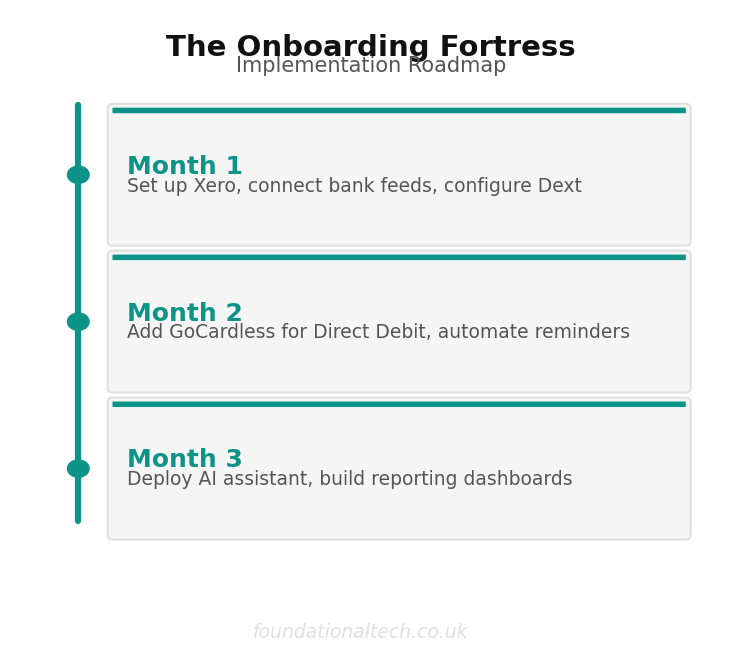
Here is the implementation sequence I walk firms through, typically over four to six weeks:
- Audit your current service catalogue. List every service you deliver and its price. Identify services you deliver but do not charge for — these are your scope-creep leaks.
- Build the Ignition service library. Create fixed-price service items and bundle them into two to four packages. Draft your engagement letter template using ICAEW or ACCA guidance notes.
- Configure payment collection. Connect GoCardless to Ignition. Set billing to monthly direct debit — it smooths cash flow and reduces debtor days to near zero.
- Set up Karbon workflows. Build your onboarding workflow template: AML check, Xero/Dext setup, agent authorisation (64-8, CT41G), prior-year records request. Assign default team members and deadlines.
- Connect the webhook. Use Ignition's native Karbon integration or Zapier/Make: trigger on "Proposal Accepted," action creates contact and work items in Karbon. Test with a dummy proposal.
- Integrate AML verification. Set up BrightID or Thirdfort. Create an email template that sends the verification link alongside the Ignition proposal.
- Pilot with five new clients. Run the full sequence for the next five enquiries. Gather team feedback on friction points and refine.
- Roll out and train. Make automated onboarding mandatory for all new clients. Retire the old Word-document engagement letters.
What It Costs
For a five-person firm onboarding around eight to twelve new clients per month, here is a realistic monthly cost breakdown:
- Ignition Professional: ~£120/month
- Karbon (5 users): ~£245/month
- BrightID or Thirdfort AML checks (10/month): ~£50/month
- GoCardless transaction fees: ~£30–50/month (depending on average engagement value)
- Zapier or Make (if not using native integration): ~£25/month
- Total: approximately £470–490 per month
Set that against a part-time administrator spending eight to ten hours monthly chasing engagement letters and managing AML paperwork — at £15/hour, that is £120–£150 in labour alone, before you count write-offs and the cash-flow cost of late payment collection.
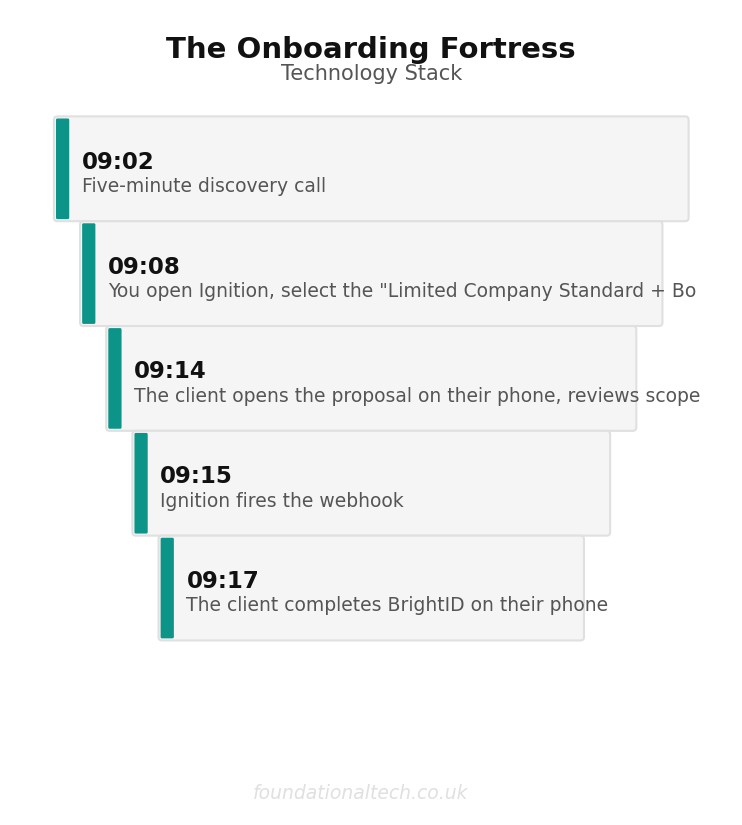
The Fifteen-Minute Onboard: A Real-World Scenario
A limited company director contacts your firm on a Tuesday morning:
09:02 — Five-minute discovery call. The client needs accounts, CT, VAT, and monthly bookkeeping. You confirm the fee.
09:08 — You open Ignition, select the "Limited Company Standard + Bookkeeping" bundle, and send the proposal. You also send the BrightID verification link.
09:14 — The client opens the proposal on their phone, reviews scope and fees, signs the engagement letter, and sets up a monthly direct debit — all in one flow.
09:15 — Ignition fires the webhook. Karbon creates the client contact, generates work items, triggers the onboarding checklist, and notifies your accounts manager.
09:17 — The client completes BrightID on their phone. The verified result lands in Karbon.
Fifteen minutes. Signed engagement, payment mandate, AML verification, live workflow. No printing, no posting, no chasing.
Common Mistakes Firms Make
- Building the service library too granularly. Fifty individual line items overwhelm clients and slow down proposal creation. Start with four to six bundles and a short list of add-ons.
- Not enforcing the process. If partners can bypass automation and scribble a fee on the back of a napkin, the system fails.
- Skipping change orders. The service library only works if you issue change orders for out-of-scope requests. Without this, scope creep returns through the back door.
- Delaying AML verification. If CDD is not complete before work begins, that is a direct MLR 2017 breach. Send the verification link with the proposal, not after it.
- Neglecting GDPR. You are processing personal data as part of onboarding. Ensure privacy notices, data processing agreements with third-party platforms, and retention policies (typically six years post-engagement per ICAEW/ACCA guidance) are all in order.
ROI Calculation
The return on this stack comes from four sources:
- Eliminated write-offs. Fixed-price proposals with clear scope reduce average write-offs by 60–80% in year one. A firm writing off £1,500/month recovers £900–£1,200 monthly.
- Faster cash collection. Monthly direct debit on acceptance drops debtor days from 45–60 to effectively zero. For a firm billing £30,000/month, that frees £45,000–£60,000 in working capital over a year.
- Time savings. Automated workflows and digital AML checks save eight to twelve hours per month — hours redeployed to billable advisory work.
- Reduced professional risk. Consistent AML compliance and signed engagement letters protect against regulatory action and fee disputes.
Against a monthly stack cost of approximately £490, most firms see a net positive return within the first full month of operation, driven primarily by the elimination of write-offs and the shift to upfront payment collection.
The onboarding fortress is not about technology for its own sake. It is about building a commercial and regulatory perimeter around every new client relationship — a perimeter that protects fees, enforces scope, ensures compliance, and frees the team to focus on the work that actually requires professional judgement. Fifteen minutes, properly automated, buys you twelve months of clarity.
See also: I Was a Qualified Accountant Who Couldn’t Get Paid on Time.
With ITSA deadlines approaching, see what UK trade businesses need to know about Making Tax Digital.