Key Takeaway
How to automate a UK painting and decorating business with AI in 2026. Enquiry to quote to Xero without retyping anything — no-code workflow guide.
Ten quotes a week is five hundred a year. If one in ten dies of silence — not a no, just nothing — that's fifty jobs you never hear about again. Nobody rang to tell you that you lost them, so they never show up in any number you look at.
Articles 1 to 8 of this series gave you the pieces: a quoting tool that talks to Xero, a deposit taken at acceptance, and a balance invoice fired at the walkthrough. Article 8 added an AI assistant that knows your price book. What's missing is the connective tissue. Every hand-off between those pieces still runs through you — reading the enquiry, retyping it into YourTradebase, remembering which quotes have gone quiet. And at month-end you're still the one wondering whether that Victorian hallway ate more paint than you charged for. This article takes you out of the hand-offs.
The Hand-Offs Are Still Yours
Every trade in this publication gets a version of this article, and every trade's version is different, because the bottleneck sits in a different place. A builder prices ten jobs a month, so his bottleneck is the size of each quote. You price ten a week, so yours is the number of times per week your thumbs have to move information from one screen to another.
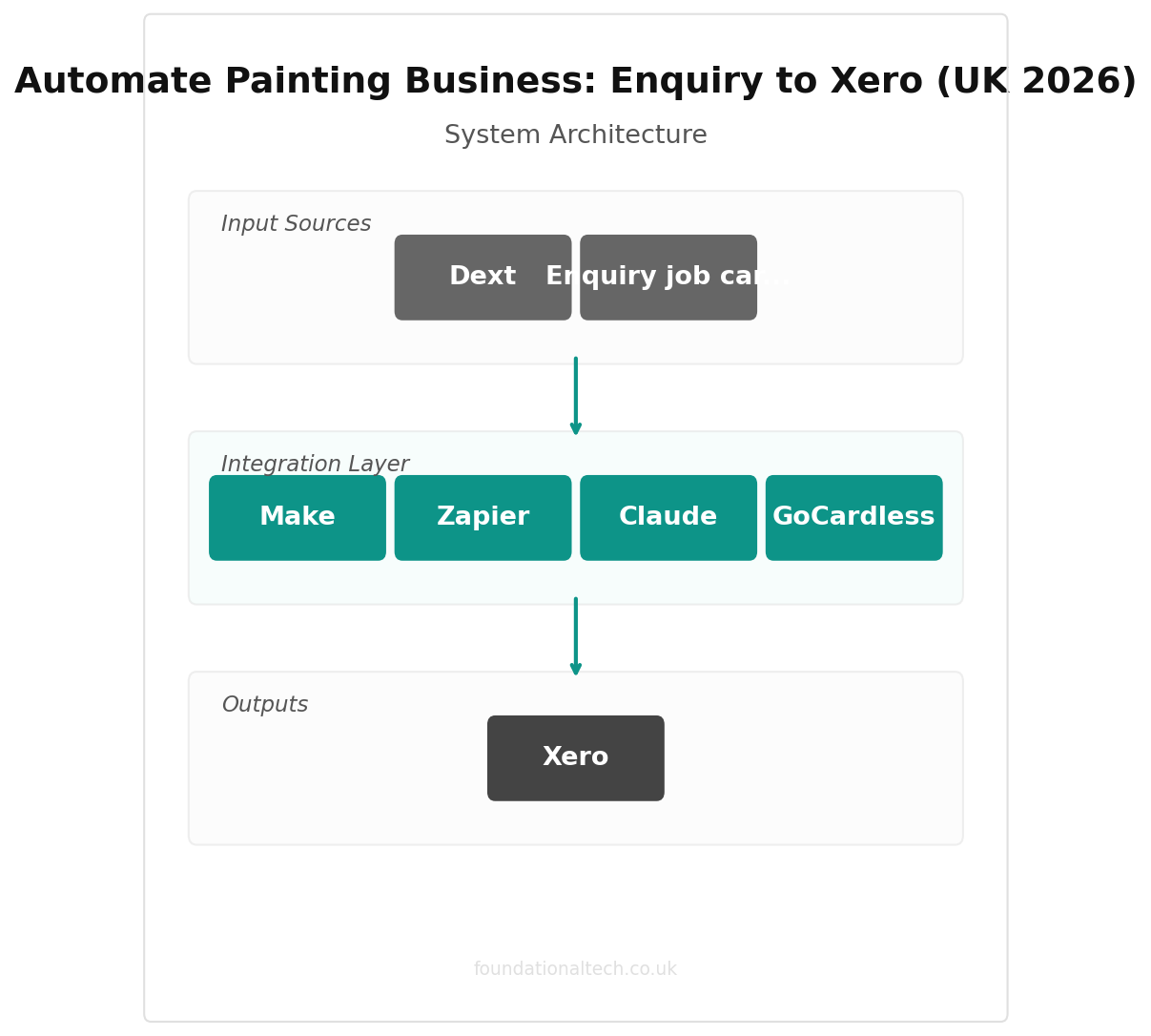
That's what no-code automation platforms — Make.com and Zapier are the two that matter — actually fix. They watch for an event (an email arrives, a quote's status changes, an invoice gets paid), then run a chain of steps you've defined once. Add an AI step in the middle and the chain can read and write, not just copy. None of it needs a developer. All of it runs while you're cutting in a ceiling line and can't touch your phone for two hours.
Three workflows follow. Each one attacks a leak specific to how decorating work actually flows.
The Enquiry That Arrives as a Job Card
The typical enquiry a decorator receives is a paragraph of vagueness: "Hi, we're looking to get our hall, stairs and landing done, maybe the front bedroom too, house is a 1930s semi, how much roughly?" Buried in that are five pieces of information you need and four you still have to ask for. Normally you read it at 6pm, mean to reply, and type it into your quoting tool two days later — if the customer hasn't already booked whoever answered first.
The workflow:
Trigger: a new email lands in your enquiries inbox (Gmail and Outlook both connect to Make and Zapier natively). A website contact form works the same way.
AI step: the message is passed to Claude or ChatGPT with a fixed instruction: extract rooms, property age, surface hints, timing, postcode — and list what's missing. Property age matters more for you than any other trade: anything pre-1960 gets an automatic lead-paint flag, per the Control of Lead at Work Regulations brief from Article 6. A "1930s semi" should trip that flag without you thinking about it.
Action: the structured result becomes a new lead — pushed into YourTradebase through its Zapier connection. If your plan doesn't cover the Zapier app, point the workflow at your own inbox instead. It emails you a formatted job card, and pasting one in takes seconds rather than the ten minutes of retyping it replaces.
Action: you get one tidy notification: the job card, plus a short list of questions to ask at the site visit — "confirm ceiling condition, ask about the bedroom, pre-1960? No — 1930s, lead flag applies to any original woodwork."
Notice what this is not. It is not an auto-reply. Six other trades in this series get AI to draft response emails; for decorating I'd argue the higher-value move is structure, not speed of reply. Your reply can be two human lines sent from the van — "Thanks, I can look Thursday evening, does 6 work?" — because the thinking has already been done and filed.
The Quote That Follows Itself Up
Here is the leak nobody measures. You send a quote on Tuesday. The customer meant to reply. Life happened. By the time they remember, they've had a second quote from someone who nudged them. You never chase because chasing feels like begging and, more honestly, because at ten quotes a week you cannot hold ten open loops in your head.
Article 3 automated chasing invoices. This is different — chasing quotes, before there's any money owed, where tone matters even more.
Trigger: quote sent, no acceptance after three days. (If your quoting tool doesn't expose quote status to Zapier, run it from a dated row in a Google Sheet that the first workflow fills in — one extra step, same result.)
AI step: draft a nudge matched to the job type. This is where the two-payer split from Article 3 earns its keep again. A letting agent gets brisk and operational: "Morning — quote for the Ashfield Road void is still open, happy to hold the price if you can confirm by Friday, we've got a gap the week after next." A homeowner gets warmth and zero pressure: "No rush at all — one thing worth knowing is the spare-room price includes sealing the new plaster, which most quotes leave out."
Action: the draft lands in your drafts folder, not the customer's inbox. You read twenty seconds, tweak or don't, send. A second, gentler nudge fires at day ten, then the sequence stops. Silence after two touches is an answer.
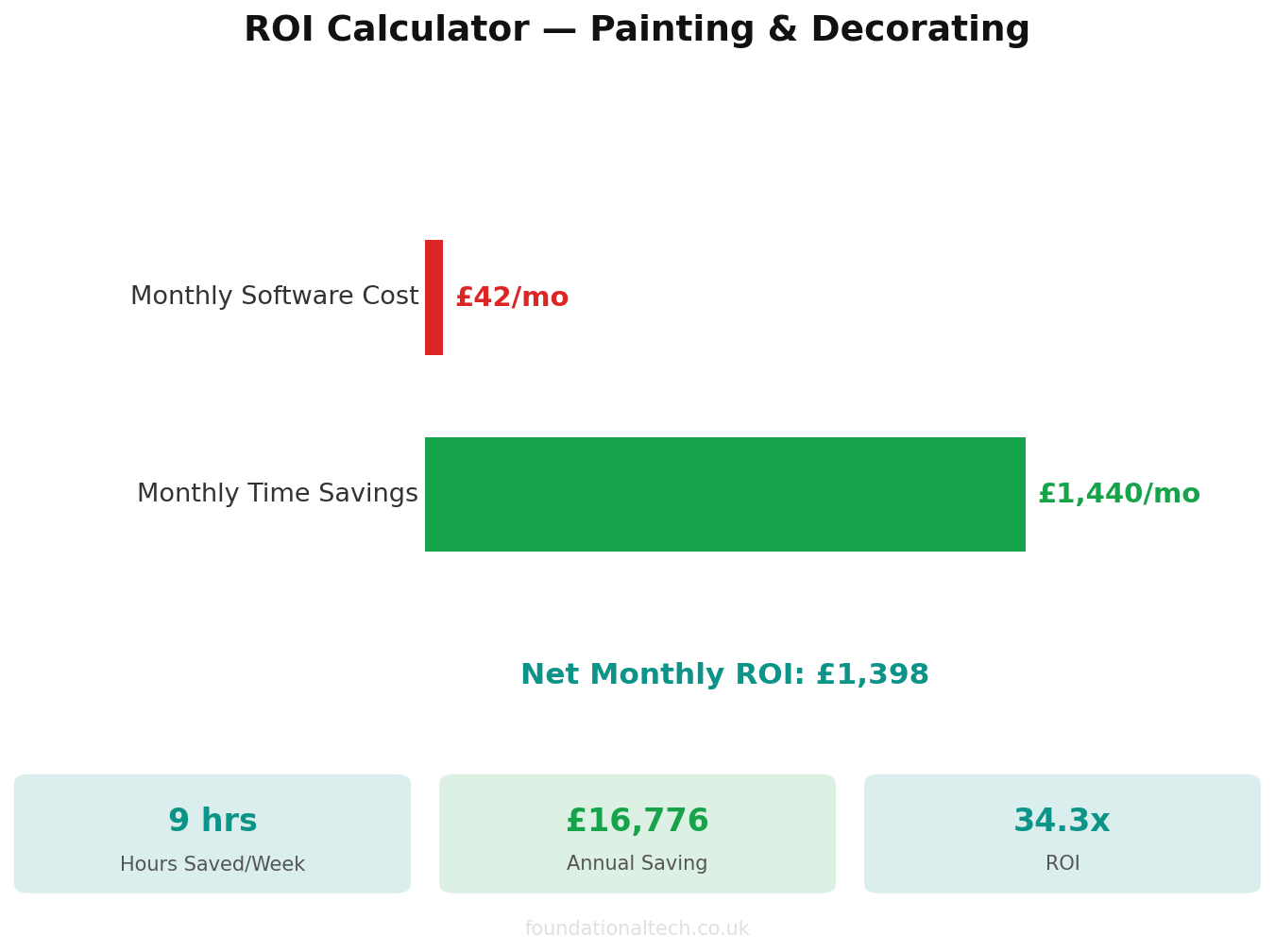
A decorator who converts even three extra quotes a month at an average £900 job has paid for this stack roughly thirty times over. And unlike discounting, a well-timed nudge wins the job at full price.
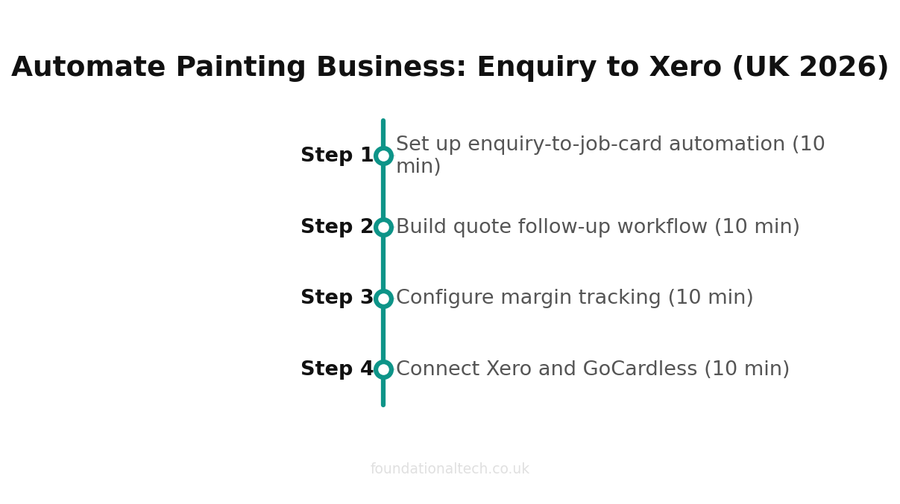
| Step | Action | Time |
|---|---|---|
| 1 | Set up enquiry-to-job-card automation | 10 min |
| 2 | Build quote follow-up workflow | 10 min |
| 3 | Configure margin tracking | 10 min |
| 4 | Connect Xero and GoCardless | 10 min |
The Margin Autopsy You Never Have to Run
Articles 3 and 4 established the quiet killer: the prep-heavy job that eats 15 to 20 per cent more materials than quoted. You know it happens. You almost never know which jobs, because checking means cross-referencing Dext receipts against quote line items, and no one does that on a Sunday.
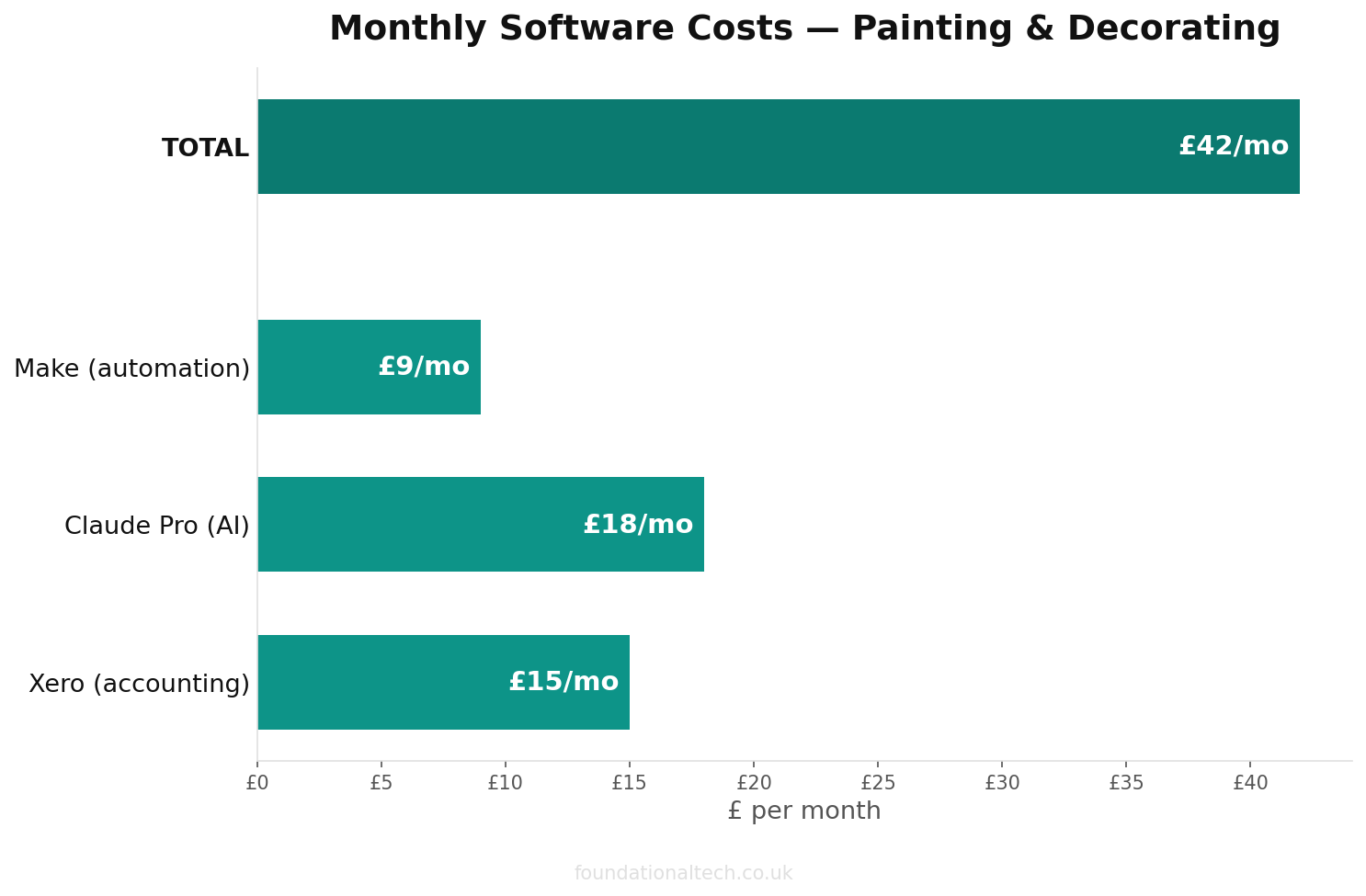
Under £15/month
total automation cost to handle enquiries, quotes, follow-ups and margin reporting for a decorating business
So make the software do the autopsy the moment a job closes:
Trigger: balance invoice paid in Xero (the true end of a job, per the walkthrough-to-invoice rule from Article 3).
Gather: Make pulls every Dext-captured purchase tagged to that job, plus the materials line from the original quote.
AI step: Claude writes a five-line verdict. Not a spreadsheet — a verdict: "Quoted £310 materials, spent £402. Overrun driven by two extra tins of undercoat — bare plaster in the hallway. Third bare-plaster overrun since March. Suggest raising the new-plaster surcharge from 10% to 15%."
Action: verdicts collect in a monthly digest email. Ten minutes with a cup of tea, once a month, and your pricing sharpens itself job by job.
This only works if purchases are tagged to jobs at the till — the Dext habit from Article 4. The automation doesn't replace that habit; it's the payoff for it. And remember the gotcha from Article 5: your Dulux or Crown trade account still has no API, so trade-counter purchases enter this loop through Dext photo capture or the monthly statement, nothing fancier exists yet.
What It Runs On and What It Costs
Both platforms have free tiers that will genuinely carry you for a while. Make's free plan gives you 1,000 credits and two active scenarios a month — enough to run the enquiry job-card workflow on its own. Its Core plan works out at roughly £8–9/month plus VAT for 10,000 credits and unlimited scenarios (billed annually, in dollars). Zapier's free tier allows 100 tasks a month on two-step zaps only; the multi-step workflows above need its Professional plan, at roughly £16/month plus VAT (also billed annually, in dollars).
My honest steer for a decorating business: start on Make's free tier, build workflow one, and upgrade only when you add the second workflow. The AI step costs barely register. At this volume, API calls to Claude or ChatGPT cost pennies a week — or nothing extra if you wire in the Claude Pro subscription you may already have from Article 8.
Total for all three workflows running: under £15/month on top of the £69 stack from Article 2. Less than one tin of decent trade emulsion.
Build Them in This Order
Enquiry job card first. It touches no customer directly, so nothing can go wrong publicly while you learn the platform. One wet afternoon.
Quote follow-up second, once you trust the plumbing — because it drafts words a customer will eventually read. Keep the human send button. Always.
Margin autopsy last. It needs a month of job-tagged Dext data to say anything useful, so switch it on and forget it.
And carry over the rule that has held since Article 6: AI drafts nothing that goes to a customer without your eyes on it. The workflows above are built so that every outward-facing word passes through your drafts folder. The customer should only ever hear you.
Related guides: If you found this useful, see our guide on How to Stop Chasing Payment as a UK Painter and Decorator: Automated Invoicing, Deposits and Direct Debit (2026) and 10 AI Prompts for Painters and Decorators: Copy-and-Paste Templates for Quotes, Colour Advice and Getting Paid (2026).
Count last month's decorating quotes, then count the ones that never got any answer at all — not a no, just silence. Reply with both numbers. I'm collecting them, because I suspect the quote-mortality rate for painters and decorators is far worse than anyone admits, and the results will shape a future piece.