Key Takeaway
Train Claude AI on your painter & decorator price book in 2026. Step-by-step setup to auto-generate quotes.
Your price book lives in three places: a dog-eared notebook in the van, half a spreadsheet you started two Januaries ago, and your head. Mostly your head. Which means every quote, every colour email and every payment reminder starts from a blank page. The prompts from Article 7 — good as they are — still need you to paste in your rates, your finishes and your tone every single time.
This article moves all of that into one place, once. Forty-five minutes of setup, and from then on "quote the three-bed semi from this voice note" comes back priced in your structure, in your voice, with your deposit terms already on it. The assistant was trained on your price book before you asked.
From Ten Prompts to One Setup
The difference is memory. A prompt is an instruction; an assistant is an instruction that persists. Both Claude and ChatGPT let you create a private workspace — a Project in Claude, a Custom GPT in ChatGPT — with two permanent layers. The first is a standing brief (called a system prompt) that applies to every conversation; the second is a set of uploaded documents it can consult. Set both up properly and the blank page stops being where every quote starts.
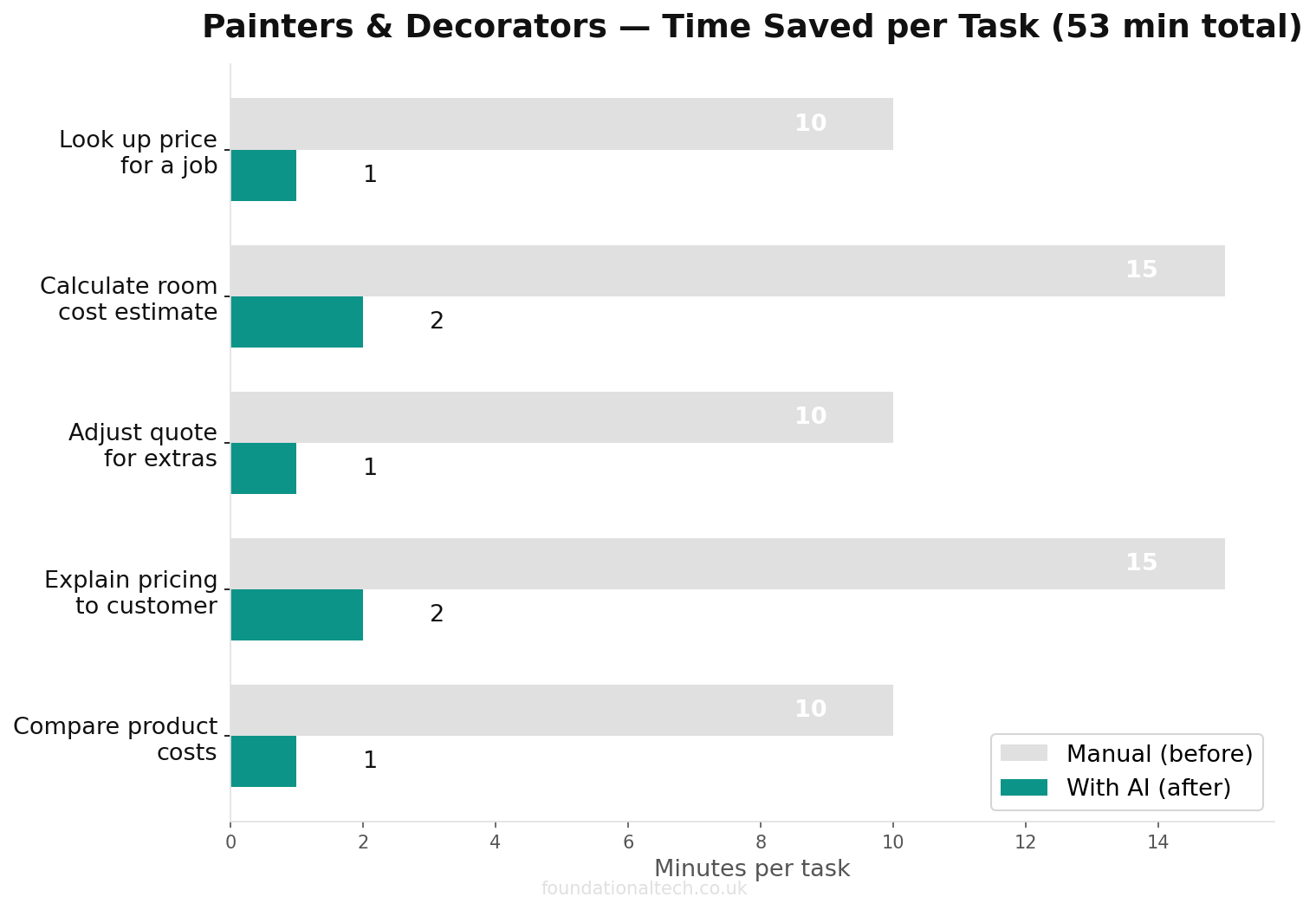
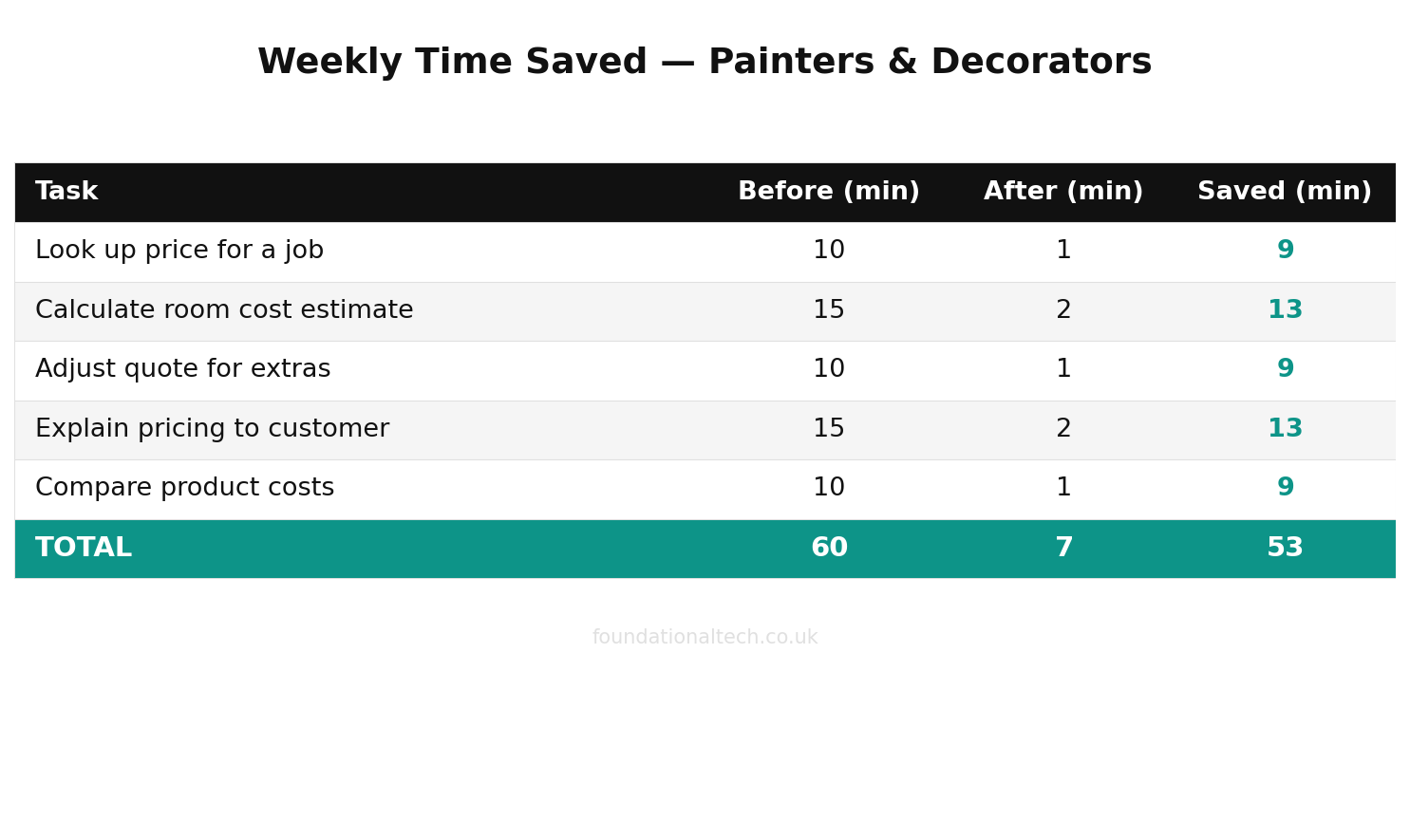
For a decorating business the payoff is bigger than for most trades, for the reason Article 6 gave: volume. Ten quotes a week, each with a colour conversation and a deposit line attached, means the same context gets re-typed dozens of times a month. That's exactly the overhead this kills.
Where It Lives: Claude Project or Custom GPT
Claude Pro (dollar-priced, so typically £16–17/month, dropping to roughly £14/month if you pay for the year up front) gives you Projects: a workspace with custom instructions and uploaded files. It's the stronger writer of the two — the colour consultation summaries and lead paint briefs come out needing less editing — and it's the better choice if most of your output is client-facing prose.


ChatGPT Plus (£20/month) gives you Custom GPTs, which do the same job and are slightly quicker for rapid back-and-forth. That suits bouncing a quote around while you're still deciding whether the stairwell needs scaffold. If your phone is already full of ChatGPT, stay there rather than switching.
Either works. What matters is doing the setup below, not the logo on the app. Skip the API and automation platforms for now — that's Article 9's territory.
The Brief: Your System Prompt
This is the assistant's standing instruction — who it works for, what it knows, what it must never do. Copy this into your Project's instructions or your GPT's configuration and fill in your numbers. It's long. That's the point: everything here is a sentence you'll never type again.
You are the office assistant for [BUSINESS NAME], a painting and
decorating business covering [AREA]. You draft quotes, client emails,
colour advice and payment reminders. I check everything before it's sent.

THE BUSINESS
- [SOLE TRADER / TEAM SIZE], trading since [YEAR]
- Work mix: domestic repaints, letting agent void turnarounds,
  [NEW-BUILD SITE WORK — delete if not applicable]
- Tone: friendly, plain-spoken, confident. Knowledgeable neighbour,
  not showroom brochure. Never pushy.

RATES (defaults — I override when a job warrants it)
- Day rate: £[DAY RATE] per decorator
- Walls and ceilings, emulsion: £[RATE] per m² (two coats)
- Woodwork (gloss/satinwood): £[RATE] per metre of skirting/architrave,
  £[RATE] per door including frame
- Wallpaper hanging: £[RATE] per roll, plain; £[RATE] per roll, patterned
- Exterior: quoted by survey only — never give a standing rate

PREP CATEGORIES (every quote states one)
- Light: sound surfaces, fill and caulk only
- Standard: minor repairs, sanding, one problem wall
- Heavy: layered wallpaper removal, Victorian woodwork, nicotine or
  damp staining — always flag as a pricing risk

QUOTING RULES
- Structure: room by room, surfaces + prep + coats per line
- Never invent paint quantities or coverage figures. Write [LITRES]
  and I calculate from my own figures.
- New plaster always gets a mist coat line
- Deposit: [PERCENTAGE]% covering materials, balance due at the final
  walkthrough — both stated on every quote
- Letting agent work: fixed menu prices from the uploaded rate card,
  invoice references the property address, 24-hour turnaround promise

COMPLIANCE FLAGS
- Any property built before 1960 with sanding or stripping in scope:
  add a note to attach the lead paint safety brief (Control of Lead
  at Work Regulations 2002). Method is wet abrasion; never suggest
  dry sanding or burning off old paint.
- Site work as a subcontractor: mark the quote CIS so the deduction
  is expected on the remittance, per the uploaded CIS one-pager.

HARD RULES
- Never state a final price as confirmed — quotes go out after I
  review them
- Never recommend a colour as a done deal; always suggest a sample
  pot on the actual wall first
- Never promise a start date; offer to check the diary
- Anything missing from the brief: ask for it, never fill the gap
  yourself
Two of those blocks earn their place the first week. The prep categories stop the assistant writing cheerful quotes for jobs with three layers of woodchip lurking under lining paper. And the hard rules are the difference between a tool and a liability — an assistant that invents coverage figures or confirms start dates is worse than no assistant at all.
The Price Book: What to Upload
The system prompt holds the rules; uploaded files hold the detail. Five documents, most of which already exist somewhere in the van.
Your rate card — the real one, including the awkward numbers: what you actually charge for a staircase with a return, the scaffold-access uplift, the minimum job charge. Your letting agent menu — the fixed prices from Article 3's void-turnaround arrangement, per flat type, with add-ons. Three of your best past quotes — not templates, real ones (names removed). This is how the assistant learns that your quotes say "make good" and "two full coats" rather than whatever the internet says. Your finishes one-pager — which sheen you use where and why: washable matt for family halls, eggshell for woodwork clients touch, satinwood where gloss would yellow. You explain this weekly by phone; write it once. The CIS one-pager from Article 4 — job types that trigger it, the 20% deduction on labour, why the remittance won't match the invoice.
Refresh rule: when a price changes in real life, it changes in the upload the same week. An assistant quoting last spring's rates is a subsidy you're paying your clients.
A Wednesday With It Running
Here's how a two-man decorating firm in Wrexham — half domestic repaints, half letting agent voids — runs it.
20% faster quotes
when your AI assistant already knows your rates, exclusions and preferred wording from your uploaded price book
7:40, van. Overnight enquiry: hallway, stairs and landing, "before my in-laws visit at Easter." Voice note to the assistant; it drafts a reply in the firm's tone offering two survey slots and asking about property age. The assistant flagged "1930s semi" in the enquiry, so the reply already mentions checking old paintwork properly — thoroughness to the client, the lead paint rule doing its job.
12:30, merchant's car park. Yesterday's survey voice note comes back as a structured quote draft: three rooms, prep categories assigned, [LITRES] brackets waiting. Coverage calculated against the notebook figures, prices in, quote out by one o'clock — the evening version of this job used to be Thursday night.
16:50, kitchen table. Two payment reminders drafted in the delighted-client-who-forgot tone, referencing the actual rooms. One colour summary for the client wavering between two greens for a north-facing lounge. Total admin time for the day: about twenty-five minutes, most of it reading and approving rather than writing.
Nothing in that day is spectacular. That's the point — it's the same admin as before, done in the gaps the day already had.
What It Won't Do
It can't see the wall. Every coverage figure, coat count and prep judgement still starts with you standing in the room — the assistant structures your judgement; it doesn't have any. It doesn't know a job ran over unless you tell it, which is why the monthly trade-statement check from Article 7 still needs your Dext numbers pasted in. And it will drift out of date exactly as fast as your uploads do. The maintenance habit is one diary slot a month: prices current, a recent quote added, anything that made you wince deleted from its memory.
What It Adds to the Bill
One subscription — Claude Pro at roughly £16–17/month or ChatGPT Plus at £20 all in — on top of the £69/month stack from Article 2. No new tools, no developer, no integration fees. Set it against ten quotes a week at half an hour saved each, and the subscription has paid for itself before the first Friday.
Related guides: If you found this useful, see our guide on How to Stop Chasing Payment as a UK Painter and Decorator: Automated Invoicing, Deposits and Direct Debit (2026), 10 AI Prompts for Painters and Decorators: Copy-and-Paste Templates for Quotes, Colour Advice and Getting Paid (2026) and YourTradebase vs Trades Panel vs HiveSuite: Which Quoting Software Fits Your UK Painting and Decorating Business? (2026 Guide).
Reply with the one question clients ask that you'd want this assistant to answer word-perfectly every time. Mine's "can't you just do it in one coat?" — I'm collecting the real ones, and the best answers go into a follow-up piece.
Sceptical about AI tone? See The Decorator Who Was Sure the Robot Would Sound Nothing Like Him.