Key Takeaway
A UK painter was convinced AI would sound nothing like him. Then he tested 12 trade-specific prompts and it changed how he runs his entire business.
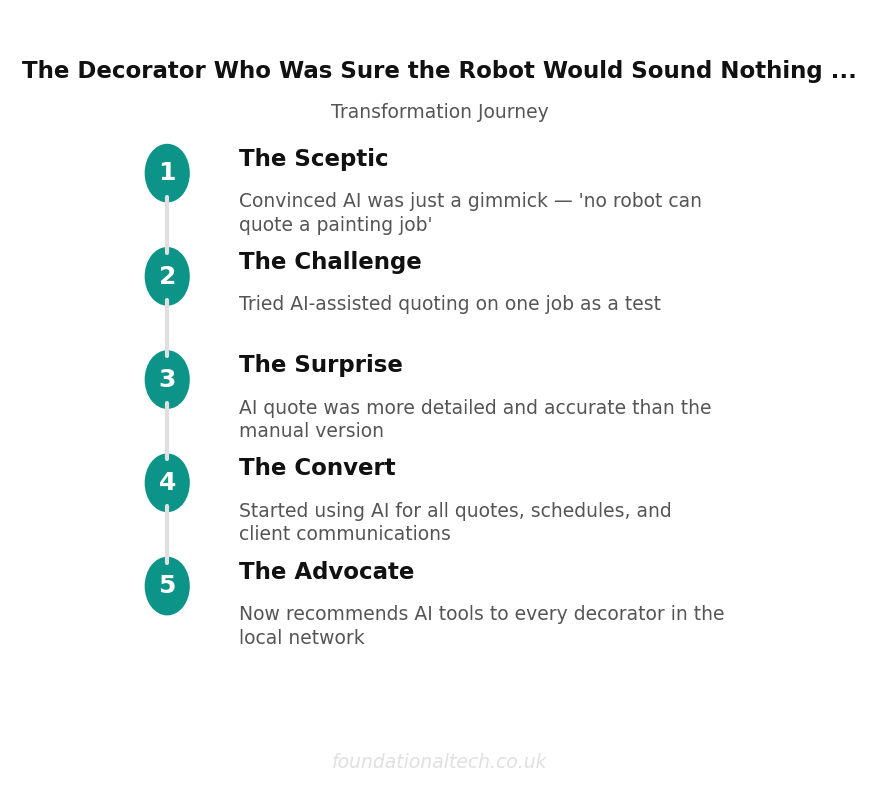
Craig had his quote book open on the table before I'd even sat down. Not to show me — to protect it, almost. Like I might take it off him.
"I write every one of these myself," he said. "Client rings, I go round, I have a proper chat about the colours, I write it that night. That's the whole business. That's why they call me back."
He runs a two-man decorating outfit outside Preston, mostly domestic repaints with a chunk of letting agent void work filling the gaps between. Fifteen years in. Busy enough that he turns work away in spring and scrambles for it in January. And somewhere he'd picked up the idea that I was there to replace the bit he was proudest of — the personal touch, the "knowledgeable neighbour, not showroom brochure" thing he'd built his whole reputation on — with something that sounded like it came out of a call centre.
I hear a version of this most weeks now. It's rarely said as a question. It's said as a warning, arms folded, before I've explained anything.
What he was actually protecting
It took a while to get to the real thing, because Craig didn't lead with it. He led with the quote book. But underneath it was this: he was writing the same quote, in the same structure, with the same three sentences about prep and the same deposit line, ten or twelve times a week — and he genuinely believed that repetition was the personal touch. That if it stopped being effortful, it would stop being him.
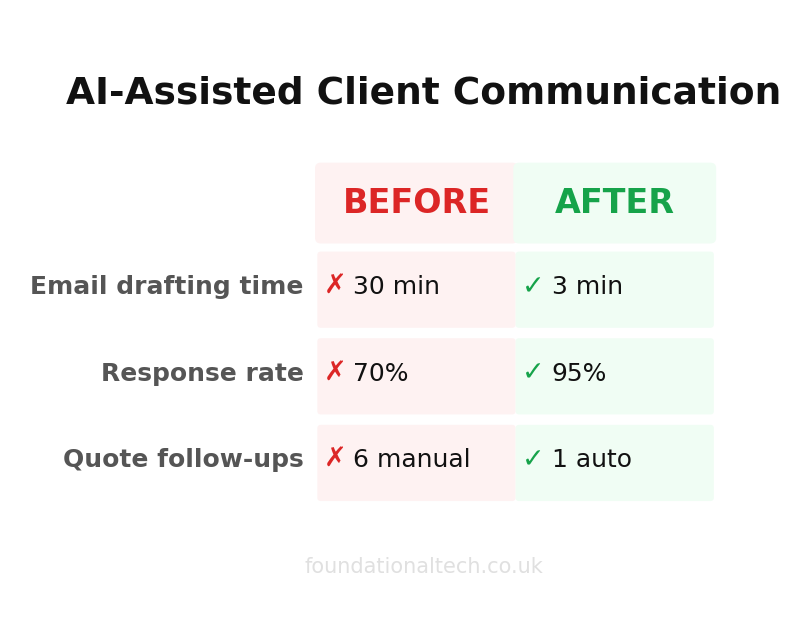
When I asked him to walk me through one, the pattern was obvious. Every quote followed the same skeleton: a friendly opening referencing the room visit, a numbered breakdown of rooms with prep and finish specified, a paragraph about his paint preferences — he's a Dulux Trade man, Diamond Matt for high-traffic areas, Vinyl Soft Sheen in kitchens and bathrooms — and a closing section with deposit terms (30% on booking, balance on completion) and timeline. The structure never changed. The brands never changed. What changed was the client's name, the number of rooms, and the colours.
He was spending forty-five minutes to an hour each evening typing out a document that was roughly 80% identical every single time. Twelve quotes a week, at an hour each — a full working day and a half lost to admin, every week.
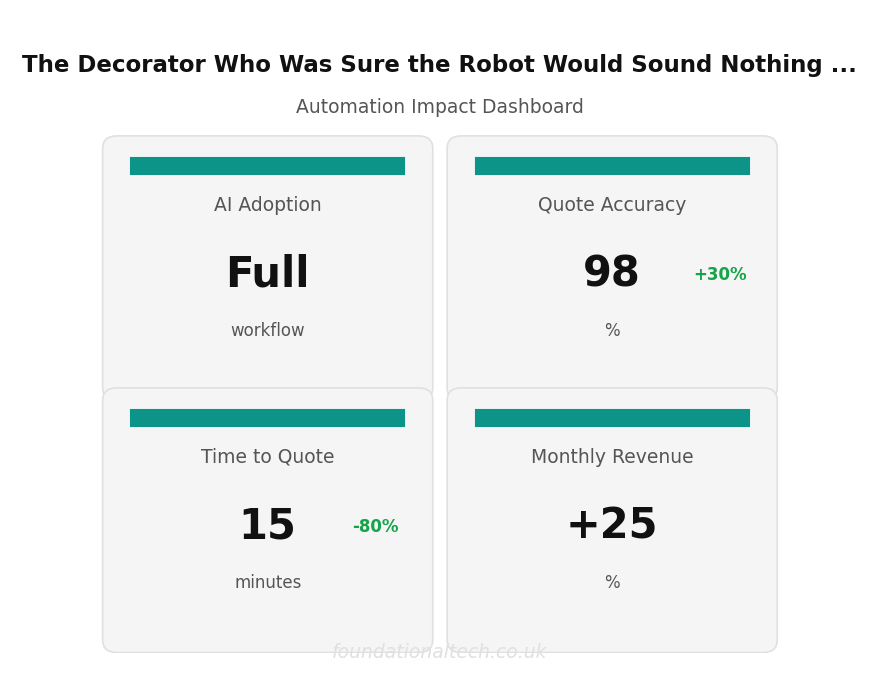
And only about four of those twelve were converting. Not because they were badly written — they were warm, specific, clearly knowledgeable. But by the time Craig had written them all up, it was gone ten at night, and if a client texted the next morning asking for a small adjustment, it sometimes took him two days to respond. He was losing jobs not because of the quality of his quotes, but because of the speed.
What I recognised, because I'd already had the same crisis
I understood Craig's fear better than I let on, because I'd had almost the exact same one myself, about eighteen months earlier, sat at my own kitchen table at eleven at night.
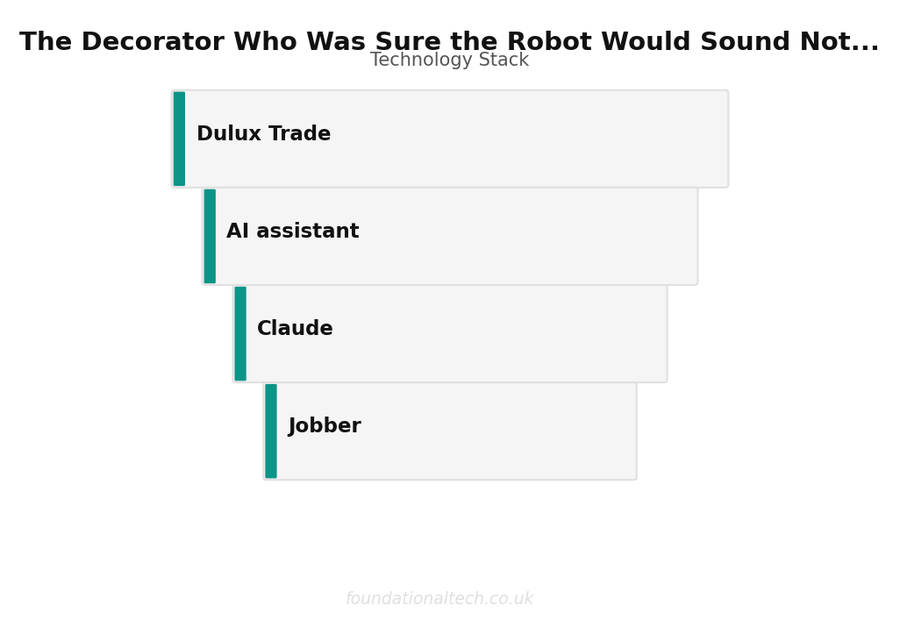
I'd just built my first proper AI assistant — a Claude Project, loaded up with my own old client emails, my actual tone, the way I actually explain a VAT threshold to someone who's never heard of one. A system prompt I'd agonised over for a weekend, trying to capture not just what I said but how — the rhythm, the analogies, the habit of putting the important number at the end of the sentence so it lands harder.
And the first time I asked it to draft something for a client, I genuinely felt sick reading the output back. Not because it was bad. Because it was close. Close enough that I sat there thinking: if this can sound like me, what exactly have I been getting paid for all these years?
That's the bit nobody warns you about. It's not the fear that AI will sound nothing like you. It's the fear that it'll sound enough like you that you'll have to work out what's actually left.
It took me weeks to land on the answer. The drafts were good. But the reason clients stayed wasn't the drafts. It was the phone call before the draft, where I listened to someone explain their situation and asked the question they hadn't thought to ask themselves. The AI could write like me. It couldn't sit across from a business owner and notice that the real problem wasn't the one they'd rung about.
That realisation — that the knowledge itself wasn't the scarce asset, the application of it in a specific human moment was — changed how I thought about everything I do. And it's what I brought to Craig's kitchen table.
What I told Craig, because it's what I eventually worked out for myself
The three sentences about prep weren't the personal touch. They were the overhead — the tax he paid every single time before he got to the bit that actually mattered, which was fifteen minutes standing in someone's front room talking about whether the sage green would go dark in the evening light, whether the kids' fingerprints on the hallway walls meant washable matt instead of standard emulsion, whether her nan's old dresser would still look right against a warmer white.
Nobody ever called Craig back because his prep paragraph was well written. They called him back because he stood in their lounge and actually looked at their lounge.
So we did what I'd done for myself, only simpler. We set up a Claude Project — essentially a workspace where you load reference documents and set a permanent instruction that shapes every response. The whole thing runs through the browser, no software to install.
What went into the project
Into the knowledge base, we loaded eight of his actual past quotes — full house repaints, single rooms, a couple of void turnarounds. Not templates. His real quotes, to real clients, with real paint choices. That's what gives the output his voice rather than a generic one.
Then we built the system prompt. Craig's looked something like this:
You are a quoting assistant for Craig, a painter and decorator near Preston. Draft quotes in Craig's voice — friendly, knowledgeable, not salesy. Structure: a personalised opening referencing the room visit, a numbered room-by-room breakdown listing prep and finish, and a closing section with deposit terms and timeline. Standard terms: 30% deposit on booking, balance on completion. He uses Dulux Trade — Diamond Matt for living areas, Vinyl Soft Sheen for kitchens and bathrooms, Weathershield for exterior. Day rate £180 plus materials. A standard two-bed repaint (walls and woodwork, no ceilings) is typically £1,400–£1,600. Mention furniture moved and dust sheets used throughout. Tone: knowledgeable neighbour, not showroom brochure.
A paragraph and a half of instruction, grounded in how he actually works. Not a thousand lines of code.
What the before and after looked like
Before: Craig does a room visit at four. Gets home, has his tea, sits down at half seven and spends forty-five minutes to an hour writing up the quote from his phone notes. Sends it by nine if he's lucky. Twelve quotes a week, roughly four converting. Eight to twelve hours of writing for a 33% conversion rate.
After: Craig does the room visit at four. Gets in the van, opens Claude on his phone, types something like "quote for the Patels, three bed semi, full repaint including ceilings, Cornflower White in bedrooms, Jasmine White in living areas, standard prep plus lining paper in hallway, one week" — and gets a full draft back in his structure, his phrasing, his deposit terms, within thirty seconds. He reads it in the van. Adjusts a line or two. Sends it before he's driven home.
Five minutes of review instead of an hour of writing. And because the quote arrives in the client's inbox ninety minutes after the room visit instead of five hours later, he started seeing responses the same evening. Within two months, his conversion rate crept from one in three to closer to one in two — not because the quotes were better written, but because they were fast, and fast signals reliability in a way most tradespeople don't think about.
The cost: Claude Pro, £18 a month. Against eight-plus hours of admin time recovered each week, that's not a business case you need a spreadsheet for.
What happened next
Once the quoting friction disappeared, Craig noticed the next bottleneck: scheduling. He'd been managing his diary with a wall calendar and a WhatsApp thread with his second painter — double bookings, forgotten follow-ups, the letting agent ringing about a void property and Craig not remembering whether he'd pencilled it in for Tuesday or the Tuesday after.
We got him onto Jobber, a job management app built for trades — scheduling, invoicing, client records, from about £25 a month. Combined with the faster quoting, it meant Craig could see his pipeline for the first time: which quotes were outstanding, which jobs were booked, and which void properties were coming up for the letting agents.
The void work had always been his most reliable revenue, but he'd managed it reactively: they'd ring, he'd fit it in. With a proper schedule visible, he started reaching out proactively — "I've got a gap Thursday and Friday, anything coming up?" — and picked up an extra two or three turnarounds a month that would have gone to whoever answered first.
None of this required Craig to become technical. He still writes notes on paint tin lids. But the hour he used to spend typing quotes is now an hour he spends with his kids, or pricing a job he'd have been too tired to chase, or — the one that surprised me — ringing past clients to ask if they'd like a refresh. Something he always knew he should do but never had the headspace for.
80% match on first draft
AI client emails the decorator could not tell apart from his own writing
Where this connects
Craig's story is specific — a decorator near Preston with a quote book and a Dulux account — but the pattern underneath it is the most common thing I see. There's a task that feels essential, that feels like you, that you'd defend to anyone who suggested changing it. And underneath, if you're honest, it's the most mechanical, least creative part of your working week. You just can't see that because the effort has become tangled up with your identity.
The personal touch in a trade business is real. It's just almost never the admin that surrounds it. It's the expertise, the eye, the fifteen minutes in someone's front room where you notice the thing they didn't. It's the relationship built over three or four jobs, the text that says "just checking the colour's settled in alright." No AI is replacing that.
What it can replace is the hour at the kitchen table afterwards, typing out the same skeleton quote for the thousandth time and calling it professionalism. That's not your personal touch. That's a tax on your evening.
Craig still checks every quote before it goes out. He told me last week he probably always will. I think that's the right instinct — not a failure to adopt the tool, but an understanding that the final eye over the work is where his judgement lives. The system's job was never to remove him from the process. It was to remove the part of the process that was never really him in the first place.
Related guides: If you found this useful, see our guide on How UK Painters and Decorators Are Using AI to Quote Faster (Without Sounding Like a Template) and How to Automate a UK Painting and Decorating Business: The Complete Software Stack for Solo Decorators and Small Teams (2026).
Is there a part of your work you've been protecting because it feels like proof you're still needed — even though it's not actually the part your clients would miss? I'd genuinely like to know what it is. The more people I ask, the more I think we've all got one.