Key Takeaway
The complete 2026 automation stack for UK painters & decorators. Every tool connected from enquiry to Xero.
It's gone 8pm on day two of a three-day repaint. You're standing in an empty lounge with a torch, checking whether the second coat on the chimney breast has actually covered the previous owner's nicotine-stained magnolia or whether you're going to need a third. You already quoted two coats of emulsion. The client isn't home. There's no one to ask. You make the call yourself — third coat, first thing tomorrow. Standing there, you know you've just turned a day of profit into a day of break-even — and you still haven't worked out what you're charging the next three enquiries sitting unanswered in your texts.
This is the arithmetic nobody puts in the quote. Not the wall area, not the litres — the judgement calls made alone, on site, at the end of a long day, that quietly decide whether the job makes money.
Most automation advice aimed at trades is written for people who do one job, invoice it, and move to the next. Painting and decorating doesn't work that way, and it doesn't work like the heavier construction trades either. A domestic repaint runs two days to two weeks, is priced by room, by wall, by metre of coving — and the margin lives or dies on things a spreadsheet can't see: how many coats a colour actually needs, how much prep a Victorian skirting board really requires once you start scraping, whether the client will change their mind about the feature wall on day three.
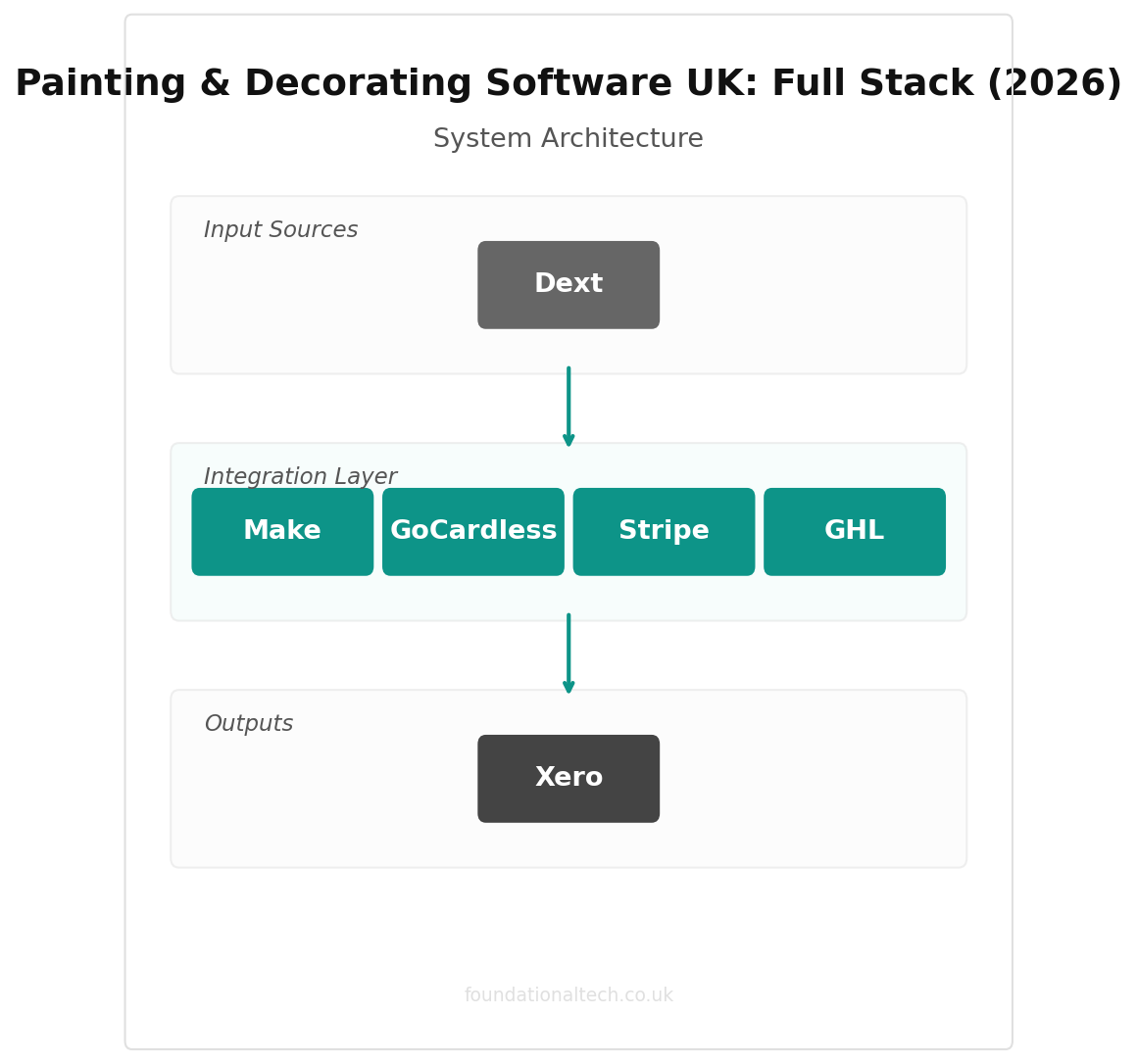
Software doesn't remove that judgement. What it does is stop the admin around it from eating your evenings — the quote that takes ninety minutes to type up from a phone note, the invoice you forget to send until the client asks, the paint account you're not using efficiently, the tax return built from a shoebox of till receipts in April.
This article maps the automation stack for a UK painting and decorating business — sole trader or small team. Nine deeper articles follow.
The Four Layers of a Decorator's Stack
A plasterer or a plumber can often run on an invoicing app and a diary. A decorator needs slightly more, because pricing accurately depends on variables — surface condition, number of coats, prep time — that change on nearly every job, and because most decorating income comes from a high volume of small, short jobs rather than a handful of large ones.
1. Quoting and Scheduling — YourTradebase, Trades Panel or HiveSuite
This is where the job either gets priced properly or gets guessed. YourTradebase is built specifically around trades like decorating: itemised quotes with labour and materials broken out by room, deposit requests built into the quote itself, and a client portal so the homeowner can accept and pay without a phone call. It costs £29/month with no contract, plus £15/month for each additional user, and includes an unlimited 30-day trial before you're asked for card details.
Trades Panel covers similar ground — quotes broken down by labour, materials and prep time per line, crew scheduling with conflict alerts if you double-book a painter, and location-verified clock-in so hours per job are captured automatically for billing. It has a genuine free tier with no card required, which makes it the obvious starting point for a one-person outfit still deciding whether to pay for software at all.
HiveSuite, a UK-native platform covering quoting, scheduling, invoicing and a customer portal, scales further: Solo at £34.99/month, Small Team at £89.99, rising to £249.99 for a Professional tier with twenty admins and unlimited crew. Most solo decorators and two-to-three-person teams will outgrow the need for this tier of software long before they outgrow YourTradebase or Trades Panel, but it's worth knowing it exists for the point where you're running multiple crews across multiple jobs in the same week.
None of these tools calculate paint quantities for you with any precision — that's a separate job, covered next — but all three turn a WhatsApp conversation and a mental estimate into a proper, sequential, itemised quote a client can actually query line by line.
2. Paint Quantity and Coverage — The Calculation That Decides Your Margin
This is the layer unique to this trade, and the one most decorators still do in their head. Standard emulsion covers roughly 10m² per litre, but that figure assumes a sound, previously painted surface — it collapses on bare plaster, dark colours needing three coats instead of two, or textured walls that drink paint. Free calculators from TradeCalcs and similar tools let you enter wall area, number of coats and paint type and get back litres and tin sizes needed, with a sensible 10-15% wastage allowance built in. Price Doctor goes a step further, folding coverage calculation into a full pricing tool that also works out labour and prep time so the quote and the material order come from the same numbers.
The habit worth building: never quote from a mental estimate of "two coats, should be fine." Run the calculation, and build the third-coat contingency into the price before you start, not into your profit margin once you're three rooms in.
3. Materials and Supplier Accounts — Trade Accounts Are Free Margin
Every decorator buys paint somewhere, and most are leaving money on the table by paying retail. A Dulux Decorator Centre trade account gets new account holders 25% off their first order, free delivery, and ongoing trade pricing that a domestic customer buying the same tin at a DIY shed simply doesn't get. The Dulux Trade Points app layers a loyalty scheme on top — points per pound spent, redeemable against future purchases, plus early access to new product test-and-tell schemes. Crown Trade and Leyland Trade run comparable trade-account and loyalty structures.
The automation angle here is basic but underused: link your trade account purchases to job codes so that Dext (below) captures the receipt and your accounts show, per job, exactly what the materials actually cost — not what you estimated when you quoted. Over a year, the gap between estimated and actual paint spend is usually where a decorator discovers they've been underpricing prep-heavy jobs.
4. The Financial Backbone — Xero, Dext and Payment Collection
Xero handles invoicing, bank reconciliation and VAT once you're registered. Current UK pricing: Standard at £33/month, Growing at £37/month, Comprehensive at £42/month, Ultimate at £65/month — most solo decorators run comfortably on Standard or Growing. Dext captures receipts from the merchant, the fuel station and the trade counter by photo and pushes the line-item data to Xero, at roughly £24/month plus VAT — genuinely useful given how many small receipts a decorating job generates compared with a single large materials invoice on other trades.
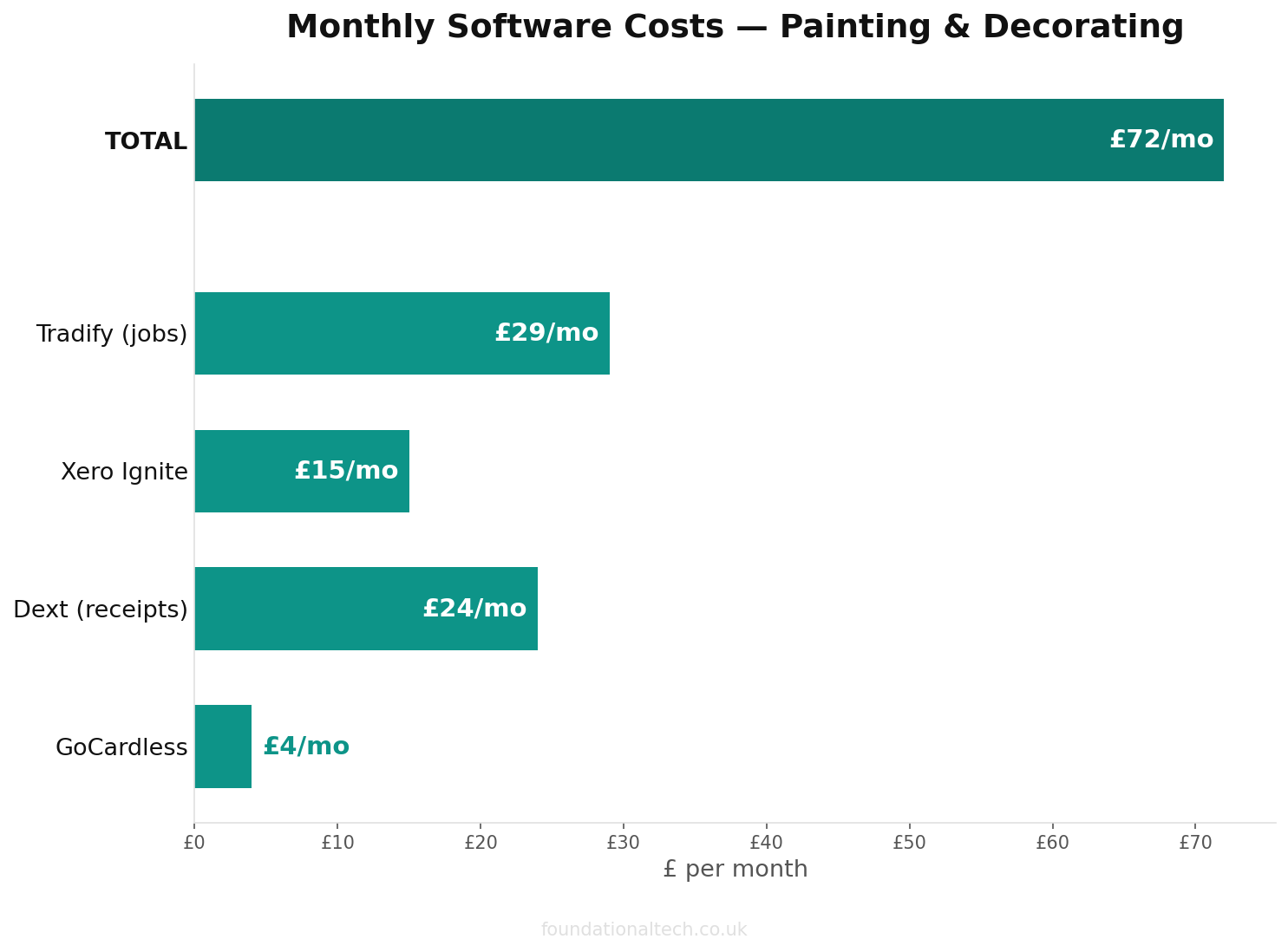
For getting paid, most decorating jobs don't carry the multi-stage milestone billing that a re-roof or an extension does — a typical domestic repaint is priced as a deposit on booking (commonly a third to a half) and the balance on completion, because the job itself only runs days, not weeks. GoCardless collects the deposit and balance by Direct Debit mandate at 1% + 20p per transaction, capped at £4, with no monthly fee on the standard plan; Stripe handles card payments at 1.5% + 20p per transaction for clients who'd rather tap a card than set up a mandate. Automated payment reminders sent from Xero on the completion invoice matter more in this trade than in most, because a happy client who has already had their lounge repainted has little urgency to pay quickly unless prompted.
The Regulatory Layer Most Decorators Underestimate
Painting and decorating carries specific compliance obligations that a generic "trades admin" article won't mention.
CIS applies to decorating work on construction sites. Painting or decorating the internal or external surfaces of any building falls squarely within the Construction Industry Scheme's definition of construction operations. If you subcontract to a main contractor on a new-build or commercial refurbishment, that contractor deducts 20% from your labour (30% if you're not CIS-registered, 0% if you hold gross payment status) before paying you — materials are paid in full, untouched. If you invoice a homeowner directly for domestic work, CIS doesn't apply at all. Knowing which side of that line each job sits on, and configuring Xero's CIS settings accordingly, avoids a nasty surprise at year end.
VAT registration kicks in at £90,000 rolling turnover (2025/26 threshold). Once registered, you charge 20% on labour and materials for most domestic work, though certain new-build and listed-building projects can qualify for the 0% or 5% rate — worth checking before you quote a period conversion or a new-build snagging contract.
Control of Lead at Work Regulations 2002 matter enormously in this trade and get almost no attention. Any property built before 1960 is likely to have layers of lead-based paint beneath the current finish. Dry sanding or heat-stripping old paintwork releases lead dust, which is a genuine health hazard to you and to the occupants — children especially. The safe approach is wet sanding or chemical stripping rather than dry sanding, disposable coveralls, and correct disposal of the waste rather than the household bin. This isn't a box-ticking exercise like some construction paperwork — it's a real occupational hazard specific to this trade, and it should be a standing item on your pre-job checklist for any pre-1960s property, alongside a note to the client about what method you'll use and why.
COSHH (Control of Substances Hazardous to Health) covers the solvent-based paints, thinners and strippers still used for certain finishes and heritage work. Adequate ventilation, correct storage of flammable products, and appropriate respiratory protection when spraying or using strong solvents in an enclosed room are all COSHH requirements, not optional good practice.
Public liability insurance is not legally mandatory for a sole trader but is, in practice, required by nearly every serious client and platform. A domestic policy with a sensible £1-2 million of cover runs roughly £150-£400 a year for a solo decorator, with some insurers offering monthly rates from under £10. Checkatrade, TrustMark and most private clients now expect to see proof of cover before they'll book you, so it belongs in your standard onboarding pack, not just your filing cabinet.
The Blue CSCS Skilled Worker card is the recognised proof of trade competence on any site requiring CSCS, and it's earned through an NVQ Level 2 or 3 in Painting and Decorating plus the CITB Health, Safety and Environment Test (£23.50), with the card application itself costing £36. All-in, training through to a Blue Card typically runs into four figures, but it's frequently the difference between being allowed on a commercial or new-build site and being turned away at the gate.
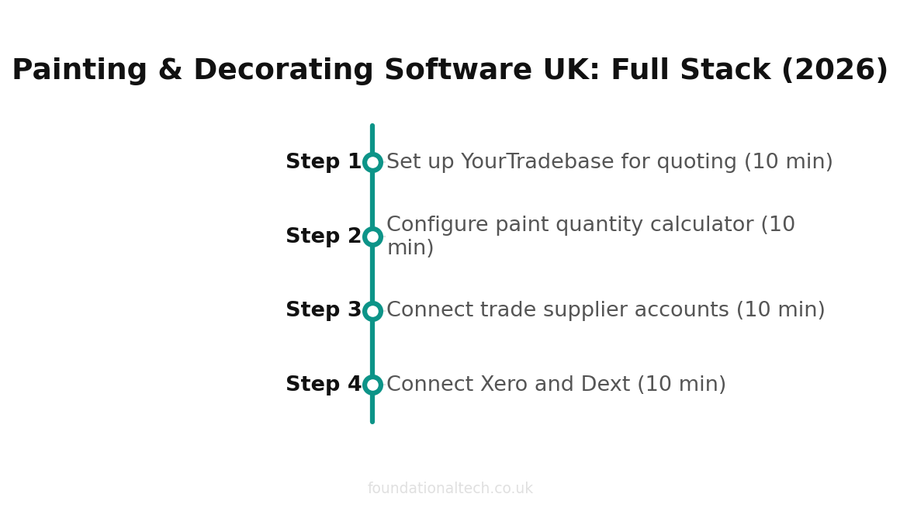
| Step | Action | Time |
|---|---|---|
| 1 | Set up YourTradebase for quoting | 10 min |
| 2 | Configure paint quantity calculator | 10 min |
| 3 | Connect trade supplier accounts | 10 min |
| 4 | Connect Xero and Dext | 10 min |
What This Looks Like in Practice
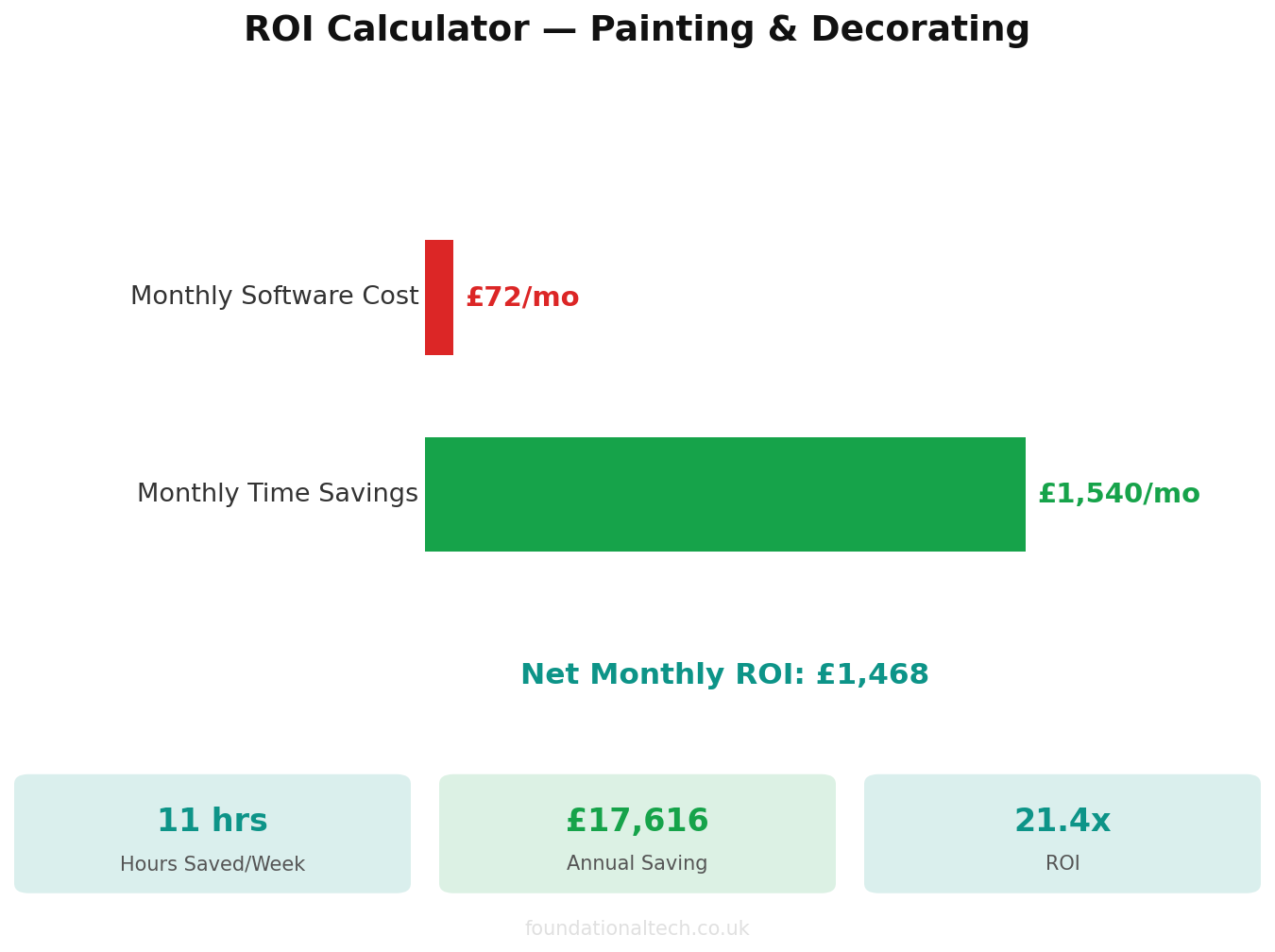
A solo decorator running YourTradebase, Xero on Ignite or Grow, Dext, and a Dulux trade account with GoCardless for deposits can typically expect: quotes sent same-day instead of "I'll type it up tonight," deposits collected automatically rather than chased by text, accurate job-costed material spend instead of a guess at year-end, and a CIS position that's correct without a January scramble. None of that fixes a wall that needs a third coat. It does mean the ninety minutes you used to spend on the quote and the invoice go back into either the next job or your evening.
4 layers
Quoting, paint calculation, supplier accounts, and financial backbone — the complete decorator stack
What Comes Next in This Series
Article 2 compares YourTradebase, Trades Panel and HiveSuite head-to-head, with a real setup walkthrough and monthly cost breakdown. Article 3 covers the cash flow reality of a business built on many small, short jobs rather than a few large ones — deposit structures, chasing a completion invoice on a happy but slow-paying client, and quiet-season cash planning. Article 4 automates the back office: CIS tracking for subcontract site work, mileage between jobs, and receipt capture at scale. Article 5 maps the full integration stack — quoting tool, Xero, Dext, GoCardless and your Dulux trade account working as one system. Article 6 covers how decorators are using AI day to day. Article 7 is a prompt playbook: the exact wording to turn a site note into a quote or a colour-change request into a change order. Article 8 walks through setting up an AI assistant that already knows your price list and tone of voice. Article 9 covers no-code automation workflows connecting your inbox to your quoting tool and Xero. Article 10 is a full case study of a decorator who automated over a single winter of one UK decorating business that rebuilt its admin from scratch.
Related guides: If you found this useful, see our guide on How UK Painters and Decorators Are Using AI to Quote Faster (Without Sounding Like a Template) and How to Stop Chasing Payment as a UK Painter and Decorator: Automated Invoicing, Deposits and Direct Debit (2026).
What's the one job in the last year where the prep took twice as long as you quoted for — and did you eat the difference, or did you have a system for catching it before you started?