Key Takeaway
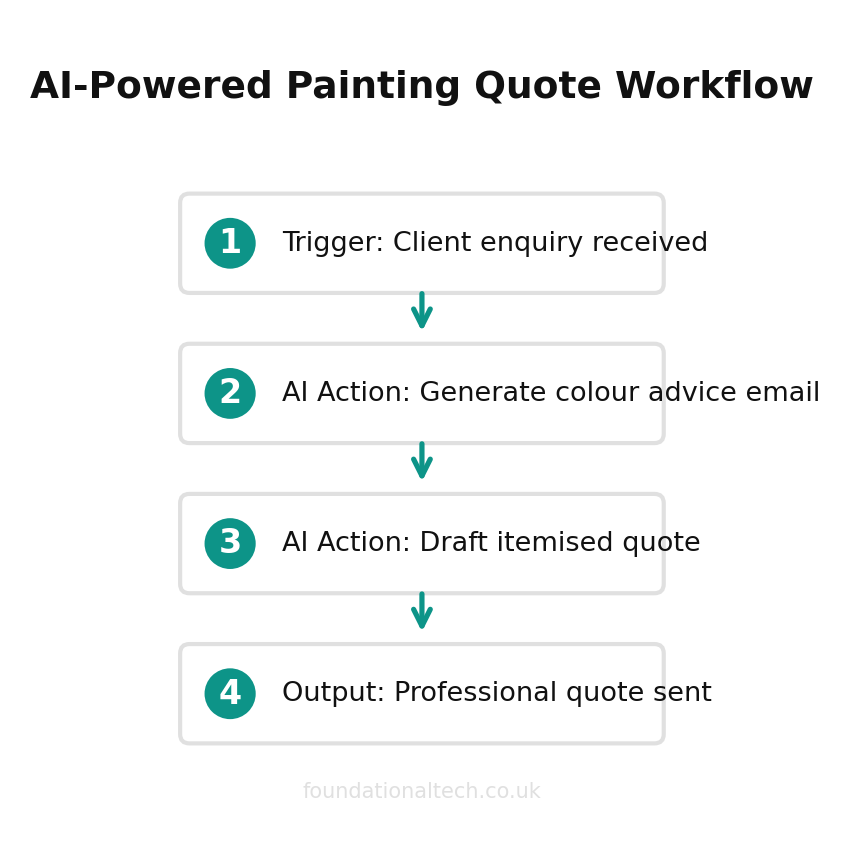
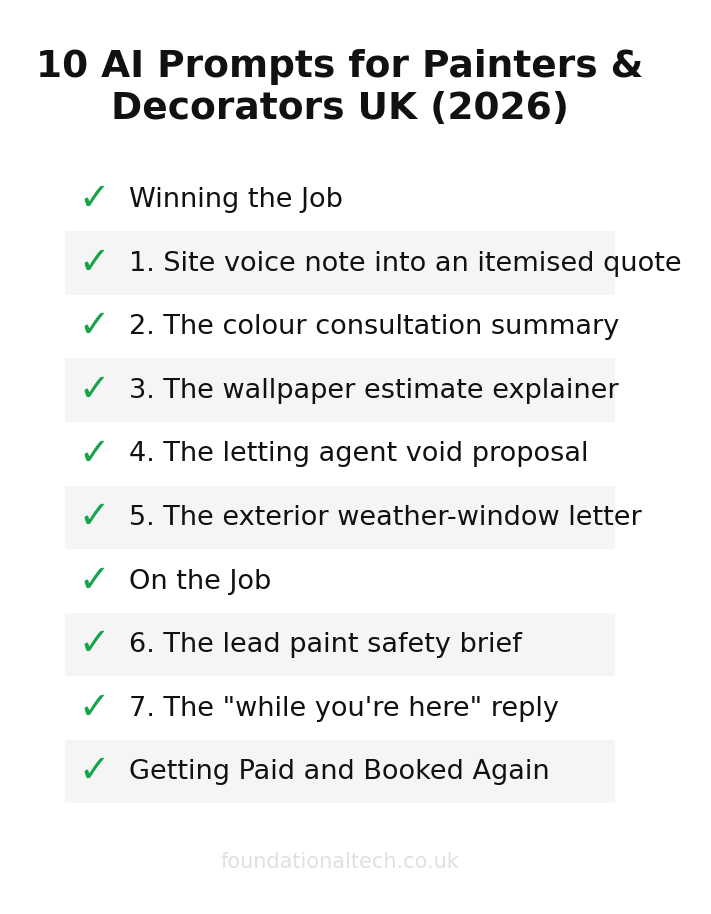
10 copy-and-paste AI prompts for UK painters and decorators — quotes, colour advice, invoicing and customer emails. Works with ChatGPT and Claude.
There's a moment in almost every colour consultation where the client shows you a Pinterest photo of a room with three-metre ceilings and floor-to-ceiling sash windows. Then you have to explain — kindly, and in writing, because they'll want to forward it to their partner — why that exact shade of grey will turn their north-facing lounge into a cave. That email takes twenty careful minutes to write well. Prompt 2 below writes it in ninety seconds, and it still sounds like you.
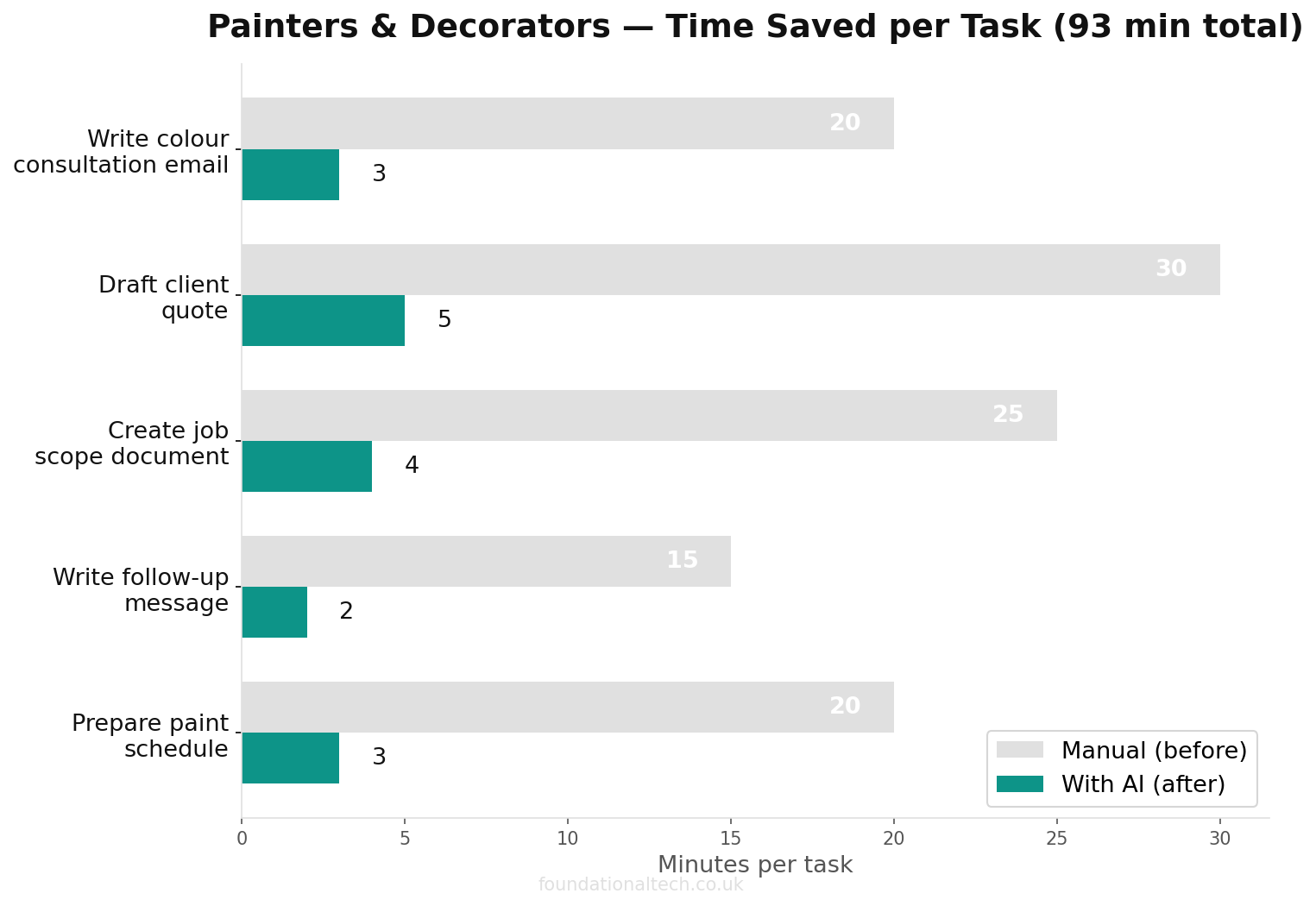
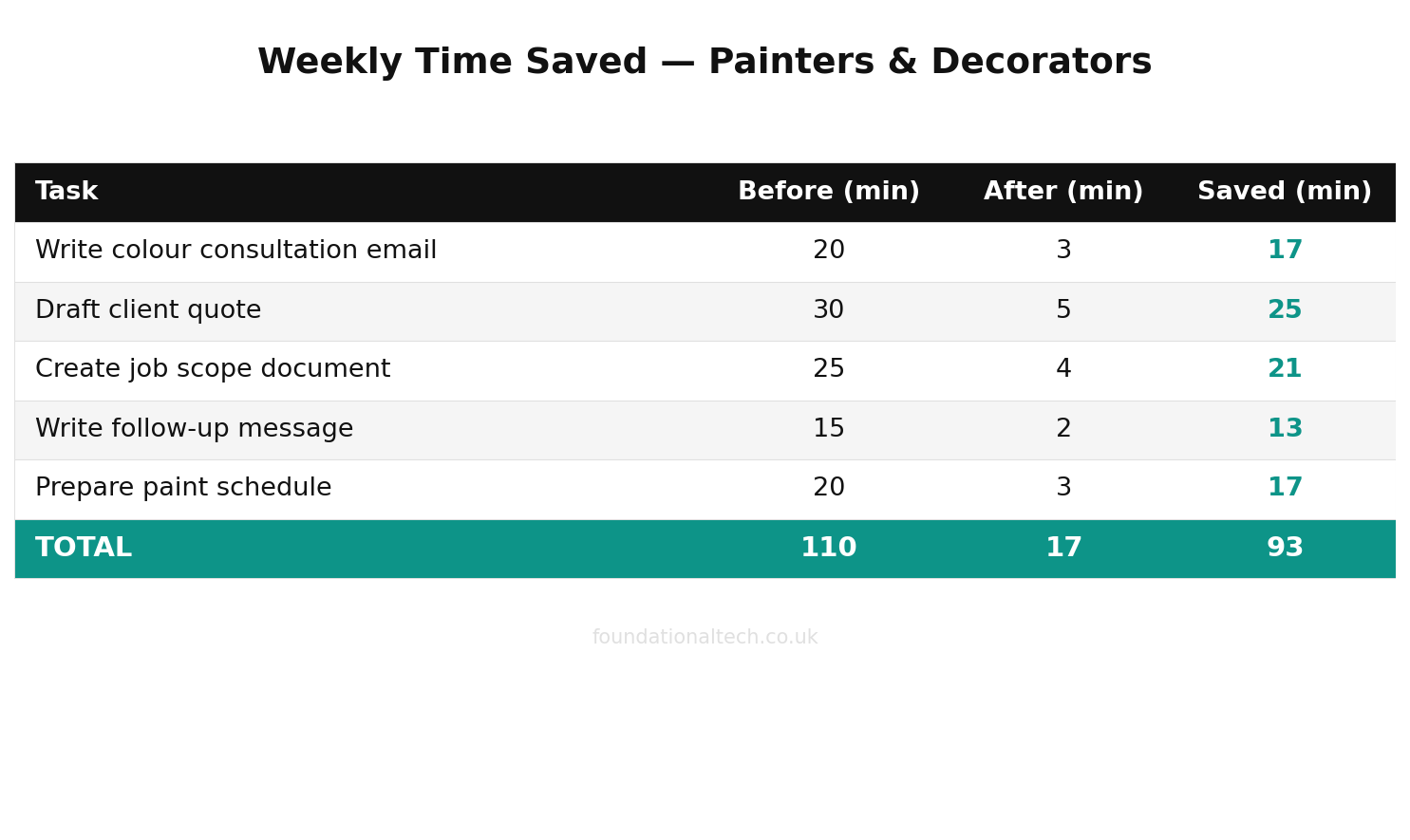
30 min → 3 sec
Average time to draft a professional painting and decorating document — manual vs AI-assisted
Ask a generic AI to help with decorating admin and you'll see the problem immediately. It talks about "paint contractors," measures in gallons, and can't tell a mist coat from a top coat or eggshell from emulsion. It has never heard of a pattern repeat, doesn't know why a hallway needs washable paint, and will cheerfully suggest dry-sanding a Victorian skirting board. The ten prompts below fix that by putting the trade knowledge into the instruction, so the AI's job is just the typing.
Each prompt is copy-and-paste ready. Replace anything in [brackets], keep everything else. They're grouped the way your week actually runs: winning the job, doing the job, and getting paid for it.
Winning the Job
1. Site voice note into an itemised quote
The prompt Article 6 promised. You've walked the property and dictated a voice note before pulling off the drive, and the transcript is a mess. This turns it into a structured draft you check against your coverage calculator — it never invents your prices.
You are helping a UK painter and decorator draft a quote. Below is a rough
voice-note transcript from a site visit. Turn it into an itemised quote
draft, structured room by room.

For each room: surfaces to be painted (walls / ceiling / woodwork), the prep
required, number of coats, and a line for materials. Use UK decorating
terminology (emulsion, satinwood, mist coat, caulk, lining paper).

Leave every price as [PRICE] — I will fill in my own rates. Do not estimate
paint quantities; list them as [LITRES] for me to calculate. Flag anything
in the transcript that suggests hidden prep (old wallpaper layers, damp
staining, nicotine, filler-heavy walls) in a "Check before pricing" note
at the end.

Transcript: [PASTE VOICE NOTE TRANSCRIPT]
When to use: every quote. Dictate the walkthrough in room order and this does the structuring. Time saved: 30–45 minutes per quote — the evening typing, not the pricing judgement.
2. The colour consultation summary
The document that wins jobs on advice rather than price. You're better at judging colour by eye than explaining it in writing; this closes the gap.
Write a short, friendly colour consultation summary from a UK decorator to
a client, based on my notes below. Explain in plain English:
- how each colour under consideration will read in this room given the
  light direction and window size (not how it looks on the swatch)
- which sheen level suits each surface and why (matt vs eggshell vs
  satinwood), based on how the room is used
- my recommendation and the reason for it

Room: [ROOM, DIMENSIONS, LIGHT DIRECTION, WINDOW SIZE]
How the room is used: [KIDS/PETS/HIGH TRAFFIC/etc.]
Colours being considered: [COLOURS/BRANDS]
My recommendation and reasoning: [YOUR NOTES]

Tone: knowledgeable neighbour, not showroom brochure. Under 250 words.
End by suggesting a sample pot on the actual wall before committing.
When to use: any client who's undecided — it's the difference between a swatch and a considered written case. Time saved: 20 minutes, and it converts consultations into bookings.
3. The wallpaper estimate explainer
Nobody believes they need eight rolls when the room "looks like six." The culprit is the pattern repeat, and explaining it badly costs you either the job or two rolls of paper.
Write a short explanation from a UK decorator to a client about wallpaper
quantities. The client expected [EXPECTED NUMBER] rolls; the correct
number is [ACTUAL NUMBER].

Explain in plain English why: the pattern repeat of [REPEAT SIZE] means
each drop wastes up to [WASTE] cm, batch numbers mean we must buy all
rolls from one batch now rather than topping up later, and one spare roll
protects against damage during hanging and repairs years later.

Reassure them this is normal for a patterned paper, not padding. Under
150 words, warm, no jargon without a translation.
When to use: every patterned-paper quote where the roll count raises an eyebrow.
4. The letting agent void proposal
Article 3 covered the letting agent as a different kind of customer — volume, speed, standard spec. This prompt writes the pitch that gets you on their contractor list.
Draft a one-page proposal from a UK decorating business to a letting agent
for between-tenancy redecoration work. Structure it as a fixed-price menu:

- [FLAT TYPE 1, e.g. one-bed flat, walls and ceilings, one colour]: [PRICE]
- [FLAT TYPE 2]: [PRICE]
- Add-ons: woodwork refresh [PRICE], stain-block ceilings [PRICE]

Emphasise what agents actually care about: guaranteed turnaround of
[DAYS] days from key collection, photos on completion for the file,
invoice within 24 hours referencing the property address, and one point
of contact. Professional but not stiff. One page maximum.
When to use: approaching a new agent, or turning ad-hoc void work into a standing arrangement.
5. The exterior weather-window letter
Exterior work sold in February for May is the cheapest cash-flow smoothing there is — if the client understands why they're paying a deposit three months early.
Write a friendly email from a UK decorator to a homeowner who has asked
about exterior painting. Explain that exterior work needs sustained dry
weather above [TEMP]°C, which in the UK means a realistic window of
[MONTHS]. My diary for that window fills by [MONTH].

Offer them a confirmed slot in [TARGET MONTH] secured with a deposit of
[AMOUNT], with the balance only after completion and walkthrough. Make
the early booking feel like the smart move it is, not pressure. Under
200 words.
When to use: every exterior enquiry between October and March.
On the Job
6. The lead paint safety brief
The compliance document Article 6 flagged: pre-1960 property, old paint layers, and an obligation under the Control of Lead at Work Regulations 2002. Most decorators handle it with a verbal "we'll wet-sand it" and nothing on paper.
Write a short client-facing safety note from a UK decorator about working
on painted surfaces in a pre-1960 property that may contain lead paint.

Property: [AGE, SURFACES BEING WORKED ON]
My method: [e.g. wet abrasion, no dry sanding or burning, sheeting taped
and sealed, damp wipe-down, waste bagged]

Explain calmly: why old paint layers may contain lead, why my method
avoids creating dust, and what the household should expect during the
work — including keeping children and pets out of the work area until
each day's clean-down is done. Reassuring, factual, no alarm. Under 200
words, ready to send with the quote.
When to use: every pre-1960 property with sanding or stripping in the spec. Two minutes, and the document that should exist actually does.
7. The "while you're here" reply
Every decorator knows the moment: dust sheets down, client hovering in the doorway — "could you just do the box room while you're at it?" Absorbing it eats the margin; refusing it sours the job. Pricing it kindly does neither.
Write a short, warm message from a UK decorator to a client who has asked
mid-job for extra work beyond the quoted scope.

Extra work requested: [DESCRIPTION]
Price for the addition: [PRICE]
Effect on schedule: [e.g. adds one day]

Thank them for the confidence, confirm I'm happy to do it, and set out
the price and revised finish date plainly — presented as a natural
extension, not a penalty. Ask them to confirm by reply before I start
the extra work. Under 120 words.
When to use: the same day they ask, before the extra work starts. The written confirmation is the point.
Getting Paid and Booked Again
8. The walkthrough-day balance reminder
Article 3's principle: your late payers are mostly delighted clients who forgot, not debtors avoiding you. The reminder has to hold that tone — especially the fifth one you've written that week.
Write a payment reminder from a UK decorator. The client is happy with
the work; they have simply not paid yet.

Job: [ROOMS/WORK DONE], completed [DATE] with a final walkthrough they
signed off. Amount outstanding: [AMOUNT]. Days since invoice: [DAYS].

Open with a specific reference to the finished work (e.g. hope the
[ROOM] is looking good now the furniture's back in). Then a plain, easy
ask: the balance, the payment link, one line. No "per my previous
invoice", no legal tone. Under 100 words.
When to use: day seven after the walkthrough, before the direct debit conversation from Article 3 becomes necessary.
9. The trade statement check
The monthly five minutes that stops prep-heavy jobs quietly eating your margin. You need Dext's job-tagged receipt totals (Article 4) and your quoted materials figures.
I run a UK painting and decorating business. Below are this month's jobs
with two figures each: materials as quoted, and materials actually spent
(from my Dulux/Crown trade account and receipts).

For each job, calculate the overrun or saving in pounds and percent.
Then tell me: which jobs ran more than 10% over, and what those jobs
have in common (property age, prep level, job type) based on the
descriptions. One short paragraph of pattern, then the table.

Jobs: [JOB NAME — DESCRIPTION — QUOTED MATERIALS £ — ACTUAL MATERIALS £]
When to use: monthly, when the trade account statement lands. The pattern paragraph is the answer that changes next year's pricing.
10. The January pipeline email
Your past exterior clients are your spring diary. This fills it while the competition is waiting for the phone to ring in April.
Write an email from a UK decorator to past clients whose exterior work
is [NUMBER] years old. Purpose: book spring exterior repaints now.

Mention that exterior paintwork in the UK climate typically needs
attention every [NUMBER] years, that a maintenance repaint costs a fraction
of letting bare timber go, and that my [SPRING MONTHS] diary is filling.
Offer a free condition check in [MONTH] and first pick of dates for
anyone who books by [DATE]. Friendly, no discount language, under 180
words. Subject line included.
When to use: first week of January, to every exterior client from three-plus years back.
Making Them Yours
Three adjustments turn these from good to indistinguishable-from-you. First, give the AI a sample of the real thing before you start: last year's best quote, pasted into the chat, teaches it your phrasing faster than any instruction — including the slightly-too-blunt bits clients secretly like. Second, the numbers stay yours. Every price, litre and coat count sits in [brackets] until you fill it in, because the moment AI invents a coverage figure is the moment a two-coat quote becomes a three-coat loss. Third, keep the finished versions where a paint-flecked thumb can find them — a pinned note, a saved message, anything that opens in two taps. The prompt you can't find at half eight in a client's hallway saves nothing.
Article 8 takes the next step: an assistant with your rate card and standard finishes loaded in from the start, so the context stops needing to be pasted in fresh with every prompt.
Related guides: If you found this useful, see our guide on How to Stop Chasing Payment as a UK Painter and Decorator: Automated Invoicing, Deposits and Direct Debit (2026), How UK Painters and Decorators Are Using AI to Quote Faster (Without Sounding Like a Template) and Train an AI Assistant on Your Price Book: The Setup Guide for UK Painting and Decorating Businesses (2026).
Which client conversation do you most dread writing up — the colour you know won't work, the "just do the box room while you're here," or the invoice they've forgotten about? Reply and name it. I'd rather write the prompt decorators actually need than guess at an eleventh.
Worried AI won’t sound like you? Read The Decorator Who Was Sure the Robot Would Sound Nothing Like Him.