Key Takeaway
How UK electricians are using AI to cut admin time in 2026. Real examples for quoting, invoicing, and client communications — without sounding robotic.
The best quote you sent last month probably took you forty minutes to write, most of it spent staring at a blank screen at half past nine. The version an electrician down the road sent took four minutes, read better than yours, and won the job. The difference was not skill. It was that he had stopped writing from scratch.
That is what AI actually does for a trade business in 2026. Not robots, not self-driving vans, not your job replaced. Just the writing and the sorting and the remembering — the unbillable evening work — done in a fraction of the time. This is the honest version of what is working right now, what it costs, and where it still falls flat.
AI in Electrical Work: What's Actually Working Right Now
Forget the headlines. No AI is going to test a board or pull a cable. What it is genuinely good at is language and patterns. It turns your rough notes into a clean quote, reads a messy email and tells you what the customer actually wants, and drafts the awkward "your payment is overdue" message so it sounds firm but friendly.
The electricians getting value from it are not doing anything clever. They open a chatbot —Claude, ChatGPT or Google's Gemini —type in plain English what they need, and paste the result into Tradify or their email. No apps to build, no code, no integration. The whole thing happens in a browser tab between jobs. The cost of entry is one subscription, around the price of a tank of diesel a month, and a few minutes learning how to ask for what you want.
Below are the five jobs it does best.
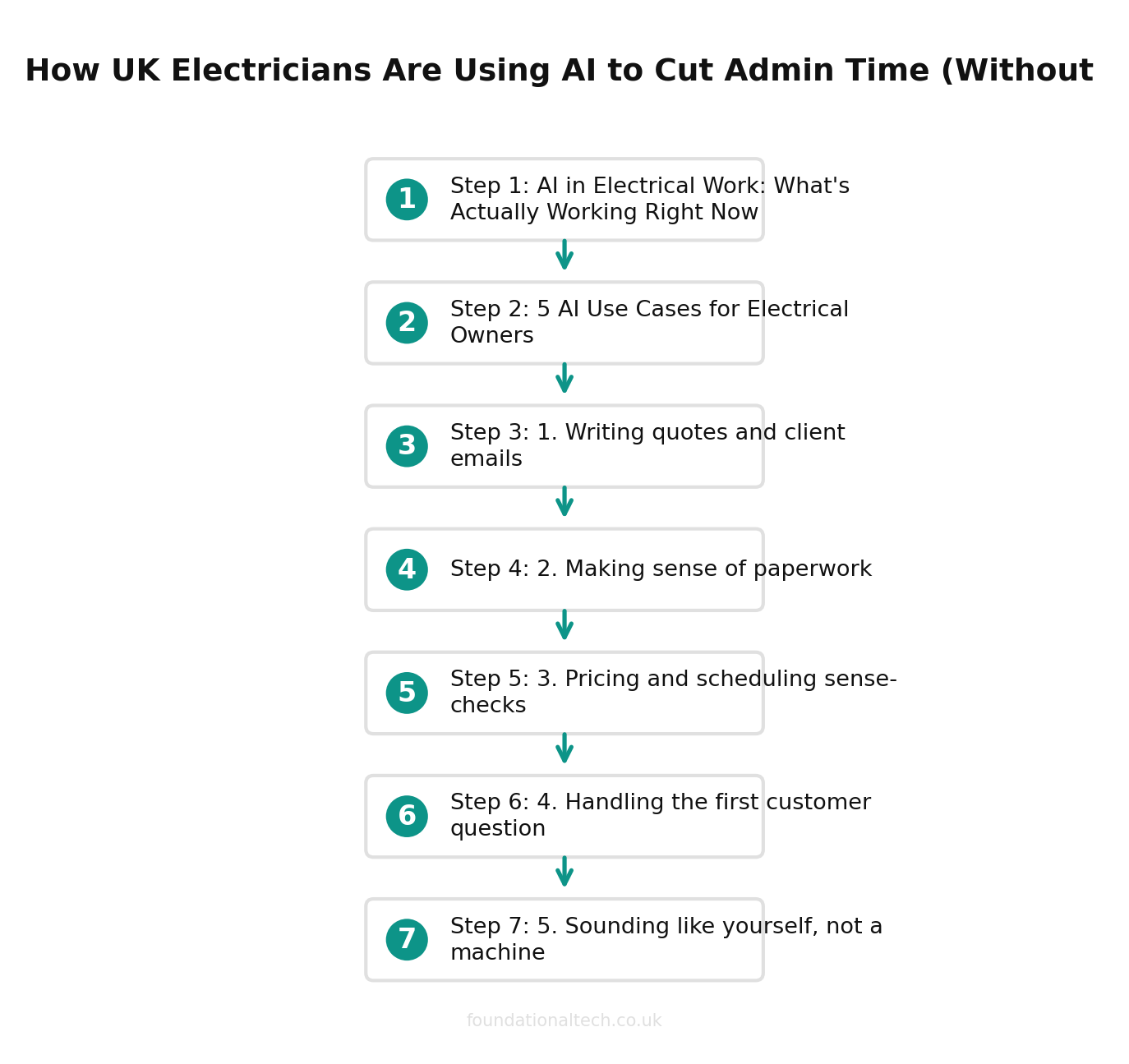

5 AI Use Cases for Electrical Owners
1. Writing quotes and client emails
This is the big one. You finish a survey, you have scribbled notes —"consumer unit swap, 1930s semi, no RCBOs, customer worried about cost" —and you need a quote that explains the work in language a homeowner understands and makes them feel safe spending the money.
25% more quotes
sent per week when AI handles the drafting and electricians focus on the technical detail and pricing
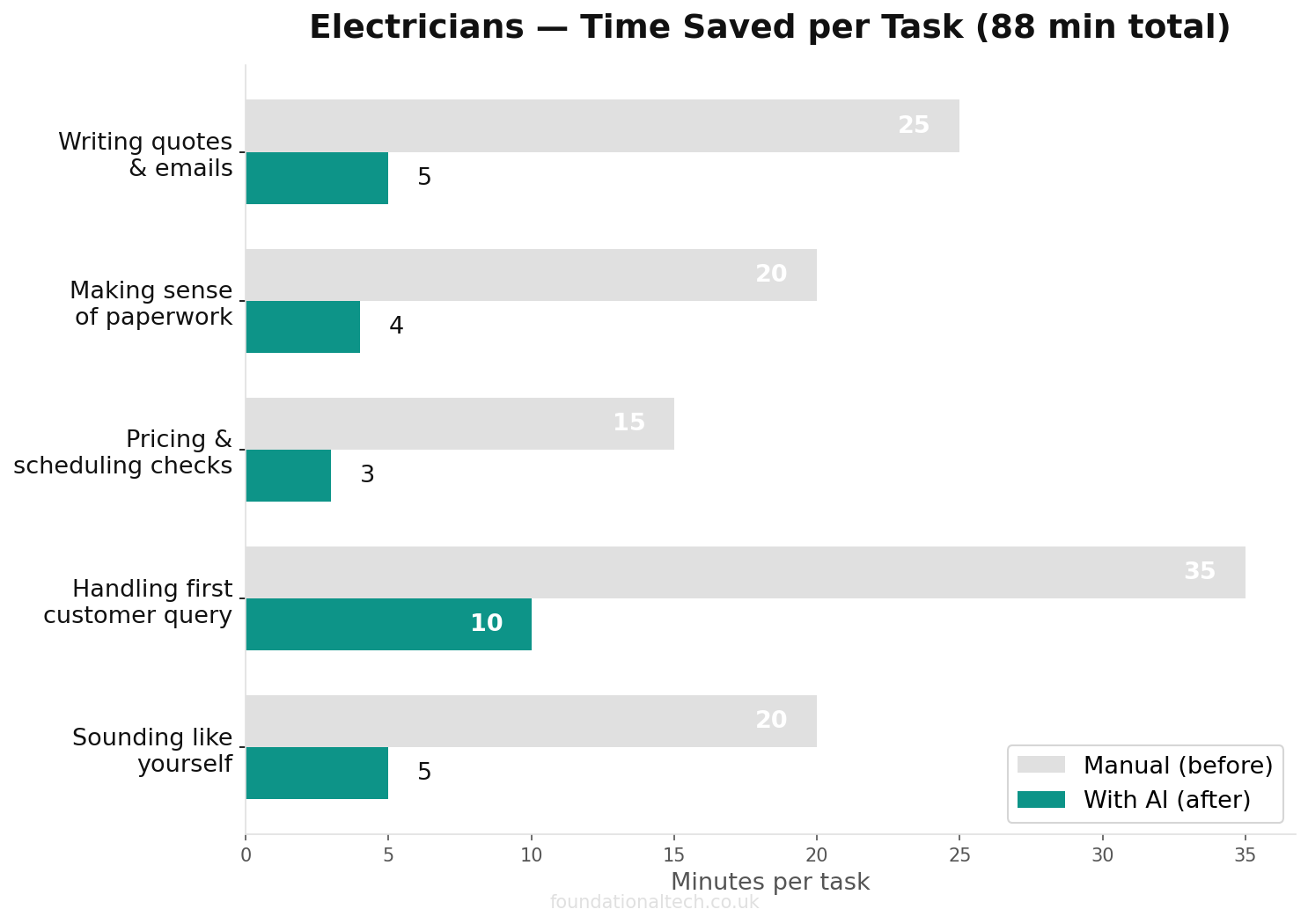
Paste those notes into an AI and ask it to draft a friendly, professional quote covering the scope, why the work matters for safety, and a clear next step. You get a first draft in seconds. You check the prices, fix anything wrong, and send. The forty-minute job becomes a five-minute one, and the writing is usually warmer than what you would have managed at the end of a long day.
Here is what that looks like in practice. Type: "Write a quote for a customer in a 1930s semi for a consumer unit upgrade. They're worried about cost. Explain in plain English why the old fuse board isn't safe, that the work meets the current wiring regulations, and that I'll leave everything tidy. Friendly but professional. Leave the price as a placeholder." What comes back is a structured quote with a warm opening, a short plain-English explanation of why RCBOs matter, a clear scope, and a polite close —the bones of a £1,200 job you can fill in and send before you have started the van. The same trick works for chasing emails, deposit requests, the "sorry I'm running late" message you never quite word right, and the follow-up two weeks later asking for a review.
2. Making sense of paperwork
Electrical work drowns in documents —datasheets, regs, supplier quotes, long customer emails. AI is fast at reading a wall of text and pulling out what matters. Paste in a rambling email from a letting agent listing eight properties and ask it to turn the lot into a simple table of addresses, jobs and deadlines. Paste in a manufacturer's spec and ask what it means in plain terms. It will not always be perfect, but it turns ten minutes of squinting into thirty seconds of skimming.
It is also a quiet help with the quoting that comes off a wholesaler order. Paste in a list of materials and your labour estimate and ask it to lay the whole thing out as a tidy customer-facing breakdown, with the parts grouped and the wording softened. You still set the prices and you still check the maths —but the formatting and the explaining, the bit that eats twenty minutes per quote, is done. For a firm sending ten quotes a week, that is most of a working day handed back.
A worked example makes it concrete. A letting agent emails: "Can you do the EICR softwares on 14 Mill Lane (3-bed), Flat 2 Carter House (1-bed) and the shop at 8 High Street before the end of the month? Tenants in for the first two, shop has a key safe." Type: "Turn this email into a simple table —property, type, access notes, and what's needed —then draft a short reply confirming I can do all three before month-end and asking for the three earliest dates that suit the tenants." What comes back is a clean table you can paste straight into your job list and a warm reply ready to send, the whole thing handled in under a minute instead of the ten you would have spent reading it three times and writing back.
The same trick tames a supplier datasheet. Paste in the technical page for an EV charger or a surge protection device and ask: "Explain this to a homeowner in three sentences —what it does, why it matters, and one reason to choose it." What comes back is wording you can drop straight into a quote, so the customer understands what they are paying for instead of glazing over at a wall of amperages and IP ratings. It is the same job a good supplier rep would do for you over the counter, available at nine at night when the quote is actually getting written.
3. Pricing and scheduling sense-checks
AI cannot see your accounts, but it is a useful second brain for the thinking-out-loud parts of running a firm. Describe a job and your day rate and ask it to sanity-check whether your quote covers your costs. Ask it to help you word a price increase to existing customers. Ask it to suggest the most efficient order to visit five jobs across town. It will not make the decision for you —and it should not —but it breaks the blank-page paralysis and gives you something to react to.
A worked example shows the value. Type: "I charge £45 an hour. A full rewire on a three-bed semi will take me five days with an apprentice on £14 an hour, and I reckon £2,200 in materials. What should I be quoting to hit a 25% margin, and what have I forgotten?" What comes back is a costed breakdown —your labour, the apprentice's time, materials, a margin line —plus a nudge about the things owners routinely leave out: van running costs for a week, waste disposal, scaffold or access hire, and a contingency for the surprises every old house hides behind a wall. You still own the final number, because only you know your real overheads and your local market. But instead of a blank page at nine at night, you have a structured starting point you can argue with, and you are far less likely to underprice the job by forgetting a cost that quietly eats your profit.
4. Handling the first customer question
A lot of enquiries are the same three questions: do you cover my area, can you do an EICR, how soon can you come. AI can draft the replies, build a simple FAQ for your website, or —if you want to go further —power a chat assistant that answers the basics while you are up a ladder. Used well, it means fewer missed enquiries and fewer evenings spent typing the same answer for the hundredth time. Used badly, it sounds like a machine, which is exactly the fear we will deal with below.
The bigger win here is speed of reply. The trade lives and dies on who answers first —the electrician who responds within the hour usually gets the job over the one who calls back tomorrow. Keep a few drafted replies ready, or let AI rough out a response to a new enquiry the moment it lands. Then you can reply from the van in two taps, instead of letting it sit in your inbox until the evening. The work is the same; you just stop losing jobs to silence.
If you do build a website FAQ this way, feed the AI your real answers first — your actual coverage area, your rough lead times, what you will and will not quote remotely. The AI reshapes the wording, but the substance has to be yours. A chatbot that confidently tells a customer you cover Bristol when you only work in Birmingham is worse than no chatbot at all.
5. Sounding like yourself, not a machine
This is the part most guides skip, and it is the part that matters most for a trade business. AI writes in a particular way — clean, polished, slightly corporate. That is fine for a formal quote but wrong for a text message, wrong for a casual email, and wrong for a social media post. The electrician who sounds like a machine loses the trust that got them the enquiry in the first place.
The fix is simple: tell the AI how to sound before you ask it to write. "Write this the way a friendly, experienced electrician would explain it to a homeowner over the phone" produces something entirely different from "Write a professional communication." Add specifics: "Use short sentences. Do not use the word 'solutions'. Do not use exclamation marks. My name is Dave." The more personality you feed in, the more the output sounds like you instead of a chatbot.
You can also keep a running note — a few paragraphs of your own writing that you paste in as a reference. "Here is how I normally write to customers. Match this tone." AI is surprisingly good at mimicking a voice when it has an example. The first draft will still need a pass — change a word here, soften a sentence there — but the starting point will sound like your business, not like a template.
One more thing. Proofread the output before you send it. AI occasionally invents qualifications you do not hold, references regulations that do not exist, or confidently states something that is simply wrong. You are the qualified electrician. The AI is the typist. If you would not sign the document without reading it, do not send it because a machine wrote it.
What It Costs
Claude Pro is £18 a month. ChatGPT Plus is £20. Gemini is available on a free tier for short tasks, or from £5.90 a month per user on Google Workspace. You do not need all three — pick one, learn how to ask it for what you want, and use it for a month before deciding if it is worth keeping.
For most sole traders, the time saved on quoting alone covers the cost several times over. If you send five quotes a week and each one takes thirty minutes less, that is over two hours a week — ten hours a month — bought back for less than the price of a pair of cable cutters.
Where It Falls Flat
AI does not know the 18th Edition from the 17th unless you tell it. It will happily cite regulation numbers that do not exist. It cannot see your installation, assess a board, or spot a fault. It has no idea what your local wholesaler charges for a Hager RCBO this week. And it will occasionally write something that sounds authoritative but is completely wrong — the confident delivery is its most dangerous feature.
Treat everything it produces the way you would treat work from a keen but unqualified apprentice: check it before it leaves the premises. The moment you stop checking is the moment it costs you a customer or, worse, your reputation.
Getting Started This Week
You do not need a system. You do not need an app. You need one subscription and one job.
Tonight, take the next quote sitting in your head. Open Claude, ChatGPT or Gemini in a browser tab. Type your survey notes in plain English and ask for a customer-ready quote. Read what comes back. Fix the prices and the details. Send it.
If it saves you twenty minutes, do the same thing tomorrow. Within a week you will have a sense of what it handles well and where it stumbles. Within a month you will wonder how you managed without it — not because the technology is extraordinary, but because the admin was always the part that did not need to be done by hand.
Related guides: If you found this useful, see our guide on AI Prompts for Electricians: 12 Copy-and-Paste ChatGPT & Claude Prompts Every UK Electrician Should Use in 2026 and Fire and Security Software UK: How Alarm and CCTV Installers Automate Maintenance Contracts, BAFE Paperwork and Recurring Billing (2026).
For the moment it clicks, read The First Time AI Wrote a Better Client Email Than Me.