Key Takeaway
The first time AI wrote a better client email than me and the automation system I built afterward. A real story about using Claude in a UK trade business.
It was a Thursday evening in March. I had three client emails to send before I could close my laptop — a VAT deadline reminder, a dividend planning summary, and a reply to a new enquiry asking about our bookkeeping packages.
I'd been putting them off all day. Not because they were difficult. Because they were boring. The same emails I'd written hundreds of times, with slightly different numbers and slightly different names.
On a whim — honestly, half out of procrastination — I opened Claude. I'd been hearing about it for months. A friend in consulting wouldn't shut up about how it had "changed his workflow." I'd nodded politely and assumed it was overhyped.
I typed three bullet points about the dividend situation. Client name. Tax year. Unused basic rate band. Asked Claude to draft an advisory email in a professional but approachable tone.
Eight seconds later, I was reading an email I couldn't have written that well in twenty minutes.
It structured the information better than I would have. Tax implications first, action items second, reassurance third. It anticipated the follow-up question the client would ask and addressed it in the final paragraph. The tone was right — warm but not matey, technical but not intimidating.
I sat there for a long time after that.
The feeling nobody talks about
There's a specific kind of dread that hits when you watch a machine do your job better than you. It's not anger. It's not fascination. It's a cold, quiet question: if this thing can do the part of my job I spend the most time on, what exactly am I for?
I'd spent 15 years building a career on being the person who could explain complex tax situations clearly. Who could write the email that made clients feel informed without feeling overwhelmed. That was my value. That was the thing I thought couldn't be automated.
And here was a free tool doing it in 8 seconds.
I didn't immediately embrace AI. I closed the laptop and didn't touch Claude for two weeks.
I told myself the email wasn't that good. Told myself clients would notice. Told myself there were compliance risks. Every excuse was technically plausible and entirely motivated by fear.
What pulled me back
What broke the avoidance wasn't curiosity. It was a Monday morning with 14 client emails to write, a VAT return to review, and a new client to onboard. By 11am I'd done two emails and was already behind.
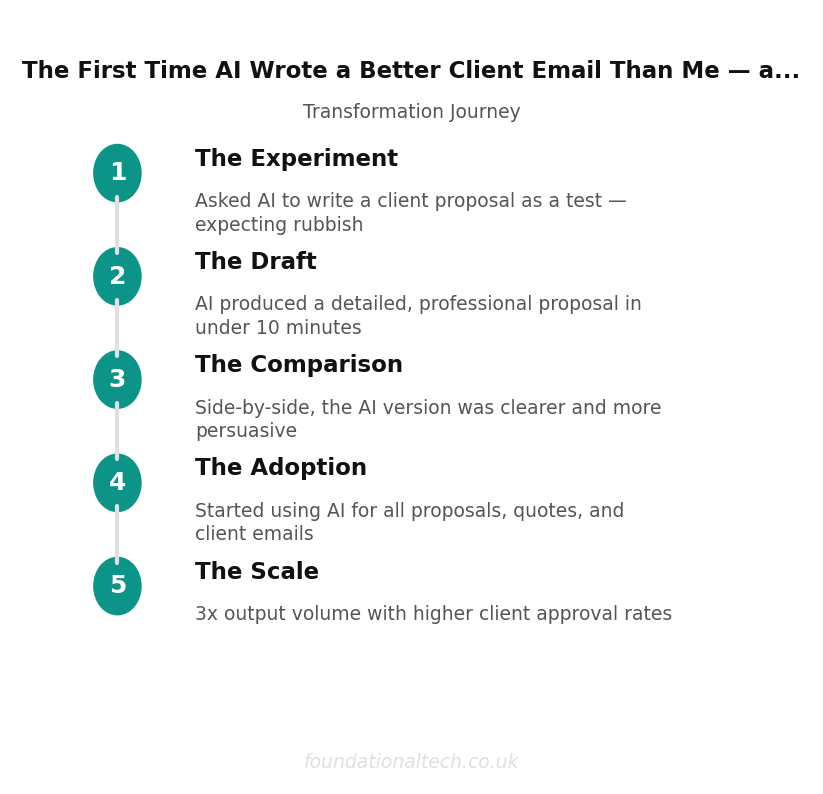
I opened Claude again. Not because I'd accepted anything. Because I was drowning.
I drafted all 14 in about 40 minutes. Bullet points in, polished draft out. Some needed a sentence changed. A couple needed a paragraph rewritten. But the heavy lifting — structuring, phrasing, anticipating questions — was done.
I sent 14 client emails before lunch. That hadn't happened in years.
Then I got curious. Summarising HMRC guidance updates. Drafting board meeting minutes from my notes. Explaining FRS 102 vs FRS 105 in language a sole trader would actually understand. Writing the practice newsletter I'd been meaning to start for three years.
Same pattern every time: 80% of the way there in seconds. The remaining 20% was my expertise — knowing what to adjust, what to cut, what the client actually needed to hear. That 20% turned out to be where all my real value lived.
The learning curve that surprised me
Here's what I didn't expect: the better I got at using AI, the more my accounting experience mattered.
Generic prompts produce generic results. When I typed "write an email about dividends," I got something that could have come from any accountancy website. When I typed "write an email to a husband-and-wife director team who are basic rate taxpayers with £40,000 of retained profits, advising on the optimal dividend split for 2025/26, in a tone that's direct but not condescending because they're sophisticated business owners" — I got something remarkable.
The difference is domain knowledge. Fifteen years of knowing what matters in a client's situation, knowing what tone works with which type of client, knowing which details are legally important and which are just noise. AI doesn't have that. I do.
I spent the next few months building what I now call prompt playbooks — structured prompts for every recurring task in my practice. Client emails. Tax summaries. Management report commentaries. Engagement letter drafts. Each prompt bakes in the context that turns a generic AI response into a practice-ready document.
It took about 30 hours across three months. But those hours forced me to articulate things I'd been doing instinctively for years. What makes a good client email? What structure works for a dividend planning letter? What tone do you use when delivering bad news about a tax bill?
The unexpected dividend was what this taught me about my own work. Writing those prompts forced me to name rules I'd followed on instinct for fifteen years — that a tax-bill email leads with the number and the deadline, not the apology; that a sophisticated client wants the reasoning, not just the recommendation; that "professional but warm" means short sentences and no hedging. I had never written any of it down. Once I had, I could hand it to a machine — and, more usefully, to a junior on their first week.
Turning instinct into system is the real work of AI adoption. Everything else is just clicking buttons.
What changed in the practice
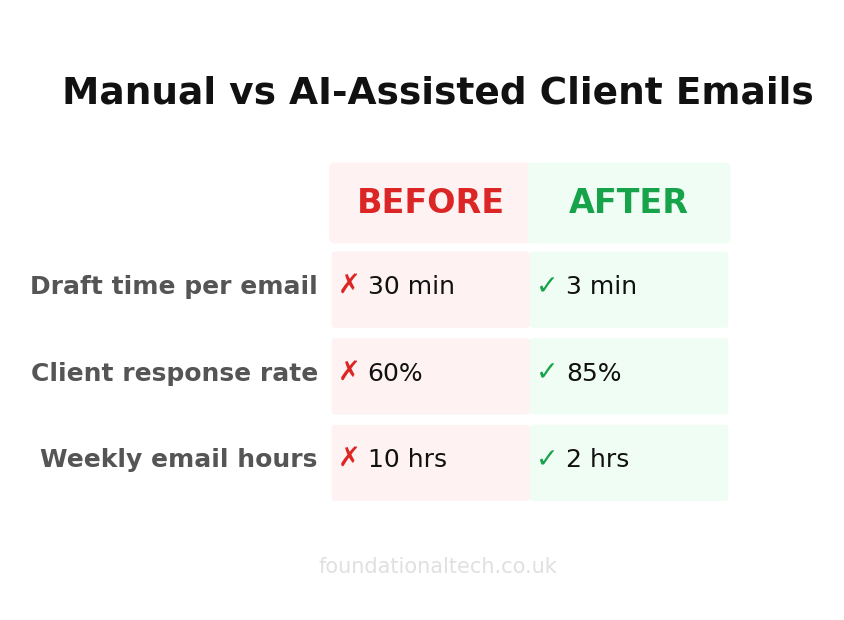
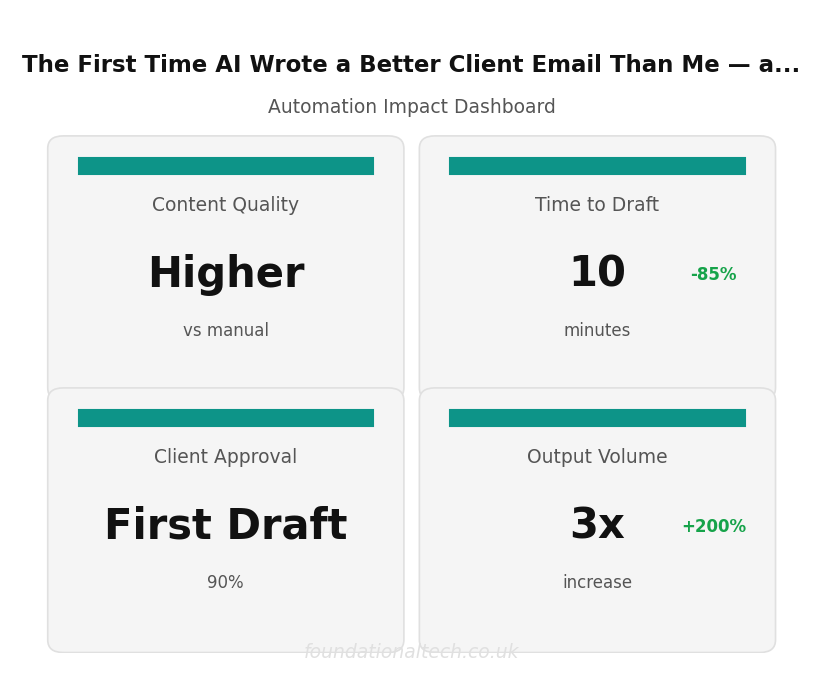
The numbers are straightforward. I reclaimed roughly 10 hours a week of drafting time. Some of that went to taking on new clients. Some went to the advisory conversations I'd always wanted to have but never had bandwidth for — sitting down with a client and actually talking through their business strategy instead of rushing to the next email.
To put numbers on it: a management report that used to mean 45 minutes staring at a blank document now takes eight. I paste the figures, Claude drafts the variance commentary, and I add the two or three things only I know about that client's quarter. The batch of forty VAT cover letters I used to dread became a single afternoon's review. Across a normal week, the drafting tax — the dead time between knowing what to say and having it written down — fell by roughly 70%.
One example stuck with me. A long-standing client rang in a panic about an HMRC compliance check letter. The old me would have set aside an anxious hour that evening. Instead I gave Claude the facts, got a calm, correctly-scoped first draft in under a minute, spent ten minutes adding the specific figures and the reassurance that client needed, and had it out before the end of the call. The client thought I'd dropped everything for them. In a sense I had — I'd spent the time on them, not on the prose.
But the bigger change was psychological. I stopped seeing myself as someone who writes emails and reconciles bank feeds. I started seeing myself as someone who understands client situations deeply enough to direct AI to produce the right output. That's a fundamentally different job. A better one.
My clients didn't notice. Their emails still sounded like me — because I was still deciding what to say. The AI just removed the 20-minute tax of turning thinking into polished prose.
AI wrote a better email than me
the moment that changed how one accountant handles client communication
Why I'm telling you this
I publish the AI guides on Foundational Tech because I've done the work of figuring out which prompts actually produce usable results in a UK accounting practice. The prompt playbook and AI worker setup guide we published this week aren't theoretical — they're the systems I built for myself when I was trying to claw back 10 hours a week.
But the technical guides are only half the story. The other half is the bit nobody writes about: the moment you realise a machine can do something you thought was uniquely yours, the two weeks you spend pretending it can't, and the morning you open it again because you're simply too busy not to.
Every professional I talk to — accountants, solicitors, estate agents, contractors — is somewhere on that timeline. Denial. Quiet experimentation. Full adoption. Wherever you are, the pattern is the same: the tool is faster, your expertise makes it useful, and the combination is worth more than either one alone.
The accountants who figure this out in 2026 will spend 2027 advising clients while their competitors are still drafting emails. That's not a prediction. It's already happening.
When was the last time a tool did something better than you expected — and how did that feel? I'd genuinely like to know. Hit reply.
I built A&Y Financial Services to help business owners make this exact transition — from manual operations to automated, AI-enhanced systems. If you're wondering where to start, let's talk.