Key Takeaway
How UK plumbers are using AI to cut admin time in 2026. Real examples for quoting, invoicing, and client communications — without sounding robotic.
A plumber in Leeds writes his quotes in ninety seconds now. He speaks the job into his phone on the drive home — “supply and fit a Worcester combi, drain down, dispose of old unit, two days” — and an AI turns it into a clean, itemised quote his customer actually understands. He hasn’t typed a quote in three months.
That’s not the future. That’s a £20-a-month tool doing the thing plumbers hate most. This guide skips the hype about robots taking over. It shows you exactly what UK plumbers are doing with AI right now — the five jobs it does well, the three tools worth paying for, and the things it still can’t be trusted to touch. If you are also choosing job management software, read that comparison first — the AI layer works best on top of a solid operational stack.
AI in Plumbing: What’s Actually Working Right Now
Forget anything you’ve read about AI replacing tradespeople. No algorithm is going to fix a leaking pushfit joint under a bath. What AI is doing — today, in real plumbing businesses — is killing the admin that eats your evenings.
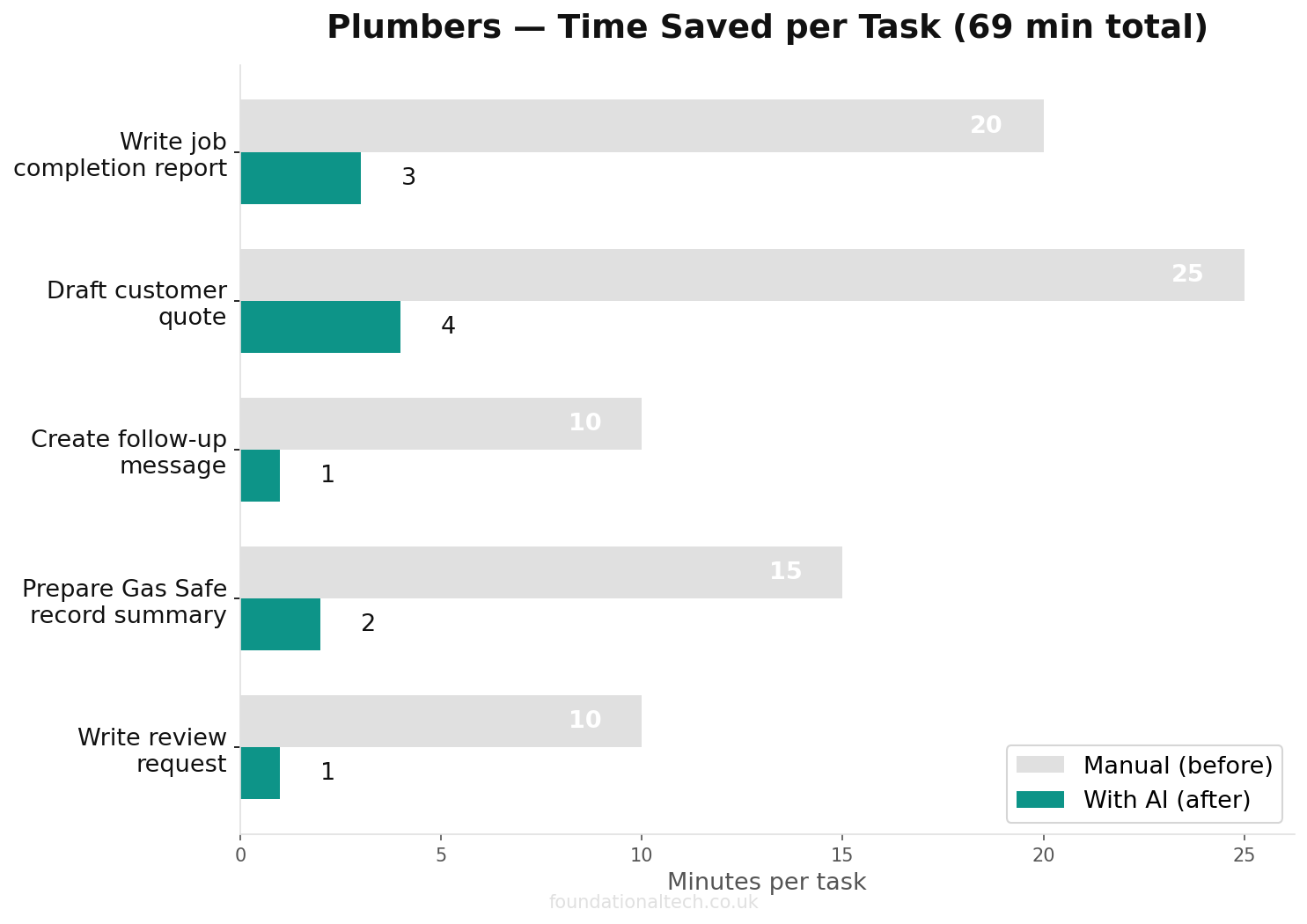
The pattern is simple. Anything that involves turning a few rough facts into polished words, reading a document, or answering a predictable question is now something a £20-a-month AI assistant does in seconds. Quotes. Customer emails. Categorising a pile of receipts. Drafting a follow-up to a landlord. Explaining to a worried customer why their boiler keeps losing pressure. These are the tasks plumbers either do badly at 9pm or don’t do at all, and they’re exactly what AI is good at.
You don’t need to understand how it works. You need to know what to point it at. Here are the five jobs.
5 AI Use Cases for Plumbers
1. Client communications — quotes, emails and the awkward chase
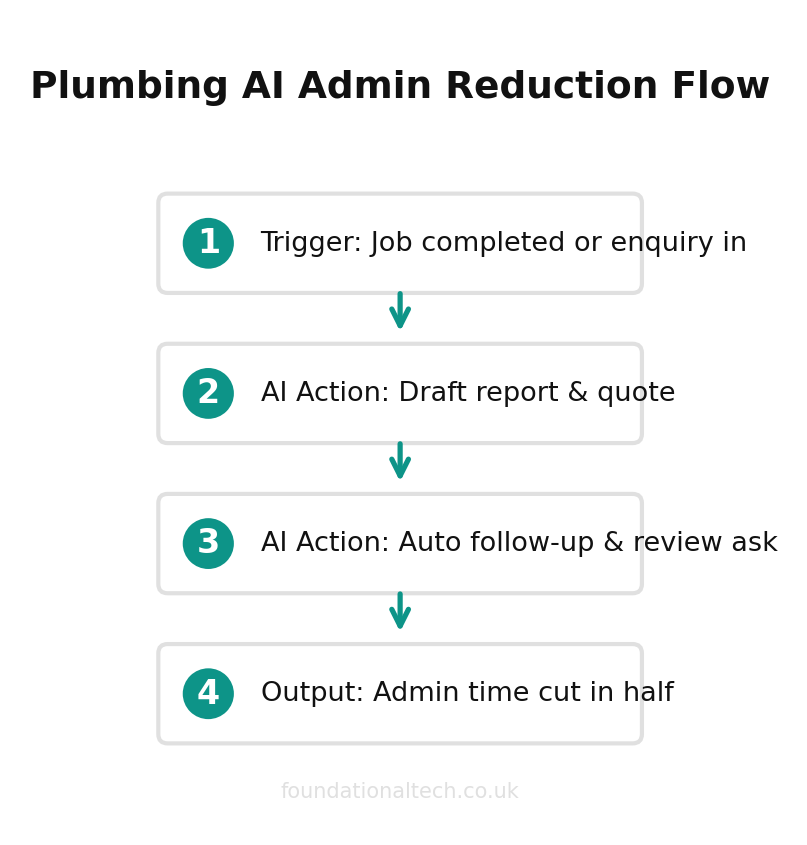
The biggest win. You feed the AI the rough details of a job — in plain speech or a few bullet points — and it writes the quote, the booking confirmation, or the polite-but-firm payment chaser. You read it, tweak a number, send it.
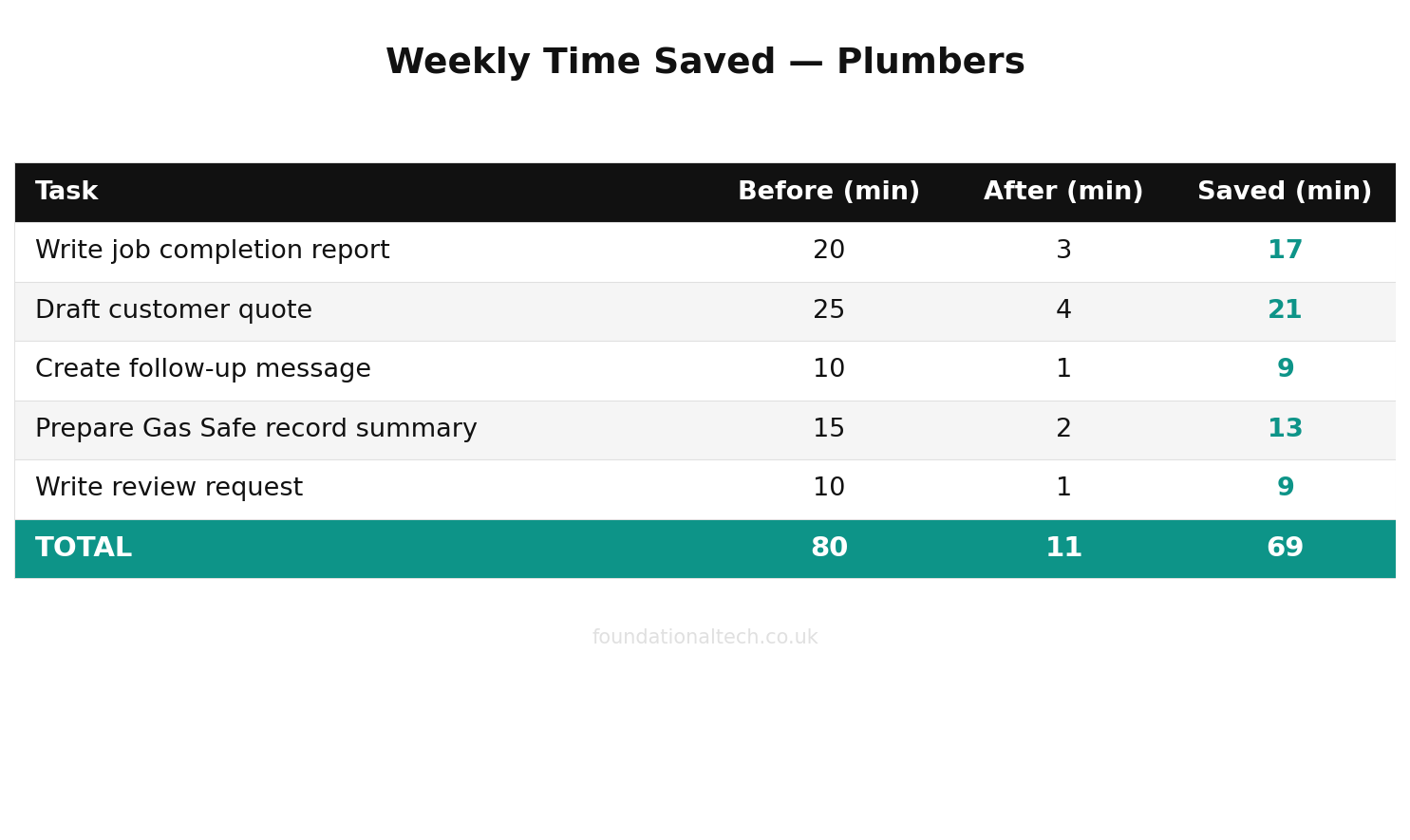
5+ hrs/week
of paperwork eliminated when plumbers use AI to draft quotes, warranty docs and customer communications
A plumber’s quotes are often where jobs are won or lost, and a rushed quote scribbled on the van dashboard loses to a tidy, itemised one every time. AI gives you the tidy version without the hour at the laptop. The same goes for the email nobody wants to write: the third reminder to a customer who’s 40 days late. Ask the AI for “a firm but friendly final reminder before late-payment charges,” and it strikes a tone you’d struggle to find when you’re annoyed.
2. Document processing — receipts, certificates and supplier bills
Point your phone at a builders’ merchant receipt and AI reads it: supplier, date, what you bought, the VAT. Modern accounting tools like Dext and Xero already bake this in, but a general AI assistant goes further — paste in a messy supplier statement and ask “which of these invoices haven’t I paid?” and it sorts the lot. For the accounting side specifically, connecting Tradify to Xero removes most of the manual bookkeeping before AI even enters the picture.
It also drafts the repetitive paperwork. Give it the details of a boiler service and ask for a plain-English summary of the work for the customer’s records, and you’ve got a professional job sheet in seconds. (Crucial caveat: AI must not generate your Gas Safe certificates or CP12s — those are legal documents tied to your registration. More on that below.)
3. Decision support — pricing, scheduling and “should I take this job?”
This is the underused one. AI is a sounding board for the business decisions you usually make on gut feel.
Paste in your last three months of jobs and ask which type was most profitable per hour. Describe a big commercial enquiry and ask it to list the risks before you quote. Tell it your week’s bookings and ask for the most fuel-efficient order to drive them. It won’t always be right — it can’t see your van or know that one customer always overruns — but as a second opinion that costs nothing per question, it surfaces things you’d miss at the end of a long day.
Here’s a real example of the shape this takes. A plumber exports a spreadsheet of last quarter’s jobs — date, type, hours, amount invoiced — and pastes it in with one question: “Which type of work earned me the most per hour, and which earned the least?” The answer comes back in seconds: boiler servicing was £71 an hour, bathroom installs £44, and emergency call-outs — the jobs he’d been prioritising because they felt urgent — were the worst at £38, once travel and waiting were counted. That’s not a decision the AI makes for him. It’s a number he never had time to work out, handed over in the time it takes to make a brew, that changes how he fills next month’s diary.
4. Customer service — answering the questions you get every week
Plumbers field the same questions endlessly. “Why is my boiler pressure dropping?” “How often should I service it?” “Do you cover my area?” AI drafts clear, reassuring answers you can keep as templates, or — for the more technical among you — powers a simple FAQ chatbot on your website that handles enquiries while you’re on a job.
Used well, it means a customer messaging at 8pm gets a helpful reply immediately instead of waiting until you surface from the next morning’s call-out. That responsiveness wins work.
5. Marketing the trade hates doing
Most plumbers know they should post on Facebook or Google to win local work, and most never do, because writing a post feels like homework. AI removes the friction. “Write a short Facebook post about a bathroom refit I just finished in Headingley, friendly, no jargon” gives you something to post in ten seconds. Feed it five recent jobs and it’ll draft a month of posts. It writes your Google Business profile, your van wrap tagline, the blurb on your website’s home page — all the words you’ve been avoiding for two years.
The Tools: Claude vs ChatGPT vs Gemini for Plumbers
Three tools dominate, and they cost roughly the same — about £20 a month for the paid tier, which is the one worth having. Here’s the honest comparison for a plumbing business.
ChatGPT Plus (around £20/month inc. VAT). The best-known and the easiest to start with. The free version is genuinely useful for occasional quotes and emails; the £20 Plus tier removes limits and adds voice, which is perfect for dictating jobs from the van. If you want one tool and no decisions, this is it.
Claude Pro (around £20/month + VAT, so roughly £20–21). Strongest at writing that sounds like a human, not a brochure. For customer emails, quotes and the delicate payment chasers, Claude’s tone tends to need the least editing. It’s also good at working through a document — paste a long supplier statement or a tenancy agreement and it reasons through it carefully. A solid choice if communications are your main pain.
Google Gemini (Gemini Advanced, around £18.99/month). The pick if you live in Gmail and Google Calendar. Gemini plugs into Google’s apps, so it can draft replies inside your inbox and work with your existing diary. If your whole business already runs on a Google account, the integration saves steps the others can’t.
The honest answer: any of the three will transform your admin, and all offer a free tier to test before you pay. Start with the free version of whichever you’ve heard of, point it at your next quote, and upgrade to the £20 plan only once it’s earning its keep. Don’t pay for all three.
One more practical note on cost. Twenty pounds a month sounds like another bill on a pile of them. Frame it against an hour of your time. If AI saves you two hours of evening admin a week — a conservative figure once quoting and emails are off your plate — that’s eight hours a month you’ve bought back for the price of one billable hour. At a £60–£80 charge-out rate, the maths isn’t close. The tool pays for itself in the first quote you don’t have to write at the kitchen table. Layer it on top of an automated quoting and invoicing stack and the evening admin disappears almost entirely.
How to Start This Week
Don’t try to automate everything at once — that’s how good intentions die in a settings menu. Pick the single task you dread most. For most plumbers that’s quoting, so start there.
This week, the next time you finish a job and a quote needs writing, open the free version of ChatGPT, Claude or Gemini and type the rough details exactly as you’d say them out loud: the customer, the work, the rough materials, the days. Then ask it to “write this as a clear, itemised quote for a customer, friendly and professional.” Read what comes back, fix the prices, and send it. That’s the whole experiment. If it saves you twenty minutes, you’ve proven the case for the £20 plan without spending a penny.
Once quoting is handled, move to the next task — payment chasers, then social posts, then the receipt pile. One task at a time, each one stuck before you add the next. Within a month you’ll have handed over most of the admin you hate, and you’ll wonder why you spent so many evenings doing it by hand.
What AI Can’t Do (Yet)
Being clear about the limits is what keeps you out of trouble.
It can’t do the plumbing. Obvious, but worth saying — diagnosis from a photo is unreliable, and AI advice on a live gas or water problem should never override what you see on-site.
It can’t sign off compliance. Your Gas Safe certificates, CP12 landlord records and Building Regulations notifications are legal documents tied to your registration and your liability. AI can help you draft a plain-English covering note to the landlord; it must never generate the certificate itself.
It gets things confidently wrong. AI sometimes invents details — a wrong boiler spec, a made-up regulation, a price that’s years out of date. Treat everything it produces as a first draft from a keen but green apprentice: useful, fast, and always checked before it leaves your hands.
It doesn’t know your business unless you tell it. It can’t see your prices, your area, or your reputation. The quality of what you get out depends entirely on the detail you put in.
What’s Coming Next
This guide is the overview. The next two articles in this series get practical and go behind the paywall.
The Prompt Playbook gives you a dozen copy-and-paste prompts built for plumbers — the exact wording to get a perfect quote, a payment chaser that works, a month of social posts — so you’re not staring at a blank box wondering what to type. After that, the AI Worker Setup shows you how to build a proper digital assistant for your business: one that knows your prices, your tone and your standard jobs, so it gets things right the first time without a paragraph of instructions every time.
Start before then. Pick one tool, point it at one annoying task this week, and see how much of your evening you get back.
Related guides: If you found this useful, see our guide on AI Automation for Plumbers: 3 No-Code Workflows That Connect ChatGPT to Tradify, Xero and Your Inbox (UK 2026) and AI Prompts for Plumbers: 12 Copy-and-Paste ChatGPT & Claude Prompts Every UK Plumber Should Use in 2026.
Have you tried using AI in your plumbing business yet — and if so, what for? Reply and tell me the one task you’d hand over first. I’m collecting real examples from UK plumbers for the next article.
Considering Tradify? Get 50% off for 3 months.