Key Takeaway
Stop chasing late payments as a UK construction firm. UK average: 61 days. Set up automated invoicing in 2026.
Construction is the slowest-paying industry in Britain. Trade firms wait an average of 61 days to be paid against terms that usually say 30, and on most jobs the longest delays in the whole economy land on builders, electricians and plumbers. The average small business is owed about £22,000 in overdue invoices at any moment, and spends 86 hours a year — more than two working weeks — chasing money it has already earned.
None of that is a pricing problem or a sales problem. It is a plumbing problem, in the literal sense: the pipe between finishing a job and the cash arriving leaks at every joint. This article shows how to seal it, so an invoice goes out the day the work ends and the money collects itself.
The Cash Flow Gap
Walk the gap a trade firm actually lives through. The job finishes Friday. The invoice gets written the following Wednesday, because Monday and Tuesday were on the tools. It sits in the customer’s inbox for a fortnight. A polite chaser goes out, then an awkward one, then a phone call nobody enjoys. The cash finally lands six weeks after the work was done — and that is the well-run version.
61 days
average wait before payment — costing UK trades £22,000/yr in tied-up cash
Every one of those days is your money funding someone else’s business. Worse, it is unpredictable money, which is what actually kills trade firms: you cannot pay a subcontractor, settle a merchant account, or take on the next job when you do not know which of last month’s invoices will clear this week. Thirty-eight UK companies go under every single day because of overdue invoices. Almost none of them were unprofitable on paper. They simply ran out of cash while waiting to be paid for work they had already done.
The fix has three moving parts: raise the invoice automatically the moment the job closes, collect the payment without asking, and reconcile it in the books without typing. Each part already exists as an off-the-shelf tool. The saving is in wiring them together.
The Automated Billing Architecture
Automated Invoice Generation
The invoice should not be a separate task you do later. It should be a by-product of finishing the job.
In a job-management app like Tradify (Lite £34, Pro £37 per user/month, with volume discounts as you add staff), the invoice is already half-written before you think about it. The accepted quote, the hours your team logged against the job on their phones, the materials added from the van — all of it is sitting in the job record. When you mark the job complete, Tradify turns that record into an invoice in a couple of taps, on site, before you have packed the tools away. No blank screen on a Wednesday night, no digging through a notebook to remember what you used.
That single change — invoicing same-day instead of “when I get round to it” — typically pulls payment forward by one to two weeks on its own, before you have automated a single thing about collection. You cannot be paid late for an invoice you never got round to sending.
Payment Gateways
Now make the customer’s part frictionless. The longer it takes someone to pay you, the longer they will.
For ongoing and staged work — service plans, retainers, a kitchen paid in three instalments — GoCardless collects by Direct Debit automatically. You agree the amount and date once; the money moves on schedule without the customer lifting a finger. The Standard plan costs 1% + 20p per transaction, capped at £4, with no monthly fee (VAT applies on top). On a £2,000 instalment, that is the £4 cap — less than the cost of the stamp-and-chase cycle it replaces. Its higher tiers add automatic retries for failed payments (Advanced, 1.25% + 20p, capped £5) if bounced Direct Debits become a problem.
For one-off bills, Stripe puts a “Pay now” button directly in the invoice. The customer taps it and pays by card from the email it arrived in — no logging in, no bank transfer, no “what’s your account number again?”. UK card payments cost 1.5% + 20p per transaction, with no monthly fee. (Budget for the occasional £15 dispute fee, refunded if you win the case.)
The rule of thumb: Direct Debit through GoCardless for anything recurring or staged, card payments through Stripe for one-off jobs. Most trade firms end up using both, and both feed straight back into the accounts.
Automated Follow-Ups
Some invoices still need chasing. The trick is that you should never be the one doing it.
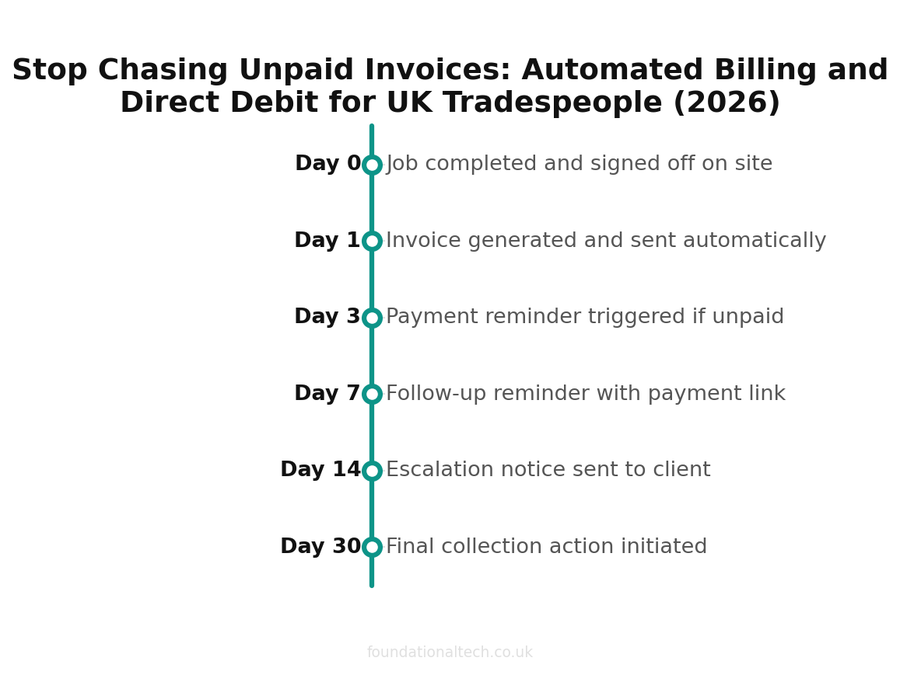
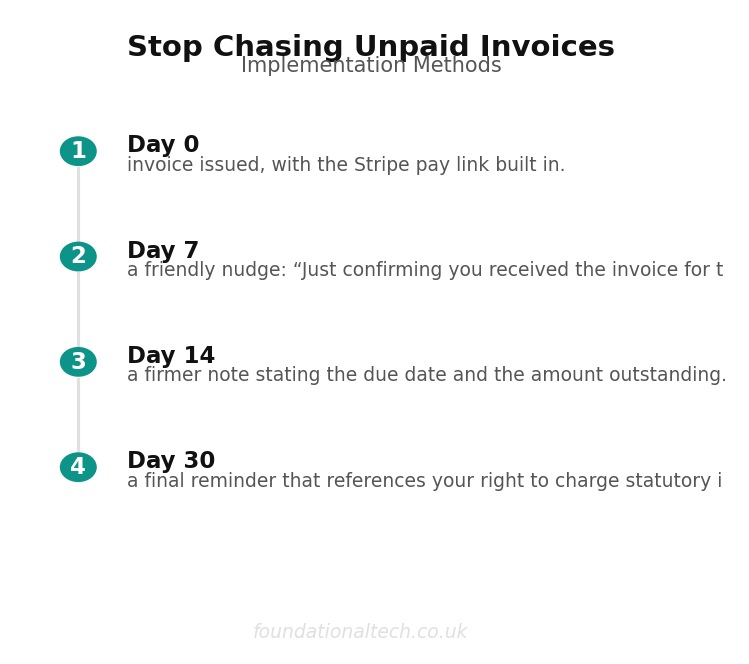
Tradify and Xero both send invoice reminders automatically on a schedule you set once. A sensible sequence for a trade firm:
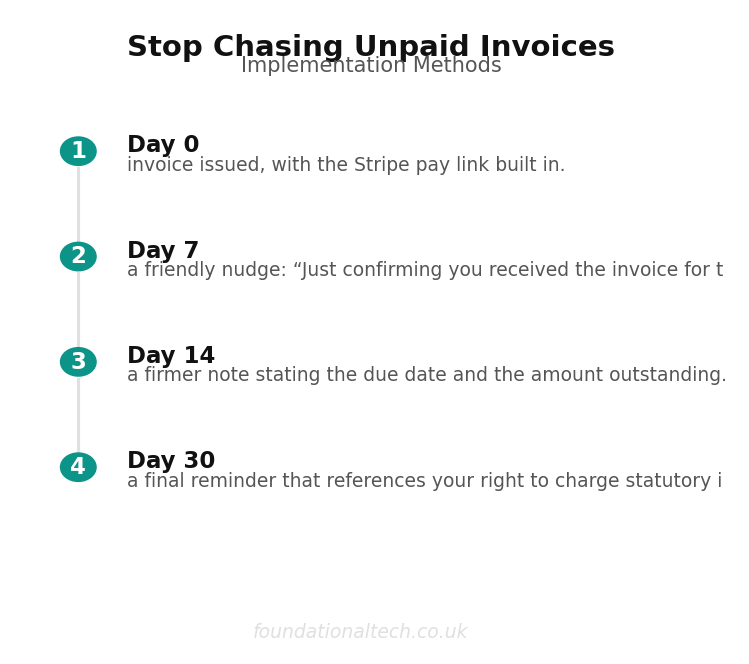
Day 0 — invoice issued, with the Stripe pay link built in.
Day 7 — a friendly nudge: “Just confirming you received the invoice for the work at [address] — the payment link is below.”
Day 14 — a firmer note stating the due date and the amount outstanding.
Day 30 — a final reminder that references your right to charge statutory interest and a £40–£100 fixed recovery cost per invoice under the Late Payment of Commercial Debts legislation.
The point is not the wording. It is that the sequence runs itself, identically, for every customer, without you deciding each time whether it is worth the awkwardness. The system is never too busy, never embarrassed, and never forgets. That removes the single biggest reason trade invoices go unpaid: the person owed the money hates asking for it.
The Day 30 reference to statutory interest is not an empty threat, and it is worth knowing the actual figures before you use it. The Late Payment of Commercial Debts legislation entitles a business to charge interest at 8% above the Bank of England base rate on overdue commercial invoices, plus a fixed recovery charge of £40 on debts under £1,000, £70 up to £10,000, and £100 above that. You rarely have to invoke it. Simply stating the entitlement in the final reminder tends to move an invoice that three polite nudges did not, because it signals you know your rights and intend to use them. The automated chaser delivers that line in exactly the same measured tone every time, with none of the reluctance a tired owner feels typing it at the end of a long week.
Reconciliation
The last leak is the quiet one. A payment arrives in your bank account, but until someone matches it to the right invoice, your books still say you are owed the money — so you chase a customer who has already paid, or lose track of who genuinely hasn’t.
Connect Xero (Ignite £15/month or Grow £30/month, both covering CIS, VAT and MTD) to your business bank account, and the feed pulls every transaction in automatically. Payments collected through GoCardless and Stripe arrive already tagged, so Xero matches them to the original invoice and marks it paid without you touching anything. What is left on your “owed” list at any moment is then real — only the invoices that genuinely have not been paid, ready for the automated chaser to handle.
That closed loop is the whole game: quote to job to invoice to payment to reconciled ledger entry, with your only manual step being the tap that says “job done”.
Getting the Reverse Charge Right
Construction billing carries one wrinkle other trades do not face: the VAT domestic reverse charge, live since March 2021 and still tripping firms up. On most business-to-business construction work, the subcontractor no longer charges VAT on the invoice — the contractor receiving the service accounts for it instead. Raise that invoice the old way, with VAT added, and you create a reconciliation mess and a potential HMRC correction down the line.
The fix is to set it up once, not police it every time. In Xero, flag the customer or the specific service as reverse-charge, and the system applies the correct treatment automatically — the invoice shows the right wording, the VAT return reflects it properly, and you stop having to remember which jobs qualify. Like CIS, it is a rule the software enforces far more reliably than a tired human at the end of the week. Get the setup right at the start and the compliance looks after itself.
Deposits and Staged Payments
The cheapest cash-flow fix of all is to stop funding the job yourself. On anything sizeable — a rewire, a bathroom, a loft — you are buying materials and paying labour weeks before the customer pays you. A staged-payment structure shifts that burden back where it belongs.
Build it into the quote: a deposit before work starts, an interim payment at an agreed milestone, the balance on completion. Tradify lets you raise each stage as its own invoice from the same job, and GoCardless can collect the agreed amounts automatically on the dates you set, so you are not renegotiating payment every fortnight. The deposit alone often covers your materials, which means you are no longer borrowing against your own bank account to do someone else’s job. For trade firms, getting paid in stages is frequently a bigger cash-flow win than getting paid faster.
The Mistake That Breaks the Loop
One error undoes all of it: buying the tools and never connecting them. A firm signs up for Tradify and Xero separately, keeps copying invoices from one to the other by hand, never switches on the bank feed, and concludes the software did nothing. The saving lives entirely in the integrations — Tradify to Xero, GoCardless and Stripe to Xero — all of which are native, built-in, and free to turn on. Connect them once, properly, on day one. The automation is the point, not an optional extra you get to later.
86 hours/yr
spent chasing invoices manually — eliminated with automated follow-ups
The Numbers
Take a firm turning over £300,000 a year, raising perhaps 25 invoices a month.
Before: invoices sent four to seven days after the job, paid on average at 45–60 days, with the owner spending two-plus hours a week writing bills and chasing money — roughly 100 hours a year of unpaid admin, and a cash position nobody can forecast.
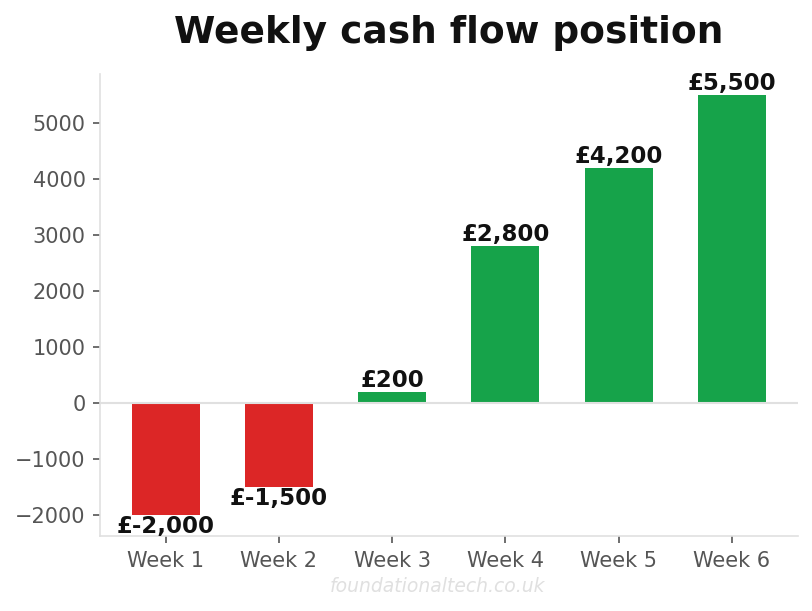
After: invoices raised same-day on site, the majority collected automatically by Direct Debit or card, chasers running themselves, and reconciliation happening on the bank feed. Days-to-payment typically falls from the high 40s into the low 20s. The two weekly hours of billing admin shrink to a few minutes of reviewing what came in.
Put a figure on what that movement is worth. Pulling days-to-payment from 50 down to 22 on a £300,000 turnover frees up roughly £23,000 of cash that was previously stuck in the gap between doing the work and being paid for it — money you can now use to buy materials, take the next job, or simply stop lying awake over. That is not extra profit; the work was always going to be paid eventually. It is the difference between controlling your cash and being controlled by it.
The tooling to run all of it — Tradify, Xero, GoCardless and Stripe — costs well under £100 a month for a small firm, most of it transaction fees you only pay when money actually moves. Set against £22,000 of cash routinely trapped in unpaid invoices, it is one of the cheapest problems in the business to fix, and the only one that pays you back in working capital rather than just saved hours. Build the loop once, and it keeps paying you back on every job for as long as the firm runs.
What’s your average days-to-payment right now — from finishing the job to the cash actually clearing? Be honest; the number usually shocks people, and it’s the single best measure of whether your billing is costing you.
Related guides: If you found this useful, see our guide on Scaffolding Software UK: How Scaffold Contractors Are Automating Quotes, Weekly Hire and the 7-Day Inspection in 2026 and AI for UK Scaffolding Contractors: Using Claude and ChatGPT for RAMS, Quotes and Inspection Sheets (2026).
A & Y Financial Services builds automated billing and Direct Debit systems for UK construction and trade businesses. That’s what we do.