Key Takeaway
How UK scaffolding contractors are using Claude and ChatGPT to win more work in 2026. Practical AI use cases for specifications, quotes, and compliance.
It is half nine on a Sunday night and the RAMS for tomorrow's start on a Georgian terrace are being written by opening last month's job in Barnsley, changing the address, and changing the date. The Barnsley job was a straightforward independent on an open commercial site. Tomorrow's is a listed frontage, a live pavement, a bus route eleven feet from the base plates, and a client who has never once looked at a method statement in his life.
Nobody involved thinks this is good practice. It happens because writing a genuinely site-specific risk assessment takes ninety minutes, and it is Sunday, and there are four more jobs to price before Tuesday.
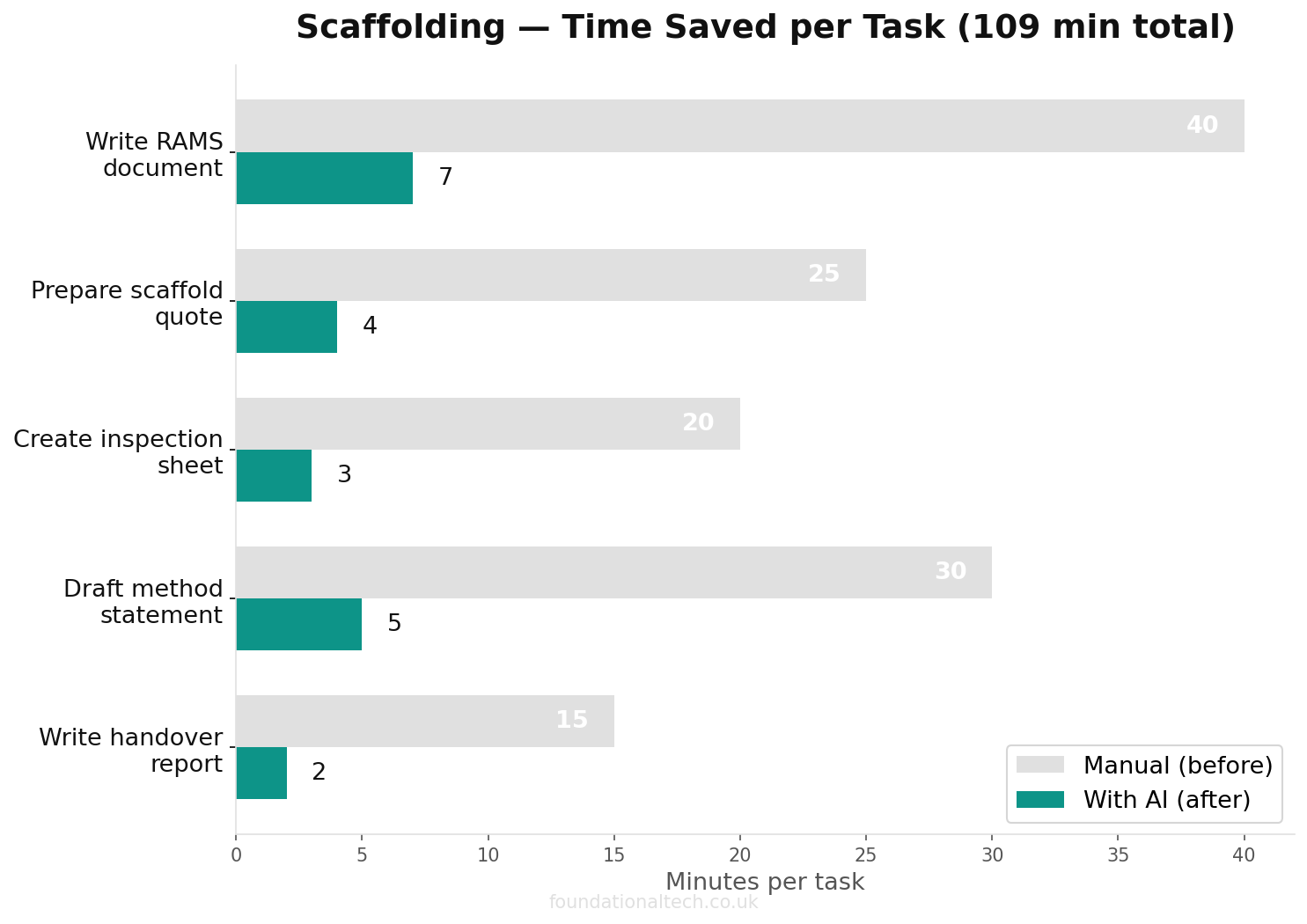
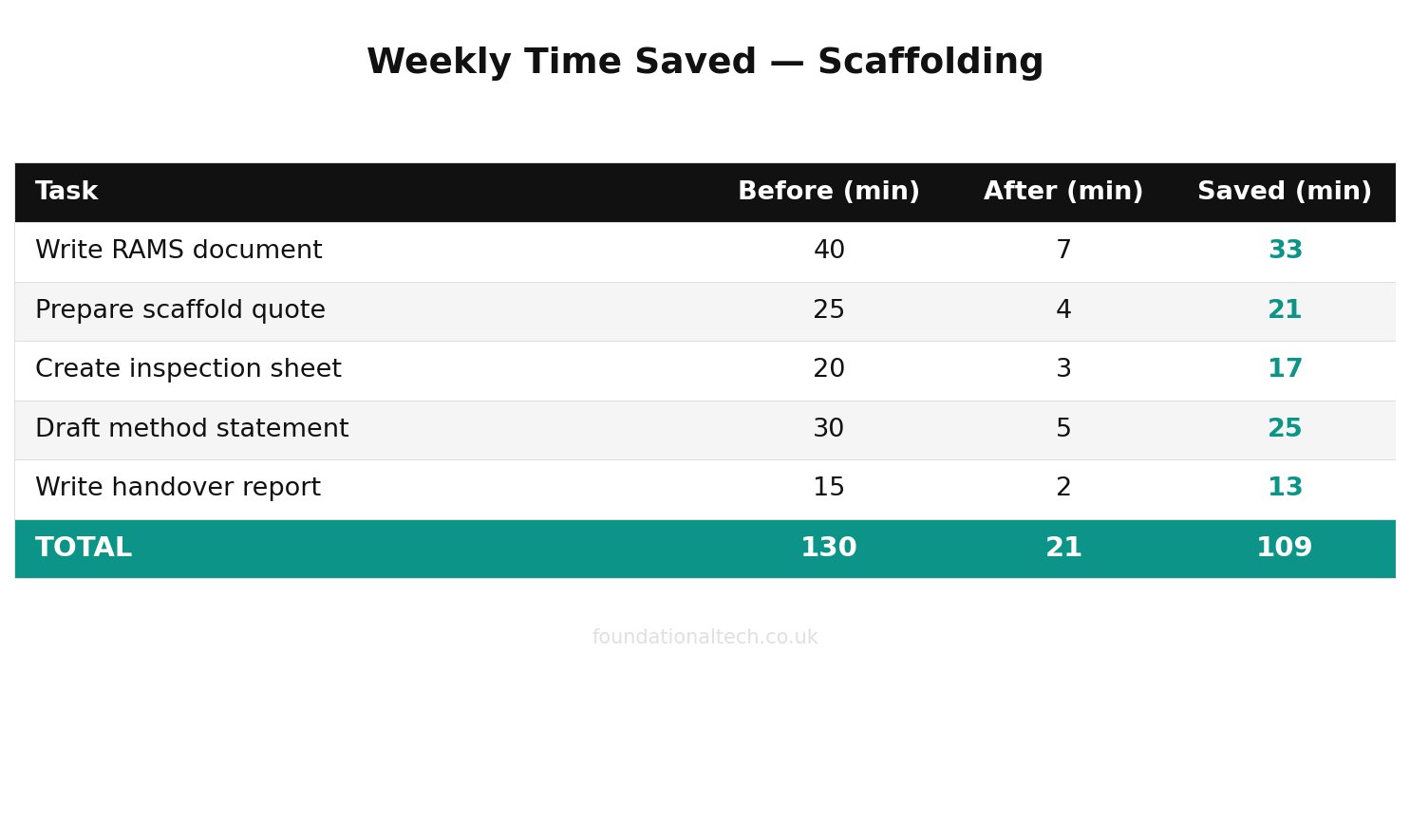
This is the sharpest thing AI does for a scaffolding firm. Not clever — useful. It sits on top of the operational software stack. It turns ninety minutes of writing into fifteen minutes of checking, which is the difference between a document that describes the actual scaffold and one that describes a different one.
What a Scaffolding Office Is Actually Using It For
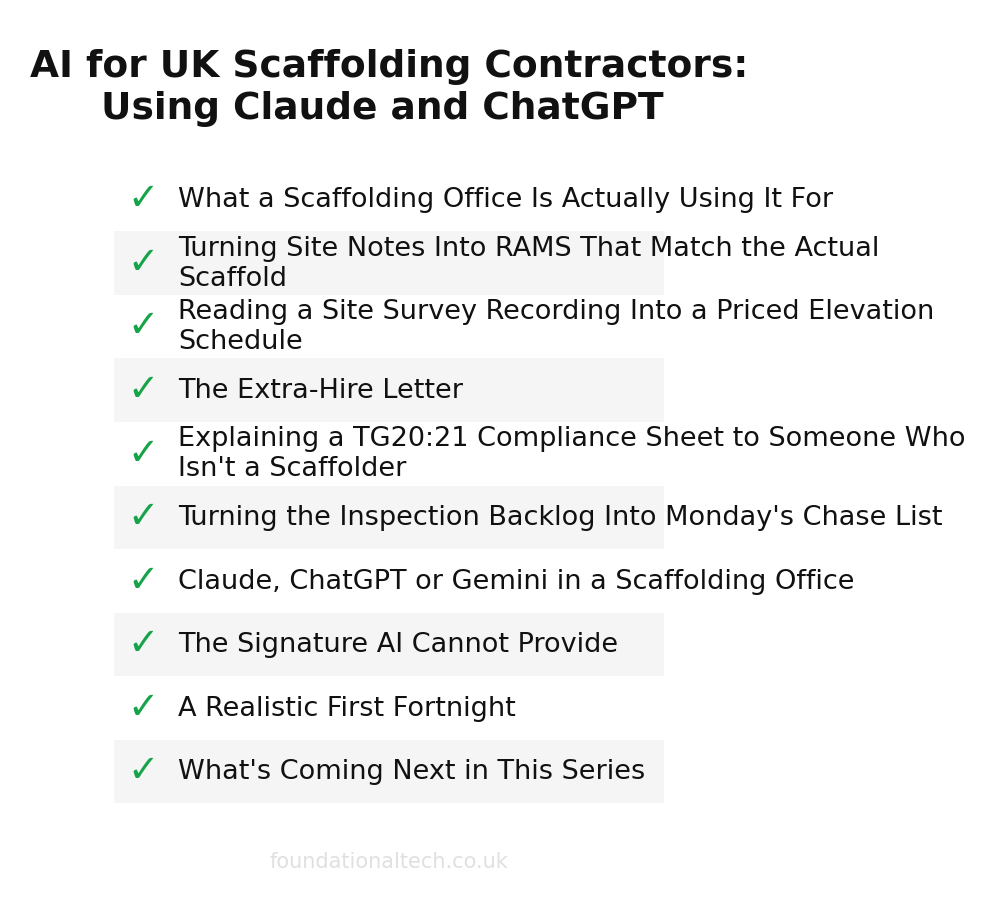
Skip the demos. Across UK scaffolding firms of one gang to twenty, the same five jobs come up, and every one of them is a writing job dressed up as a technical one.
Turning Site Notes Into RAMS That Match the Actual Scaffold
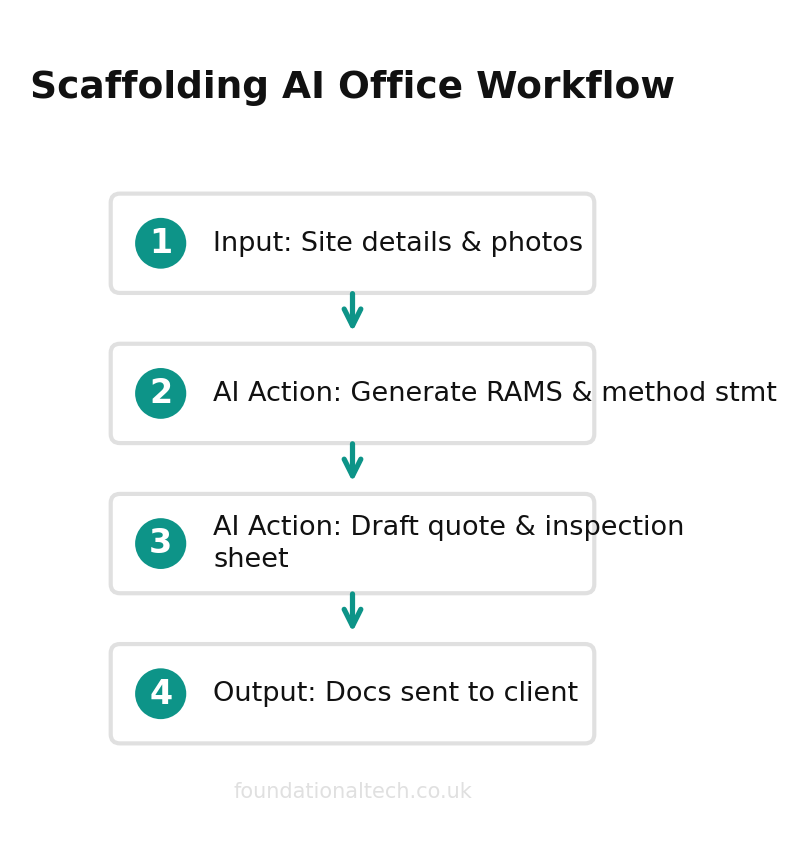
The workflow that works is not "write me a RAMS". It is: give the model your own approved RAMS as the template, then give it the specifics of this site, and ask it to rewrite only what the site changes.
Feed it the elevation dimensions and tie pattern, the ground conditions, and whether you are working over a public footpath or highway. Add whether there is a pavement licence, the access arrangements and the client's own site rules. Then add any hazard you flagged on the survey: overhead lines, a fragile roof below the working lift, listed stonework that rules out through-ties, a school next door with a 3.15pm problem.
What comes back is a document that names the actual hazards on the actual job rather than the generic set. The control measures still have to be yours. But then there's the paragraph explaining why you are using a tied independent with a debris netting arrangement rather than the standard configuration. It has to be written in language a principal contractor's health and safety officer will accept without three rounds of comments. That is the part that used to eat the Sunday evening.
One instruction to build into every prompt: tell it to leave a clearly marked gap wherever it does not have the information, rather than filling it with something plausible. A RAMS with three obvious blanks is safe. A RAMS with three invented tie centres is a liability.
Reading a Site Survey Recording Into a Priced Elevation Schedule
Most scaffolding quotes die on the walk back to the van, where a set of dimensions scribbled on the back of a compliance sheet turns into a two-hour evening job.
Record a voice note as you walk the building instead. Elevation by elevation: length, lift heights, number of lifts, returns, any beamed openings, loading bay, hoist tower, the lot. Then paste the transcript in and ask for a structured elevation schedule. You want a table with one row per elevation, the meterage and the number of lifts, plus a flag against anything you described that would need a designed solution rather than a standard configuration.
You still price it. Your rates, your pricing bible, your judgement on the awkward return. What the AI removes is the transcription and the arithmetic, and the risk that the third elevation gets forgotten because the note was written in the rain.
The Extra-Hire Letter
There is a specific letter every scaffolding firm writes and nobody enjoys: the one telling a client their scaffold has passed the contracted hire period and is now accruing weekly charges — the same billing tracked by scaffold hire management software. Send it too bluntly and you sour a relationship with a contractor you want more work from. Send it too softly and it gets ignored for another five weeks.
AI is genuinely good at this, because the difficulty is tonal rather than technical. Give it the contracted period, the actual dates and the weekly rate. Tell it the relationship too: long-standing client you want to keep, or a one-off who has been slow paying all year. Then ask for a letter that states the position clearly, offers a firm off-hire date, and does not apologise for charging for a service you are providing.
Ask for three versions at different levels of firmness. Pick one. Keep it as your template. You will send it forty times a year.
Explaining a TG20:21 Compliance Sheet to Someone Who Isn't a Scaffolder
A compliance sheet is a dense technical document, and clients ask what it means roughly as often as they are given one. So do homeowners, letting agents, conservation officers and, occasionally, insurers after an incident on a neighbouring property.
Paste the configuration details and ask for a short plain-English summary. What the scaffold is designed to carry, what it is not designed to carry, why the ties are where they are, and what would invalidate it. The output is a page you can attach to the handover certificate.
The commercial value is in what it prevents. Clients who understand that the scaffold is designed for a specific loading class are markedly less likely to store a pallet of slates on the third lift.
Turning the Inspection Backlog Into Monday's Chase List
Export the list of live scaffolds with their last inspection date. Paste it in with today's date. Ask which are due within forty-eight hours — a missed window cost one firm its framework — which are already outside the seven-day window under Regulation 12, and which sit on jobs where an alteration was recorded since the last inspection. An alteration restarts the requirement regardless of where you are in the week.
What you get back is a ranked list with the overdue ones at the top. It is a spreadsheet formula you never got round to writing, available in twenty seconds, and it is the single most useful two minutes of a scaffolding contracts manager's Monday.
Claude, ChatGPT or Gemini in a Scaffolding Office
All three cost around £16–£20 a month for an individual plan; team plans run roughly £20–£25 per user per month. Any of them will do the work. The differences are narrower than the marketing suggests, but they are real.
~£16–20/month
for Claude Pro or ChatGPT Plus — the only ongoing cost to automate RAMS, quotes and inspection admin
Claude handles long documents best. Say your workflow is "here is our approved twelve-page RAMS template, here are the site specifics, rewrite the relevant sections". It holds the whole thing in mind and rewrites what needs rewriting, without quietly restructuring the rest. It also writes the flattest, least salesy British English of the three, which matters when the output is a formal document going to a principal contractor. Claude Pro is £18 a month; Anthropic bills in US dollars at $20 rather than publishing a sterling price, so the exact figure moves with the exchange rate.
ChatGPT has the better voice input and the better mobile experience, which is decisive if the survey-recording workflow above is the one you actually adopt. Talking into your phone in a car park and getting a structured table back is a genuinely different experience from typing. ChatGPT Plus is £20 a month.
Gemini is worth considering only if your office already runs on Google Workspace, where it sits inside Docs and Gmail at £5.90–£18.40 per user per month depending on tier. If your RAMS live in Google Docs, the integration saves real friction. If they live in Word, it does not.
The practical answer for most scaffolding firms: one Claude or ChatGPT subscription, used by whoever writes the RAMS and the quotes. Not a licence for everyone. Not a project.
The Signature AI Cannot Provide
This section matters more in scaffolding than in almost any trade in this series, because the legal duties here attach to named, competent individuals.
Scaffold design. The Work at Height Regulations require that any scaffold not assembled to a generally recognised standard configuration — TG20:21 being the usual route — is designed by bespoke calculation by a competent person. AI cannot produce that design, cannot check one, and will produce confident-sounding nonsense if you ask it to. If the eGuide tells you the configuration needs a design, that is the end of the conversation.
Inspection. Regulation 12 requires inspection by a competent person: in practice someone holding a CISRS inspection endorsement, or equivalent training appropriate to the complexity of that particular structure, standing on the lift. AI can tell you an inspection is due, can draft the wording of a report from your findings, and cannot inspect anything.
The RAMS remain your document. Under the Management of Health and Safety at Work Regulations 1999, the duty to assess risk sits with the employer. A drafted risk assessment is a draft until a competent person in your business has read every line and put their name to it. If an incident occurs and the investigation establishes that nobody checked the control measures before the gang worked to them, "the software wrote it" is not a defence — it is an aggravating factor.
Anything the client will rely on. Handover certificates, loading class statements, permits. Draft with it, sign with your own judgement.
The pattern across all four: AI produces the words, a competent person produces the assurance. Confuse the two and you have automated your way into a prosecution.
Stop doing scaffolding admin by hand
The Scaffolding Automation Starter Kit gives you a quote-to-invoice Excel workbook, a Make.com automation blueprint, and a step-by-step setup guide. Save 8–12 hours a week on paperwork.
A Realistic First Fortnight
Do not roll this out. Test it on work you have already done, where you know what right looks like.
Week one. Take a RAMS you wrote in the last month for a job that has finished. Give the model your template and the site details, and compare what it produces against what you actually issued. You are looking for two things: what it missed, and what it invented. Both tell you how to write the instruction better.
Week two. Record one site survey as a voice note and see whether the elevation schedule that comes back matches the quote you would have written by hand. If it does, that is roughly two hours a week back for the rest of your working life.
If both work, write the two prompts down properly and put them somewhere the office can reach. Write the good prompt down instead of retyping a worse one every time. That single step is the difference between a firm that uses AI and a firm that occasionally messes about with it.
What's Coming Next in This Series
The next two articles go behind the paywall and get specific.
Article seven is the prompt playbook: twelve prompts written for scaffolding, ready to paste. RAMS drafting against your own template, variation-order wording that survives a QS, inspection report language, the extra-hire letter in three registers, and the pavement licence application.
Article eight builds the assistant properly. Not a chat window you visit when you remember, but a configured AI worker that holds your rates, your RAMS template, your standard terms and your tone. Anyone in the office gets the same output without knowing how to prompt.
Then article nine connects it to the stack from the integration map, and article ten follows one firm through a full year of it.
Related guides: If you found this useful, see our guide on How to Connect The Scaffold Software, Xero and GoCardless: The Complete UK Scaffolding Integration Map (2026) and AI Automation for Construction: How to Connect Claude to Tradify, Xero and Your Job Stack (2026).
Be honest: when did you last write a RAMS from scratch rather than editing the last one? And what changed between the two sites that the edited version never mentioned?
Considering Tradify? Get 50% off for 3 months.