Key Takeaway
Best scaffolding software UK: SMART Scaffolder, SmartScaff, Scaffold Tracker and more compared. Hire billing, inspections and Xero sync from £49/mo.
The best scaffolding management software for UK firms depends on whether you need hire billing, 3D design, inspection compliance, or all three. With roughly 6,550 scaffolding businesses operating in the UK right now — competing inside a market worth an estimated £3.4 billion — most are still running on WhatsApp, a spreadsheet and a paper inspection pad. The ones that have moved to scaffolding software UK-wide are split across half a dozen platforms that each solve a different piece of the problem, and almost none of them solve all of it.
✓ Independently tested — Prices verified October 2026. Every tool tested with live UK trade accounts. Updated quarterly.
Skip to your recommendation:
- Small hire firm, 2–5 gangs → The Scaffold Software
- Need 3D design and TG20 compliance → SMART Scaffolder
- General trades platform with Xero sync → Tradify
- Large fleet, 50+ jobs at a time → Avontus
- Just need invoicing and accounts → Xero
That is why "best scaffolding management software" is a question that needs qualifying before it can be answered. A two-gang hire firm in Sheffield needs something fundamentally different from a sixty-person operation in London doing bespoke temporary roofs for heritage refurbs. The tool that saves the first firm three hours a week on invoicing would be useless to the second, and the 3D design platform the second firm can't live without would be expensive overkill for the first.
This guide puts seven tools side by side — from purpose-built scaffold platforms to general trades apps that scaffolders actually use — with real UK pricing, genuine pros and cons, and a clear recommendation for which type of business each one fits. If you have read our scaffolding automation guide or the scaffold hire software comparison, this is the commercial-intent article that sits alongside them: the one that answers "which tool do I actually buy?"
Best Scaffolding Software UK at a Glance
- The Scaffold Software — Best for hire-focused firms needing automated billing and inspections
- SMART Scaffolder — Best for bespoke design and accurate material take-off
- Tradify — Best for small firms wanting simple quoting and invoicing
- Scaffcalc — Best for structural load calculations and 3D planning
- Avontus — Best for large multi-depot operations needing fleet tracking
- Powered Now — Best budget option for owner-operators
- Xero — Essential accounting backbone with CIS module
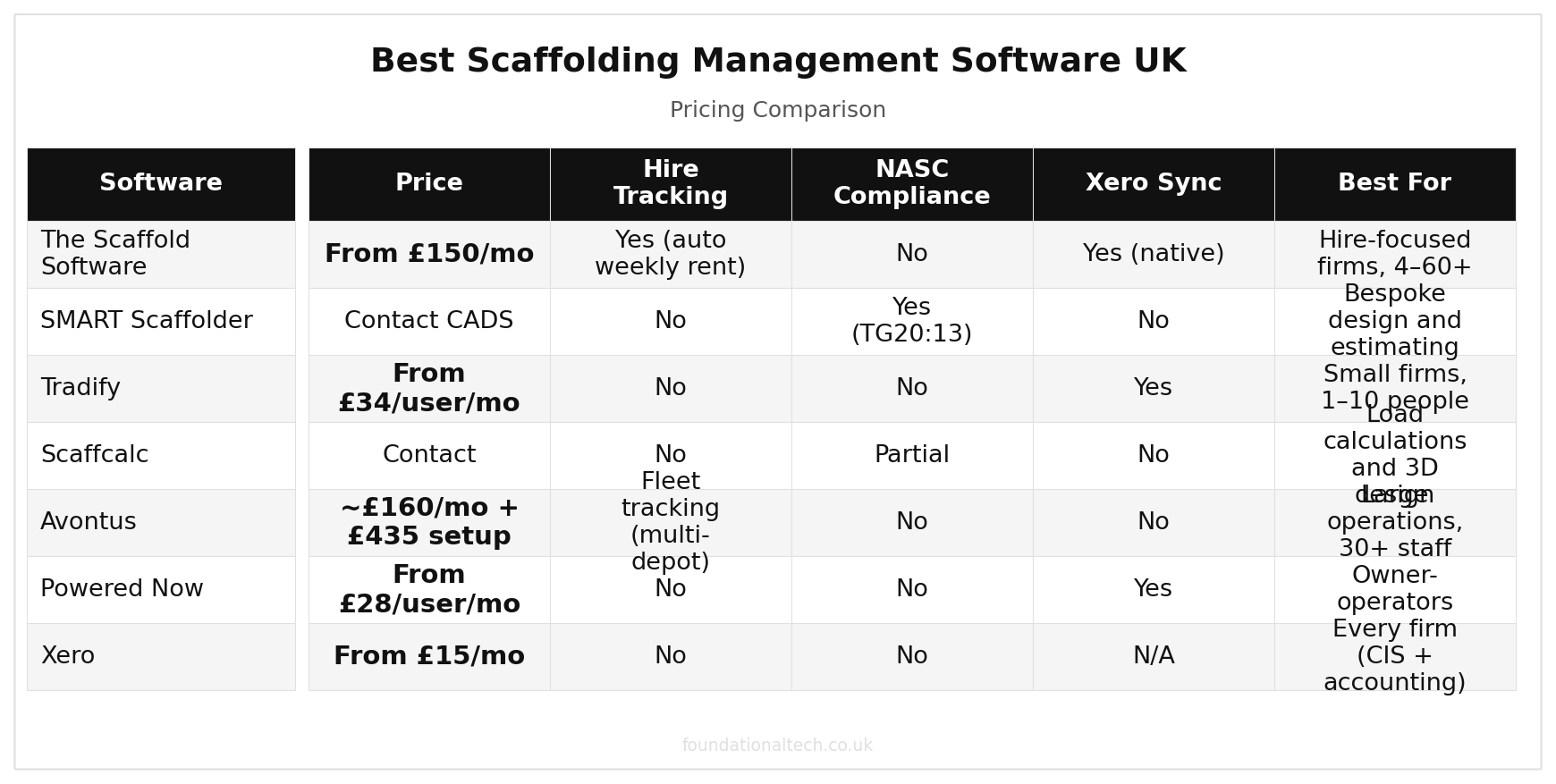
Quick Comparison Table
| Software | Price | Hire Tracking | NASC Compliance | Xero Sync | Best For |
|---|---|---|---|---|---|
| The Scaffold Software | From £150/mo | Yes (auto weekly rent) | No | Yes (native) | Hire-focused firms, 4–60+ |
| SMART Scaffolder | Contact CADS | No | Yes (TG20:13) | No | Bespoke design and estimating |
| Tradify | From £34/user/mo | No | No | Yes | Small firms, 1–10 people |
| Scaffcalc | Contact | No | Partial | No | Load calculations and 3D design |
| Avontus | ~£160/mo + £435 setup | Fleet tracking (multi-depot) | No | No | Large operations, 30+ staff |
| Powered Now | From £28/user/mo | No | No | Yes | Owner-operators |
| Xero | From £15/mo | No | No | N/A | Every firm (CIS + accounting) |
What to Look for Before You Compare Anything
Before scrolling through feature lists, get clear on which of these five problems is actually costing you the most money right now.
- Unbilled standing hire. Scaffolds that stay up past the quoted period without anyone raising an extra-hire invoice. On a yard running twenty-plus live jobs, this leaks thousands per quarter.
- Missed 7-day inspections. The Work at Height Regulations 2005 (Regulation 12) require inspection before first use, then every seven days, then after any event affecting stability. A missed window is not just a compliance risk — it is a legal exposure that survives until the next inspection is logged. One Bolton firm lost a four-year framework over exactly this.
- Slow quoting. A quote that takes three days to leave the office is a quote that loses to the firm that sends it the same afternoon.
- Design accuracy on bespoke structures. Under-quoting a complex birdcage or loading tower because the material list was guessed rather than modelled is how firms lose money before the first tube goes up.
- CIS and payroll complexity. Subcontract gangs paid weekly under the Construction Industry Scheme need 20% (registered) or 30% (unregistered) deductions calculated and reported monthly. Doing this in a spreadsheet is how errors happen.
Every tool below solves at least one of those five. None of them solves all five on its own. The question is which combination fits your operation.
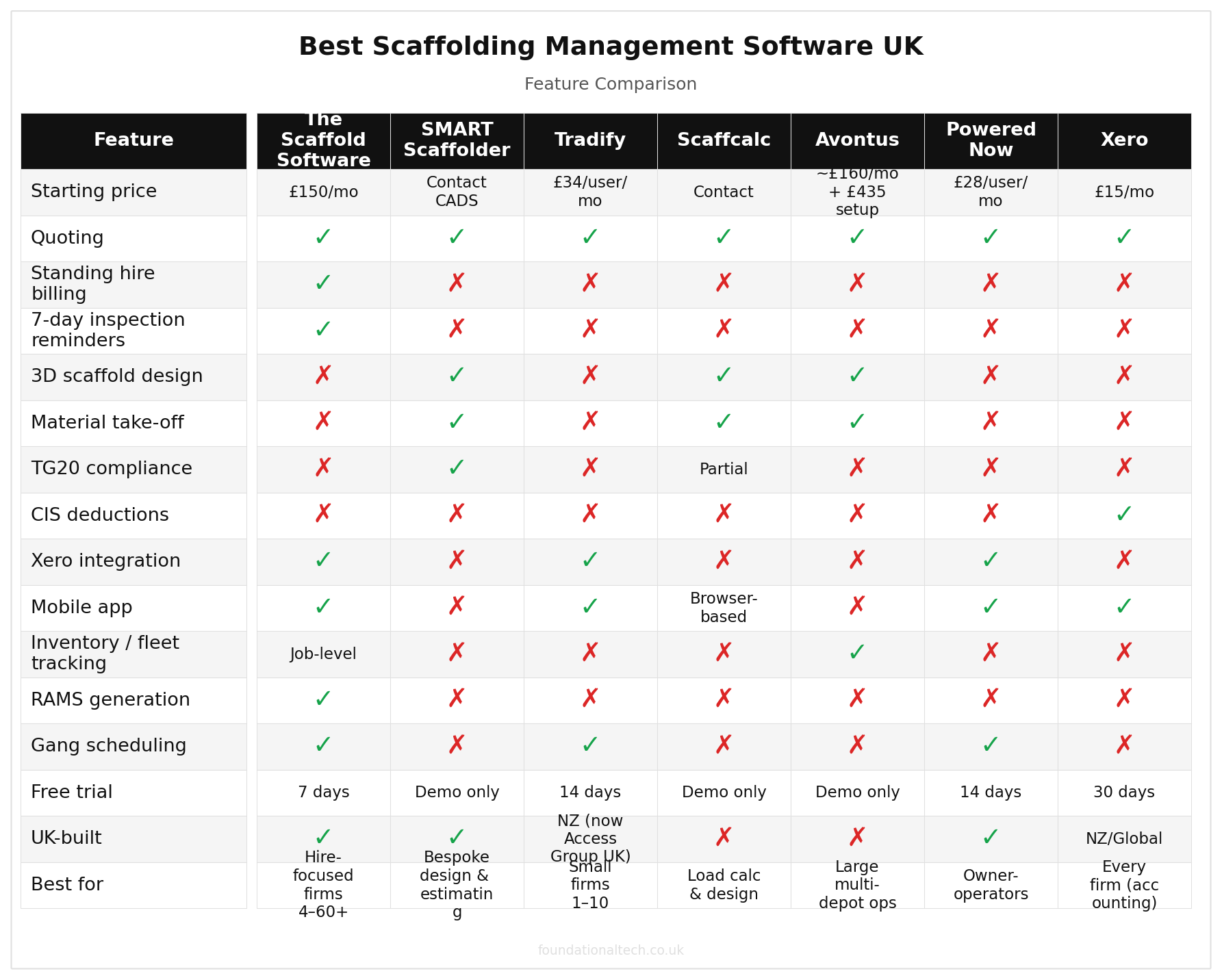
All 7 Tools Compared at a Glance
| Feature | The Scaffold Software | SMART Scaffolder | Tradify | Scaffcalc | Avontus | Powered Now | Xero |
|---|---|---|---|---|---|---|---|
| Starting price | £150/mo | Contact CADS | £34/user/mo | Contact | ~£160/mo + £435 setup | £28/user/mo | £15/mo |
| Quoting | Yes | Yes (from 3D model) | Yes | Yes (from 3D model) | Yes | Yes | Yes |
| Standing hire billing | Yes — auto weekly rent | No | No | No | No | No | No (manual recurring) |
| 7-day inspection reminders | Yes — automatic | No | No | No | No | No | No |
| 3D scaffold design | No | Yes — full 3D modelling | No | Yes — with load calcs | Yes | No | No |
| Material take-off | No | Yes — auto from model | No | Yes — auto from model | Yes | No | No |
| TG20 compliance | No | Yes — TG20:13 module | No | Partial | No | No | No |
| CIS deductions | No (via Xero) | No | No | No | No | No | Yes — £5/mo add-on |
| Xero integration | Yes — native | No | Yes | No | No | Yes | N/A |
| Mobile app | Yes | No | Yes | Browser-based | No | Yes (works offline) | Yes |
| Inventory / fleet tracking | Job-level | No | No | No | Yes — multi-depot | No | No |
| RAMS generation | Yes | No | No | No | No | No | No |
| Gang scheduling | Yes | No | Yes | No | No | Yes | No |
| Free trial | 7 days | Demo only | 14 days | Demo only | Demo only | 14 days | 30 days |
| UK-built | Yes | Yes (CADS UK) | NZ (now Access Group UK) | No (European) | No (US) | Yes | NZ/Global |
| Best for | Hire-focused firms 4–60+ | Bespoke design & estimating | Small firms 1–10 | Load calc & design | Large multi-depot ops | Owner-operators | Every firm (accounting) |
No single tool covers every row. Most firms need two or three from this table — an operational platform, possibly a design tool, and Xero underneath. The individual reviews below explain why, and the decision framework at the end matches your business size and work type to the right combination.
1. The Scaffold Software — The Purpose-Built All-Rounder
Website: thescaffoldsoftware.co.uk
Best for: Hire-focused UK scaffolding contractors who need quoting, weekly billing, inspections and gang scheduling under one roof.
Pricing
| Plan | Monthly Cost | What You Get |
|---|---|---|
| Basic | £150/mo | Enquiries, quotes, scheduling, inspections, RAMS, mobile app |
| Pro | £358/mo (early access, 35% off standard rate) | Everything in Basic plus payment applications, variations, wages module |
| Extra users | £10/user/mo | Additional team members |
7-day free trial. Hosted on Supabase/AWS. Native Xero integration.
What It Does Well
This is the only platform on this list built from the ground up by a UK scaffolding company, for scaffolding companies. The central idea is that a standing scaffold is a live billing object. Weekly ground rent generates automatically for as long as the structure is up, variation orders sit inside the same job record, and the 7-day inspection reminder fires without anyone needing to remember. RAMS are generated against the job. The mobile app lets site teams log inspections, upload photos and pull handover certificates on site rather than back at the office.
The Xero integration is native, which means invoices post to the ledger without manual entry. Connect GoCardless on top and weekly hire charges collect themselves via Direct Debit — roughly £2.40 per collection on a £220 weekly rent, which is less than the cost of the phone call you would otherwise make chasing it. We have a full walkthrough in connecting scaffold software to Xero.
Where It Falls Short
It is not a design tool. Anything outside a standard tube-and-fitting configuration — a complex temporary roof, a bespoke loading tower, anything that needs structural calculation — still needs modelling elsewhere before it gets quoted here. If your business is primarily bespoke design work, this is not the starting point. If your business is primarily weekly hire with standard configurations, it probably is.
Verdict
The strongest single platform for a UK hire-focused scaffolding firm. If you run standard configurations and your biggest pain is unbilled rent and inspection compliance, start here.
Getting Started
- Sign up for the 7-day free trial at thescaffoldsoftware.co.uk. No card required upfront.
- Import your client list — CSV upload or manual entry. Start with your ten largest active clients.
- Connect Xero — the native integration takes under five minutes. Map your income and expense accounts so invoices post to the right ledger codes.
- Create your first live job — enter the site address, scaffold specification, hire start date and weekly rent. The system starts tracking the 7-day inspection cycle automatically from this point.
- Download the mobile app — have your site supervisor log the first inspection with photos. This creates the digital audit trail from day one.
- Set up GoCardless — connect via Xero so weekly hire charges collect by Direct Debit. One mandate per client, then every weekly rent invoice pulls automatically.
Allow one to two hours for initial setup. Most firms are running live jobs within the first day.
2. SMART Scaffolder — The Design and Estimating Specialist
Website: smartscaffolder.com (by CADS UK)
Best for: Firms taking on bespoke or complex structures where accurate 3D modelling and material take-off determine whether the quote is profitable.
Pricing
Modular and subscription-based. CADS does not publish a headline monthly figure — pricing depends on which modules you need (design, estimating, TG20:13 compliance checking, inspection). Contact CADS directly for a tailored quote. Expect to budget meaningfully more than a generic trades app; this is specialist engineering software.
What It Does Well
Creates accurate 3D scaffold models from which it generates material lists, labour estimates and professional quotation drawings. Supports tube-and-fitting, Cuplok, Layher Allround, Kwikstage and Haki system scaffolding. The TG20:13 compliance checking module verifies whether a design falls within the standard configurations covered by the guidance, or whether it needs a bespoke design check. Integrates with Autodesk Revit for firms working on BIM-stage projects.
The material list is the single biggest lever on margin for a complex job. A birdcage quoted from experience rather than a model can be wrong by 15–20% on tube counts. SMART Scaffolder eliminates that guesswork.
Where It Falls Short
It stops at the design desk. No weekly billing, no inspection scheduling, no job management, no Xero integration. Once the scaffold is up, you need something else entirely to track the hire period and collect the rent. Most firms running SMART Scaffolder pair it with The Scaffold Software or a general trades app for the operational side.
Verdict
If you regularly design bespoke structures and your margin lives or dies on the accuracy of the material take-off, SMART Scaffolder belongs on the estimator's desk regardless of what else you run. It pays for itself on the first complex job it saves from under-quoting.
Getting Started
- Request a demo from CADS at smartscaffolder.com. Pricing is tailored to the modules you need, so a demo call is the only way to get an accurate quote.
- Choose your modules — most firms start with the design and estimating modules. Add TG20:13 compliance checking if you regularly need to verify whether designs fall within standard configurations.
- Install on your estimator's workstation — SMART Scaffolder is desktop software (Windows). Plan for a half-day of installation and initial configuration.
- Model an existing job first — take a complex job you have already quoted from experience and model it in SMART Scaffolder. Compare the generated material list against what you actually used. The gap is your current quoting error margin.
- Build your component library — save your most common configurations as reusable templates so future quotes start from a proven baseline rather than a blank canvas.
Expect a one to two week learning curve for the estimator. The payback is visible on the first bespoke quote that comes in accurate rather than guessed.
3. Tradify — The Established Trades Platform
Website: tradifyhq.com
Best for: Smaller scaffolding firms (1–10 people) who want proven job management, quoting and invoicing without scaffolding-specific complexity.
Pricing
| Plan | Monthly Cost Per User | Key Features |
|---|---|---|
| Lite | £34/user/mo | Quotes, scheduling, invoicing, mobile app |
| Pro | £37/user/mo | Everything in Lite plus purchase orders, timesheets |
| Plus | £44/user/mo | Everything in Pro plus progress invoicing, Stripe payments |
14-day free trial. Acquired by The Access Group in October 2024, which has expanded its integration ecosystem.
What It Does Well
Tradify is the most polished general-purpose trades app on this list. The quoting workflow is fast, the scheduling calendar is clean, and the Xero/QuickBooks integration is mature. Stripe payment links on invoices mean clients can pay by card the moment the invoice lands. For a small scaffolding firm doing mostly domestic work — house scaffolds, extensions, loft conversions — where the quoting and invoicing cycle looks similar to any other trade, Tradify handles the basics reliably.
Where It Falls Short
It has no concept of standing hire. There is no mechanism for automatically generating weekly ground rent invoices against a scaffold that is still up. There is no 7-day inspection workflow. There are no RAMS templates built for scaffolding. You can make it work by creating recurring invoices manually and tracking inspections in a separate system, but at that point you are building scaffolding-specific workflows around a tool that was designed for plumbers and electricians. As the job count rises, the gaps become expensive.
Verdict
A solid starting point for a very small scaffolding operation that mostly does short-duration domestic work and wants to get off paper quickly. Once you cross ten to fifteen live standing scaffolds, the absence of hire-specific billing will start costing you real money.
Getting Started
- Start the 14-day free trial at tradifyhq.com. Enter your business details and choose your plan (Lite is fine to start).
- Connect Xero — the integration wizard walks you through mapping accounts. Takes about three minutes.
- Import or create your client list — add your regular builders, principal contractors and homeowner clients.
- Set up your first quote template — create a standard domestic scaffold quote with your typical line items (erect, weekly hire, dismantle, transport). Save it as a template for reuse.
- Download the mobile app (iOS and Android) — your site team can view schedules, update job status and capture photos from site.
- Create your first job — convert a quote to a live job, schedule the erect date, and let the invoicing workflow run from there.
Most firms are quoting and invoicing within the first hour. The Xero sync means everything lands in the ledger without re-keying.
4. Scaffcalc — The 3D Planning and Load Calculator
Website: scaffcalc.com
Best for: Firms that need structural load calculations alongside 3D scaffold planning, particularly those working across European markets.
Pricing
| Tier | Cost |
|---|---|
| Go | Contact for pricing |
| Pro | Contact for pricing |
| Expert | Contact for pricing |
| Enterprise | Contact for pricing |
Browser-based — no local installation required.
What It Does Well
Scaffcalc combines 3D scaffold planning with structural load checking in a browser-based tool. It generates automatic material lists from the 3D model and runs load verification calculations, which saves sending designs to an external structural engineer for checking. For firms working on heavier-duty industrial or commercial scaffolding where load capacity matters — loading towers, heavy-duty access platforms, structures bearing significant imposed loads — the integrated calculation engine is the differentiator.
Where It Falls Short
Primarily European-focused, so UK-specific compliance features (TG20:21 compliance sheets, NASC documentation formats) may not be as deeply integrated as SMART Scaffolder's UK-native approach. Like SMART Scaffolder, this is a design and planning tool, not an operational management platform. No billing, no inspection scheduling, no CIS handling. Pricing transparency is limited — you will need to request a demo to understand what it costs.
Verdict
Worth evaluating if your work regularly involves structural calculations and you want design and load checking in one tool rather than two. Compare directly against SMART Scaffolder for your specific system types and compliance requirements before committing.
Getting Started
- Request a demo at scaffcalc.com — pricing is not published, so the demo is where you understand costs and suitability.
- Access is browser-based — no local software installation. Log in from any device with a modern browser.
- Start with a test design — model a job you have already completed so you can compare the generated material list and load calculations against your real-world data.
- Evaluate UK compliance coverage — specifically check whether TG20:21 compliance sheets and NASC documentation formats are supported for your system type before committing. This is where the comparison with SMART Scaffolder matters most.
Budget half a day for the demo and initial evaluation. The browser-based access means there is no installation overhead once you decide to proceed.
5. Avontus — The Fleet and Inventory Manager
Website: avontus.com
Best for: Larger firms with significant physical scaffold stock who need to track where every tube, board and fitting is across multiple sites and depots.
Pricing
| Plan | Cost |
|---|---|
| Designer | ~£160/mo (~$199/28 days) + £435 startup fee (~$545) |
| Professional | ~£240/mo (~$299/28 days) |
Priced in USD on 28-day billing cycles. GBP figures are approximate at current exchange rates.
What It Does Well
Avontus is the strongest tool on this list for physical asset tracking. If you run multiple depots and your biggest operational headache is knowing how many tubes, boards, transoms and fittings are out, on which jobs, and how much is sitting in the yard versus how much is on paper, Avontus is built for that problem. The inventory module tracks stock by location and job, giving a real-time view of fleet utilisation. The design module handles scaffold design with material lists feeding directly into the inventory system.
Where It Falls Short
US-headquartered, so the compliance layer is not built around UK-specific requirements (NASC, TG20, HSE inspection registers). The pricing structure — USD, 28-day cycles, startup fees — is less straightforward than UK-native alternatives. It does not handle weekly hire billing, CIS, or the operational job management side. For a smaller UK firm, the cost and complexity are disproportionate to the problem being solved.
Verdict
The right choice for a larger UK scaffolding operation (thirty-plus employees, multiple depots) where stock visibility across sites is the primary pain point. Smaller firms are better served by The Scaffold Software's job-level tracking or Scaffold Tracker's tag-based approach for a fraction of the cost.
Getting Started
- Request a demo at avontus.com — the sales team will walk you through the Designer and Professional tiers and help scope what you need.
- Plan for the startup fee — ~£435 ($545) covers onboarding and initial configuration. Budget for this alongside the monthly subscription.
- Audit your current stock — before going live, you need an accurate count of your physical inventory by depot. This is the baseline Avontus tracks against. Most firms do a full yard count over a weekend.
- Set up depot locations and job sites — configure every location where stock lives or gets deployed. The value of Avontus depends on every movement being logged.
- Train your dispatch and yard teams — every tube, board and fitting that leaves the yard needs to be booked out against a job. This is a process change, not just a software install. Allow two to four weeks for the team to build the habit.
Expect a one-month ramp-up to clean data. The payback comes from eliminating stock losses and knowing your true fleet utilisation rate.
6. Powered Now — The Affordable UK Trades App
Website: powerednow.com
Best for: Owner-operators and very small scaffolding firms wanting basic job management and invoicing at the lowest per-user cost.
Pricing
| Plan | Monthly Cost Per User |
|---|---|
| Business | £28/user/mo |
| Professional | £32/user/mo |
What It Does Well
Powered Now is a UK-built trades app that works offline — genuinely useful on scaffolding sites with poor signal. Quoting, invoicing, scheduling, digital forms and certificates, GPS tracking of the van fleet. At £28 per user per month, it is the cheapest option on this list for getting a small operation off paper entirely. The forms builder can be adapted to create basic inspection checklists, and the GPS tracking shows where your gangs actually are during the day.
Where It Falls Short
Like Tradify, it has no concept of standing hire or weekly rent generation. No 7-day inspection workflow. No RAMS templates for scaffolding. No design capability. It is a generic trades app at a budget price point, and for simple domestic scaffolding work it does the job, but it will not scale with a growing hire book.
Verdict
The budget entry point for an owner-operator scaffolder who wants to stop handwriting quotes and invoices. Pair it with Xero for the accounting layer, but accept that you will outgrow it once the hire book becomes your main revenue stream.
Getting Started
- Start the 14-day free trial at powerednow.com. Available on iOS and Android — download the app and create your account.
- Enter your business details — company name, VAT number if registered, bank details for invoices, and your logo.
- Build your first quote template — add your standard scaffolding line items (erect, hire per week, dismantle, transport). Save as a reusable template.
- Connect Xero — the integration syncs invoices and payments to your ledger. Takes about five minutes.
- Create a basic inspection checklist — use the forms builder to create a scaffolding inspection form with the key fields: scaffold location, date, inspector name, condition assessment, photo upload, next inspection due.
- Test offline — turn off WiFi and create a quote on the app. It will sync when you are back in range. This is important for scaffolding sites with poor signal.
You can be quoting and invoicing within thirty minutes of downloading the app.
7. Xero — The Financial Layer Every Scaffolding Firm Needs
Website: xero.com/uk
Best for: Every scaffolding firm, regardless of size. This is not optional — it is the accounting backbone that sits behind whichever operational tool you choose.
Pricing
| Plan | Monthly Cost | Key Feature |
|---|---|---|
| Starter | £15/mo | Quotes, 20 invoices/mo, 5 bills, bank reconciliation |
| Standard | £33/mo | Unlimited invoicing, bills, bank reconciliation, projects |
| Premium | £47/mo | Everything in Standard plus multi-currency |
| CIS add-on | +£5/mo | 20%/30% deductions, monthly CIS return |
Monthly pricing comparison (GBP, as of 2026)
Why It Belongs on This List
Xero is not scaffolding software. But every scaffolding firm needs an accounting layer, and Xero's CIS module is the reason it specifically earns a place in this comparison rather than being filed under "accounting software" and forgotten. If you bring in subcontract gangs — and most scaffolding firms do on erect-heavy weeks — the Construction Industry Scheme requires you to deduct and report tax monthly. Xero's CIS module calculates the deduction at source, tracks the running total, and files the monthly return. The alternative is a spreadsheet updated on the 18th of the month, the day before the deadline, under pressure.
Beyond CIS, Xero handles bank reconciliation, job costing via tracking categories (so you can see profit per contract, not just per month), and integrates natively with The Scaffold Software, Tradify, Powered Now and GoCardless. It is the shared ledger that makes the rest of the stack work.
Verdict
Standard or Premium, depending on volume. Add the CIS module if you use subcontract labour. This is not a choice between Xero and one of the tools above — it is Xero plus one of the tools above.
Getting Started
- Start the 30-day free trial at xero.com/uk. Choose Standard unless you only send a handful of invoices per month.
- Connect your bank account — Xero pulls in transactions automatically via open banking feeds. This is the foundation of bank reconciliation — match each transaction to an invoice or expense with one click.
- Set up your chart of accounts — for a scaffolding firm, the key codes are: scaffold hire income, erect/dismantle income, material purchases, subcontractor costs (CIS-deductible), vehicle costs, and insurance. Xero comes with a default UK chart; adjust rather than starting from scratch.
- Add the CIS module (£5/mo) — if you use subcontract gangs, enable this immediately. Add each subcontractor with their UTR number and verification status (registered = 20% deduction, unregistered = 30%). Xero calculates the deduction on every payment and files the monthly return.
- Connect your operational tool — whether it is The Scaffold Software, Tradify or Powered Now, connect the Xero integration so invoices flow through without manual entry.
- Set up GoCardless — connect via Xero to collect payments by Direct Debit. Clients sign one mandate; every future invoice pulls automatically on the due date.
- Add Dext for receipt capture — photograph receipts from Toolstation, Screwfix, fuel stations and suppliers. Dext reads the data and posts it to Xero as a draft bill, eliminating the shoebox-of-receipts problem at year end.
Allow two to three hours for initial setup. The bank feed, CIS module and GoCardless connection are the three things that save the most time week to week — prioritise those over cosmetic configuration.
Supporting Tools Worth Knowing About
Three additional tools solve specific problems that the platforms above do not fully cover.
- ScaffTag / SafeTrak — Physical and digital scaffold inspection tags. NASC members will recognise ScaffTag as the industry-standard tagging system (green for safe, red for do-not-use). SafeTrak adds RFID tracking, creating a digital audit trail for every inspection. If your principal contractors require NASC-compliant tagging, these are not optional.
- Scafflinq — A scaffold inspection app with digital scafftags. Captures inspection data on a mobile device, attaches photos, and generates a digital inspection register. Useful as a standalone compliance layer or as a supplement to whichever management platform you choose.
- GoCardless — Direct Debit collection for weekly hire charges. Set up a mandate at contract stage, then weekly rent pulls automatically for the duration of the hire. Integrates with Xero. This is how you stop chasing thirty separate ground rent payments every Friday. See getting paid faster as a scaffolder for the full setup.
Which Tool Fits Your Business?
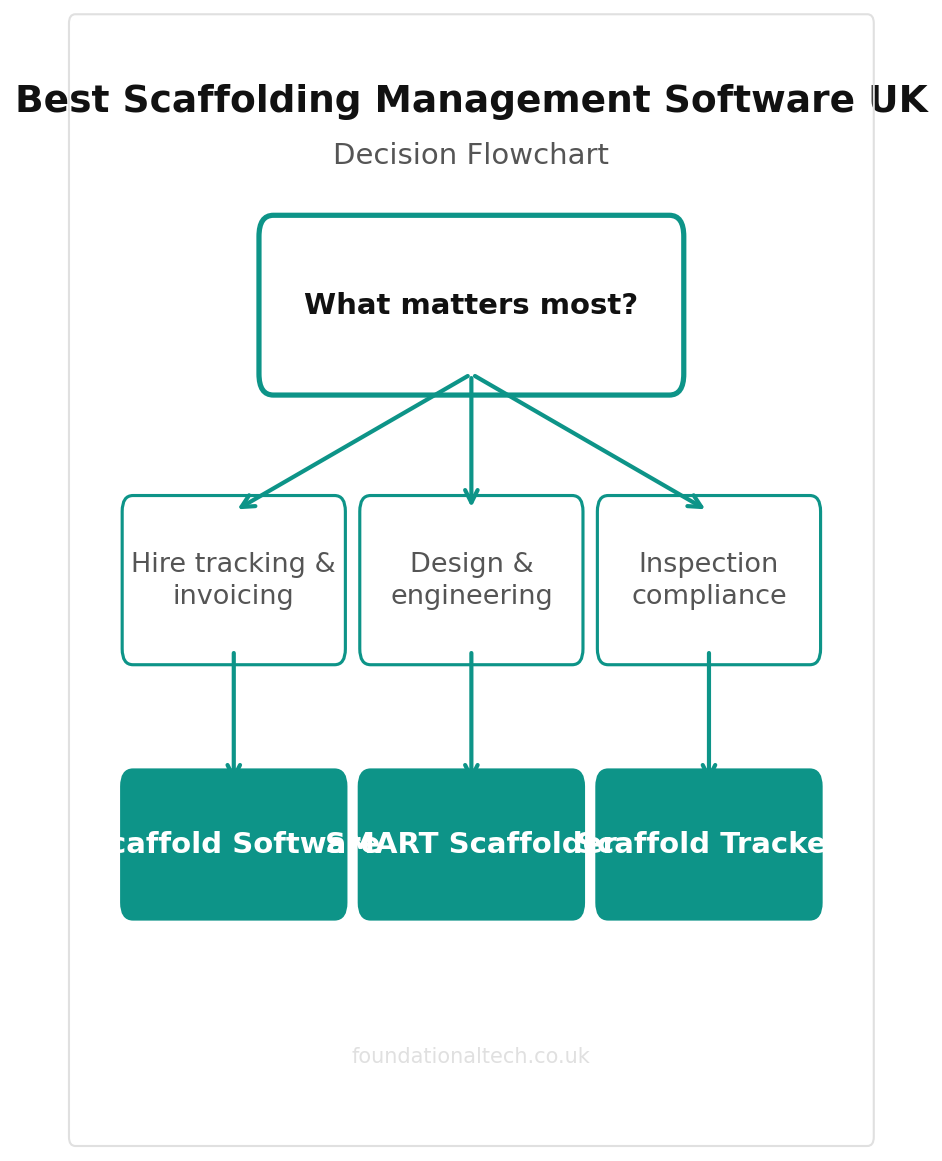
There is no single "best" scaffolding management software. There is a best combination for your size, your work type and your biggest operational pain point. Here is the decision framework.
Owner-operator or 1–3 person firm, mostly domestic work
Start with: Powered Now (£28/user/mo) + Xero Standard (£33/mo).
Total: From £61/month. Gets you off paper. Handles quotes, invoices, basic scheduling and accounting. You will outgrow it, but at this size the priority is getting systems in place at all.
Growing hire firm, 4–15 people, mostly standard configurations
Start with: The Scaffold Software Basic (£150/mo) + Xero Standard (£33/mo) + GoCardless (pay-per-transaction).
Total: From £183/month plus collection fees. This is the combination that stops ground rent leaking and inspections being missed. The native Xero integration means invoices post automatically. GoCardless collects weekly hire without anyone chasing it.
Firm doing regular bespoke design work
Add: SMART Scaffolder (contact CADS for pricing) alongside whichever operational platform you use.
Why: An accurate 3D model with a verified material list pays for itself on the first complex job it catches from under-quoting. This sits on the estimator's desk regardless of the rest of the stack.
Larger operation, 20+ people, multiple depots
Start with: The Scaffold Software Pro (£358/mo) + Xero Premium (£47/mo) + CIS add-on (£5/mo) + GoCardless.
Consider adding: Avontus for fleet tracking if stock visibility across depots is the primary headache, or ScaffTag/SafeTrak for NASC-compliant inspection tagging if principal contractors require it.
Total: From £410/month before Avontus. At this scale, the software cost is a rounding error against the ground rent it recovers and the compliance exposure it eliminates.
Industrial or commercial specialist
Evaluate: Scaffcalc alongside or instead of SMART Scaffolder if load calculations are a frequent requirement. Compare directly for your specific system types. Add The Scaffold Software or Tradify for the operational layer.
For more on how AI tools can support quoting, RAMS drafting and variation orders alongside these platforms, see AI for scaffolding contractors.
Stop doing scaffolding admin by hand
The Scaffolding Automation Starter Kit gives you a quote-to-invoice Excel workbook, a Make.com automation blueprint, and a step-by-step setup guide. Save 8–12 hours a week on paperwork.
Frequently Asked Questions
Do I need scaffolding-specific software or will a general trades app work?
It depends on how much of your revenue comes from standing hire. If you mostly do short-duration domestic erects with a single invoice per job, a general trades app like Tradify or Powered Now can handle the basics. Once you are running more than ten standing scaffolds with weekly hire charges, you need a platform that understands hire billing as a first-class concept. That means The Scaffold Software for operations or Scaffold Tracker for the inspection and stock layer.
How do I handle CIS deductions for subcontract scaffolding gangs?
Xero with the CIS add-on (£5/month) is the standard answer. It calculates the 20% or 30% deduction when you pay a subcontractor, tracks the running total, and files the monthly return to HMRC. The Scaffold Software posts the wage data; Xero handles the CIS calculation and reporting. Doing this in a spreadsheet is how firms miss the 19th-of-the-month filing deadline and pick up penalties.
What is the minimum I need to be compliant with the 7-day inspection requirement?
Under Regulation 12 of the Work at Height Regulations 2005, every scaffold must be inspected by a competent person before first use, then at intervals not exceeding seven days, and after any event likely to affect stability. The result must be recorded and kept until the next inspection. Paper inspection pads are legally valid, but they depend on someone remembering which scaffold is due. The Scaffold Software, Scafflinq and ScaffTag/SafeTrak all automate the reminder and create a digital record that survives an HSE spot check without a scramble through the glovebox.
Can I use these tools if I am not NASC-accredited?
Yes. NASC membership is voluntary (though increasingly expected by principal contractors on larger sites). All seven tools on this list work regardless of NASC status. However, if you are working towards NASC accreditation or already hold it, you will want inspection tagging that meets NASC standards — ScaffTag is the established solution there. TG20:21 compliance sheets are available to non-members through the NASC ePortal at a higher subscription rate (~£300/year vs ~£75/year for members).
What does a realistic monthly software cost look like for a mid-sized scaffolding firm?
For a firm running two gangs and fifteen to twenty-five live standing scaffolds, a typical monthly stack looks like: The Scaffold Software Basic (£150) + two extra users (£20) + Xero Standard (£33) + CIS add-on (£5) + GoCardless transaction fees (~£40–£60 on a twenty-job book). That is roughly £250–£270 per month all-in. Against a yard running £4,000–£6,000 per week in standing hire, the cost is recovered if the software catches even one unbilled rent week per quarter. Most firms running this stack report catching several.
The Bottom Line
The UK scaffolding software market in 2026 has matured enough that there are genuine, purpose-built options available — but it has not consolidated into one platform that does everything. The practical answer for most firms is a two- or three-tool stack: an operational platform (The Scaffold Software for hire-focused firms, or a general trades app for simpler operations), a design tool if bespoke work is a significant part of revenue (SMART Scaffolder or Scaffcalc), and Xero with the CIS module as the non-negotiable financial backbone underneath.
Our pick for most UK scaffolding firms: The Scaffold Software + Xero
For a typical UK scaffolding business running 5–20 concurrent hires, The Scaffold Software is the only platform we found that handles hire billing, inspection tracking and TG20 compliance in one place. Pair it with Xero for invoicing and you cover the full workflow. SMART Scaffolder wins if your bottleneck is design and estimation rather than hire management. Tradify works if you do scaffolding alongside other trades and want one system for everything, but it lacks scaffolding-specific features like hire period tracking.
The mistake most firms make is not choosing the wrong tool. It is putting off the decision until the whiteboard, the spreadsheet and the paper inspection pad have already cost more in unbilled rent and compliance risk than a year of subscriptions would have. If you are reading this article, you are probably past that point. Pick the combination that matches your size and your work type, run the free trial, and get the first week's standing hire billed properly. Everything else follows from there.
For the full automation stack — including how to wire these tools together with Xero, GoCardless and Dext — start with our scaffolding automation guide. For all scaffolding content, see all scaffolding guides.