Key Takeaway
How UK scaffolding contractors automate quotes, scheduling, and compliance in 2026. Complete software guide with pricing, Xero integration, and setup.
It is day eight since your gang tied in the last lift on a five-storey block behind the high street. The inspection sheet clipped to the base board still carries Tuesday’s date — day one. Regulation 12 of the Work at Height Regulations 2005 gave you until close of play yesterday to get a competent person back up there, walk every lift, and log the result. Nobody did. Not because anyone forgot the scaffold was standing. Because nobody owns the calendar that says when it’s due.
Then the phone goes. It’s the principal contractor’s site manager. He’s standing next to a man in a hi-vis vest with an HSE lanyard, and that man wants to see the inspection register before another soul sets foot on that scaffold. You know the tubes are sound. You know the ties are in. What you don’t have, at half past nine on a Thursday, is a piece of paper proving it. As far as the regulations are concerned, a scaffold with no current inspection record is no different from one that’s actually unsafe.
That’s one clock. Here’s the other, running quietly in the background of every job you have standing: the hire clock. You didn’t just build a scaffold and hand over an invoice. You built a structure that earns you ground rent every single week it stays up. But if nobody’s tracking which of your thirty-one live jobs crossed into week six, or which client’s project manager has been “meaning to send a purchase order” for a month, that rent simply evaporates. Most scaffolding firms don’t lose money on the erect. They lose it on the standing weeks nobody billed.
This article maps the automation stack built to close both gaps — the compliance one and the cash one. It’s written for a UK scaffolding contractor or scaffold hire firm running anywhere from one gang to a multi-depot operation. It’s the first piece in a ten-part series. Everything after this takes one layer apart in detail.
The Bit Nobody Warns You About: You Bill By The Week, Not The Job
Every other trade in this series invoices once, more or less, and moves on. A roofer strips, felts, tiles, invoices the final stage, and the job is closed. An electrician certifies a consumer unit, raises one bill, and the relationship with that particular circuit is over.
Scaffolding doesn’t work that way. You quote and erect — that’s one transaction, priced by design, tube count and labour. Then the scaffold stands, sometimes for a fortnight, sometimes for eight months on a slow commercial refurb, and every week it stands you’re owed ground rent on top of the original erect cost. Dismantle triggers a final invoice. In between, you’re running what is effectively a rolling hire book across every live contract. Clients complicate it further: they extend jobs, add extra lifts, or ask for a loading bay bolted on halfway through. Each one is a variation order that needs pricing and billing separately from the base rent.
Run that manually across twenty or thirty standing structures and the maths gets away from you fast. A scaffold that should have come down in week four but is still up in week nine, uninvoiced because nobody flagged it, isn’t a rounding error. On a mid-sized contract that’s easily £1,500 to £3,000 of ground rent quietly written off. Multiply that leakage across a full yard of live jobs and it’s the difference between a firm that’s profitable and one that only feels busy.
The Stack That Closes Both Gaps
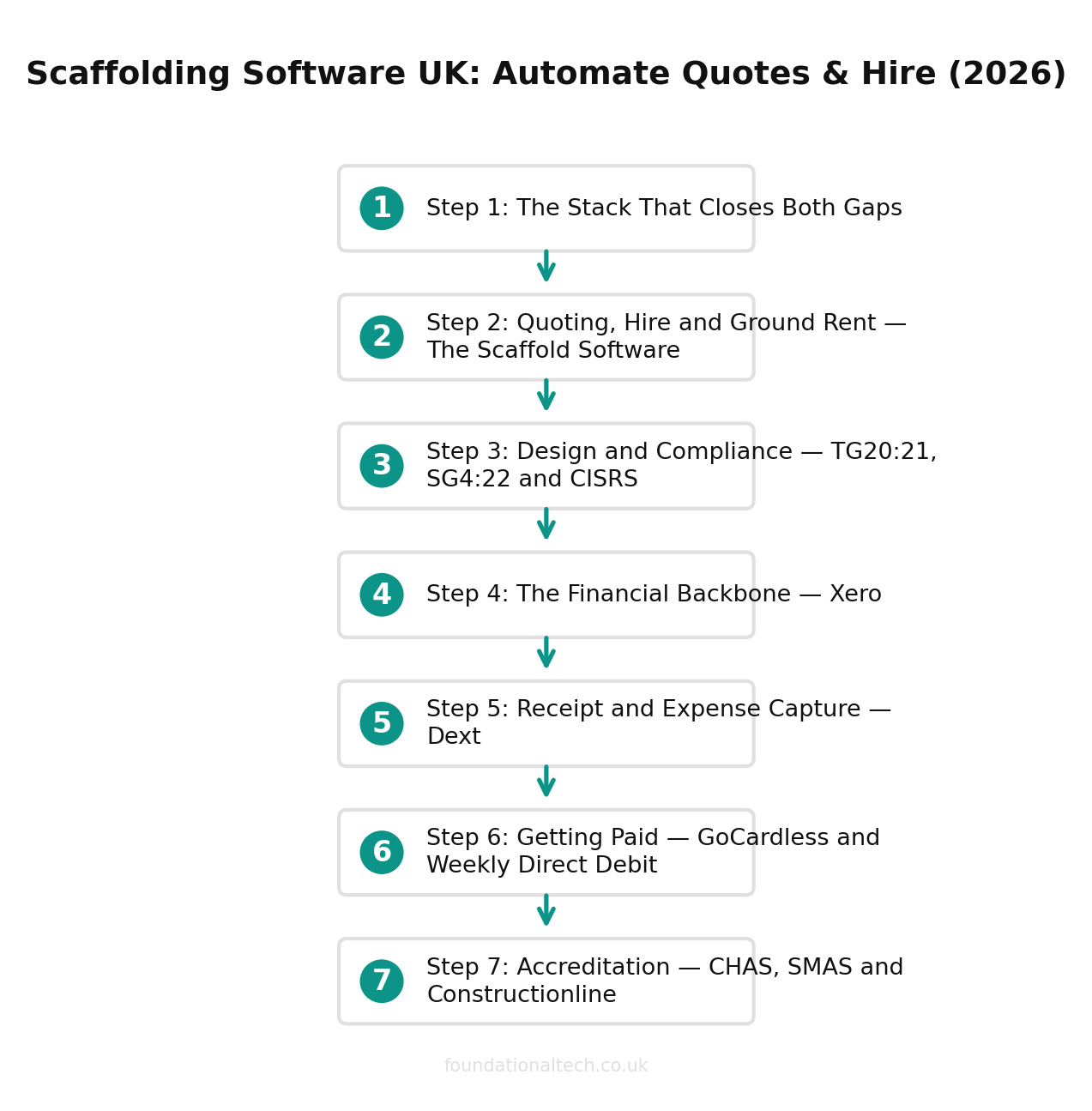
Quoting, Hire and Ground Rent — The Scaffold Software
The centre of gravity for a modern UK scaffolding business is purpose-built software, not a generic trade job app repurposed with scaffold-shaped fields bolted on. The Scaffold Software (thescaffoldsoftware.co.uk) is the clearest example. It covers enquiries, multi-elevation quoting, gang scheduling, RAMS generation, statutory weekly inspection logging, handover certificates, payment claims, variation orders and extra-hire tracking in one place. There’s a mobile app for the yard and the crew on site.
Current pricing runs Basic from £150/month and Pro from £358/month, both on the current early-access offer — standard rates apply once the founding-cohort spots fill — with extra users at £10/month each. The mechanism that matters most for a hire business is the one most generic tools don’t have. It treats “still standing” as a billable state, not a forgotten one. The weekly rent invoice generates automatically rather than waiting for someone to remember.
Design and Compliance — TG20:21, SG4:22 and CISRS
Scaffolding is the only trade in this series where the design standard is as central to the paperwork stack as the accounting software. TG20:21 is the National Access & Scaffolding Confederation’s guidance for tube-and-fitting scaffolds. Since the 2021 revision, the compliance sheets, design guide and eGuide calculation software all live behind the NASC ePortal — a subscription running roughly £75/year for NASC members and £300/year for non-members. Every scaffold that falls outside a standard TG20 configuration needs a bespoke design instead. At that point a firm either pays a design engineer, or — with enough volume — brings estimating in-house with dedicated design software.
Sitting alongside TG20:21 is SG4:22, NASC’s current guidance on preventing falls during erection, alteration and dismantling. It’s the practical safe system of work your gang actually follows on the tubes, distinct from the finished-structure design standard. And underneath both sits CISRS, the Construction Industry Scaffolders Record Scheme: the individual competence cards your scaffolders must hold, plus a separate CISRS Scaffold Inspection card for whoever’s signing off that weekly sheet. A Part 1 trainee course runs somewhere in the £1,000–£1,250 range including card application — the exact figure varies by training centre — and the inspection card itself costs £38.
None of this is software, exactly. But every one of these documents is exactly what the man with the HSE lanyard asks to see. The TG20 compliance sheet, the RAMS built around SG4:22, proof of current CISRS cards for the gang on site. A stack that can’t produce them in thirty seconds on a phone is a stack that’s failing at the one job that matters most.
The Financial Backbone — Xero
Xero remains the shared ledger underneath every trade in this series, and scaffolding is no exception. Current UK pricing sits at Ignite £15/month, Grow £37/month and Comprehensive £42/month, with payroll at £1.50 per employee per month on Grow and Comprehensive. The detail worth flagging for scaffolding specifically: firms that bring in subcontract gangs for erect-heavy weeks fall under the Construction Industry Scheme. Xero’s CIS module — a £5/month add-on — handles the 20% (registered) or 30% (unregistered) deduction and the monthly return automatically. The alternative is a spreadsheet someone updates on the 18th of the month, the day before the return is due.
Receipt and Expense Capture — Dext
Tube, board, fittings, fuel for the wagon, a skip hire invoice for site clearance — the receipts pile up fast on an erect-heavy week. Dext photographs and codes them automatically, at roughly £25–£30/month for five users and 250 documents on current UK pricing. Several gangs buying materials independently across different merchants is the hardest case of all. This is the difference between a bookkeeper chasing paper receipts in January and a set of accounts that are essentially done in real time.
Getting Paid — GoCardless and Weekly Direct Debit
Here’s where the weekly billing pattern really bites if you haven’t automated it. Chasing thirty separate ground rent invoices by hand, every single week, is not a task — it’s a second job. GoCardless solves it the way ground rent should be solved. One Direct Debit mandate gets signed at contract stage, then the weekly hire charge pulls itself every seven days for as long as the structure is standing. On a £220 weekly rent that costs £2.40 to collect — roughly the price of the phone call you would otherwise make. The alternative is re-invoicing and re-chasing every seven days across every live job. That’s the kind of admin that eats a Friday afternoon and never gets faster, no matter how experienced you are at it.
Accreditation — CHAS, SMAS and Constructionline
Principal contractors on anything beyond small domestic work will ask for third-party health and safety accreditation before they’ll even let you quote. CHAS Standard runs roughly £150–£400/year and CHAS Advanced £300–£700/year depending on turnover band. SMAS Worksafe runs approximately £400–£800/year on the same basis. Constructionline starts from around £249/year at Bronze, rising to roughly £499–£1,100/year at Gold, plus a one-off joining fee. Bands are turnover-tiered and revised periodically, so check the current schedule before budgeting a renewal. These aren’t software in the automation-stack sense, but they’re recurring compliance costs that belong in the same annual budget line as everything above. Several of the platforms in this stack can store the certificates and flag renewal dates automatically.
From Quote to Reconciled Rent
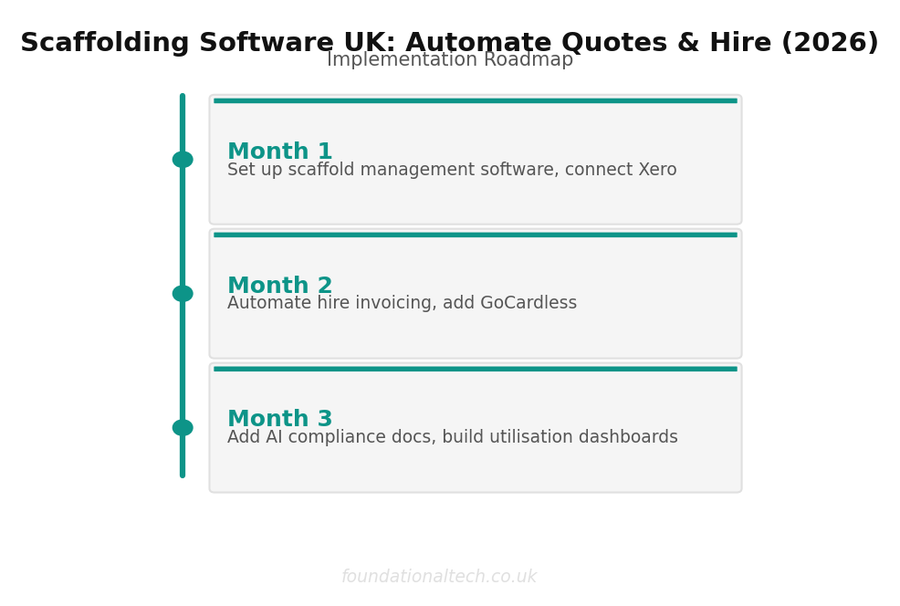
A quote accepted in The Scaffold Software becomes a scheduled job with a gang assigned and RAMS generated against SG4:22. Once erected, the system starts the statutory inspection clock and pushes a reminder before day seven, every time, for every scaffold currently standing. That’s the exact mechanism that would have caught the block behind the high street before an HSE inspector had to catch it for you. Weekly ground rent generates and posts to Xero automatically for as long as the job stays open. GoCardless collects it without anyone raising a phone. Dext catches the tube and fittings receipts as they’re bought. When the CIS-registered gang gets paid, Xero calculates the deduction and rolls it into the monthly return. Nothing here requires a scaffolder to become a software specialist — it requires the handful of tools to actually talk to each other, most of them through native integrations, the rest through Zapier or Make.
Stop doing scaffolding admin by hand
The Scaffolding Automation Starter Kit gives you a quote-to-invoice Excel workbook, a Make.com automation blueprint, and a step-by-step setup guide. Save 8–12 hours a week on paperwork.
The Difference On The Yard
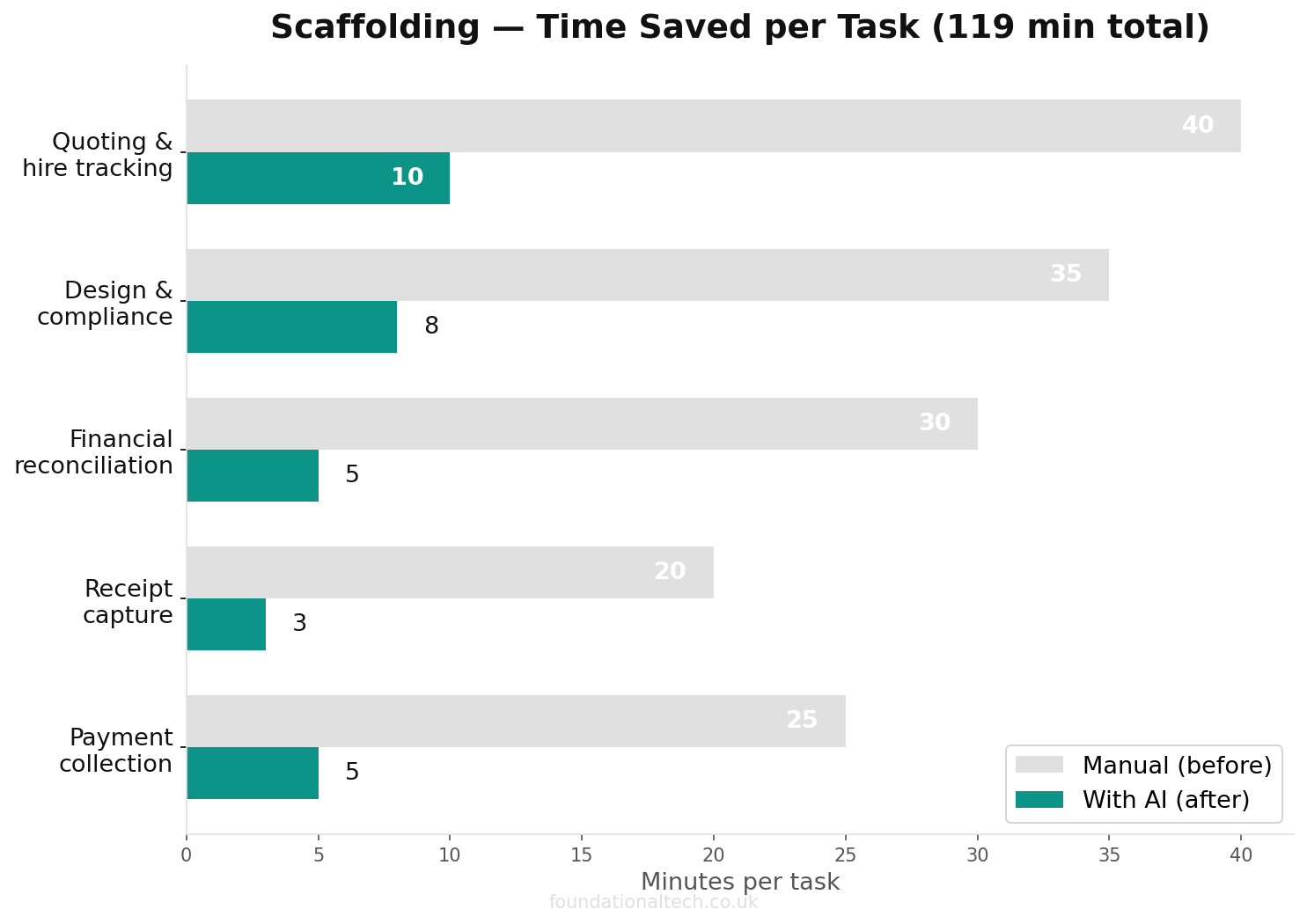
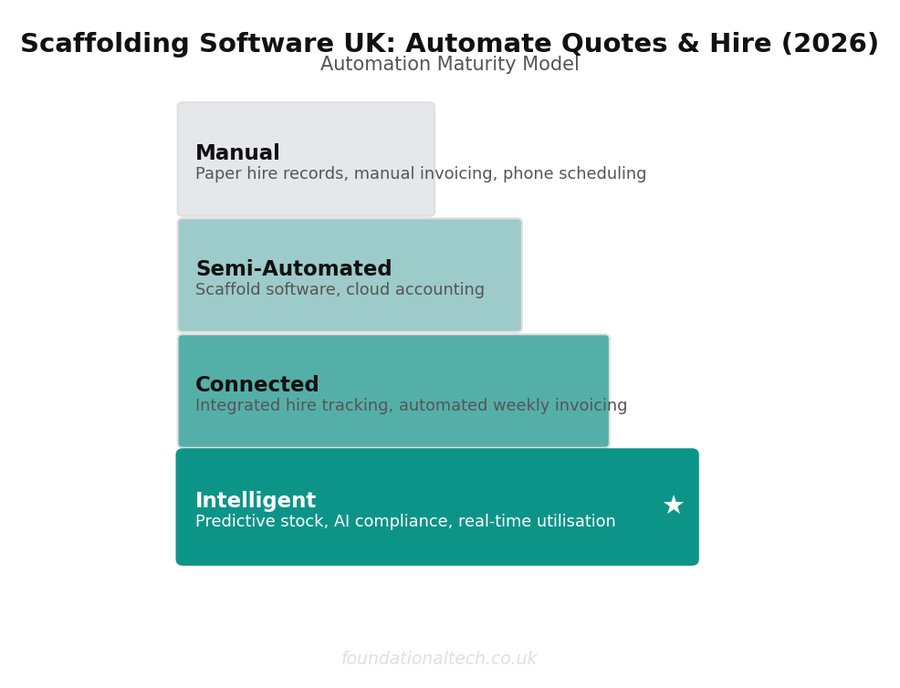
A firm running this stack against one running on a WhatsApp group, a paper inspection pad and a spreadsheet of “jobs currently up” sees the difference in two places. First, compliance: statutory inspections happen on time because the system asks, not because someone remembers, which matters enormously the day an HSE inspector or a principal contractor’s site manager turns up unannounced. Second, cash: ground rent that would have quietly gone unbilled for two, four, sometimes eight weeks on a forgotten job gets caught and invoiced the week it’s due. On a yard running twenty-five to thirty live contracts, firms that have made this switch typically report recovering several thousand pounds a quarter in rent that was previously falling through the gaps. Money that was earned, just never asked for.
Zero hire leakage
when weekly scaffold billing is automated — no more lost weeks between erection and first invoice
What Comes Next in This Series
Article 2 compares The Scaffold Software, SMART Scaffolder and Scaffold Tracker head-to-head, with a real setup walkthrough. Article 3 covers the cash-flow reality of weekly hire billing against ground rent, retention on larger contracts, and financing the erect before the first week’s rent lands. Article 4 automates the back office: CIS returns for subcontract gangs, inspection register retention, and CISRS card expiry tracking across a full workforce. Article 5 maps the full integration stack. Article 6 covers how scaffolding firms are using AI day to day. Article 7 is a prompt playbook built for scaffold quoting, RAMS drafting and variation order emails. Article 8 walks through setting up an AI assistant that knows your standard TG20 configurations and current live jobs. Article 9 covers no-code automations — including one built specifically around the 7-day inspection deadline. Article 10 is a full case study of one UK scaffolding firm that rebuilt its admin from the ground up.
How many scaffolds have you got standing right now — and could you say, without checking a single piece of paper, which one is due its next statutory inspection first? Hit reply and tell me. I read every one.
For trades that need compliance certification, we also cover gas certificate software for Gas Safe engineers and EICR software for electricians.