Key Takeaway
12 Claude AI prompts for UK builders in 2026. Copy-paste templates for quotes, emails. Tested for UK-specific tone, pricing, and compliance. Save hours.
Most builders type six words into an AI and get six paragraphs of waffle back. “Write a quote for a bathroom.” The reply is generic, American, and useless on site. Change six words to sixty — the job, the materials, the margin, the tone — and the same tool hands you a quote you’d email after a 30-second read.
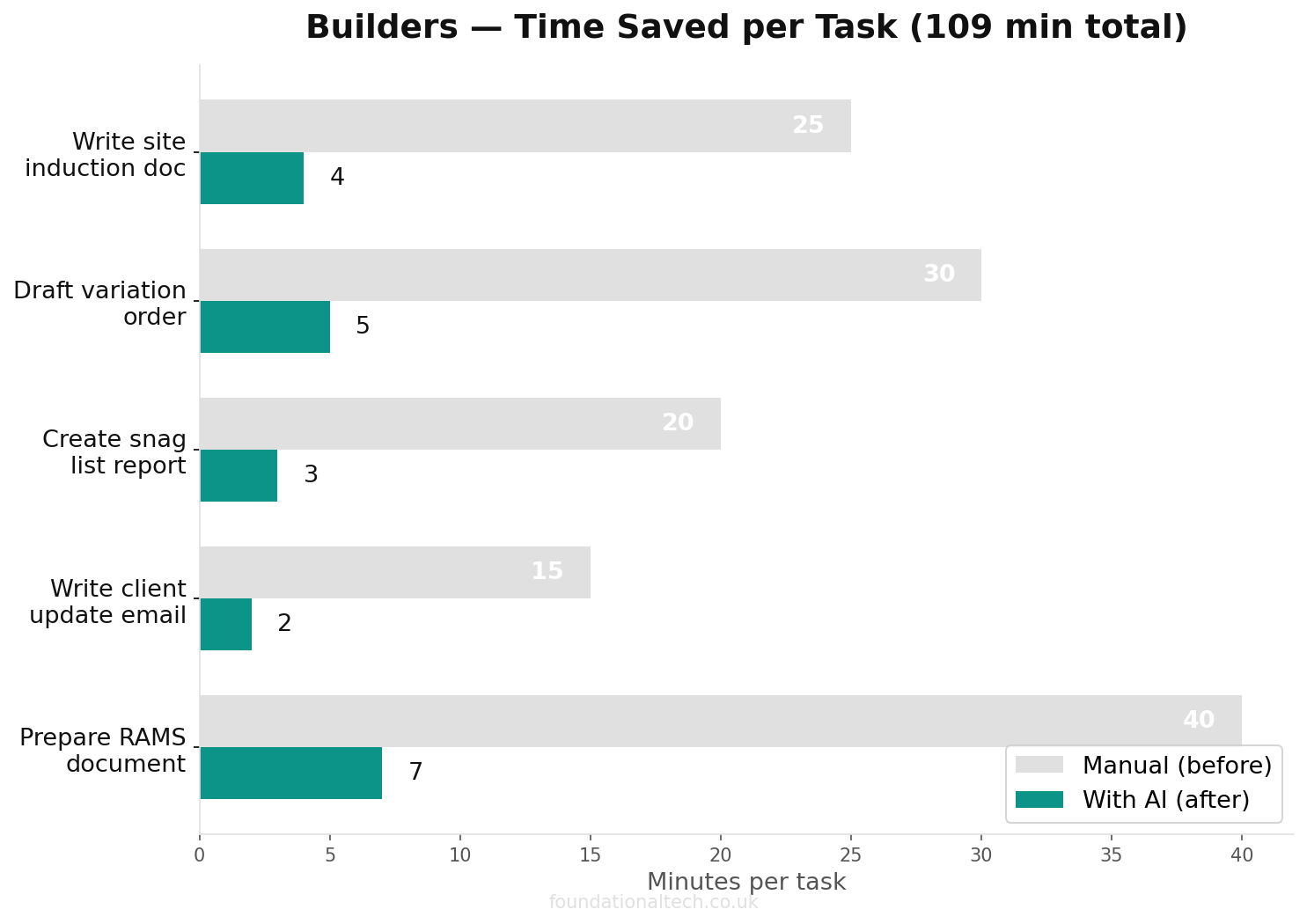
35 min → 3 sec
Average time to draft a professional building contractor document — manual vs AI-assisted
That gap is the whole game. These 12 prompts are written for UK trades — builders, electricians, plumbers, roofers, the lot. Copy them. Paste them into Claude. Swap the bits in square brackets for your own job. Each one tells you exactly when to use it and roughly how much time it claws back from your evenings.
Why Generic Prompts Don’t Work on a Building Site
A prompt that works for a builder needs four things a lazy prompt skips. The actual job detail. The UK context — CIS, VAT reverse charge, the way we price here. Your firm’s voice, and a clear line on what the AI must not do. Leave those out and Claude writes for an American homeowner who’s never heard of a builders’ merchant. Build them in, and it writes like the office manager you can’t yet afford to hire.
A word on what these prompts are for. They draft. You decide. Every output below still needs your eyes before it leaves your phone — the same check you’d give a quote a new estimator handed you. The point isn’t to remove you. It’s to delete the blank screen.
The Prompts
1. Quote From a Site Visit
You are writing a quote for a UK [TRADE — e.g. building] firm. Be clear and professional, plain English, no jargon.

Job: [DESCRIBE — e.g. "supply and fit a new 1700mm bathroom suite, re-tile floor and walls, replace extractor fan, make good and paint. Customer's house, occupied, parking on driveway"]

My costs: labour [X days at £X/day], materials approx £[X], skip/waste £[X], my margin [X]%.

Write a customer-facing quote with: a short friendly intro, a clear scope of works (bullet the included items), a clear list of what is NOT included (exclusions), the total price with VAT shown separately, payment terms [e.g. "40% deposit, 40% on first fix, 20% on completion"], and how long the quote is valid.

Do not invent prices I haven't given you. Leave [GAPS] where you need a figure I haven't provided.
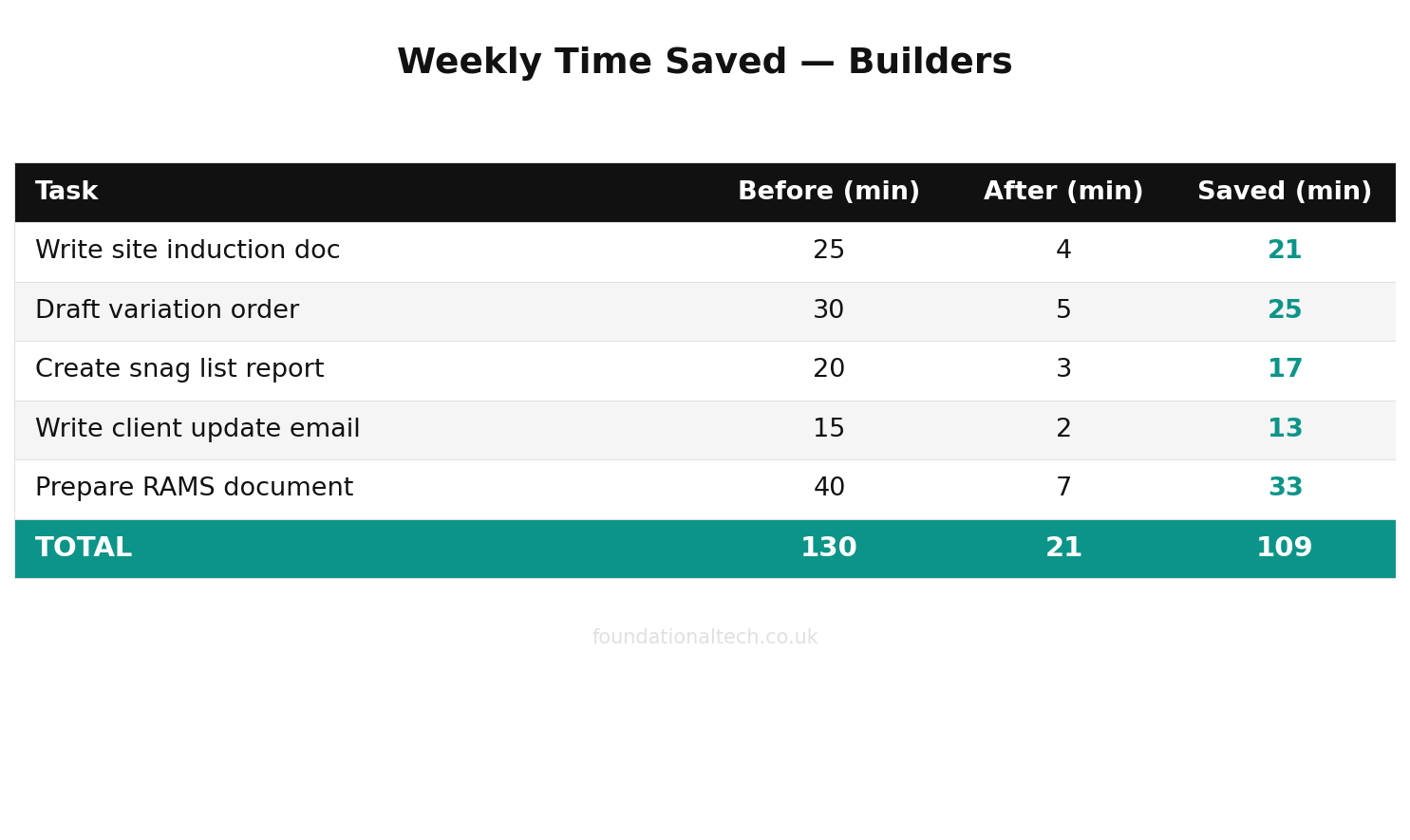
When to use: The evening after a site visit, when the customer is waiting and you’re tired. This turns scribbled notes into a proper quote. Time saved: 20-30 minutes per quote. Win one extra job a month because the quote went out same-day instead of three days late and it has paid for itself many times over.
2. Quote Follow-Up Chaser
Write 3 short follow-up messages chasing a UK [trade] quote the customer hasn't replied to.

Job quoted: [BRIEF — e.g. "loft conversion, £42,000, quoted 10 days ago"]

Message 1 (day 3, gentle): friendly, check they got it, offer to talk it through.
Message 2 (day 10, helpful): ask if anything's holding them back, offer to revise the spec to suit a budget.
Message 3 (day 21, final): polite, let them know I'm booking up and want to hold a slot if they're keen.

Each under 60 words. Warm, never pushy. Sound like a real person, not a sales script.
When to use: Every quote that goes quiet. Most trades send a quote and pray. The follow-up is where the work actually gets won. Time saved: The messages take 30 seconds. The job they recover is worth thousands.
3. Variation / Extra Works Notice
A UK [trade] customer has asked for work beyond the agreed quote. I need to confirm the change and the extra cost in writing BEFORE I do it.

Original job: [BRIEF]
What they've now asked for: [DESCRIBE — e.g. "move the kitchen sink to the opposite wall, which means re-routing waste and water"]
Extra cost: £[X] plus VAT. Extra time: [X days].

Write a short, friendly message that: confirms what they've asked for, explains plainly why it costs more, states the extra price and any delay to the finish date, and asks them to reply "yes" to approve before I start. Keep it under 150 words. Firm but warm — this protects both of us.
When to use: The moment a customer says “while you’re here, could you also...” This single habit prevents the most common cause of end-of-job arguments. Time saved: 10 minutes — and one avoided dispute over unpaid extras, which is worth far more than the time.
4. Snagging / Complaint Response
A UK [trade] customer has raised a problem with completed work. Draft a calm, professional reply.

Their message: "[PASTE WHAT THEY SAID]"
The facts as I see them: [2-3 bullets — e.g. "the grout has hairline cracks, this is normal settlement, I offered to re-grout as goodwill"]
What I'm willing to do: [DESCRIBE]

Write a reply that: thanks them for raising it, shows I'm taking it seriously, states plainly what I'll do and when, and keeps the door open. Do not admit legal liability or blame. Stay polite even if their message was rude. Under 180 words.
When to use: Any complaint, snag, or angry text. These land when you’re on another job and tempt a reply you’ll regret. Let Claude write the calm version. Time saved: 15 minutes, and a reputation. A bad review costs more than any prompt could save.
5. Subcontractor Request
Write a short message to a UK subcontractor to book them for a job.

Subbie trade: [e.g. plasterer]
Job: [DESCRIBE — e.g. "skim 4 rooms and a hallway, plasterboard already up"]
Dates I need them: [DATES]
Site: [TOWN/POSTCODE]
What I need back from them: a price, confirmation they're CIS registered, and their UTR.

Keep it brief and direct — a working message between two tradespeople, not a formal letter. Under 100 words.
When to use: Every time you bring a subbie on. Getting CIS status and UTR up front saves a headache at payment time. Time saved: 5 minutes per booking — and it builds the paper trail HMRC expects under CIS.
6. CIS Deduction Statement Explainer
Explain a CIS deduction to a UK subcontractor in plain English so they understand what they've been paid and why.

Their gross labour: £[X]
Materials (no deduction): £[X]
CIS deducted at [20% / 30%]: £[X]
Net paid to them: £[X]

Write a short, friendly note that explains: what CIS is in one line, why I've deducted [20/30]%, that the deduction goes to HMRC and counts towards their tax, and that I'll give them a monthly statement for their records. Reassure them it's normal and required by law. Under 150 words.
When to use: When a new subbie queries why they got less than their invoice. Saves the awkward “it’s a tax thing, trust me” conversation. Time saved: 10 minutes, and a better relationship with the subbies you rely on.
7. Risk Assessment & Method Statement (RAMS) First Draft
Draft a Risk Assessment and Method Statement (RAMS) for a UK [trade] job. This is a FIRST DRAFT for me to review and adapt — not a finished compliance document.

Job: [DESCRIBE — e.g. "replace guttering and fascias on a two-storey domestic property, access by scaffold tower"]
Main hazards I can see: [LIST — e.g. "working at height, public footpath below, power tools"]

Produce: a hazard table (hazard, who's at risk, control measures), a step-by-step method statement for doing the job safely, and the PPE required. Reference relevant UK regs where appropriate (e.g. Work at Height Regulations 2005).

End with "REVIEW: this is a draft — check against site-specific conditions and your own competent assessment before use."
When to use: Any job a main contractor or commercial client asks for paperwork on. Gets you 80% of the way; you add the site specifics. Time saved: 30-40 minutes per RAMS. For trades chasing commercial work, this removes the single biggest paperwork barrier to bidding.
8. Overdue Invoice Chase Sequence
Write 3 escalating messages chasing an overdue invoice for a UK [trade] firm.

Invoice: £[X], for [JOB], due [DATE], now [X] days late. Customer is a [homeowner / main contractor / business].

Message 1 (day 1 overdue, friendly): assume it's an oversight, polite nudge, include the invoice number and how to pay.
Message 2 (day 14, firmer): clear, state the amount and original due date, ask for a payment date.
Message 3 (day 30, formal): professional, mention I may add statutory interest under the Late Payment of Commercial Debts Act (for business customers) and pause any further work. Never threatening.

Each under 120 words. Keep my reputation intact — these people talk to each other.
When to use: The UK construction average is over 60 days to get paid. This is the difference between a cash flow wobble and a crisis. Time saved: 20 minutes to build the full sequence, reusable on every late payer.
9. Material Order / Merchant Email
Write a clear material order email to a UK builders' merchant.

Merchant: [NAME]. My account ref: [REF].
Delivery to: [SITE ADDRESS], needed by [DATE], [AM/PM].
Items: [LIST — quantities and descriptions, e.g. "20 x 100mm dense concrete blocks (pack), 10 bags multi-finish plaster, 5 sheets 12.5mm plasterboard 2400x1200"]

Ask them to confirm stock, the price including any account discount, and the delivery slot. Polite and businesslike. Flag that I need a VAT invoice for my records.
When to use: Any order too big to text. Getting it in writing means fewer wrong deliveries and a clean record for your books. Time saved: 10 minutes, and fewer “that’s not what I ordered” mornings.
10. Job Advert for a Labourer or Apprentice
Write a job advert for a UK [trade] firm hiring a [labourer / apprentice / qualified tradesperson].

About us: [2 lines — e.g. "small family building firm in [town], mostly domestic extensions and renovations, busy and growing"]
The role: [DESCRIBE day-to-day]
Must have: [e.g. CSCS card, own transport, 2 years on the tools]
Pay: [£X/day or £X/hour], [hours], [start date]

Write it to attract reliable people, not time-wasters. Honest about the graft, clear on what's on offer. Include how to apply. Sound like a real firm, not a recruitment agency. Under 250 words.
When to use: Every hire. A clear advert filters out the no-shows before they waste your time. Time saved: 20 minutes, and a better calibre of applicant.
11. Google Review Request & Replies
I run a UK [trade] firm and want more Google reviews.

Task A: Write a short, friendly text to send a happy customer the day after I finish a job, asking for a Google review. Include a clear ask and make it easy. Under 50 words. Not pushy.

Task B: Write 3 reply templates I can adapt — one for a 5-star review (warm thanks), one for a fair 3-star review (gracious, show I've listened), one for an unfair 1-star (calm, professional, factual, never defensive). Each under 80 words.
When to use: After every good job, and whenever a review lands. Reviews are how trades get found now — this builds the habit. Time saved: 15 minutes, and a steady trickle of reviews that win the next ten jobs.
12. Weekly Schedule From a Job List
I run a UK [trade] firm. Turn my messy job list into a clear week plan.

This week's jobs: [PASTE — e.g. "Smith extension, 3 days, need plasterer Wed. Jones boiler swap, 1 day. Patel quote visit. Pick up bathroom suite from merchant. Two warranty call-backs."]
My team: [e.g. "me, one labourer, plasterer subbie available Wed-Thu"]
Constraints: [e.g. "merchant shut Sunday, Patel only free mornings"]

Produce a day-by-day plan (Mon-Sat) showing who's where, what's needed on site each day, and anything I must book or order in advance. Flag any clashes. Keep it to a one-screen list I can read on my phone.
When to use: Sunday evening, instead of working it out in your head at 6am Monday. Catches the clashes before they cost you a wasted morning. Time saved: 20-30 minutes, and the quiet relief of a week that’s already planned.
Three Rules That Make Every Prompt Better
First, feed it the detail. The square brackets are not decoration — fill every one. “Quote for an extension” gets you mush. “Single-storey rear extension, 4m x 5m, cavity wall, two Velux, bi-fold doors, 6 weeks, my day rate £280, materials £14,000, 18% margin” gets you something you can send.
Second, tell it what not to do. “Do not invent prices,” “do not admit liability,” “do not volunteer information” — these matter as much as the instruction itself. An AI left unchecked over-delivers, and on a building site over-delivering means promising something you’ll have to honour.
Third, read it before you send it. Claude gets the tone and structure right almost every time. It is your job to check the numbers, the dates, and the one site-specific fact only you know. The prompts save you the writing, not the thinking.
Which of these 12 prompts are you going to try first — and on which job this week? Reply and tell me. I’m tracking which ones UK trades actually use, and I’ll publish the winners.
Related guides: If you found this useful, see our guide on How to Set Up Claude as Your Construction Business AI Assistant: Step-by-Step Guide (2026) and How UK Builders and Tradespeople Are Using AI to Kill the Paperwork (Without Losing the Personal Touch).
*A & Y Financial Services helps UK trade and construction firms put AI to work without the jargon. That’s what we do.