Key Takeaway
Automate CISRS, compliance for your UK scaffolding contractor business in 2026. Step-by-step guide using Dext, Xero, and payroll tools to cut admin hours.
Ryan Doyle got the call on a Thursday afternoon. A principal contractor's site manager needed a full compliance pack for Monday's start: every CISRS card for the gang, current insurance certificates, RAMS, the NASC accreditation documents. No pack, no job. Ryan had all of it. Somewhere. Three CISRS cards turned out to have lapsed in the previous six weeks without anyone noticing. One gang member's inspection card had quietly expired the month before. The public liability certificate on file was last year's, superseded by a renewal nobody had filed. He spent Friday chasing training centres and the insurance broker instead of pricing next week's quotes.
None of that is a compliance failure in the sense of doing anything unsafe. It's an admin failure — the kind that costs a scaffolding firm a contract not because the work is wrong, but because the paperwork proving it's right can't be produced fast enough. The statutory 7-day inspection clock covered in Article 1 runs against a structure. This one runs against every single person in your workforce, continuously, on a rolling five-year cycle nobody's watching until a principal contractor asks.
Ten Documents Away From Losing the Job
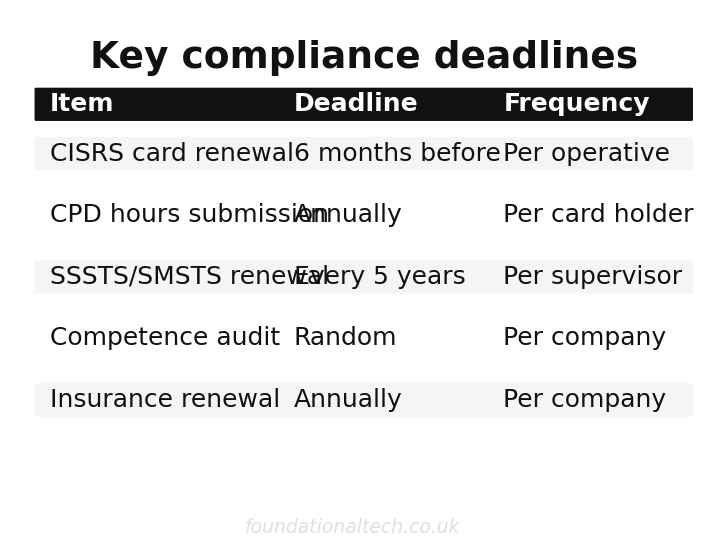
A scaffolding firm's compliance paperwork isn't one document. It's a stack, and every item in it expires on its own independent schedule. That stack starts with CISRS Scaffolder and Advanced Scaffolder cards. These renew every five years via a two-day CPD refresher course. Renewal notices go out roughly three months before expiry, and there's a hard six-month cutoff after which lapsed cardholders need full re-assessment rather than a simple refresher. On top of those sit the separate CISRS Scaffold Inspection card for whoever signs the weekly sheet. Then public and employers' liability insurance certificates, RAMS specific to each live job, and the NASC and CHAS/SMAS/Constructionline accreditation documents introduced in Article 1.
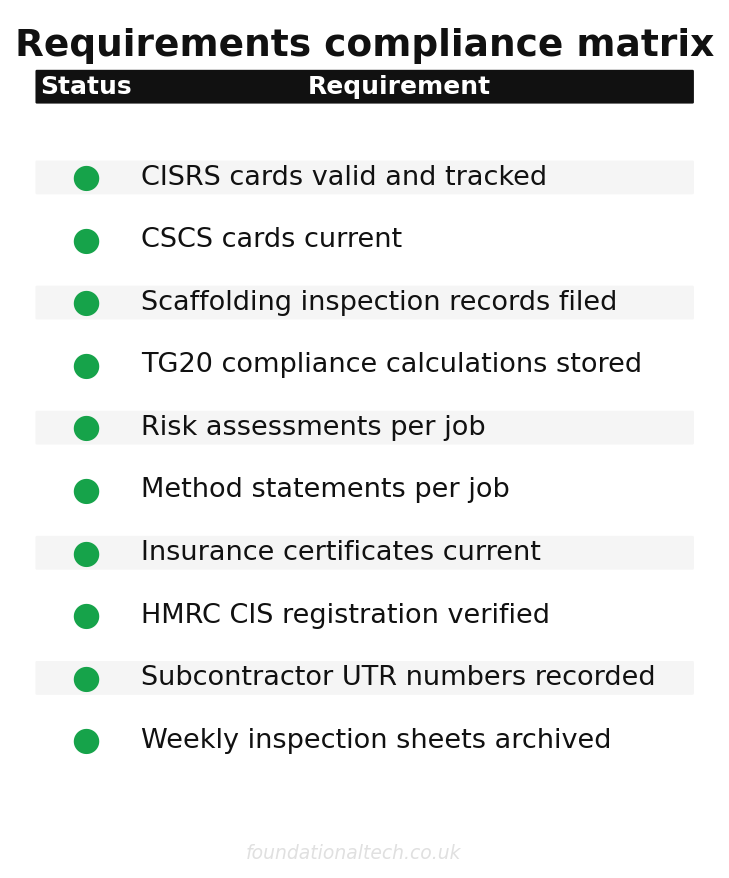
| Status | Requirement |
|---|---|
| ✓ | CISRS cards valid and tracked |
| ✓ | CSCS cards current |
| ✓ | Scaffolding inspection records filed |
| ✓ | TG20 compliance calculations stored |
| ✓ | Risk assessments per job |
| ✓ | Method statements per job |
| ✓ | Insurance certificates current |
| ✓ | HMRC CIS registration verified |
| ✓ | Subcontractor UTR numbers recorded |
| ✓ | Weekly inspection sheets archived |
None of these expiring in isolation is a crisis. What turns it into one is that they expire on different clocks, tracked (if at all) across a card in someone's wallet, a PDF in an email inbox, and a filing cabinet. Nobody is cross-referencing "who's on Monday's gang" against "whose card is still valid" — until a principal contractor's compliance officer does it for you, at the worst possible moment, standing at the site gate.
The Automation Stack
Compliance Tracking — Complys
Where Article 1 covered The Scaffold Software's day-to-day billing and Article 2 covered Scaffold Tracker's inspection tagging, the tool that closes the workforce-compliance gap is different again. Complys (complys.co.uk) is built specifically for UK scaffolding contractors around a single job. It tracks every CISRS card, every insurance certificate, every RAMS document and every NASC accreditation in one register. Expiry alerts fire well ahead of the deadline, and a one-click export assembles a complete compliance pack for a principal contractor on demand. The provider doesn't publish standard pricing tiers publicly. It runs on a 90-day free trial with quotes issued directly, so treat any figure you're given as one to confirm at signup. What it replaces is the Friday Ryan Doyle lost. Instead of chasing training centres and brokers reactively, the register flags a card three months out. That's enough runway to book the CPD refresher before the six-month re-assessment cliff-edge. And the pack comes out in the time it takes to click export, not the time it takes to search an inbox.
Payroll for a Mixed CIS and PAYE Workforce
Scaffolding payroll is rarely one thing. Almost every commercial scaffolding gang operates inside the Construction Industry Scheme. Self-employed CISRS-carded scaffolders command £200–£280 a day nationally, or £300–£400 in London and the South East, precisely because they carry their own tax and NI liability. Directly employed PAYE scaffolders typically sit at £120–£180 a day, with holiday pay and employment rights attached instead. Xero's payroll, introduced in Article 1 at £1.50 per employee per month on the Grow and Comprehensive plans, handles the PAYE side. Its £5/month CIS add-on covers the monthly CIS300 return and the 20%/30% deduction calculation for registered and unregistered subcontractors respectively. Firms running heavier CIS batch volumes often add BrightPay's dedicated CIS module instead. That's BrightCIS, included at no extra cost within the BrightPay licence, and it suits firms filing returns for a large rotating pool of subcontract gangs across several contracts at once. It's built specifically for batch CIS300 filing across multiple subcontractors in one run — a genuine time saver once you're past a handful of regular subbies. Note that BrightPay's UK product moved to cloud-only pricing from the 2026/27 tax year, quoted by employer and employee count rather than a fixed published rate. Get a current quote before assuming last year's desktop pricing still applies.
The April 2026 Umbrella Company Change That Actually Matters Here
Some firms bring in additional labour through an agency and umbrella company for a big industrial contract. It's common on refinery and petrochemical scaffolding work, where demand spikes hard and briefly. A rule change landing on 6 April 2026 is worth building into your back office now rather than discovering it at year-end. From that date, umbrella companies and the "relevant party" above them in the labour supply chain become jointly and severally liable for PAYE. Where there's no agency sitting between your firm and the umbrella, that liability can pass directly up to you as the end client. HMRC's stated expectation is that end clients map their labour supply chains and carry out ongoing due diligence on the umbrellas involved. A due-diligence checklist doesn't remove the liability outright, but it materially reduces the risk. It belongs in the same compliance register as your CISRS cards, not in a separate mental note.
Expenses, Subsistence and the Away-Job Premium
Industrial and petrochemical scaffolding contracts often send a gang away from the yard for days or weeks at a stretch. HMRC publishes benchmark subsistence scale rates. It's £5 for travel of five hours or more, £10 for ten hours or more, and £25 for fifteen-hours-plus trips still running at 8pm. An overnight stay is worth up to £25. These apply on top of the day rate without needing individual receipts for every meal, provided they're applied consistently and correctly recorded. Dext, already part of the stack from Article 1 for materials receipts, does the same job here for subsistence and travel. Photograph, categorise, post to Xero — no gang leader hand-writing an expenses claim on the drive home.
What a Working Week Looks Like
A gang gets allocated to Monday's job in The Scaffold Software. Before the allocation confirms, Complys checks every name against the current CISRS register. It flags anyone whose card, inspection ticket or refresher is due inside the next fortnight. The problem surfaces before the gang is en route, not after a site manager turns them away at the gate. Timesheets from the week feed into Xero payroll for the PAYE staff and into the CIS module for the self-employed gang, with BrightCIS handling the batch return if the subcontractor count justifies it. Dext catches fuel, subsistence and away-job receipts as they're incurred. None of this removes the paperwork; scaffolding carries more of it than most trades in this series. But it moves the moment someone discovers a gap from "the site gate on Monday morning" to "an alert three months before it would have mattered."
Stop doing scaffolding admin by hand
The Scaffolding Automation Starter Kit gives you a quote-to-invoice Excel workbook, a Make.com automation blueprint, and a step-by-step setup guide. Save 8–12 hours a week on paperwork.
How Long Do You Actually Have to Keep This Paperwork?
Tracking expiry dates solves half the problem. The other half is knowing how long a document has to be kept once it's superseded. "We'll delete the old one once the new one's in" is exactly how a firm ends up unable to prove a scaffold's inspection history when a claim surfaces two years after the job finished. Weekly inspection records need to survive only until the next inspection replaces them, which is a low bar. But insurers and principal contractors routinely expect access to full project records, RAMS included, for six years after completion — and longer where a structure was involved in an incident. A CISRS card that's lapsed and been renewed still needs its predecessor's history retrievable if a contractor ever queries continuity of competence for insurance purposes. None of this is exotic; it's the same retention discipline any regulated trade needs. But it's where a compliance register earns its subscription twice over: once for the live alerts, and again the day someone asks for a record from three years back and it's still there.
10 documents
per operative per job — tracked automatically with expiry alerts
Getting There: Three Weeks, Not a Weekend
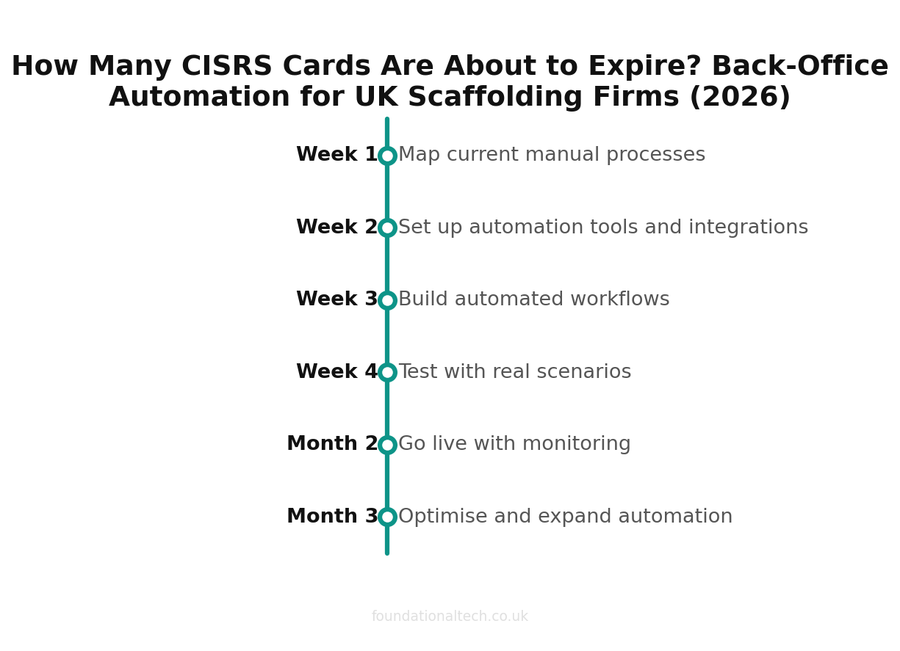
Loading five years of CISRS card data, insurance renewal dates and accreditation documents into a new compliance register isn't a Friday-afternoon task. Treat it as a proper rollout rather than something to switch on overnight. In week one, get every current cardholder's details and expiry dates into Complys, along with your live insurance and accreditation certificates — this is the single biggest time investment, but it's a one-off. In week two, connect payroll. Confirm which gang members are CIS-registered versus PAYE-employed, then set up the Xero CIS add-on or BrightCIS batch filing depending on your subcontractor volume. Build the umbrella-company due-diligence checklist too, if you use agency labour. By week three, run a live compliance-pack export before a real site start, not a test one. You'll find out whether the register is actually complete while there's still time to fix a gap, rather than finding out the way Ryan Doyle did.
How many CISRS cards in your current gang list expire in the next six months — and could you name them right now, without checking a wallet, an inbox or a filing cabinet? Reply with the number. I'm collecting real answers for Article 5.