Key Takeaway
UK scaffolding firm rebuilt admin after a missed inspection. Full automation case study covering quotes, hire tracking, 7-day inspections, and Xero sync.
The scaffold was fine. That is the part Dean Halliwell still finds hard to say without his jaw tightening.
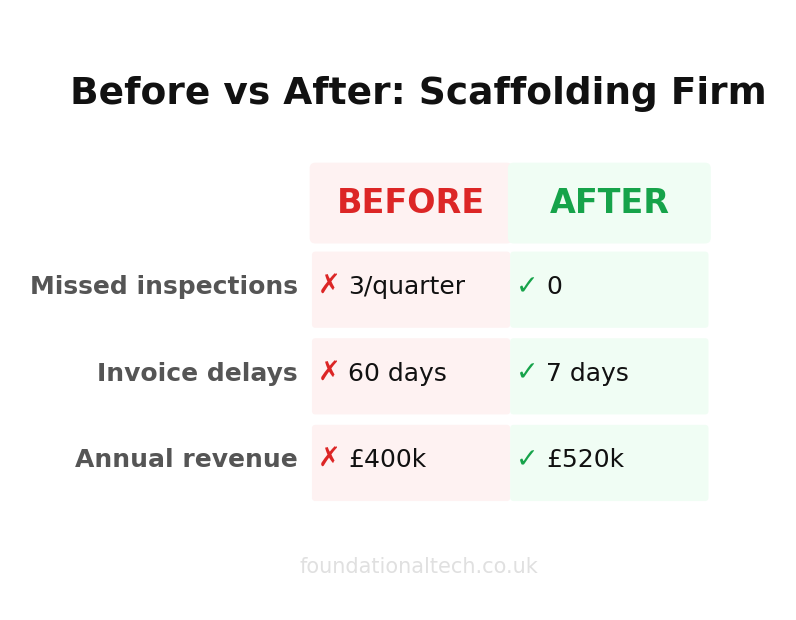
On a Tuesday morning last October, a principal contractor's safety adviser walked a residential block in Salford and asked to see the inspection records for three elevations Halliwell Access had erected. The most recent one on file was twelve days old. Nothing was wrong with the structure. It had been walked twice in that window by a carded scaffolder, who told Dean it was sound and then went to the next job without writing anything down. But an inspection that exists only in someone's memory does not exist. All three elevations were taken out of use, two trades were stood down, and Halliwell Access spent the following week off a framework it had been on for four years.
The company is eleven people in Bolton: three gangs, a yard manager called Marek, a contracts manager called Priya, Dean, and a bookkeeper who comes in on Thursdays. Turnover was a shade over £1.6m. It was, by every measure that appears on a set of accounts, a healthy scaffolding business.
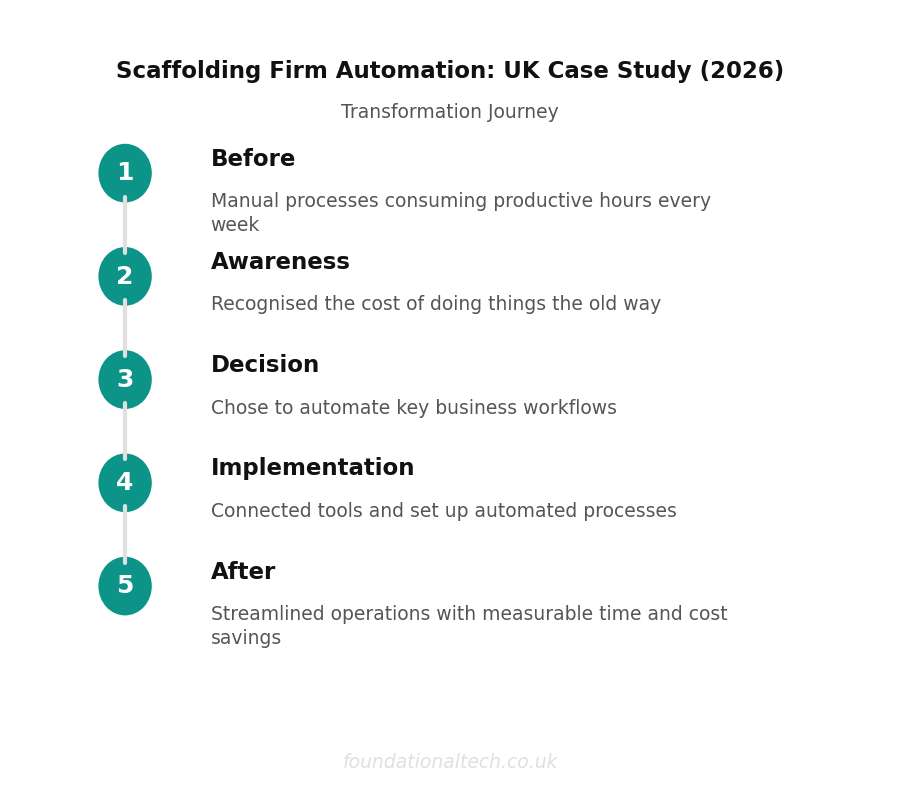
This is what the next ninety days looked like.
What the Suspension Actually Exposed
Dean's first instinct was that he needed a better inspection app. He was wrong, and it took a fortnight of looking properly to see why.
The firm had a scaffold register, and it was accurate — the kind of data that scaffolding management software is built to hold. It had a rate card. It had a decent bookkeeper. What it did not have was any mechanism by which a fact stored in one place became an instruction to a human somewhere else. The register knew that Elevation C had been handed over on 14 September. Nothing in the business turned that date into a diary entry.
The same architectural gap was quietly costing him money in the other direction. Priya sat down with a printed hire ledger and the Xero sales list side by side. Dean now describes that afternoon as the most expensive four hours of his year, in the good sense. Three things fell out of it.
Four repeating invoices had no end date. One of them had billed a main contractor for fourteen weeks on a scaffold that had been collected in June. That was a £2,900 credit note and a phone call Dean had to make himself.
Six structures were standing on sites with no written off-hire instruction and no rent being charged at all. Whoever set them up had raised a one-off invoice for the erect and never started the weekly. Between them they were owed £4,620 of hire.
And retention — around £31,400 across live and recently finished contracts — appeared nowhere on the balance sheet. Every time a QS certified less than Halliwell had applied for, the difference had been credited off. The money had not been written off in anyone's mind. It had been written off in the accounts.
Nothing on that list was a software failure. All of it was a wiring failure.
Weeks One to Four: Getting Both Clocks Into One System
The first month was unglamorous and almost entirely inside Xero.

Revenue codes were split four ways: erect labour, dismantle labour, ground rent, extra hire. Until that point everything had gone through one sales account, which meant Dean genuinely could not tell you what share of the previous quarter had been hire. The answer, once the codes had been running six weeks, was thirty-one per cent. That was a good deal higher than he would have guessed, and high enough to change how he priced two tenders in November.
Tracking categories went on next, tagged by job reference rather than by customer. Four saved invoice line items were built with their tax treatments pre-set. Erect labour under the reverse charge; erect labour zero-rated for new-build housing; hire standard-rated; and hire under the reverse charge where it forms part of a construction contract. Priya spent an hour with the accountant getting those right and has not thought about VAT coding since.
Then every repeating invoice was given an end date at the contracted hire period. All of them. It is a thirty-second job to extend one when a job overruns, and Dean has now extended dozens. He has not raised another credit note.
The Scaffold Software went from Basic to Pro in week three — £358 a month on the Early Access rate, plus the one-off £488 onboarding — mainly for hire tracking and the Xero push. One completed job was pushed across and the coding checked line by line before a second was allowed through.
Weeks Five to Eight: Making Xero the Doorbell
Month two was where the architecture from article five went in, and where Dean hit the constraint that shapes every scaffolding automation: below Enterprise, his operational software cannot tell anything that a job has happened. There is no webhook. There is no trigger.
So the triggers came from elsewhere. A repeating calendar event created at every handover. A dedicated off-hire email address printed on every handover certificate and every hire invoice. And Xero itself, which Make can watch properly.
Three scenarios went live, one a week, each run alongside the manual process for a fortnight before Priya was allowed to stop doing it by hand.
The inspection scenario checked each afternoon whether a record matching the job reference had been filed, escalating to Priya at 4pm and to Dean at 8am the next morning. The off-hire scenario turned an email into a dated instruction: a collection task, a pro-rated final hire invoice in draft, and an end date written onto the repeating schedule. The application scenario read every invoice with an "APP-" reference and diarised the payment notice deadline, the pay-less notice deadline and a chase to the QS five working days before certification.
GoCardless went on for domestic and hire-only clients — the ones paying a fixed weekly rent rather than paying against a valuation. At 1% plus 20p capped at £4, collecting £220 of weekly rent costs £2.40, against the twenty minutes Marek used to spend chasing it.
Dext went on for cross-hire. That produced the month's second uncomfortable number. Beams, stair towers and loading bays taken from other firms over the previous year came to £11,800, almost none of it attributed to a job. It had all been coded to plant hire and absorbed into overhead. When Priya went back and reattributed a quarter of it by hand, one category of work Dean had been treating as marginal turned out to be his second-best margin. He had been quoting it defensively for two years.
Weeks Nine to Twelve: The Yard Office Learns to Write
The AI went on last, deliberately, and it went on top of clean data rather than instead of it.
A Claude project was built in an afternoon, using the standing instruction from article eight. That instruction tells it the two clocks are separate, that hire runs until somebody writes to stop it, and that it never states a scaffold is compliant. Six documents went in. The rate card. The terms and conditions with the off-hire clause. Three RAMS already accepted by principal contractors. A monthly export of the hire ledger. Blank handover and inspection templates. And the licence conditions for Bolton, Salford and Manchester.
Three automations followed, in the order article nine recommends.
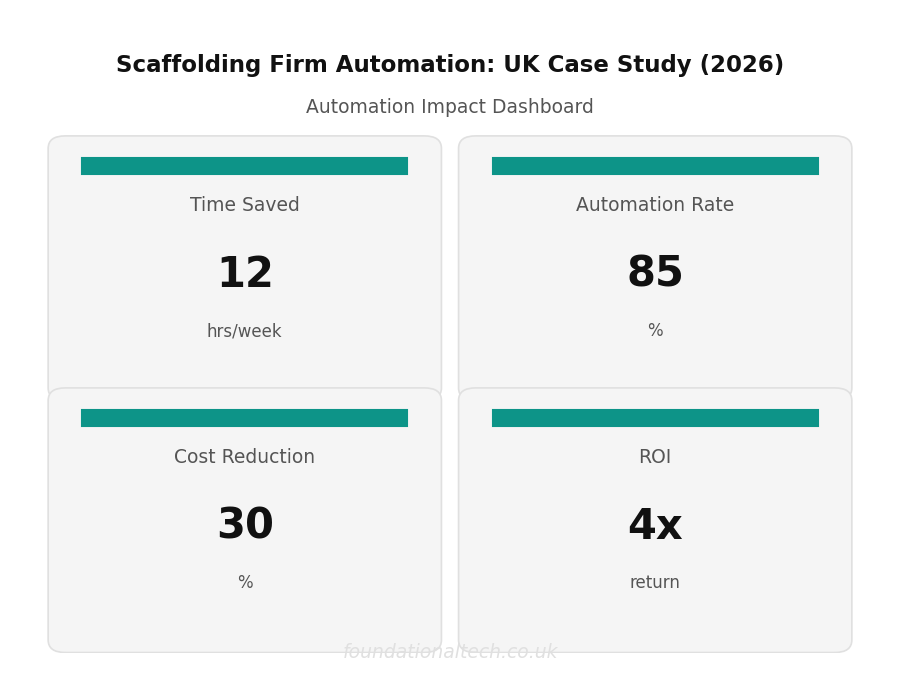
The inspection triage now runs daily. It pulls the days since each recorded inspection and the weather at each site postcode, and returns a ranked queue rather than an alphabetical list of everything overdue. Priya's Monday morning went from forty minutes of cross-referencing to reading eleven lines.
The cross-hire matcher reads new bills from a list of hire suppliers, compares the delivery address and hire dates against the live jobs, and suggests a job code with a confidence rating. High confidence writes itself. Low confidence becomes a task with the reasoning attached.
The Monday audit produces three lists: scaffolds standing with no written off-hire, repeating invoices with no end date, and jobs where the dismantle wages have gone through payroll while the hire is still charging. That third list is the one that matters most. That third list has been empty since week ten. Dean checks it anyway.
The Storm That Proved It
In February a low came through the North West with gusts recorded at 62 mph across the Manchester sites. Halliwell had twenty-two structures standing.
Before, that would have been a day of phone calls and a genuine risk that one or two got missed. Instead the triage ran at seven the next morning and produced a re-inspection queue in the order the structures actually needed walking. Sheeted elevations and anything above four lifts went to the top; a low domestic scaffold in a sheltered garden went to the bottom. All twenty-two were re-inspected and recorded inside thirty-six hours. Two principal contractors received an evidence pack the same afternoon, unprompted.
One of them has since put Halliwell on a second framework. Dean is fairly sure the two things are connected.
The Numbers, Ninety Days In
Cash actually recovered in the first quarter: £4,620 of unbilled hire, plus £9,700 of retention that came loose once someone could name the release date. Deduct the £2,900 credited back to the contractor who had been overbilled. Call it £11,420, against a stack costing roughly £1,550 across the same three months.
Dean is careful about the revenue figure. Turnover is up about eleven per cent annualised, but he did not win eleven per cent more work. He billed for weeks he was already standing, stopped writing off standing time nobody had confirmed in writing, and took on three more live structures because the office could carry them.
The Stack, Line by Line
About six thousand pounds a year. One suspended framework cost more than that in a week.
Stop doing scaffolding admin by hand
The Scaffolding Automation Starter Kit gives you a quote-to-invoice Excel workbook, a Make.com automation blueprint, and a step-by-step setup guide. Save 8–12 hours a week on paperwork.
What Dean Got Wrong First
He bought the software before he fixed the codes. The first six weeks of data pushed from The Scaffold Software into Xero all landed in one sales account, and it had to be recoded by hand. His advice, unprompted, is that the revenue split and the saved line items take an afternoon and should happen before anything is connected to anything.
He also built all three Make scenarios in one weekend, went live with all three on the Monday, and spent the following fortnight unable to tell which one was producing the odd result. Article five says to live with the first bridge for two weeks before building the second. He now understands why.
And he waited too long on the register export. The Claude project was useless for its first ten days because the ledger inside it was six weeks stale, and a confident answer built on an old rate card is worse than no answer. It is a monthly calendar reminder now, sitting on the same Thursday as the bookkeeper.
The thing he would not change is the order. Data first, pipes second, AI last. Bolt a language model onto a register nobody trusts and you get faster wrong answers.
£31,400/yr saved
by eliminating missed inspections, late invoices and compliance gaps
The Clock That Has Not Started Yet
One live piece Dean is watching is the Commercial Payments Bill, introduced to the Lords in May 2026. It would cap commercial payment terms at 60 days and make 8% above base rate an implied term on late payment. After a two-year transition, it would void retention clauses in construction contracts entirely. It is not law yet and is not expected to be in force before 2027.
For a firm with £31,400 in retention it is a large number attached to an uncertain date. Dean's position is simple. He would rather have it visible on a balance sheet while the rules change around it, than discover in 2028 that half of it was credited off years ago by someone being helpful.
Halliwell's biggest single recovery wasn't the retention — it was six scaffolds standing with no weekly rent ever started. If you ran your hire ledger against your Xero sales list this afternoon, how many structures would come back billing nothing? Reply with the number. I'll publish the spread.
Related guides: If you found this useful, see our guide on How Many CISRS Cards Are About to Expire? Back-Office Automation for UK Scaffolding Firms (2026) and Scaffolding Software UK: How Scaffold Contractors Are Automating Quotes, Weekly Hire and the 7-Day Inspection in 2026.
A & Y Financial Services builds these exact automation stacks for scaffolding businesses across the UK. If you've read the architecture and want someone to implement it — that's what we do.
Looking for compliance tools in other trades? See our guide to gas certificate software for Gas Safe engineers.