Key Takeaway
The full automation blueprint for UK electricians in 2026. Quoting, scheduling, invoicing, and compliance connected end to end with Xero and GoCardless.
The Problem Nobody Talks About
It is nine o'clock on a Thursday night. You finished the consumer unit swap in Croydon at five, drove an hour home, ate dinner standing up, and now you are at the kitchen table with a laptop and a shoebox of receipts. You still have to write up the EICR certification software from the morning, raise three invoices, copy the certificate into an email, and remember to chase the landlord in Sutton who has owed you £1,400 since May.
This is the part of the job no apprenticeship prepared you for. The wiring is the easy bit. The business is what keeps you up.
The numbers back up the feeling. UK tradespeople are chasing an average of more than £6,000 in late payments at any given moment, and the typical small business owner burns around 86 hours a year simply chasing money that is already owed to them. A self-employed electrician turning over £60,000 to £80,000 a year can lose 10 to 15 percent of their working time to admin, bad debt, and cash-flow firefighting. Construction has the worst late-payment record of any major sector in Britain, and electricians sit right in the middle of it.
Here is the uncomfortable truth: most of that lost time is not skilled work. It is copying the same address into four different places. It is typing a certificate number into an email. It is remembering who has not paid. A computer does all of that better than you do, and it never gets tired at nine o'clock on a Thursday.
This article is the map. It shows the complete stack of tools that lets a one-van electrician — or a five-van firm — run the office on autopilot, so the only thing you take home is the work you actually got paid for.
The Full Automation Stack
Think of your business as five jobs stacked on top of the electrical work: producing quotes and certificates, keeping the books, capturing expenses, managing the diary and the team, and answering the phone. Each one has a tool. The trick is making them talk to each other so you only ever enter a piece of information once.
Tradify — The Production Engine
Job management software is the spine of an electrical business. It holds your quotes, jobs, certificates, timesheets, and invoices in one place, on your phone, on site. Tradify is the most popular choice among UK sole traders and small teams, and for good reason: the quoting flow is fast, and its Xero connection is the cleanest in the category.
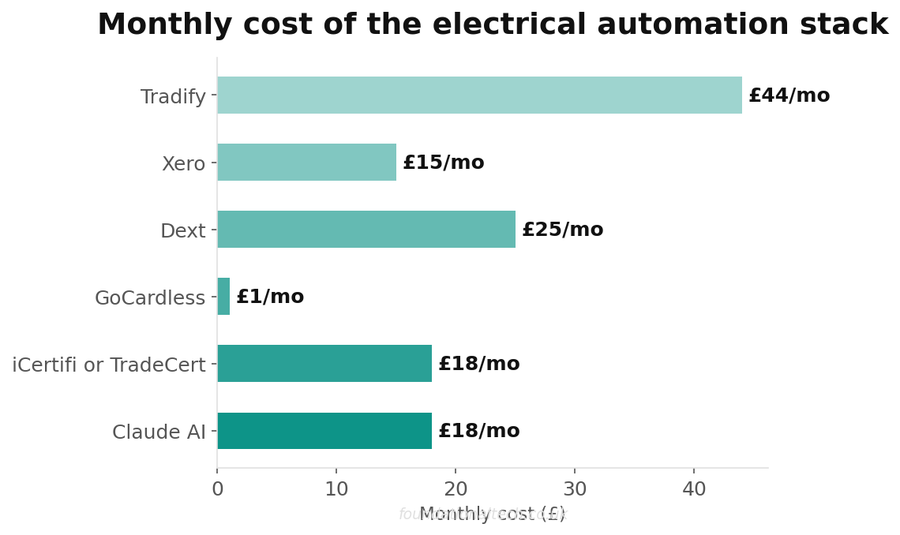
Pricing is per user. The Lite plan is £34 per user per month; the Plus plan, which adds digital forms and certificates, is £44 per user per month. There is a 14-day free trial with no card required.
The point of the production engine is that the job only gets entered once. You quote on your phone from the customer's drive. The quote becomes a job. The job becomes an invoice. The hours you log become a timesheet. Nothing is retyped, and nothing is forgotten in a notebook in the van.
For a fully UK-native alternative, Powered Now is worth a serious look. It starts at around £15 a month for solo traders, works offline, handles CIS Domestic Reverse Charge VAT automatically, and ships with ready-made BS 7671 certificate templates — EIC, EICR, Minor Works, PAT testing, fire alarm and emergency lighting sign-offs — built in. For a busier firm with fleets and planned maintenance contracts, Commusoft scales up from around £59 a month with asset tracking and PPM scheduling. We compare all three properly in the next article.
Xero — The Financial Backbone
Your job software runs the work. Your accounting software runs the money. Xero is the standard for UK trades, and it is what your accountant almost certainly already uses.
The Starter plan is around £15 a month, Standard around £30 a month, both excluding VAT. Xero often runs heavy introductory discounts for the first few months. Crucially, it is compatible with Making Tax Digital: above the VAT threshold, Xero calculates your VAT return and files it digitally with HMRC, which removes both the spreadsheet and the missed-deadline penalty. (Xero renamed its plans in late 2024, so the exact tiers you see on the pricing page may carry different names — check the features, not just the label.)
The magic happens at the join. When Tradify and Xero are connected, an invoice you raise on site appears in your accounts automatically. Your bank feed pulls in the payment when it lands. Reconciliation — once an evening's work with a highlighter — becomes a thirty-second tap-to-match on the sofa.
Dext — Plugging the Cash Leaks
Every electrician leaks money through lost receipts. The reel of cable from the wholesaler, the diesel, the parking, the new SDS drill — if the receipt does not make it into the books, you pay tax on money you actually spent. Over a year that is hundreds of pounds handed to HMRC for no reason.
Dext (formerly Receipt Bank) fixes this with your phone camera. You photograph the receipt at the counter, Dext reads the supplier, date, net, VAT, and total, and pushes it straight into Xero. The paper can go in the bin. Pricing sits at roughly £25 a month depending on volume. It is the single highest-return tool on this list for most one-van operators, because it turns a shoebox into a tax deduction with no typing.
The Workforce Layer — Scheduling and Time
The moment you put a second person in a second van, you have a rota and a timesheet problem. Who is where, for how long, and what do they get paid? Tradify and Powered Now both handle basic scheduling and timesheets in-app, which is enough for most small teams. If you grow past a handful of staff and need proper rota management, holiday tracking, and award-aware timesheets, a dedicated tool such as Deputy (from £3.50 per user per month) slots in and feeds approved hours toward payroll. The principle is unchanged: hours are captured once, on site, and flow forward without re-entry.
The Front Door — Intake and Certificates
For electricians, the front door has two halves: getting the enquiry in, and getting the certificate out.
On enquiries, the job software captures the lead and turns it into a quote, so nothing sits unanswered in a voicemail. On certificates — the part unique to your trade — you have a choice. Tradify Plus and Powered Now include certificate templates. If you want a dedicated, scheme-agnostic certification app, iCertifi covers BS 7671 EICRs, EICs, Minor Works, PAT, fire alarm and emergency lighting, works whether you are registered with NICEIC, NAPIT, ELECSA or SELECT, and costs around £20 to £40 a month (roughly £65 on its annual plan). TradeCert offers unlimited certificates from around £18 a month. A certificate produced in any of these can be emailed to the client the moment you leave site, while you are still in the van.
| Tool | Purpose | Monthly Cost |
|---|---|---|
| Tradify | Job management and certificates | £44/mo |
| Xero | Accounting and CIS compliance | £15/mo |
| Dext | Receipt capture and expenses | £24/mo |
| GoCardless | Direct Debit payment collection | 1% + 20p/txn |
| iCertifi or TradeCert | BS 7671 electrical certificates | ~£18/mo |
| Claude AI | Quote drafting and client emails | From £18/mo |
| Total monthly cost | ~£110/mo | |
How It All Connects
The stack is only worth the money if the tools talk to each other. Here is the data flow for a typical job:
The enquiry lands and becomes a quote in Tradify. The customer approves it; the quote becomes a job. You do the work, log your hours, and raise the invoice on your phone before you have packed the ladders away. That invoice flows natively into Xero, where your bank feed matches the payment when it arrives. The EICR you completed is generated in your certificate app and emailed to the client on the spot. The receipt for the cable you bought that morning is photographed into Dext and lands in Xero as a tagged expense. At month end, your VAT return is sitting ready in Xero for one-tap submission to HMRC under Making Tax Digital.
Most of these connections are native — Tradify to Xero, Dext to Xero, bank feed to Xero — so they need setting up once and then run themselves. Where two tools do not connect directly, a low-cost automation bridge such as Zapier or Make (free to start, a few pounds a month for real use) can pass data between them: a new Tradify job creating a folder, say, or a paid invoice triggering a thank-you text.
To collect the money faster, plug in GoCardless for Direct Debit on maintenance and landlord clients. It charges 1% plus 20p per transaction, capped at £4, with no monthly fee — so a £1,400 invoice costs you £4 to collect, and it collects itself on the due date instead of after three phone calls.
What This Means in Practice
Picture two versions of the same week.
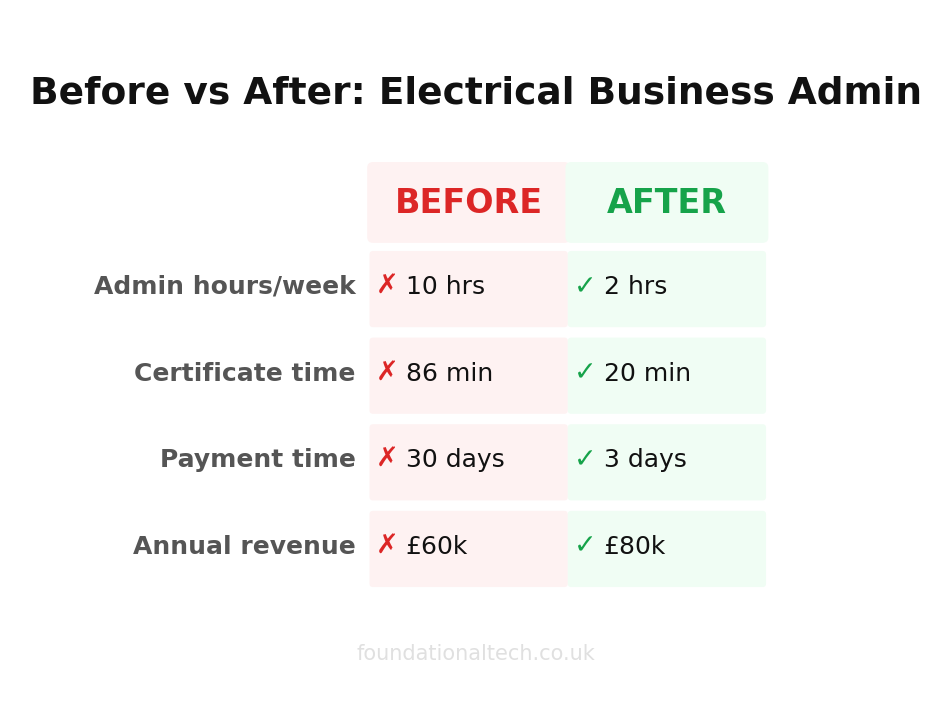
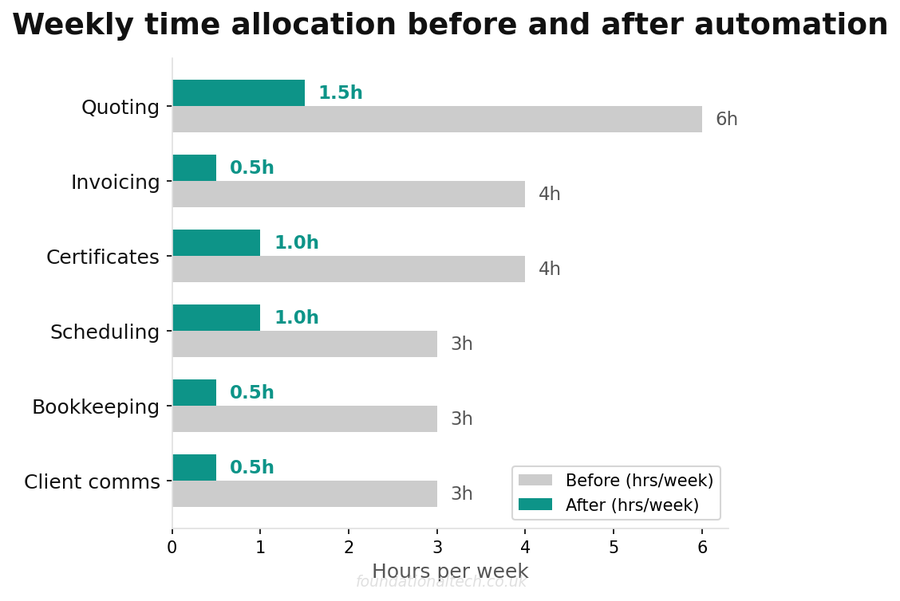
The old week: you quote on paper, write certificates at night, raise invoices at the weekend, post them, wait, chase, and reconcile by hand at month end. You lose an evening a week to admin and you carry £6,000 of other people's money on your books, unpaid.
The automated week: you quote on site in four minutes, the certificate emails itself before you leave, the invoice is in Xero before you start the engine, Direct Debit collects it on the due date, and your VAT return assembles itself. The evening at the kitchen table disappears. The £6,000 of late payments shrinks because the chasing is automatic and the collection is built in.
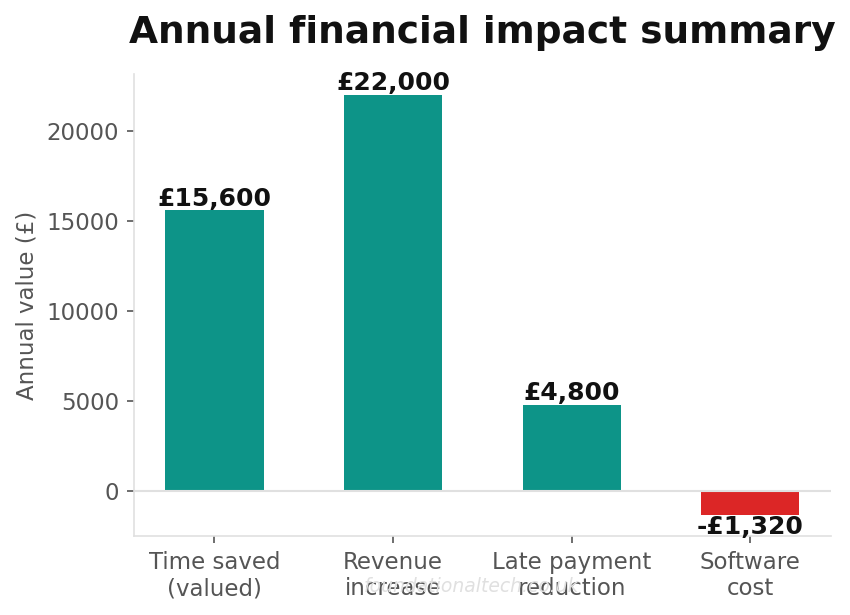
The maths is straightforward. The full stack — job software, Xero, Dext, a certificate app — costs somewhere around £80 to £110 a month for a sole trader. If it saves you four hours a week and your time is worth £40 an hour on the tools, that is £640 of recovered time a month against roughly £100 of software. You are not buying convenience. You are buying back the most profitable evenings of your week and pulling your cash in faster.
£640/month in recovered time
saving 4 hours/week at £40/hr against ~£100/month in software costs
What Comes Next in This Series
This is the overview. The next nine articles take each layer apart and show you exactly how to build it.
Tradify vs Powered Now vs Commusoft: Which Job Management Tool Fits Your Electrical Business? — choosing the production engine without a painful migration later.
How UK Electricians Get Paid Faster: Direct Debit, Instant Invoicing and the End of Chasing — the cash-flow layer in detail.
The Electrician's Back Office: Receipts, VAT and Making Tax Digital on Autopilot — Dext, Xero and HMRC without the shoebox.
The Electrician's Integration Map: Every Tool, Every Connection, One Diagram — the full wiring diagram for your software.
AI for Electricians: What It Can Actually Do for Your Business in 2026 — the honest pillar on artificial intelligence.
The Electrician's AI Prompt Playbook: Quotes, Emails and Reports in Seconds — copy-paste prompts that work.
Hiring an AI Office Assistant: Automating the Admin You Hate — the AI worker layer.
No-Code AI Automations Every Electrician Should Steal — three workflows you can build this weekend.
From Drowning in Admin to Booked Solid: A UK Electrician's Automation Story — the case study that ties it together.
Build it one layer at a time. Start with the production engine, connect Xero, add Dext, and you will feel the difference inside a fortnight.
What's the one manual process in your electrical business that steals the most hours every week — the certificates, the chasing, or the books? Hit reply and tell me which one, and I'll point you to the exact fix in this series.