Key Takeaway
A UK heat pump installer blamed Ofgem for his cash flow problems. The real issue was a 90-day payment gap — here is the automated system that closed it.
Dave rang me on a Tuesday evening, and he didn't say hello. He said, "They're holding thirty-one grand of mine and I don't know why."
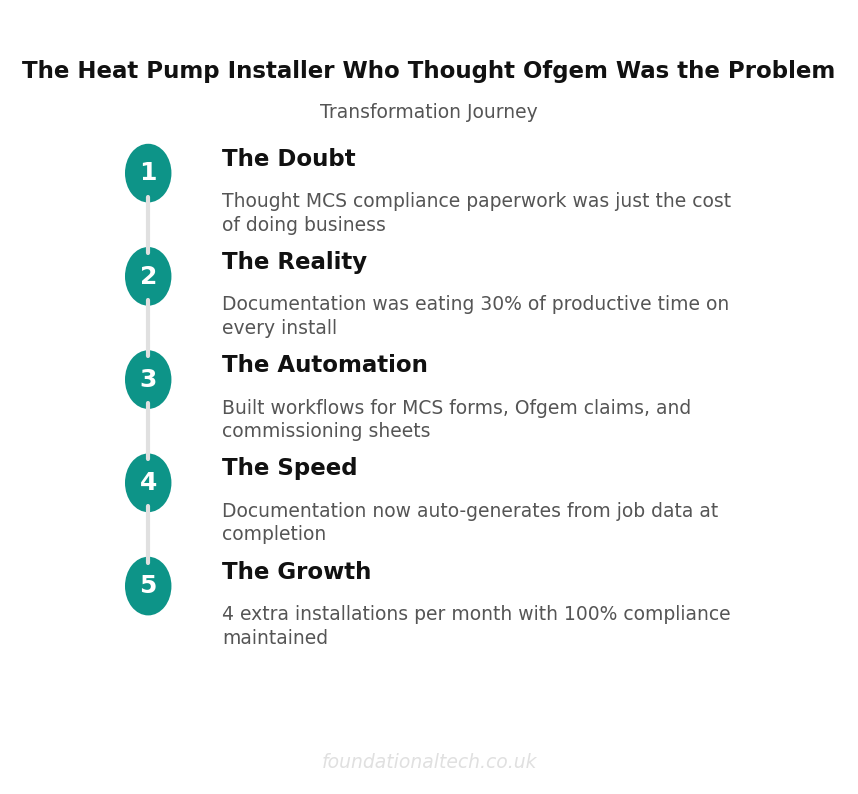
He runs a three-man heat pump business near Wrexham. MCS certified, decent reputation, busy diary. He'd looked at his bank balance that afternoon, then looked at how many Boiler Upgrade Scheme jobs he'd done that quarter, and done some rough maths in his head that scared him. Four installs a month, give or take. Each one carrying a BUS grant of £7,500 — sometimes £9,000 for the off-gas-grid properties where there's no mains alternative. He was convinced Ofgem was sitting on his money out of spite, or incompetence, or both.
It wasn't spite. It wasn't even really Ofgem.
What was actually going on
I asked him one question: "When you finish a job, when does the redemption claim go in?"
Long pause. "End of the month, usually. Sometimes I do a batch."
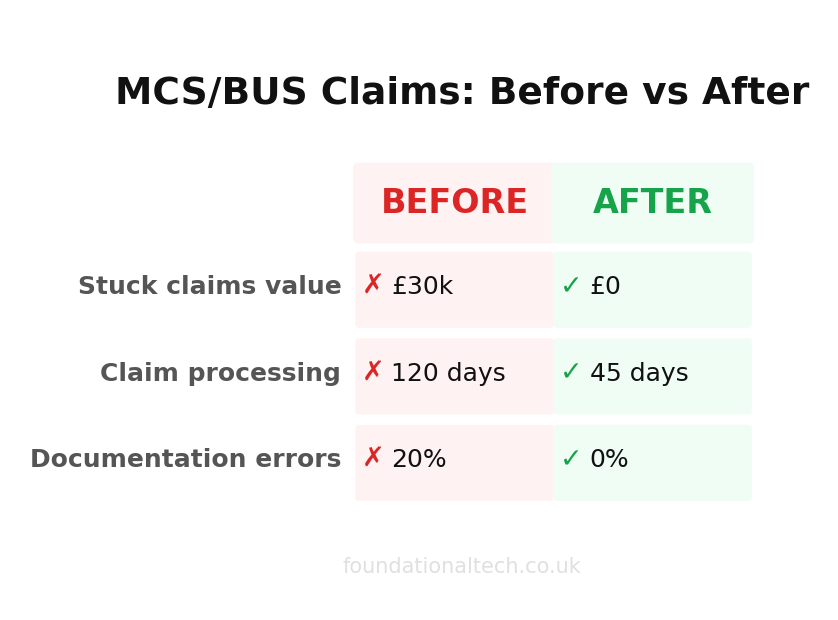
There it was. Every BUS heat pump he commissions, he's fronting the grant out of his own cash the second he signs off the install. The homeowner never sees that £7,500 — it goes from Ofgem to the installer, not to the customer — but it only moves once the paperwork chain closes: commissioning record completed, MCS certificate uploaded to the portal, BUS redemption claim submitted, then Ofgem's processing run. He has 120 days to submit that claim. He was treating that window like a generous deadline instead of what it actually is, which is a countdown on his own overdraft.
I asked him to pull up his last three months of completions. He had them in a notebook — not even a spreadsheet, a physical notebook with dates and addresses and tick marks. We counted. Twelve installs in the previous quarter. All twelve claims submitted in three batches, one at the end of each month. Some of those jobs had been finished in the first week of the month, which meant the grant money sat unclaimed for three, sometimes four weeks before he even started the paperwork. Then Ofgem's processing takes another two weeks on a good run, sometimes three.
So the maths looked like this: four installs a month at £7,500 each is £30,000 in grant money. Batching monthly meant the average claim sat for about 45 days from commissioning to cash arriving. At any given moment, he had roughly six to eight weeks' worth of grants floating somewhere between his completed-jobs notebook and Ofgem's bank account. That was his £31,000. It wasn't lost. It wasn't stolen. It was just moving slowly because nobody had ever told him it didn't have to.
The commissioning-day sequence
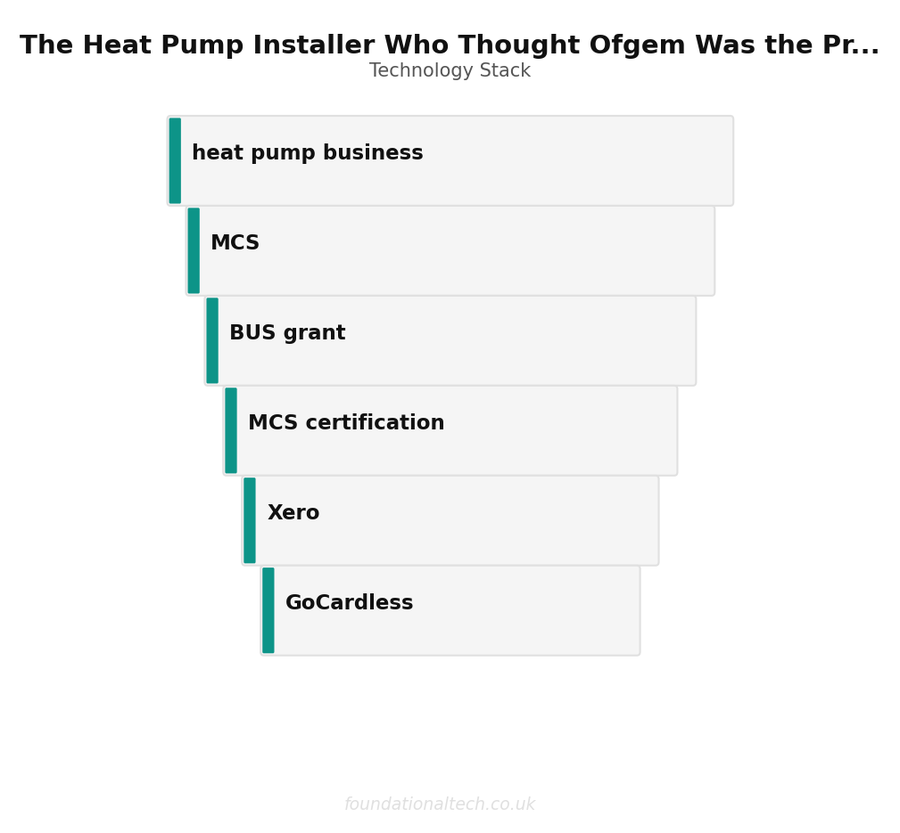
We built what I now call the commissioning-day sequence. It's not complicated, but it has to happen in order, and it has to happen on the day the install is signed off. Not the day after. Not Friday afternoon. The day.
- Complete the commissioning record. Every field, every reading, every photograph. Dave's engineers were already doing this on site — they just weren't uploading it until they got back to the office, which sometimes meant the next morning.
- Upload the MCS certificate. This is the one that trips people up. The MCS portal needs the commissioning data before it will generate the certificate, and the certificate has to exist before you can submit the BUS claim. Dave's team were completing the commissioning sheet on paper, then re-entering it digitally later. We moved that to a tablet on site — same data, entered once, uploaded immediately.
- Submit the BUS redemption claim. Same afternoon. Not batched. Not "when I get round to it." The claim goes in the day the certificate is live.
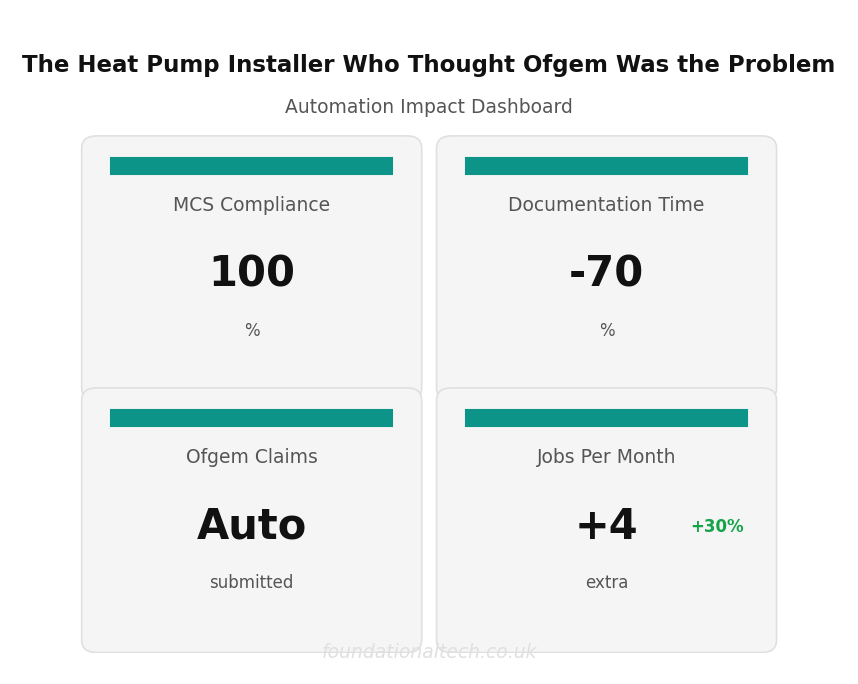
Moving from monthly batching to same-day submission cut his average float from roughly 45 days to about 14. That's the difference between £30,000 permanently out of his account and £14,000. He didn't earn a penny more. He just stopped lending money to the government for free.
The VAT position nobody had explained
While we were in the numbers, I asked about his VAT returns. He was on standard quarterly returns. Had been since he registered.
Here's the thing about heat pump installations that a lot of installers either don't know or know vaguely but haven't acted on: under the Energy Technology Criteria, domestic heat pump installations are zero-rated for VAT. Dave wasn't charging VAT on his installs — he'd got that bit right. But zero-rated is not the same as exempt. Zero-rated means you're still in the VAT system. You're still filing returns. And critically, you can still reclaim all your input VAT — the VAT on the heat pump units themselves, the copper pipe, the refrigerant, the van diesel, the tools, the MCS certification fees.
Dave's MCS membership alone costs him somewhere between £500 and £800 a year, depending on the inspection cycle, plus the annual surveillance visit. All of that carries VAT. His supply chain — heat pumps, cylinders, controls, ancillaries — all standard-rated at 20%. He was reclaiming all of it, but only every three months.
I asked him to switch to monthly VAT returns. You can do this voluntarily — you just write to HMRC or do it through your Government Gateway account. It's not complicated. It doesn't trigger an investigation. It just means that instead of waiting up to four months to get your input VAT back (three months of the quarter plus HMRC's processing time), you're getting it back every five to six weeks.
For a business spending £15,000–£20,000 a month on stock and materials, that's £3,000–£4,000 in input VAT that comes home roughly two months sooner. Not transformative on its own, but stacked on top of the BUS timing fix, it added up to something Dave could feel in his bank balance rather than just see on a spreadsheet.
He looked at me at this point and said, "Why didn't my accountant tell me this?" I didn't have a good answer for that. I still don't.
The dashboard that changed his Friday mornings
Dave was already on Xero. The Standard plan, £33 a month. He used it for invoices and not much else. His bookkeeper reconciled the bank feed once a month and sent him a profit-and-loss that he glanced at and filed.
We set up two tracking categories. Not accounts — tracking categories. The distinction matters because it lets you tag transactions without restructuring your entire chart of accounts.
The first category: Money with Ofgem. Every time an install is commissioned and the BUS claim submitted, a manual journal tags that £7,500 (or £9,000) as sitting with Ofgem. When the payment arrives, the tag clears. At any moment, filtering by that category shows exactly how much grant money is outstanding, how old each claim is, and whether anything is drifting past the three-week mark where you'd want to chase.
The second category: Money with HMRC. Same principle. Input VAT paid on purchases gets tagged. When the refund lands, the tag clears. Simple visibility on how much of Dave's cash is currently lent to the taxman.
I showed him how to pin those two filtered views to a custom dashboard — Xero calls them "short cuts" in the sidebar. He now opens Xero on Friday mornings, looks at two numbers, and knows. That's it. No forensic accounting. No anxiety spiral. Just: here's what's out, here's how long it's been out, here's when it should come back.
We also set up GoCardless for the customer-side payments — the portion of the install cost that isn't covered by the grant. Most of Dave's jobs are £10,000–£14,000 total, so the customer owes £2,500–£6,500 depending on the grant amount. He'd been chasing those on email. GoCardless connects directly to Xero, sends payment requests automatically when the invoice is raised, and collects via Direct Debit. No chasing. The money moves on the agreed date or he gets a notification that it hasn't. He pays about 1% plus 20p per transaction, which he considers a bargain compared to the hours he was spending on follow-up emails.
His bookkeeper now uses Dext — £24 a month for the sole trader plan — to photograph receipts on her phone and auto-match them to Xero. It means the bank feed reconciliation that used to wait until month-end happens in real time, which feeds the tracking categories, which means the Friday dashboard is always current. The whole stack — Xero Standard at £33, Dext at £24, GoCardless at roughly £40–£50 a month in transaction fees — costs less than a single morning of Dave's time spent chasing numbers he couldn't find.
The bit I recognised in him
I sat with that phone call longer than the maths deserved, because I'd had my own version of it.
Back when I was still doing this full-time as an accountant and building A&Y on evenings and weekends, there was a stretch — fourteen, fifteen months ago now — where I genuinely believed the hard part of my job was the technical knowledge. VAT thresholds, capital allowances, the Energy Technology Criteria list, the stuff you spend years learning and keep a shelf of HMRC guidance notes to stay current on. I thought that knowledge was the asset.
Then I started building AI systems that could produce a competent VAT explanation in four seconds, and I had to sit with an uncomfortable question: if the knowledge itself isn't the scarce thing anymore, what was I actually being paid for?
The honest answer took me longer to accept than I'd like to admit. It was never the knowledge. It was noticing where a client's money was stuck and caring enough to go and look. Dave didn't need someone who could recite the BUS grant rules back to him — he could Google those. He didn't need someone to explain zero-rating versus exemption in the abstract. He needed someone to ask "when does the claim actually go in?" and then sit there, in the silence after the question, until the answer stopped being vague.
That's the part that doesn't automate. And it's the part I nearly missed, because I was so busy being scared of the part that did.
I think about this distinction a lot now. Knowledge versus insight. Knowing that heat pump installs are zero-rated is knowledge — it lives in VAT Notice 708 and anyone with a browser can find it. Noticing that your client is on quarterly returns when monthly would free up £8,000 a year in float is insight. It requires you to know the person, know their numbers, and care enough to connect the two. One of those is a commodity. The other is the whole job.
£30,000 in stuck claims
from an installer who blamed Ofgem when the real problem was documentation
What this means if you're not a heat pump installer
Every trade I work with has some version of Dave's £31,000. A roofer's is weather delaying an invoice. A decorator's is a client who "loved it" and then went quiet on the balance. An electrician's is retention money on a commercial job that's been "nearly signed off" for six weeks. The specifics change. The shape doesn't: there's money sitting somewhere you haven't looked, and it's been there long enough that you've started to think of it as normal.
For renewables installers specifically, this year, the shape is sharper than most. You've got grant money with Ofgem, input VAT with HMRC, customer balances sitting in email threads instead of Direct Debit mandates, and MCS certification costs that nobody remembers to reclaim until the annual accounts. That's money parked with four different parties, moving on four different timescales, and most of the installers I talk to are tracking it in their heads or not at all.
The system that fixed it for Dave wasn't expensive. The total monthly software cost was under £100. It wasn't even new software, mostly — he already had Xero. It was moving three things from "eventually" to "same day": the redemption claim, the VAT return frequency, and the moment he actually looked at the numbers instead of guessing at them. The tools do the retyping. You still have to be the one who decides not to wait.
Dave still doesn't love admin. He told me that outright, more than once. But he checks his two-number dashboard every Friday morning now instead of once a quarter in a mild panic, and that's the whole difference between fearing your own numbers and just knowing them.
Is there a number in your business right now that you're avoiding looking at — money owed, a claim you haven't chased, a return you've been putting off? What would it take for you to actually check this week?