Key Takeaway
12 AI prompts for UK heat pump & solar installers in 2026. Copy-paste ChatGPT and Claude templates for quotes, BUS applications, DNO forms. UK-specific.
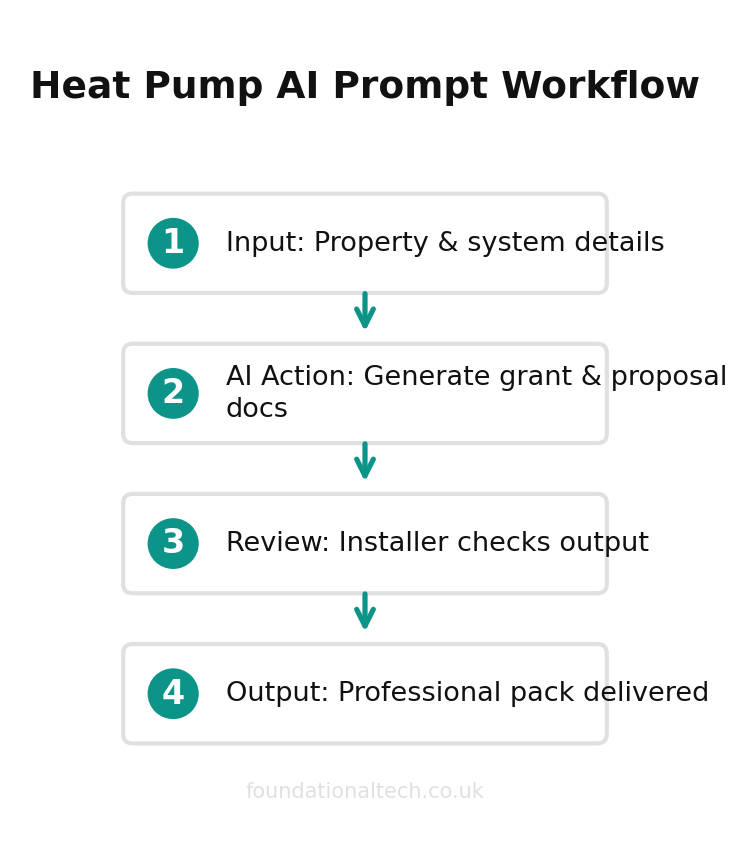
A heat loss calculation takes Heatpunk about ninety seconds. Explaining what that number means to a customer standing in their kitchen is one thing. Working out which BUS band applies to their off-gas-grid oil boiler, and drafting the DNO paperwork behind it, is the two hours nobody quotes for. Article six named five places AI earns its keep in this trade: the grant explainer, the heat-loss second opinion, the DNO draft, the scepticism script, the audit self-check. Here are the actual prompts, written for this trade, ready to paste.
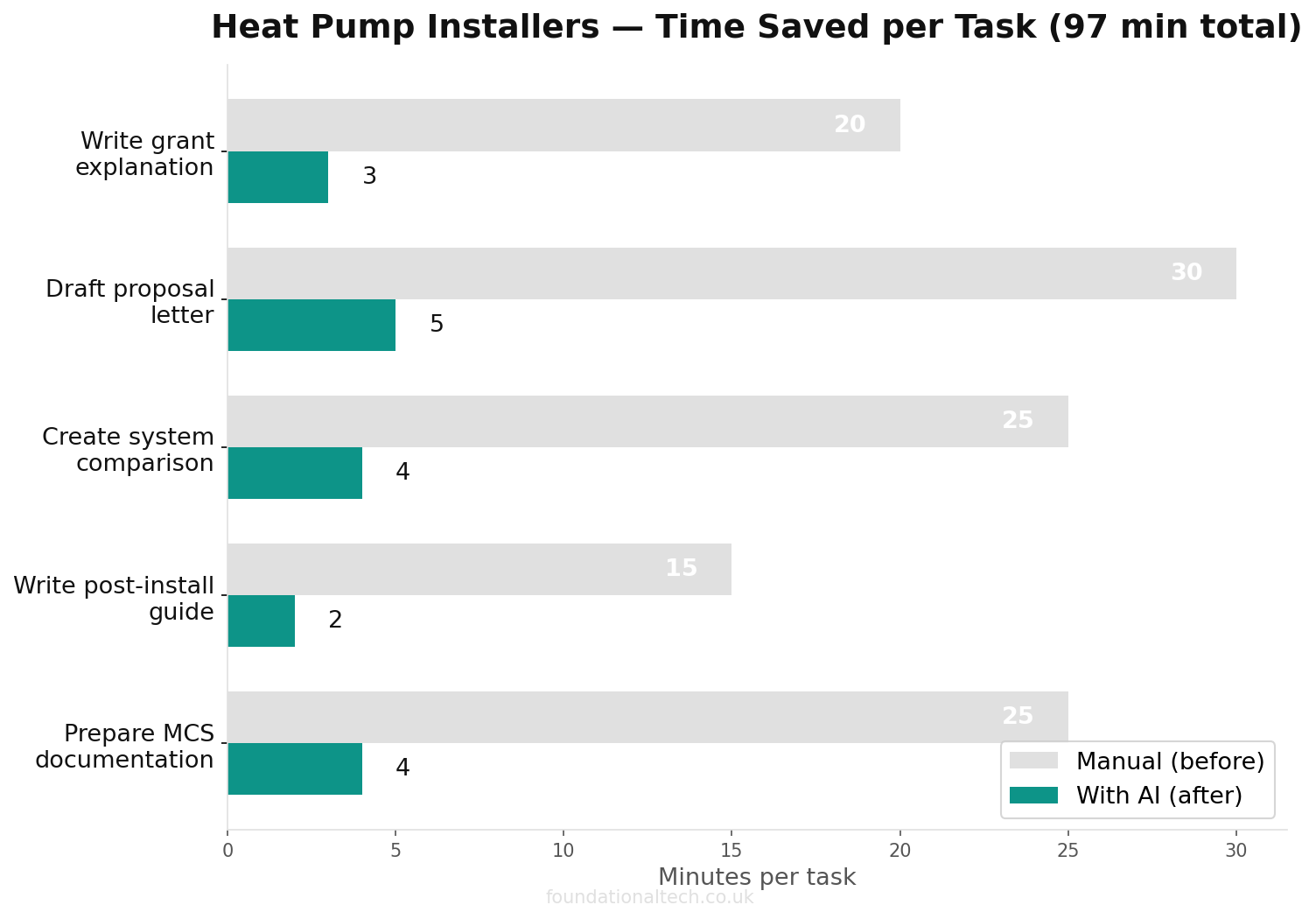
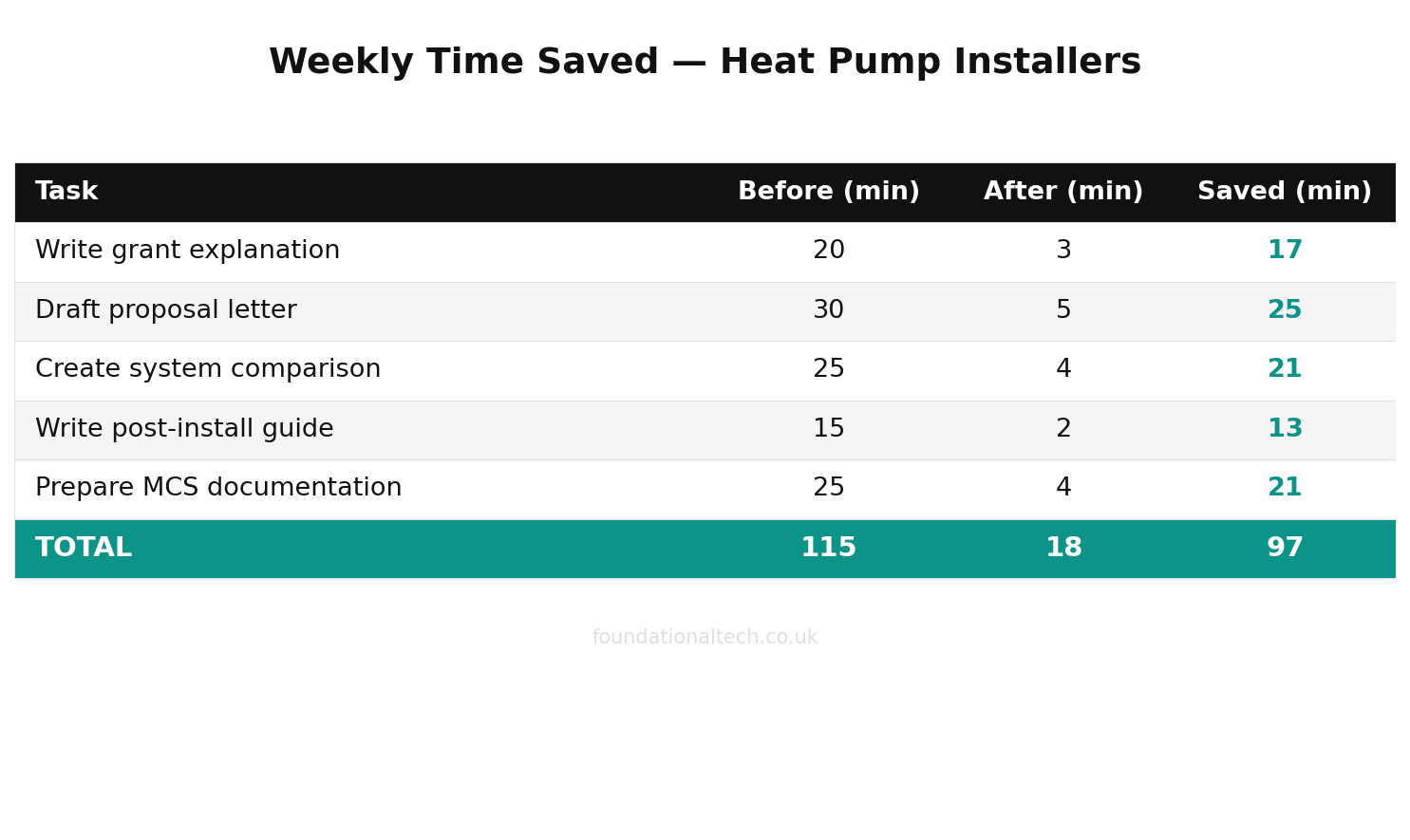
45 min → 4 sec
Average time to draft a professional heat pump installer document — manual vs AI-assisted
Generic prompts fail installers for a specific reason: they don't know what MIS 3005-D is, and they don't know a G98 from a G99. Left unchecked, they'll cheerfully invent a BUS figure rather than admit they don't have the real one. Every prompt below is built with the constraint, the terminology and the compliance boundary already loaded in. That's the difference between a draft you can use in ten minutes and one you have to rewrite from scratch.
A note on how to use these: paste the prompt exactly as written, then fill in the bracketed detail from the actual job in front of you. The output is a first draft, not a final answer — read it against what you know about the property before it reaches a customer, especially anything touching a number. These prompts assume you're using Claude or ChatGPT directly rather than a connected assistant. Article eight covers building a persistent version that already knows your business facts, so you're not re-explaining your BUS bands and deposit terms every single time.
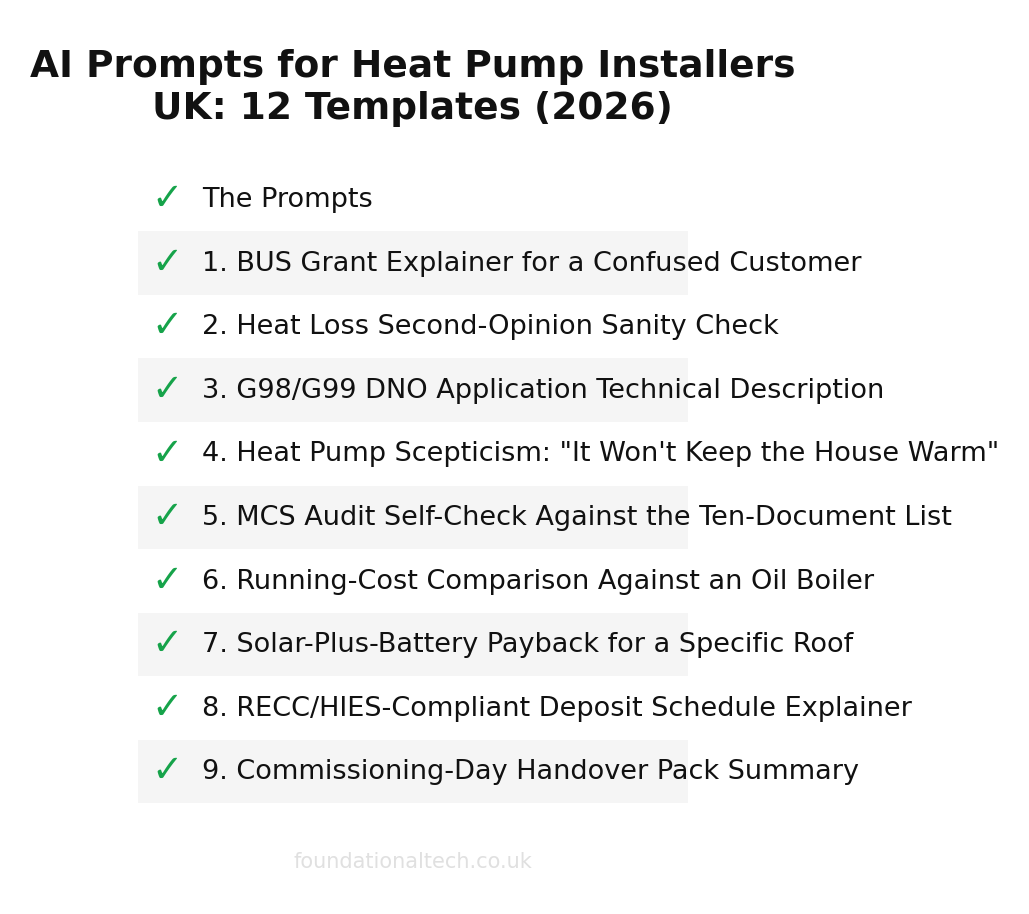
The Prompts
1. BUS Grant Explainer for a Confused Customer
I'm a heat pump installer talking to a customer about the Boiler Upgrade
Scheme. Their situation: [property type, current heating fuel - mains gas/
oil/LPG/electric, install date, whether they're off the gas grid].

Write a plain-English, one-paragraph explanation of:
1. Which BUS band applies to them and why (standard £7,500, which also
   covers direct electric replacement, or the £9,000 off-gas-grid
   uplift for oil or LPG properties only, available for installs from
   21 July 2026)
2. Why the price includes 0% VAT (until 31 March 2027)
3. That the grant is paid to me as the installer and passed on as a
   discount - they never claim it themselves
4. What could delay the redemption (commissioning date vs install date,
   the 120-day window, Ofgem's 2-4 week processing)

No jargon, no hedging language, no "T&Cs apply" vagueness. Write it as
something I could read aloud or hand over as a one-page leave-behind.
When to use: Straight after the survey, before the written quote lands, while the confusion is still fresh. Time saved: 20-25 minutes versus writing it fresh, and it's more accurate than the version you'd improvise standing in the hallway.
2. Heat Loss Second-Opinion Sanity Check
I've run a heat loss calculation in Heatpunk [or Heat Engineer] and got
[X]kW for this property: [age, construction type, wall type, glazing %,
loft insulation depth if known, floor area].

Does this figure look plausible for a property like this? If not, which
input is most likely wrong, and what should I go back and check on site
or in the photos before I commit this number to a design? Show your
reasoning, not just a verdict.
When to use: Before you order kit, especially on older or unusual properties where an input guess (loft depth, glazing ratio) could be badly wrong. Time saved: Doesn't replace the MCS-recognised tool — catches the input error that would otherwise surface as an undersized system three months after handover.
3. G98/G99 DNO Application Technical Description
Draft the technical description section for a [G98/G99] application to
[DNO name]'s network, based on this design: inverter model [make/model],
rated output [X]kW, export limitation setting [on/off, value], number of
phases, and property address type [domestic/commercial].

Write it in the register-required format a DNO reviewer expects - formal,
precise, no marketing language - so I can copy it directly into their
portal form.
When to use: As soon as the design is finalised, before the DNO portal window opens. Time saved: Turns a 20-minute writing job into a 2-minute copy-paste. You still submit through the DNO's own portal - this only drafts the wording.
4. Heat Pump Scepticism: "It Won't Keep the House Warm"
A customer is worried a heat pump won't heat their house properly in
cold weather. Their design: flow temperature [X]°C, property [type/age],
current heating [system being replaced].

Write a short, confident, technically grounded answer using the actual
flow temperature and the physics of how the system is sized for the
coldest design day, not a generic reassurance. Assume they've heard a
horror story from a neighbour and are testing whether I actually know
what I'm talking about.
When to use: Second viewing, after the first "I need to think about it." Time saved: Replaces the improvised answer under pressure with one grounded in their actual numbers.
5. MCS Audit Self-Check Against the Ten-Document List
Here's what's currently filed against job [reference]: [list what you
have - heat loss calc, MCS 020 assessment, DNO paperwork, signed quote,
contract with deposit insurance reference, commissioning record, MCS
certificate, BUS evidence, warranty registrations, handover pack].

Compare this against the standard MCS ten-document requirement and flag,
in plain terms, exactly what's missing or looks incomplete - not what's
present. I want a punch list I can action before an assessor would ever
see this file.
When to use: Weekly, on jobs from the last fortnight - not just before a scheduled audit. Time saved: Turns a surveillance-visit finding into a five-minute fix while the job's still fresh in your memory.
6. Running-Cost Comparison Against an Oil Boiler
Customer currently on oil, using roughly [X] litres/year at [local price
per litre]. Proposed heat pump: SCOP [X], estimated annual electricity
use [X]kWh at [X]p/kWh (or their actual tariff if known).

Write a side-by-side running-cost comparison in plain figures - annual
oil spend vs annual electricity spend - and one honest sentence on where
the estimate could be wrong (tariff assumptions, usage pattern, weather).
Don't oversell the saving; if it's marginal, say so.
When to use: Whenever "will it actually be cheaper" is the sticking point - usually oil and LPG conversions rather than gas.
7. Solar-Plus-Battery Payback for a Specific Roof
Roof details: orientation [e.g. south-east], pitch [X]°, usable area
[X]m², shading notes [any obstructions], proposed system size [X]kWp
plus [X]kWh battery.

Draft a plain-English payback explanation covering estimated annual
generation for this specific orientation and pitch (not a generic
"south-facing" assumption), likely export income under the current
Smart Export Guarantee rate, and a realistic payback range with the
caveat that generation varies year to year.
When to use: After the site survey, tailored to the actual roof rather than a brochure figure.
8. RECC/HIES-Compliant Deposit Schedule Explainer
Draft a short explanation for a customer of our payment schedule:
deposit of [X]% (within the RECC/HIES 25% insured deposit cap), stage
payment of [X]% at [milestone], balance on commissioning.

Explain plainly why the deposit is capped and insured, what "insured"
means in practice if the business ceased trading, and why staged
payments protect them as much as they protect us.
When to use: With every quote over a certain value - reassurance rather than just a payment term buried in the contract.
9. Commissioning-Day Handover Pack Summary
Job just commissioned: [system type], MCS certificate number [X], BUS
redemption reference [X if available], warranty terms [manufacturer,
length].

Write a one-page handover summary for the customer covering what's been
installed, what the warranty covers and for how long, what they need to
do to keep it valid (annual service), and who to contact for a fault vs
a general question. Plain English, no technical padding.
When to use: Same afternoon as commissioning, while the BUS clock is running and the file needs to move fast.
10. Annual Service and Warranty Reminder Draft
Draft a friendly, non-salesy reminder email to a customer whose system
was commissioned on [date], due its annual service around [date], with
warranty registration [manufacturer] requiring an annual check to stay
valid.

Keep it short. Make clear the service protects their warranty, not just
performance, and give one line on how to book it.
When to use: Batch-run monthly against your install log rather than drafted one at a time.
11. F-Gas/REFCOM Compliance Note for a Split System
This install uses a split system requiring F-Gas handling under REFCOM.
Draft an internal compliance note confirming the engineer on site holds
current F-Gas certification, the refrigerant type and charge amount, and
that no work on the refrigerant circuit was performed by anyone without
that certification.

This is an internal record, not customer-facing - keep it factual and
short.
When to use: Every split-system job, filed alongside the MCS certificate - monobloc systems don't need this one.
12. Objection Handler: "My Neighbour Says It's Noisy"
Customer has heard heat pumps are noisy from a neighbour or online
review. Proposed unit: [make/model], manufacturer's published sound
power level, proposed mounting location and distance from their own and
next-door's windows.

Write an honest answer using the actual published SPL (in dB(A)) at the
proposed distance, comparing it plainly to a familiar reference point
(a quiet fridge, a conversation at three metres), and acknowledging that
placement and mounting matter as much as the unit's spec sheet.
When to use: Second viewing, or whenever a neighbour's opinion has clearly landed harder than anything in your quote. Time saved: Turns a vague reassurance into a specific, checkable answer — the kind a sceptical customer actually believes.
Making These Part of the Job, Not Extra Admin
None of these twelve replace the survey, the design software or your signature on a certificate. What they replace is the blank-page moment — the twenty minutes spent working out how to phrase the grant explanation, or the DNO paragraph you've written from memory a hundred times. You could write it in your sleep, if you weren't also trying to answer the phone. Paste the prompt, fill in the brackets from the job in front of you, and read the output the way the customer will before it goes anywhere near them.
Keep a running note of which prompts you actually reach for. After a month, the two or three you use every week are worth loading into a persistent assistant so you're not re-pasting the same instructions daily — article eight builds exactly that.
Which of these twelve would save you the most time this week — and is it the BUS paperwork, a DNO letter, or an MCS document you're still drafting from scratch that isn't covered here? Reply and tell me; I build the next batch from what installers are actually stuck on, not what I assume.