Key Takeaway
2026 integration map for UK heat pump & solar installers: Xero, Heatpunk, Payaca connected step by step.
Every trade in this series eventually hits the same wall: two pieces of commercial software that won't talk to each other, bridged with a Zapier workflow or a bit of copy-paste discipline. Yours has that wall too. But you have a second, harder one that no plumber, electrician or roofer in this series has to climb. Three government systems — the MCS installer portal, the DNO's grid connection process, and Ofgem's BUS redemption service — have no API, no webhook, and no interest in your software stack at all. You don't integrate with them. You feed them, by hand, on their schedule, and the rest of your stack has to be built around that fact.
This article maps both halves: where your commercial tools connect natively or near enough, and how to discipline the manual gap around the three portals so a missed field never costs you a redemption.
The Commercial Stack, End to End
Article one named the full toolset. Here's how data actually moves through it on a real job, assuming you're running the complete stack rather than the lean version.
Enquiry lands → survey booked → Heatpunk or Heat Engineer produces the room-by-room heat loss calculation and emitter schedule → the design imports straight into Payaca. Payaca builds the MCS-compliant proposal around it, with panel counts and heat loss figures carried over without retyping → customer signs digitally → job moves to "scheduled." OpenSolar runs the same handoff for PV design, feeding panel layout and yield estimates into the same proposal if the job includes solar.
Job commissioned → Payaca's commissioning checklist captures settings, photos and sign-off → invoice fires automatically against the payment schedule set at contract stage. GoCardless collects the balance by Direct Debit, or Stripe takes the card payment — either way, the payment reconciles against the Xero invoice without anyone touching it. Dext has usually already matched the supplier invoices for the kit, the cylinder and the electrical materials against the job. The moment commissioning closes, true job margin is sitting in Xero rather than a guess.
That's the part of the chain that works the way software is supposed to. The part that doesn't is next.
Where the Chain Meets the State
Three points in every BUS job hand your data to a system you don't control, can't automate into, and can't afford to get wrong.
The MCS certificate, generated on the MID. Payaca and the design tools know the job's technical detail — kW output, SCOP, cylinder volume — but the MCS Installer Database is a closed system. You (or your certification body's portal access) re-enter the commissioning data to generate the certificate. There is no feed from Payaca to the MID. The discipline that substitutes for an integration: generate the certificate the same day as commissioning, while the numbers are still on the screen in front of you. Don't leave it three days, when a decimal point has quietly drifted and nobody notices until the claim bounces.
The DNO application, filed through the network operator's own system. A G98 notification (under 3.68kW per phase) or a G99 application (above it) goes through the relevant DNO's connection portal. Which portal depends on whose network the property sits on, and none of them accept a Payaca or Heatpunk export. Heatpunk Pro (£35/user/month) will generate the form itself from your design data, which removes the re-keying, but you still submit it into a system nothing else in your stack can see. Treat DNO status as a manual field on the job record — "submitted," "approved," "pending." Make it a hard gate: a job cannot move to "scheduled" in Payaca until that field says approved for a G99 install. That single rule stops a crew turning up to a property that's still waiting on network sign-off.
The BUS redemption, submitted to Ofgem. This is the one with real money attached and the least room for error. Ofgem's redemption service takes the certificate number, the decommissioning evidence and the customer's bank details. It does not read anything out of Xero or Payaca automatically — every field is typed in from the documents your own stack has already produced. Build a fixed checklist for this exact step (certificate number, MID registration date, decommissioning proof, bank detail confirmation) and require it before the claim goes in. A bounced claim over one missing document doesn't just cost you the resubmission — it restarts the clock on money you're already floating.
None of these three integrate. All three are foundational to whether you get paid. The fix isn't software — it's making the manual step non-negotiable and same-day, every time.
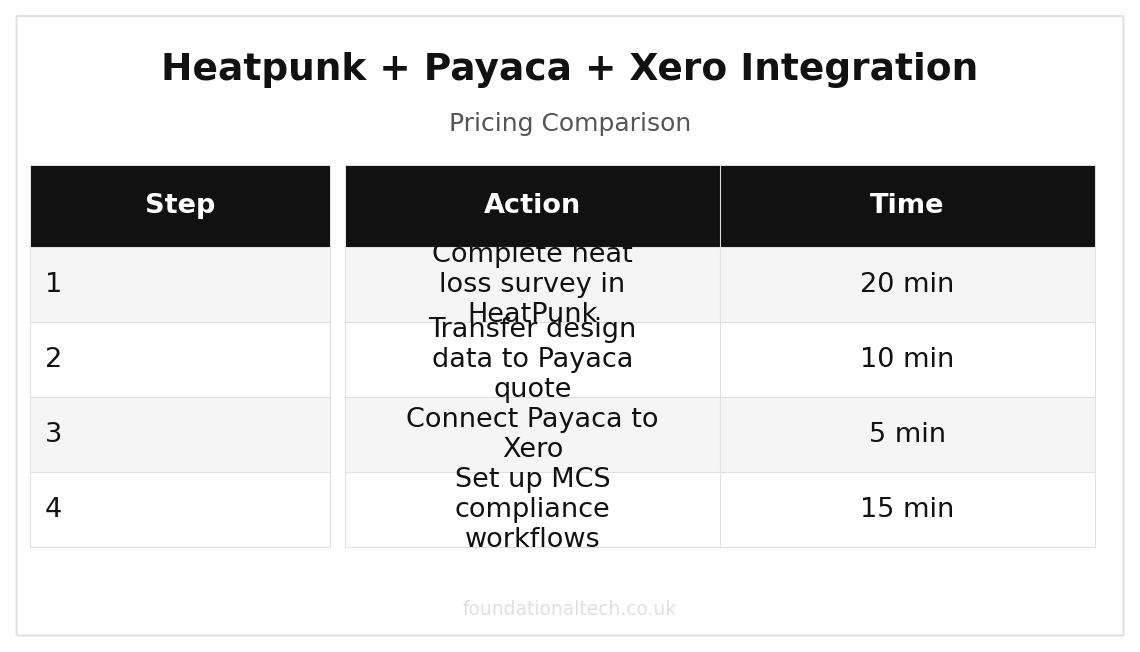
| Step | Action | Time |
|---|---|---|
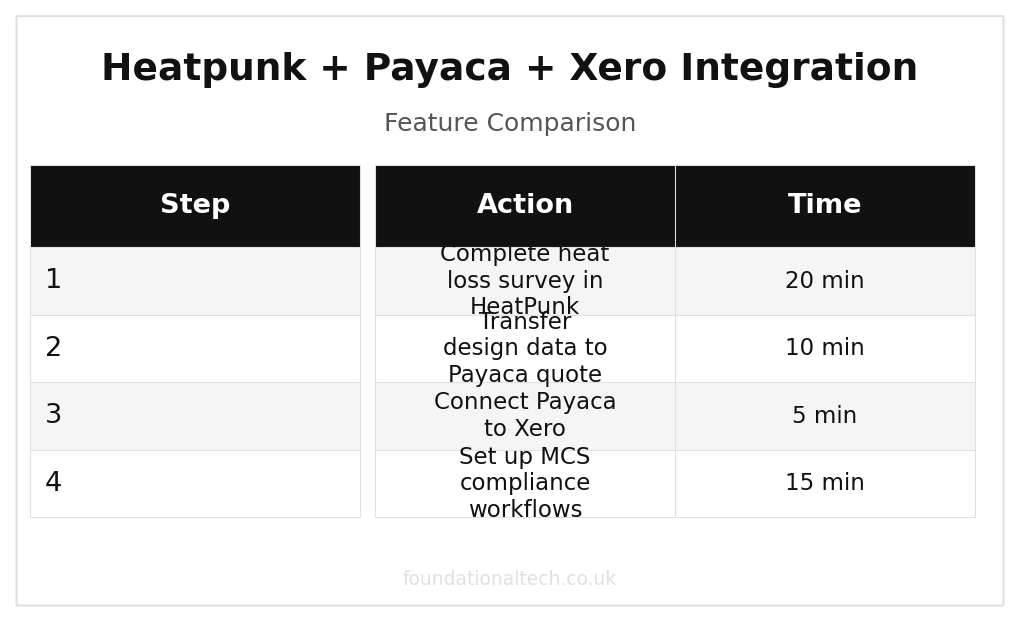
| 1 | Complete heat loss survey in HeatPunk | 20 min |
| 2 | Transfer design data to Payaca quote | 10 min |
| 3 | Connect Payaca to Xero | 5 min |
| 4 | Set up MCS compliance workflows | 15 min |
Three Workflows Worth Automating
Where automation genuinely helps is in the parts of the chain either side of the government gap — the bits that are commercial software talking to commercial software.
Workflow 1: Grant receivable posted → finance alert. - Trigger: Payaca job marked "commissioned" with a BUS voucher attached - Action: Zapier posts the job value and voucher amount into a tracked Xero account code for grant receivables, and pings a Slack or email alert if any receivable is older than 21 days without a matching Ofgem payment - Setup time: 30–40 minutes, once you've created the dedicated account code in Xero (see article three)
Workflow 2: Kit invoice received → job margin flag. - Trigger: Dext publishes a supplier invoice coded to a job - Action: Make checks the invoice total against the job's quoted materials budget in Payaca; if it's more than 10% over, it flags the job for a manual margin review before the final invoice goes out - Setup time: around an hour, mostly spent agreeing the tolerance threshold
Workflow 3: Commissioning complete → warranty and service reminder. - Trigger: Payaca job status changes to "commissioned" - Action: Zapier creates a warranty registration task, and — critically — schedules a calendar reminder at eleven months for the first annual service call, before the manufacturer's warranty conditions lapse for want of a booked visit - Setup time: 20 minutes
None of these three needs Payaca's enterprise tier to run — they work off the standard webhook and Zapier/Make integrations available on the Accelerator plan.
Where the Chain Snaps
The postcode mismatch. A single-character difference between the address on the MCS certificate, the DNO application and the Ofgem claim is the single most common reason a redemption bounces. Copy the address from one source document into the other two rather than retyping it fresh each time.
The G99 wait treated as optional. Firms that schedule installs before DNO approval lands are betting the network operator moves faster than average. Some months it does. When it doesn't, you're cancelling a booked crew and a delivered heat pump on short notice — the hard gate above exists specifically to stop this.
The 120-day window measured from the wrong date. It runs from commissioning, not from certificate issue, not from install completion if commissioning happened later. Firms with a backlog of paperwork sometimes discover a claim is time-barred because nobody checked which date started the clock.
Free-tier Heatpunk locking you into one distributor's kit list. If your design tool is the free Standard tier, your BOM comes pre-filled from Midsummer's own catalogue. Fine if that's genuinely your supplier of choice; a silent constraint if you assumed the tool was supplier-neutral.
Payaca's onboarding fee arriving as a surprise. The Growth plan carries a one-off £1,500 onboarding charge on top of the £999–£1,199 monthly fee; the Accelerator tier waives it. Confirm which tier and which fee structure you're actually being quoted before you sign.
Xero's autumn price review. Xero's current tiers (Standard from £33/month, Growing from £37/month) are scheduled for another price revision from 1 September 2026. Worth a calendar note, so a small monthly increase doesn't land as a surprise on your bookkeeping budget.
3 workflows automated
Design-to-quote, MCS compliance, and payment collection in one integrated chain
Building the Chain in the Right Order
If you're assembling this from scratch rather than retrofitting an existing setup, sequence matters.
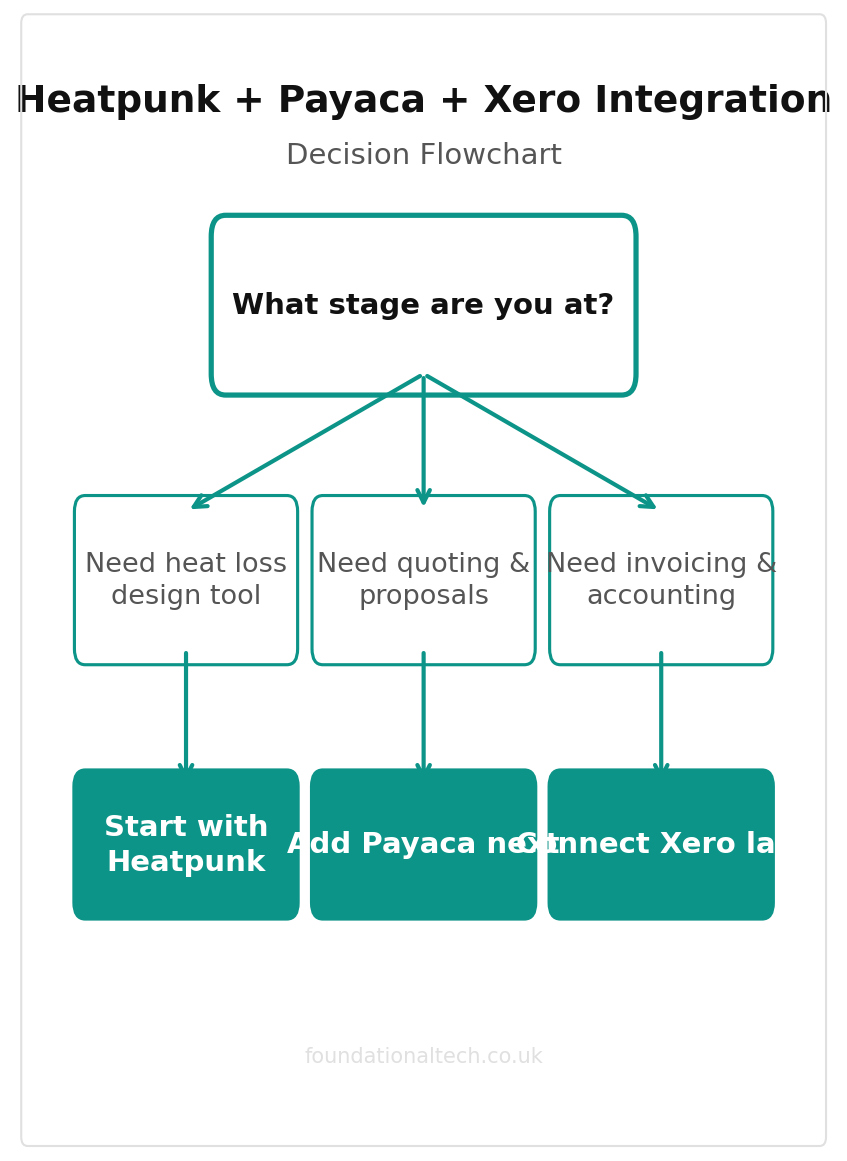
First, the design layer. Get Heatpunk or Heat Engineer running properly — this is where the job is won or lost, and everything downstream depends on its numbers being right.
Second, Xero's account structure. Set up the grant receivable code and the VAT repayment tracking before you need them, not during your first BUS job's redemption wait.
Third, the manual discipline around the three portals. Write down, literally, the checklist for MID, DNO and Ofgem submissions and pin it where the person doing commissioning can see it. This costs nothing and prevents the most expensive mistakes in the whole stack.
Fourth, Payaca or your job platform, once volume justifies the subscription — and only then layer in the Zapier/Make workflows above, because automating a process you haven't stabilised manually just automates the mistakes faster.
Get the order right and the government gap stops being a source of stalled claims and becomes what it should be: a five-minute manual step, done the same day, every time.
Which of the three government systems costs you the most retyping or the most anxiety — the MID certificate, the DNO portal, or the Ofgem redemption claim? Reply and tell me which one; I'm working out whether it's the same bottleneck for most installers or whether it splits by region and DNO.
A & Y Financial Services builds these exact automation stacks for renewables and heat pump businesses across the UK. If you've read the architecture and want someone to implement it — that's what we do.