Key Takeaway
Automate MCS, DNO and audit compliance for UK heat pump & solar installers in 2026. Step-by-step guide included.
The email arrives on a Tuesday: your certification body confirms the annual surveillance visit, three weeks out, and asks you to have a sample of recent job files ready for review. Count the places that sentence sends you. The MID for certificates. Heatpunk for heat loss calculations. The DNO portal for a G99 approval you think was granted in February. Your sent folder for warranty registration confirmations. A WhatsApp thread for the commissioning photos. Five systems, none of them talking to each other, and an assessor who wants one coherent story per install.
Other trades in this series fight timesheets, payroll and CIS. Your back office fights something different: in renewables, the paperwork is not a record of the product — it practically is the product. The heat pump works either way. What makes it an MCS install, a BUS-eligible install, a warrantied install and a legally connected install is a stack of documents. This article is about making that stack build itself.
Ten Documents, One Job
Walk through what a single air source heat pump installation generates, from survey to handover:
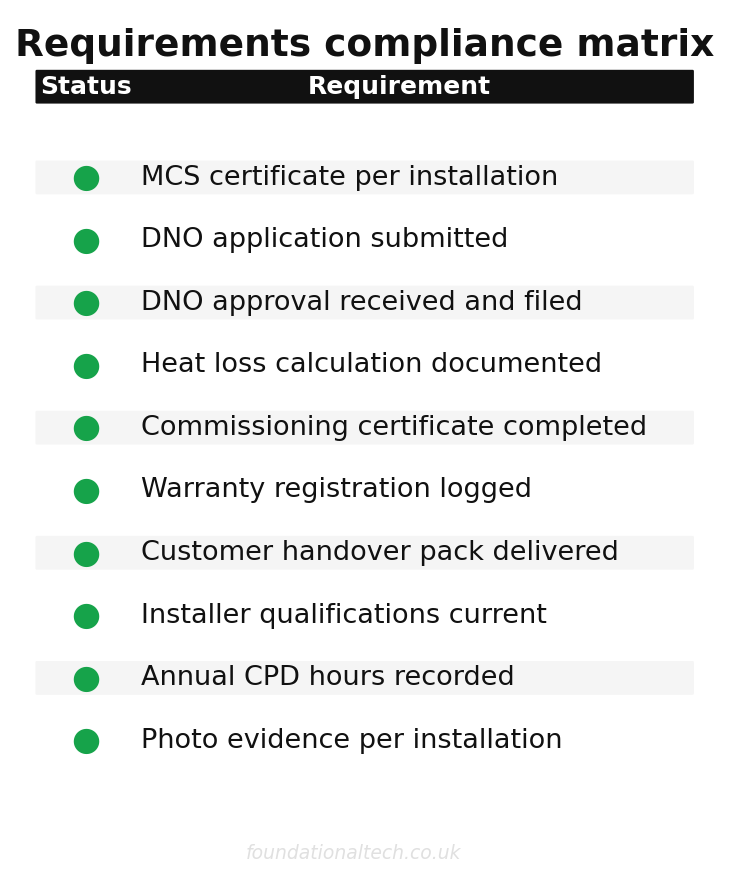
| Status | Requirement |
|---|---|
| ✓ | MCS certificate per installation |
| ✓ | DNO application submitted |
| ✓ | DNO approval received and filed |
| ✓ | Heat loss calculation documented |
| ✓ | Commissioning certificate completed |
| ✓ | Warranty registration logged |
| ✓ | Customer handover pack delivered |
| ✓ | Installer qualifications current |
| ✓ | Annual CPD hours recorded |
| ✓ | Photo evidence per installation |
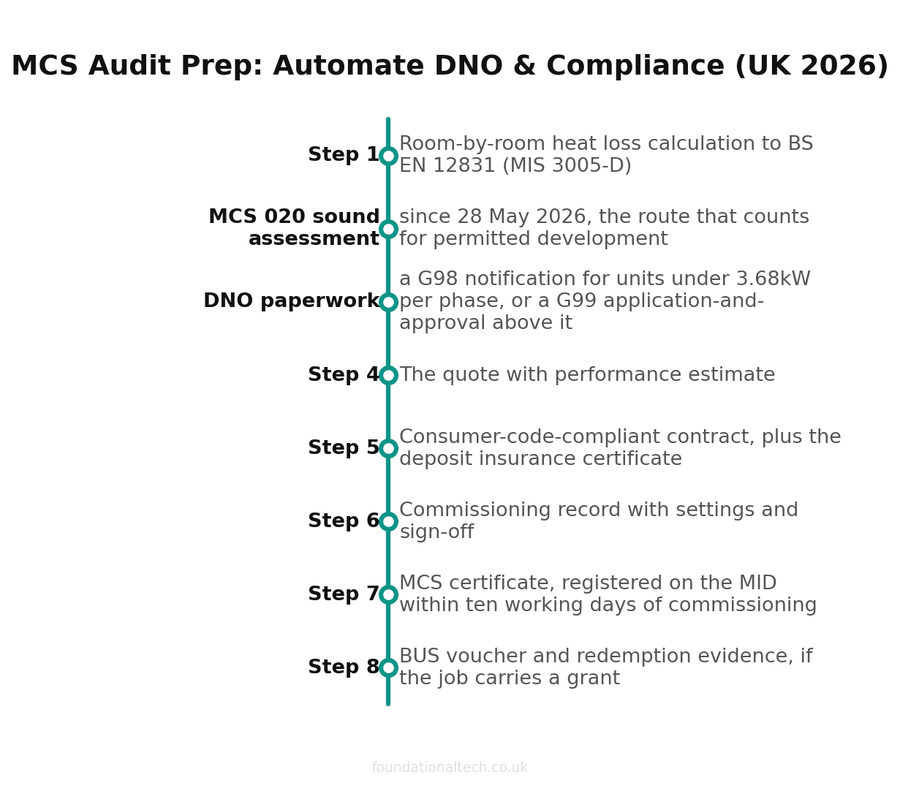
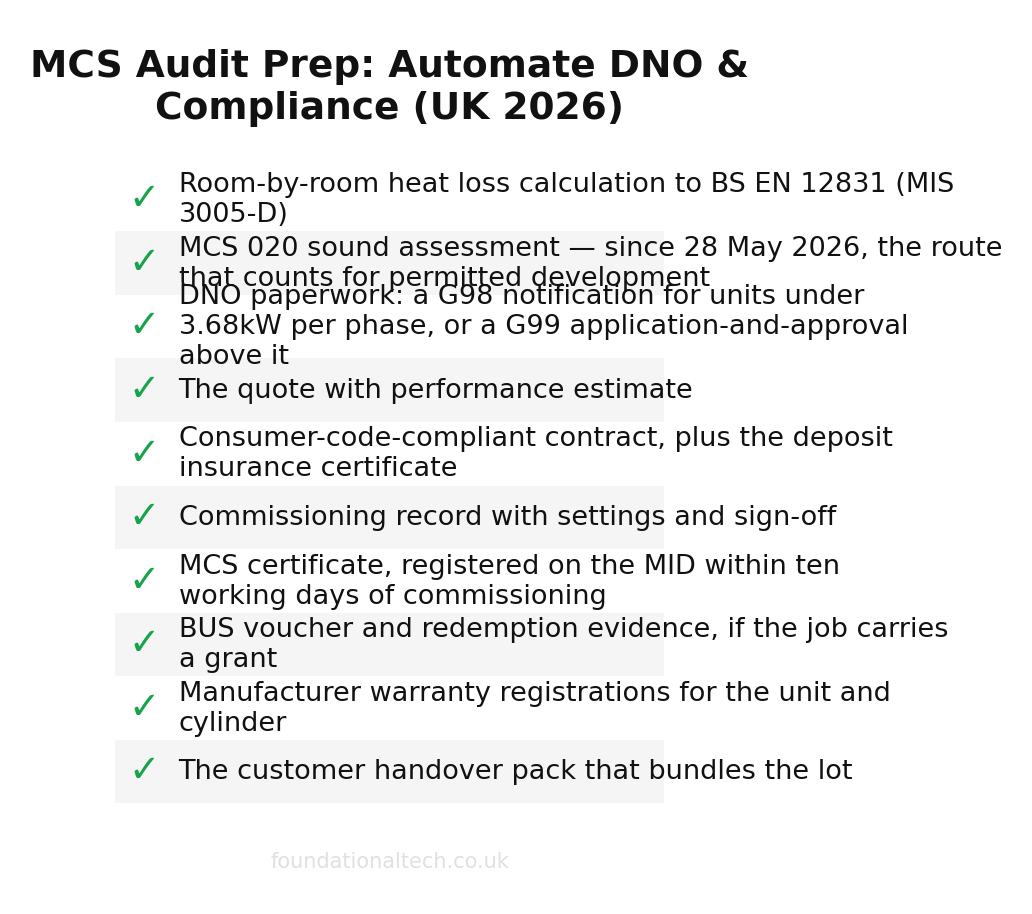
Room-by-room heat loss calculation to BS EN 12831 (MIS 3005-D)
MCS 020 sound assessment — since 28 May 2026, the route that counts for permitted development
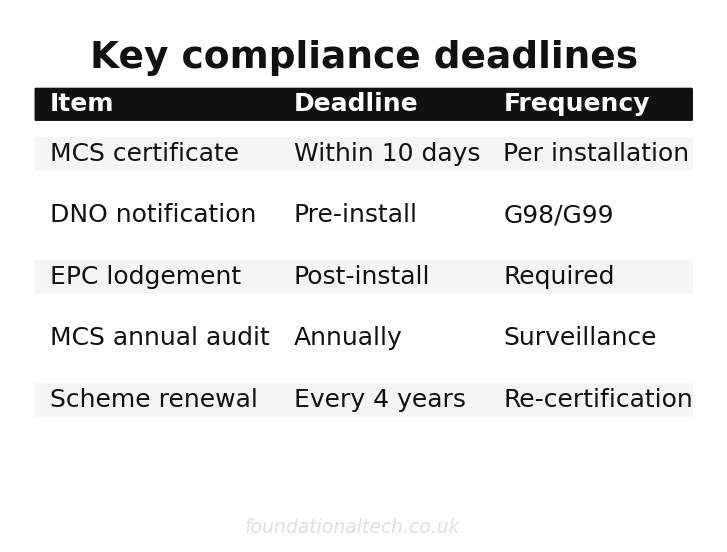
DNO paperwork: a G98 notification for units under 3.68kW per phase, or a G99 application-and-approval above it
The quote with performance estimate
Consumer-code-compliant contract, plus the deposit insurance certificate
Commissioning record with settings and sign-off
MCS certificate, registered on the MID within ten working days of commissioning
BUS voucher and redemption evidence, if the job carries a grant
Manufacturer warranty registrations for the unit and cylinder
The customer handover pack that bundles the lot
Ten documents, produced in four or five different systems, several with statutory or scheme deadlines. Multiply by six installs a month and your back office is a seventy-document-a-month filing operation. Do it ad hoc and every assessor visit, Ofgem wasn’t the real problem spot check or warranty claim becomes a hunt through five inboxes and a WhatsApp thread. Do it systematically and all three become a five-minute email.
One Job, One Spine: Make the Job Software the Filing System
The fix is structural, not heroic. Every document lives on the job record, filed on the day it's created, and the job record lives in one place — for most firms in this cluster, Payaca, which you already run for quoting and scheduling.
Set up the job template once, with a checklist mirroring the ten documents above and custom fields for the identifiers you're forever hunting: MCS certificate number, MID registration date, BUS voucher number, DNO reference, unit and cylinder serial numbers. The site engineer photographs the commissioning sheet and nameplate serials before leaving; the photos land on the job, not in a camera roll. The heat loss PDF from Heatpunk or Heat Engineer gets attached the day the design is signed off, because the checklist won't let the job progress without it.
The test of the system is brutal and simple: pick any install from four months ago and ask whether one person, in one login, can produce the full file in under five minutes. If yes, your surveillance visit is an afternoon. If no, it's a fortnight of evenings.
DNO Paperwork Without the Spreadsheet of Dread
The DNO step deserves its own process because it's the only document in the stack that can silently block an installation date. G98 is connect-and-notify — you can install first and tell the network operator afterwards. G99 is apply-and-wait, and "wait" can mean weeks, which means a G99 job scheduled before approval lands is a cancellation risk with a booked crew and an ordered unit attached.
Two automations take the pain out. First, Heatpunk's Pro tier (£35 per user per month) generates DNO application forms from the design data you've already entered — no re-keying postcodes and inverter details into ENA forms. Second, treat G99 approval as a pipeline gate in the job software: a job cannot move to "scheduled" until the DNO reference field is filled and the approval PDF is attached. That single rule ends the scenario where the office books the install and the approval is still in a queue at the network operator.
The Membership Stack: Price It In, Calendar It, Forget It
A renewables firm carries a heavier compliance overhead than almost any trade this series has covered, and most firms feel it as a series of nasty surprises rather than a known cost line. The recurring stack has four lines. MCS certification through a body such as NICEIC or NAPIT, with annual surveillance and renewal fees commonly in the £300–£500/year range depending on body and how many technologies you're certified for. Consumer code membership with RECC or HIES, banded by business size — a small firm typically pays a few hundred pounds a year. Deposit and advance-payment insurance premiums on every contract. And, if you install split systems rather than monoblocs, F-gas company certification through a scheme such as REFCOM — refrigerant work on splits requires it, while pre-charged monoblocs escape it.
Three moves turn this from surprise to overhead. Enter every membership as a repeating bill in Xero (Starter £15/month, Growing £37/month) so the renewal hits the cash flow forecast months out. Put every expiry — MCS anniversary, code membership, F-gas cert, even individual engineer qualifications — on a shared renewals calendar with eight-week warnings. An expired certification doesn't just cost a fee; it stops you generating MCS certificates and claiming grants until it's fixed. And divide the annual total by your expected installs to get a per-job compliance cost, then check your day rate actually carries it. Most firms doing fifty installs a year discover compliance adds £30–£50 per job — fine if it's priced in, painful if it's absorbed.
Few Receipts, Big Ones: Running the Kit Ledger
A decorator's receipt problem is a hundred small tickets from trade counters. Yours is the opposite: four to six large supplier invoices per job — the unit, the cylinder, radiators and pipework, electrical materials, maybe a hire charge — where a single miscoded invoice distorts the whole job's margin. Volume is low; stakes per document are high.
Dext (sole trader from £24/month, roughly 20% less on annual billing) handles capture: supplier emails forward automatically, invoices get read, coded and pushed to Xero. The renewables-specific discipline is what you add on top — every kit invoice is tagged to its job, and the serial numbers on the invoice are copied into the job record's custom fields at the same moment. That one habit means a warranty claim in year five starts with a thirty-second lookup instead of a plea to the merchant's archive department. It also gives you true per-install margin in Xero rather than a blended guess across the quarter.
Van stock deserves one line of discipline too. The consumables a heat pump crew burns through — glycol, pipe insulation, brass fittings, cable, cylinder unions — rarely get booked to individual jobs, and at renewables merchant prices that's real margin quietly leaking. The workable middle ground: a standing monthly consumables order coded to a van-stock account in Xero, reviewed each quarter against install volume. That beats both extremes — no tracking at all, or an engineer expected to type fittings into an app in the rain.
Warranty Registrations: The Seven-Year Promise Someone Has to Log
Manufacturer warranties on heat pumps routinely stretch five to seven years — and almost all of them are conditional: register the unit within a set window after commissioning, then keep up annual servicing, or the cover quietly evaporates. The registration takes four minutes. Forgetting it costs a customer thousands, and costs you the argument about whose job it was.
Fold it into commissioning day: warranty registration is a checklist item that closes the job, the confirmation email gets attached to the job record, and the first annual service date goes into the diary as a recurring task. That last step is the quiet gem in this whole article — a filed warranty registration with a service reminder attached is also next year's guaranteed maintenance booking. The compliance file and the future revenue pipeline turn out to be the same document.
3 weeks
from start to audit-ready with automated document management
Three Weeks to Audit-Ready
Week one — build the spine. Create the job template with the ten-document checklist and custom fields. Set up the renewals calendar and Xero repeating bills for the membership stack. Turn on Dext supplier forwarding.
Week two — run one live job through it. Every document filed same-day, serials captured, DNO gate enforced, warranty registered at commissioning. Fix whatever snags; the process only needs to be frictionless once to become habit.
Week three — backfill and test. Pull your last five completed installs up to the same standard — these are exactly the files an assessor will sample. Then run the five-minute test on a random job. If it passes, the next surveillance email is a calendar entry, not a crisis.
When your assessor last visited, how long did pulling the evidence together actually take — an afternoon, or a fortnight of evenings? And which document is your white whale, the one that's never where it should be: the commissioning sheet, the DNO acknowledgement, or the warranty confirmation? Reply and tell me — I'm mapping where renewables job files actually fall apart.