Key Takeaway
The complete 2026 automation stack for UK heat pump & solar installers. Every tool connected, MCS-compliant.
Every time you commission a heat pump under the Boiler Upgrade Scheme, you lend the government £7,500 of your own money, interest-free. The customer pays the discounted price. You pay the supplier for the unit, the cylinder, the radiators and the labour. Then you wait: MCS certificate generated, redemption submitted to Ofgem, claim processed, payment run. Do four BUS claim jobs in a month and you are floating £30,000 of Treasury money while your merchant account wants settling in 30 days.
No other trade in this series works like this. A roofer's cash flow problem is weather. A decorator's is a client who won't pay. Yours is structural: the biggest single line on most of your invoices is money you'll only see back if the paperwork chain — heat loss calculation, commissioning record, MCS certificate, MID registration, redemption evidence — is complete, correct and submitted inside Ofgem's 120-day window. Miss a document and the claim stalls. Miss the window and the grant is gone.
That's why automation matters more in renewables than in any trade we've covered. The admin isn't wrapped around the job. The admin is the revenue.
And the volume is about to jump. From 21 July 2026 — next week, as this publishes — the BUS grant rises to £9,000 for off-gas-grid homes replacing oil or LPG heating, running until 31 March 2027. Every installer within range of a rural postcode is about to take on more grant-funded work, which means more money in flight and more paperwork chains that have to close cleanly. The firms that handle that surge profitably will be the ones whose systems, not whose memories, track every claim.
This is the pillar article for our ninth trade cluster: MCS-certified installers of air source heat pumps, solar PV and battery storage. It maps the full software stack — design, compliance, grants, money — with current UK prices, verified this week. Nine articles follow, each taking one layer apart.
The Paperwork Chain That Decides Whether You Get Paid
Walk through what one domestic air source heat pump install generates, from enquiry to grant landing in your account:
A survey with room-by-room heat loss calculated to BS EN 12831 (MCS insists — MIS 3005-D). A system design: emitter sizing, flow temperature, cylinder spec, sound assessment to MCS 020. A DNO notification — G98 if you're under 3.68kW per phase, a G99 application and a wait if you're over. A BUS voucher application made on the customer's behalf. The install itself. Commissioning. The MCS certificate, generated through your certification body within days of commissioning. The handover pack — MCS is auditing these harder than ever under the redeveloped scheme. Then the Ofgem redemption: proof the old boiler was decommissioned, the commissioning report, the certificate number, submitted within 120 days of switch-on. Ofgem processes approved claims on weekly payment runs, typically two to four weeks after submission.
That's a dozen documents across five organisations for one job. Done by hand — retyping the same address into the heat loss tool, the DNO form, the MCS portal, the Ofgem portal and your invoice — it swallows an evening per install, and every retype is a chance to stall a £7,500 claim with a mismatched postcode.
The stack below exists to make that chain flow without retyping.
Design and Survey: Where the Job Is Won or Lost
Heat pump work is design-led in a way no wet-boiler trade ever was. Oversize the unit and it short-cycles; undersize it and the customer is cold and posting about you on Facebook. The design tool is where your margin and your reputation are both set.
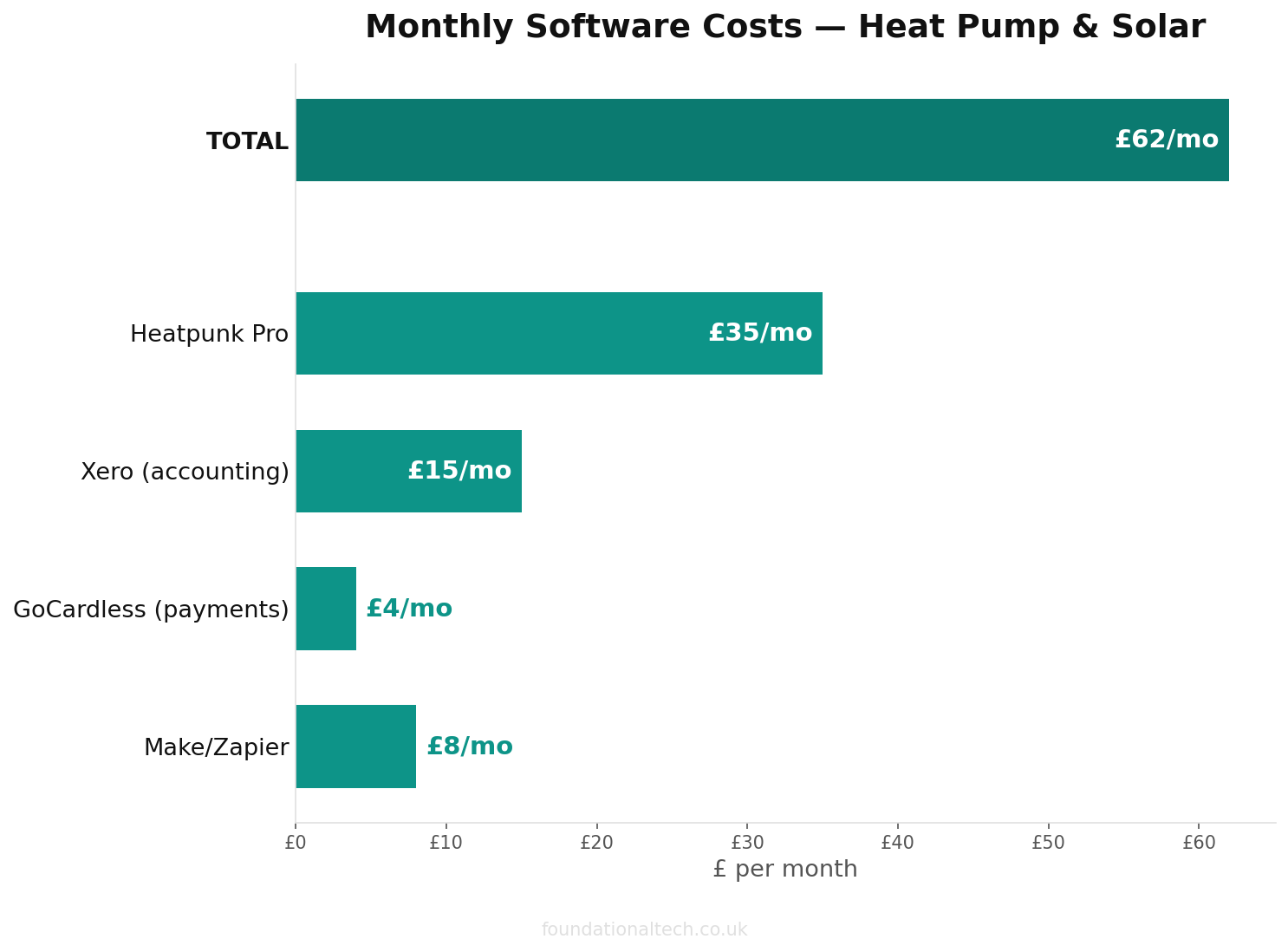
Heatpunk (from Midsummer) is the volume choice. The Standard tier is free and produces MCS-compliant (MIS 3005-D) room-by-room heat loss calculations, heat pump and hot water cylinder sizing — the catch being that the free tier specs Midsummer's own product range. Heatpunk Pro, at £35 per user per month, adds non-Midsummer components, branded survey reports, pre-install surveys and — the sleeper feature — automated DNO application forms.
Heat Engineer is the calculation purist's option: £10 + VAT per month for a sole trader (£108 + VAT annually), with four heat loss methods, CIBSE Domestic Heating Design Guide and EN 12831 compliance, and 3D room scanning through Magicplan. If you do complex retrofit work — solid stone walls, part-insulated extensions, mixed emitter systems — this is the deeper tool.
OpenSolar covers the PV side and costs nothing for its core platform. Design, shading analysis, proposals and a finance marketplace, funded by the hardware distributors and lenders on the platform rather than by you. The design-and-proposal workflow stays free — only API access and some third-party connectors carry a charge — and it carries one of the UK's largest solar product libraries.
A one-person heat pump firm can run a fully MCS-compliant design workflow for £10–35 a month. That would have been unthinkable five years ago, when installers paid consultants £300 per heat loss survey.
Job Management: The Payaca Question
Every trade cluster in this series has a job-management engine at its centre. In renewables, one platform has made itself the reference point — and its pricing forces a decision that smaller installers in other trades never face.
Payaca is built specifically for clean tech installers: MCS-compliant proposals, auto-generated handover packs and commissioning certificates, BUS grant tracking, and G98/G99 applications submitted to the DNO from inside the platform, with live approval status. It imports designs from Heatpunk, OpenSolar and Easy-PV straight into quotes, so panel counts and heat loss figures never get retyped. Some of the biggest national energy brands run on its enterprise tier.
The pricing is the catch. The standard Growth plan is £1,199 a month (£999 billed annually, 25 users included, plus a one-off £1,500 onboarding fee). That's enterprise money. The escape hatch is the Accelerator: £299/month for your first 12 months. It's only open if you have eight or fewer employees, were incorporated within the last 24 months, and hold MCS registration in solar, heat pump or battery — Payaca checks Companies House and the MCS register on the demo call.
So the honest guidance splits three ways. If you're a new MCS business, take the Accelerator — £299 a month for software that automates the exact paperwork chain above is defensible from your second BUS job onwards. If you're established and doing ten-plus installs a month, Growth's £999 pays for itself in recovered admin days and faster grant redemptions. If you're a one-van installer doing two or three jobs a month, skip it: run Heatpunk or OpenSolar for design and proposals, and let Xero do the money. We'll build that lean version in article 5.
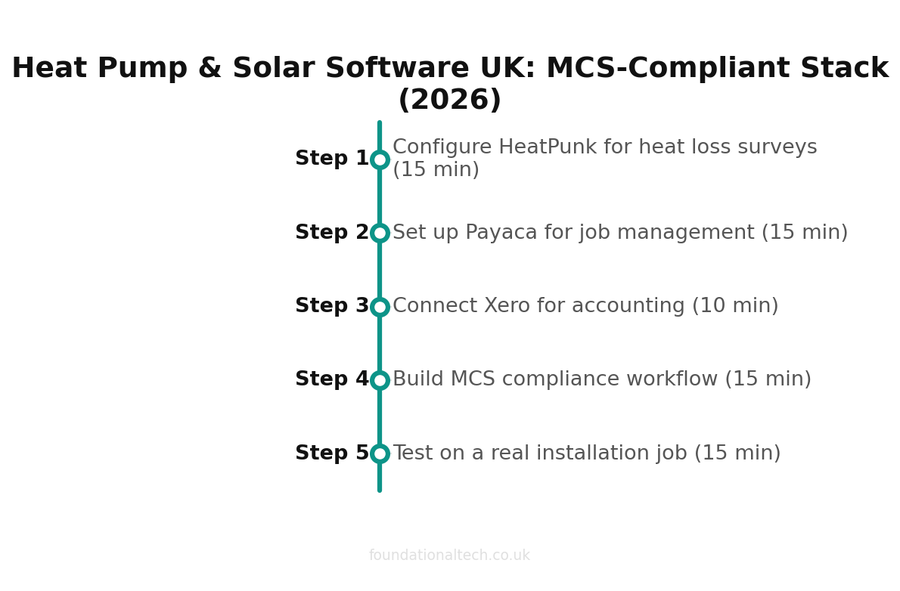
| Step | Action | Time |
|---|---|---|
| 1 | Configure HeatPunk for heat loss surveys | 15 min |
| 2 | Set up Payaca for job management | 15 min |
| 3 | Connect Xero for accounting | 10 min |
| 4 | Build MCS compliance workflow | 15 min |
| 5 | Test on a real installation job | 15 min |
The Money Layer: Where Renewables Books Get Strange
Xero is the accounting backbone, as it is for every trade in this series (Standard £33 a month, Growing £37). But a renewables installer's Xero setup has two quirks that generic bookkeeping advice misses completely.
First, you are almost certainly a repayment trader. Domestic installs of heat pumps, solar and battery storage carry 0% VAT until 31 March 2027 (it reverts to 5% on 1 April 2027). You charge your customers no VAT — but you reclaim the 20% you paid on units, cylinders, panels and materials. HMRC owes you money every period. Which means you should be filing monthly VAT returns, not quarterly: on a £6,000 materials bill, that's £1,200 of input VAT back in weeks instead of ageing for three months. One setting in Xero, and most installers have never been told to change it.
Second, the BUS grant needs its own place in the ledger. The £7,500 isn't your income to recognise casually — it's a receivable from the moment you commission, and it deserves its own account code and tracking category so you can see at a glance how much Treasury money you're floating, on which jobs, and how old each claim is. When the weekly Ofgem payment run lands, reconciliation is one click instead of an archaeology project. Article 3 builds this out properly.
Dext (from around £24/month for a small firm) captures the supplier side — and in this trade the supplier side is heavy. A single install can generate invoices from a manufacturer, an electrical wholesaler, a plumbers' merchant and a scaffolder. Photograph or forward each one and it lands in Xero coded to the job.
For collections, GoCardless fits the growing annual-service side of heat pump work: a £180 maintenance plan collected by Direct Debit costs pennies in fees (1% plus 20p, capped at £4 per collection), and on four-figure balance payments the cap does most of the work. Stripe (around 1.5% + 20p per card transaction) handles deposits, where friction matters more than fees. One consumer-protection line every installer must respect: under RECC and HIES rules, deposit and advance-payment protections are strict, so structure deposits to the code you're registered with rather than copying a builder's 40%-up-front habit.
How the Chain Links Up
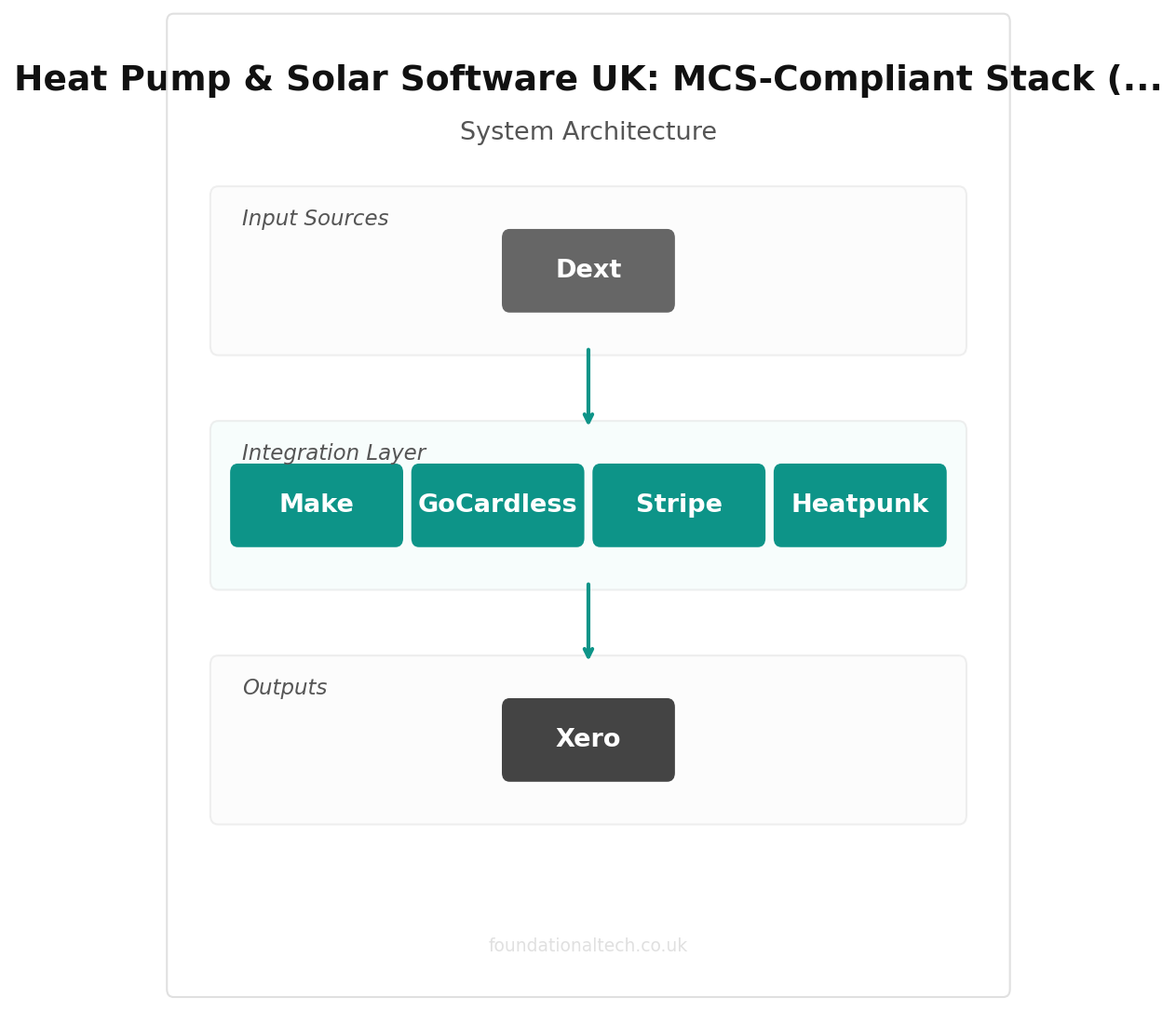
The data flow for a BUS heat pump job on the full stack looks like this: enquiry lands in Payaca → survey booked → Heatpunk heat loss imported into the Payaca proposal → customer signs digitally → G98/G99 fired to the DNO via ENA Connect → BUS voucher applied for → install scheduled → commissioning checklist completed on site from a phone → MCS certificate generated and handover pack auto-assembled → invoice syncs to Xero with the grant receivable coded separately → Ofgem redemption submitted with the evidence pack → payment lands, GoCardless collects the customer balance, Dext has already matched the supplier bills.
On the lean stack, the same chain runs with more clicks and no subscription: Heatpunk Pro handles design and DNO forms, Xero handles quotes, invoices and the grant receivable, and a shared checklist covers commissioning evidence. Slower, but £35 a month.
What you should refuse to accept in 2026 is the middle path most installers are actually on: designing in one tool, quoting in Word, tracking grants in a spreadsheet, and discovering at day 100 that a redemption was never submitted.
The Difference, Measured on Six Installs a Month
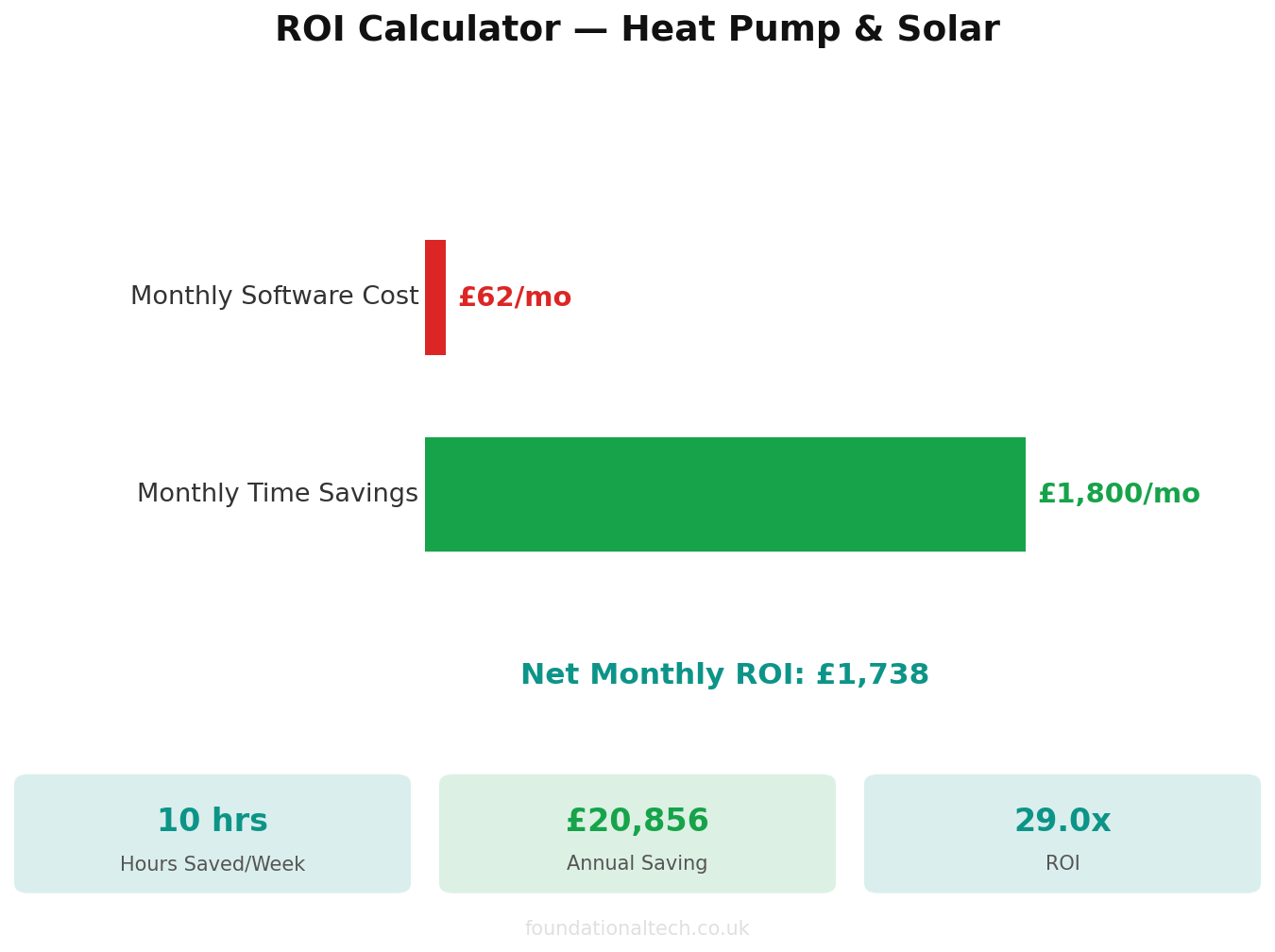
Take a two-person firm doing six heat pump installs a month, half under BUS. Manual admin — heat loss write-ups, DNO forms, voucher applications, redemption evidence, invoicing, chasing — runs comfortably over two hours per install. Call it 14 hours a month, plus the untracked cost of grant money sitting unredeemed. On the automated chain, the paperwork per job collapses to under half an hour of checking rather than creating. And — the number that actually matters — redemptions go in the day after commissioning instead of "when I get to it". At £7,500 a claim, pulling redemption forward three weeks on three jobs a month is £22,500 arriving 21 days sooner, every month. That's not a productivity gain. That's an overdraft you no longer need.
6 installs/month
The tipping point where manual paperwork costs more than the automation stack
Nine More Layers
Nine more articles take this stack apart layer by layer:
Heat loss and design software compared — Heatpunk vs Heat Engineer vs the free MCS calculator
The BUS cash flow engine: grant receivables, monthly VAT and getting paid faster
Back office: DNO paperwork, handover packs, warranty registrations and the MCS audit trail
The integration map: wiring the lean stack without Payaca money
The prompt playbook for heat pump and solar firms
Setting up an AI office assistant to draft handover packs and flag evidence gaps
No-code automations: grant claim tracking, service reminders and review requests
The composite case study — one firm, six months, the full numbers
Build it in the order the money moves. Design software first, because the survey wins the job. Then the grant and VAT plumbing in Xero, because that is where your cash is trapped. Job management last, once your volume justifies it.
Where is your money sitting right now — with Ofgem on an unredeemed BUS claim, with HMRC on a quarterly VAT return, or with a customer who hasn't seen the balance invoice yet? Reply with the biggest of the three numbers. I'm curious whether it's the grant, the VAT or the customer holding the most installer money hostage this summer.