Key Takeaway
UK heat pump installer turned a bounced £9,000 BUS claim into same-day redemptions. Automation case study with Payaca, Xero, and MCS compliance stack.
The letter from Ofgem was two lines long. Claim reference, and one sentence: the property address on the redemption claim did not match the address on the MCS certificate. A single transposed digit in a postcode — EN10 instead of EN01, keyed in fast on a Friday afternoon between two site visits. Owen Vaughan stared at it for a long moment before he understood what it meant: a £9,000 grant, on a job he'd already completed, paid for, and moved on from, was not coming.
That was the autumn before this story starts. Owen runs Fellside Renewables out of a unit near Penrith, in the Eden Valley — MCS-certified for air source and ground source heat pumps. One full-time installer works alongside him, an apprentice two days a week, and his wife Sian does the books most evenings after the kids are in bed. The business turned over roughly £340,000 that year, built almost entirely on oil-heated farmhouses and smallholdings that had spent a decade wincing at their heating bills. Good work, steady referrals, a waiting list into spring. And a single mismatched postcode had just cost more than a month's profit.
It didn't bankrupt the business. It did something worse in the short term: it made Owen distrust his own paperwork. He started re-checking every certificate three times, which slowed everything down, which meant fewer jobs got started, which meant less cash arrived to cover the float on the jobs already running. By January he was carrying roughly £22,000 of unrecovered materials and labour cost across live jobs waiting on grant redemption. It was funded from a business account that had never been designed to carry that kind of weight.
Fellside, Before
Fellside ran on a paper job folder per install and a shared Google Sheet Sian updated when she had a spare half hour. The rest lived in Owen's own memory — which of the three government systems each job was waiting on, and how long it had been sitting there. Heat loss surveys were done with a clipboard and a free version of Heatpunk, heavily reliant on the distributor's own kit list. Quotes went out three to five days after survey, typed up at the kitchen table.
Deposits were inconsistent — sometimes a third, sometimes half, sometimes whatever felt reasonable on the day. There was no fixed cap, and no reference to the RECC scheme's own 25% deposit ceiling that Owen was technically bound by as a member. DNO applications went in through each network operator's own portal, tracked nowhere except Owen's memory of roughly when he'd submitted them. That meant crews occasionally turned up to properties still waiting on Apply to Connect approval, and occasionally sat idle on properties that had been approved for a fortnight because nobody had checked.
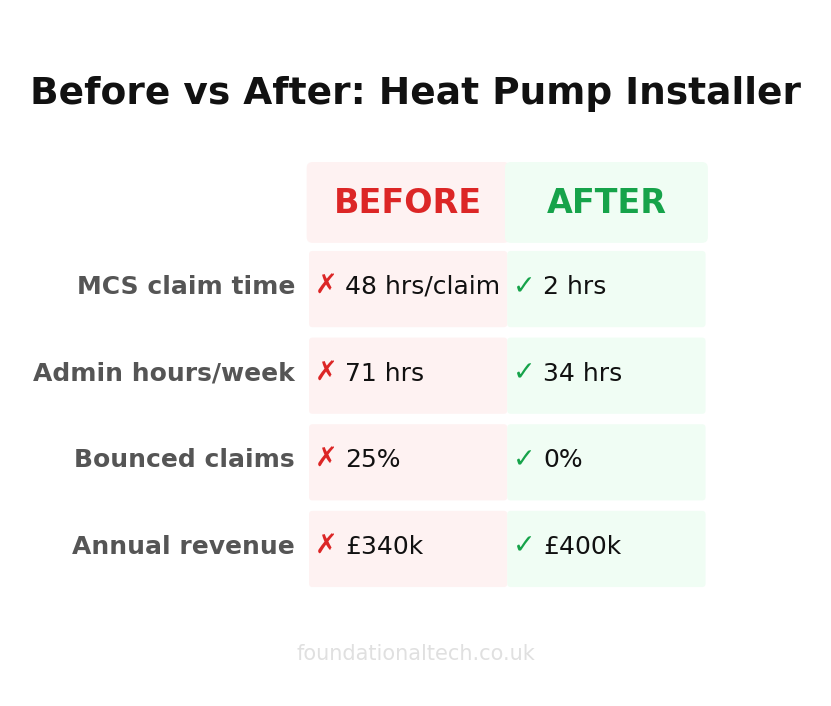
Quote-to-commissioning averaged nine weeks. Average days from commissioning to grant money actually landing: 71. Two claims had bounced in the previous eighteen months — the postcode mismatch, and an earlier one where the wrong decommissioning date had been entered from memory rather than checked against the job file.
Month 1: One Source of Truth for Every Clock
Owen didn't start with the postcode. He started with the thing that made the postcode possible: a system with no single source of truth.
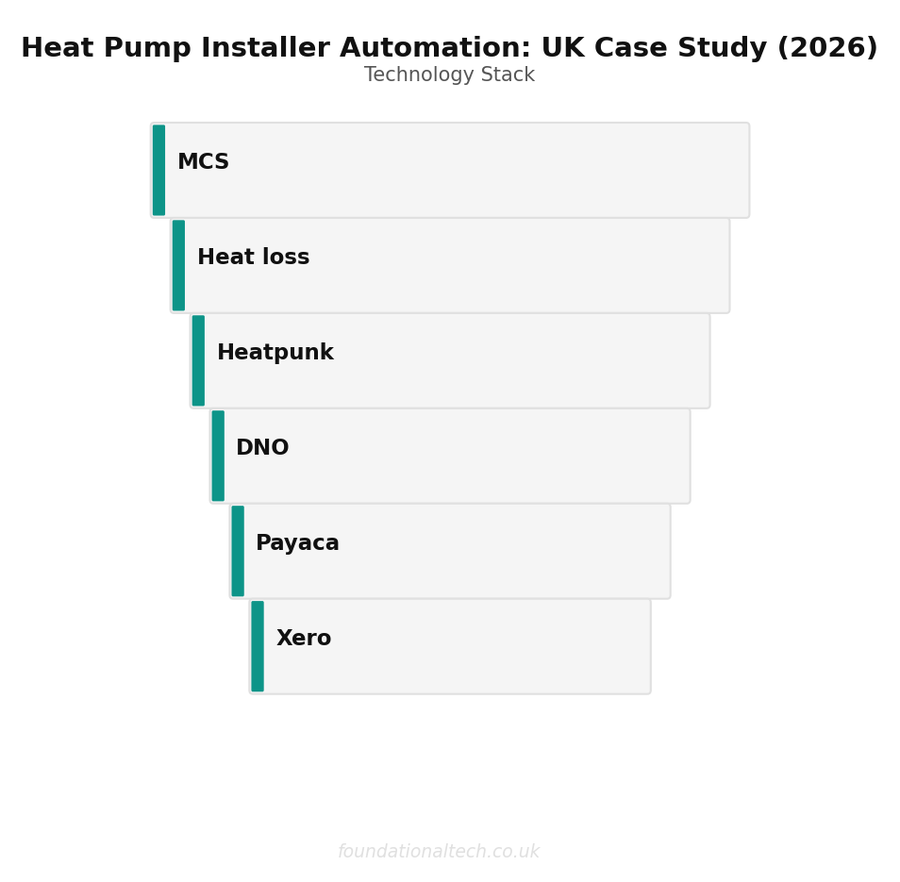
Payaca, on the Accelerator plan at £299/month, replaced the paper folders and the shared spreadsheet. Every job — survey, design, proposal, commissioning, certificate status, DNO status, redemption status — became one record. Before, it was four things living in Owen's head, Sian's spreadsheet, a paper folder and a Post-it on the van dashboard.
Heatpunk Pro, at £35/month, replaced the free tier's distributor-locked kit list with proper room-by-room heat loss calculations and MCS-compliant system design, importing straight into Payaca's proposal builder rather than being retyped.
Xero Ignite, £15/month, connected natively to Payaca, gave Sian a real ledger instead of a spreadsheet reconciled from memory once a month.
One process rule was decided in the first week and never relaxed. The certificate gets generated the same day as commissioning, from the numbers on the screen in front of you — never from memory three days later. That single habit — free, requiring no software at all — is the one Owen credits most directly with the fact that no claim has bounced since.
Quote-to-commissioning fell to six weeks within the month, mostly from Heatpunk Pro cutting survey-to-design time in half.
Month 2: The Deposit, the Gate, and the Grant Ledger
With one source of truth in place, month two went after the money.
Deposits standardised at 25% — the RECC ceiling, not a penny over — collected through GoCardless for the majority of customers and Stripe for the minority who preferred card. No job is scheduled until that deposit clears, full stop. It's a rule Owen borrowed from what he'd read other trades in this publication had done with their own deposit-gate. He adapted it for a job where the deposit also has to respect a consumer-code cap he can't quietly ignore.
Dext, at roughly £24/month, took over receipt and supplier invoice capture — kit deliveries, cylinder purchases, electrical materials. Everything was coded straight to the job, so true margin sat in Xero within a day of the invoice landing, rather than being guessed at quarter-end.
Sian built a dedicated grant-receivable account code in Xero, exactly as article 3 in this series recommends. Every commissioned job's outstanding BUS voucher was now visible as a single number, rather than buried across bank statements. And the DNO field became a hard gate in Payaca. A job cannot move to "scheduled" if that field reads anything other than "approved," for anything needing prior DNO sign-off under the Apply to Connect process. Two near-miss site visits to unapproved properties in the first six weeks of using it — caught by the gate, not by memory — told Owen the rule was earning its keep.
By the end of month two, average days from commissioning to grant money landing had fallen from 71 to 34. Most of that came from the same-day certificate discipline removing the delay at the very start of the chain, and the rest from Sian no longer discovering outstanding claims by accident.
Month 3: The Assistant That Never Touches the Portal
This is where the postcode mismatch became a resolved problem rather than a live fear.
Owen set up a Claude Pro subscription, built to the system-prompt structure from article 8 of this series: his MCS number, RECC deposit terms, standard BUS bands. It also carries one hard rule the assistant will not break. It drafts nothing that gets typed into the MID, the DNO portal or the Ofgem redemption service. A person does that, always, reading from the source document, never from the assistant's summary of it.
On top, wired through Make at roughly £8/month, went the eligibility triage and three-clock watchdog workflows article 9 in this series describes: enquiries auto-tagged by BUS band the moment they land, plus a daily digest. That digest flags any job inside two weeks of its 120-day redemption deadline with no claim filed. It also flags any DNO application sitting unanswered past three weeks, and any commissioning date with no certificate generated against it within 48 hours.
That last check is the one that matters most to Owen personally. It doesn't stop a human typo — nothing fully does. But it means a job can no longer quietly sit for three days with commissioning done and no certificate started. That was exactly the gap that let the original mismatch slip through unnoticed for six weeks before Ofgem's letter arrived.
The Uplift Test
21 July 2026 was the day the £9,000 off-gas-grid uplift went live, and Owen's phone didn't stop from nine that morning. Thirty-one enquiries by lunchtime, nearly all from oil-heated farmhouses and smallholdings across the Eden Valley and up towards the Solway coast, exactly the properties this uplift was built for.
Eighteen months ago, a funding announcement like this would have meant three days of Owen and Sian working through enquiries in whatever order they arrived. There was no way to tell a genuinely eligible off-gas household from someone on mains gas who'd misread a headline, and surveys got booked roughly in the order people happened to shout loudest. That day, the triage workflow read every enquiry within minutes, tagged the off-gas households against the £9,000 band, and sent each one a checklist of exactly what to send back. An EPC if they had one, a recent oil delivery bill and photos of the tank if they didn't. The 28 April 2026 reform means none of these is a hard blocker anymore.
By 2pm, Owen had a sorted list: nineteen genuinely eligible off-gas enquiries, ranked and ready to call, instead of a flat inbox he'd have been triaging by hand until dark.
What the Grant Ledger Recovered
Twelve months, start to today:
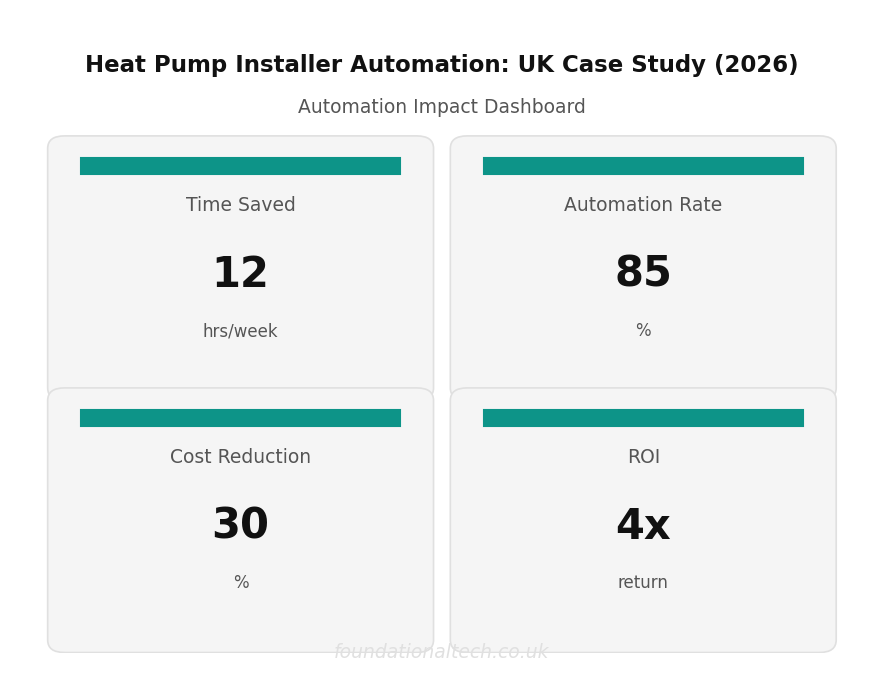
Nineteen days from commissioning to grant redemption is the number Owen tells other installers when they ask what changed. It isn't a single tool — Ofgem's process didn't get any faster. It's that nothing now sits waiting for a human to remember it, between the moment a job is commissioned and the moment the claim is correctly filed.
Fellside's Stack, End to End
Annual total: roughly £4,800, excluding per-transaction fees. Against that: one avoided bounced claim alone is worth £7,500–£9,000, more than the entire year's stack cost, and Owen's business has now gone a full year without one.
£9,000 claim recovered same day
after automating MCS documentation and Ofgem compliance
What Owen Would Do Differently
Fix the process before you buy the software. The single habit that stopped the bleeding was generating the certificate the same day, from the screen in front of you. It cost nothing, and it existed a full year before Payaca did. He wishes he'd made it a rule the day he got certified, not the week after a £9,000 letter arrived.
Respect the deposit cap even when a customer offers more. More than one customer, trusting the relationship, has offered to pay upfront in full. Owen declines every time. The RECC 25% ceiling exists to protect the customer if something goes wrong mid-install. Breaching it — even at a customer's own suggestion — is the kind of shortcut that looks fine until the one year it doesn't.
Let the AI read the DNO letter, but never let it touch the DNO portal. The hard rule in the system prompt isn't paranoia. It's the same boundary article 5 in this series drew from the start. The only reason Owen trusts the assistant with anything at all is that it has never once been allowed near the systems where a mistake costs real money.
The uplift will bring enquiries you can't survey fast enough. Triage first, survey second. That day proved it. Nineteen genuinely eligible households by 2pm beats fifty undifferentiated ones by end of week, every time.
If a claim bounced on you tomorrow over a single mismatched digit, how many weeks could Fellside-sized cash flow actually absorb before it became a real problem? Reply with a number — with this uplift pulling in a wave of new off-gas claims this year, I'm trying to work out how much float installers are really carrying, and whether it's enough.
A & Y Financial Services builds these exact automation stacks for renewables and heat pump installers across the UK. If you've read the architecture and want someone to implement it — that's what we do.