Key Takeaway
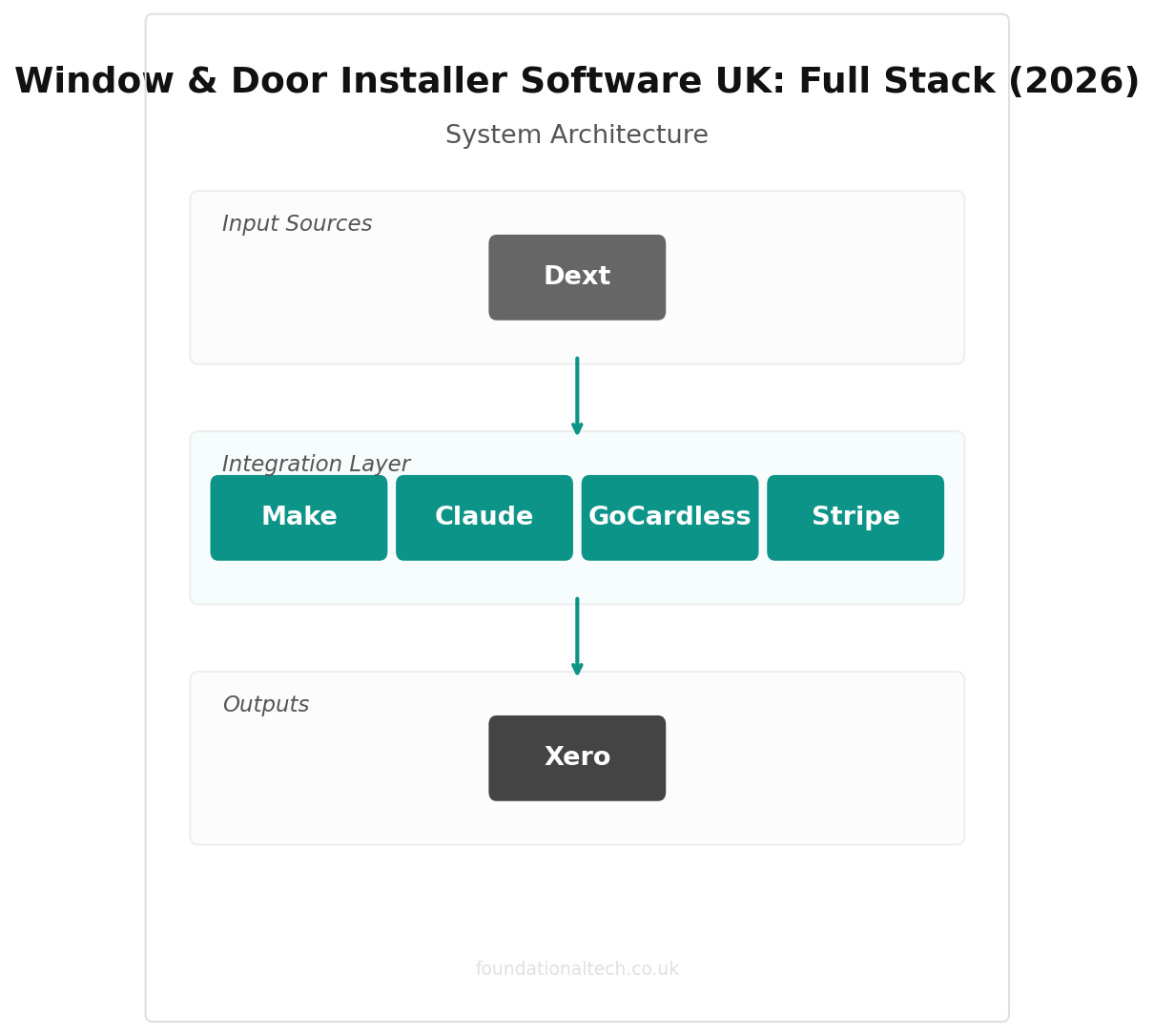
The complete 2026 automation stack for UK window & door installers. Every tool connected from enquiry to Xero.
Your phone rings at half eight on a Tuesday evening. It's a solicitor's assistant, apologetic but firm: the buyer's conveyancer has flagged that the double glazing fitted at 14 Aldermoor Close three years ago has no FENSA certificate on record. The sale is due to complete on Friday. You did that job. You definitely did that job — you remember the bay window, the tricky reveal, the customer who wanted chrome handles instead of white. Whether you actually logged the notification with FENSA within the 30-day window, or whether it got lost between a paper job sheet and a laptop that died in 2024, is a different question entirely.
While you're digging through old invoices for the Aldermoor Close job, your other phone — the work one — buzzes with a message from your fitter. The bay window on tomorrow's job is 200mm wider than the survey notes say, and the frames arriving from the fabricator on Thursday won't fit. Somewhere in between a re-measure and a supplier phone call, and a customer who's already taken the day off work for the install, you still haven't sent Wednesday's three quotes. One of them was promised same-day.
This is the shape of admin in glazing: not one crisis, but two clocks running at once. One measured in weeks — the gap between a signed order and a fitted product, while a certificate obligation and a supplier payment both tick along in the background. The other measured in hours: the quote that has to go out today or the enquiry goes to the installer down the road who answered first.
Most trade-automation advice is written for jobs that start and finish in a day. A window and door business doesn't work that way, and it doesn't work like the longer construction trades either. You take a deposit and a survey on day one, then order bespoke frames that don't exist yet. You wait four to six weeks for them to be manufactured, then fit and collect the balance. A legal certification obligation sits on top of the whole sequence, alongside a duty to protect that deposit if anything goes wrong before the van turns up.
Software doesn't remove any of that. What it does is stop the certificate you forgot, the deposit you can't account for, and the quote that took three days to reach the customer from quietly costing you jobs and reputation. This article maps the automation stack for a UK window, door and conservatory installation business. Nine deeper articles follow.
The Five Layers of a Glazing Business's Stack
A decorator can run on an invoicing app and a diary because the job starts and finishes inside a week. A window and door installer needs something built around a much longer, much riskier gap. That gap sits between two points: taking a deposit on a product that doesn't exist yet, and fitting the finished item in someone's wall.
1. Quoting and Design — Framepoint, Glazepoint or Pricepoint
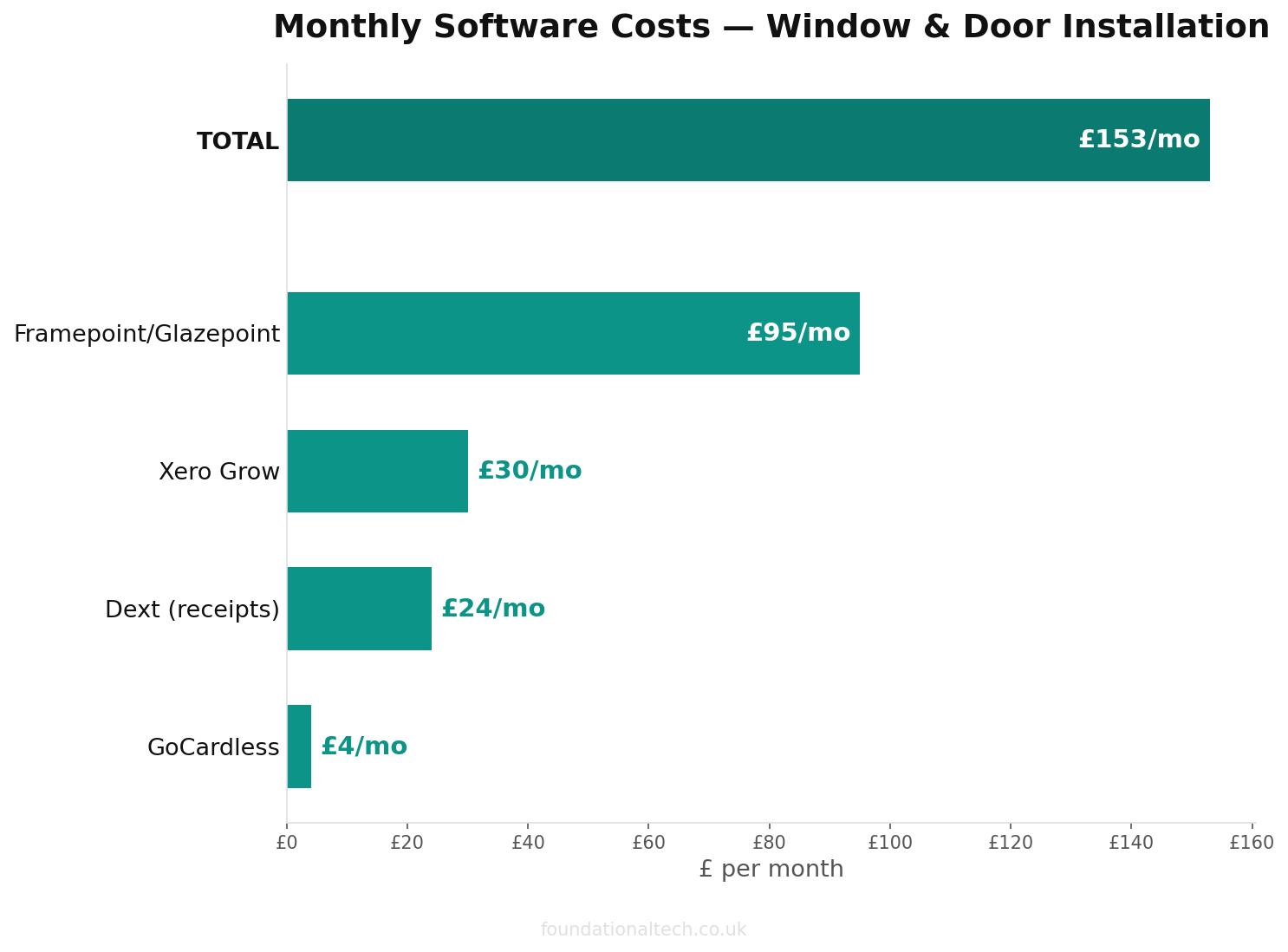
This is where the sale actually happens, usually in the customer's kitchen, on the spot, with the homeowner watching. Framepoint, from Tommy Trinder, lets you free-draw a window or door on a tablet — PVC-U, aluminium or timber — and get a live, itemised price back as you add glazing bars, colours and hardware. You can also send the same specification to multiple suppliers for a price comparison in one tap. It runs on a low-cost monthly subscription from around £95/month with no long contract. Installers using the platform were quoting well over £200 million worth of supply-and-fit work between them every month by late 2024, and the figure has kept climbing since. It's a scale that tells you how standard this style of tool has become in the trade.
Glazepoint goes further: a full CRM built specifically for double glazing companies, combining window design with lead tracking, survey scheduling, installation management and a customer database, for around £350/month for a typical company. It suits a business that has outgrown "quote on the doorstep" and needs one system tracking every enquiry from first phone call to fitted certificate.
Pricepoint sits closer to the fabrication side — window design, sales, survey and manufacturing pricing in one package. It suits installers who also run their own small fabrication operation, rather than buying finished units from a third-party supplier.
Article 2 compares all three in depth, with a decision matrix and a real setup walkthrough.
2. The Order Pipeline — Managing the Weeks Nobody Can See
Once an order is placed, the product doesn't exist yet. Standard made-to-measure uPVC windows typically take four to six weeks from confirmed order to fitting; a bespoke aluminium or timber design can run longer. This gap is where jobs quietly go wrong. A measurement error goes uncaught until the frames arrive already cut, a colour change never reaches the fabricator, or an install date gets promised to the customer that the supplier can't actually hit. Whichever quoting tool you use should double as the order tracker — survey confirmed, frames ordered, fabrication date, delivery date, install booked. Make that visible to you and, ideally, to the customer, so "when will my windows actually arrive" stops being a phone call you have to take personally.
3. The Certificate Vault — FENSA or CERTASS, Automated
Every notifiable window, door or roof-light installation in England and Wales needs either a FENSA or a CERTASS certificate confirming it meets Building Regulations, submitted within 30 days of completion. Miss it, and the homeowner is left needing a retrospective Local Authority Building Control inspection — or, as with Aldermoor Close, a stalled house sale years later. This isn't a paperwork nicety. It's the difference between a homeowner being able to sell their house without a hitch and a call to your business asking you to fix a problem you caused three years ago. Your job-management system should generate the notification the moment a job is marked complete, and store the certificate against the customer record permanently. It should let you reissue a copy in minutes, not by digging through a filing cabinet.
4. Keeping the Books Straight — Xero and Dext
Xero handles invoicing, bank reconciliation and VAT once you're registered. Current UK pricing: Standard at £33/month, Growing at £37/month, Comprehensive at £42/month, Ultimate at £65/month. Most small glazing firms run comfortably on Grow, which supports the invoice volume a typical installer generates. Dext captures fabricator invoices, ironmongery receipts, sealant and consumables purchases by photo and pushes the line-item data through automatically, at roughly £24/month plus VAT. For a business buying frames from one fabricator but hardware, sealant, trims and glass from three or four other suppliers, this is what makes accurate per-job costing possible, instead of guesswork at year end.
5. Payment Collection and Deposit Protection
This is the layer that's genuinely different in this trade. You're not collecting payment for work already done. You're collecting a deposit for a product that won't exist for weeks, against materials you'll need to pay your fabricator for before you've fitted a single unit. Take the £8,400 order mapped out below: the £2,520 deposit needs to clear the day the order is confirmed, not three days later once someone's chased a bank transfer. That's the money funding the fabricator invoice that lands on a 30-day clock the same week. A Direct Debit mandate through GoCardless, set up the moment the order is confirmed, does that automatically — 1% plus 20p per transaction, capped at £4, whether the deposit is £800 or £8,000. The balance then collects itself on the day of install rather than sitting on an invoice you're chasing a fortnight later. For the smaller number of customers who'd rather pay by card on install day, Stripe handles that at 1.5% plus 20p per UK transaction. Neither tool, on its own, protects the money you're holding if your business can't complete the job — that's a separate, and in this trade essential, layer covered next.
The Paper Trail the Law Actually Requires
FENSA and CERTASS are the two competent person schemes covering window, door and roof-light installation in England and Wales. Registration lets you self-certify compliance with Part L (energy performance) and Part Q (security), bypassing the Local Authority Building Control notification and inspection fee that would otherwise apply to every job. FENSA's fee structure runs a one-off joining cost of roughly £280 plus VAT, an annual registration fee of £172, and a £2.05 notification charge per installation. Assessment visits are priced at around £145.25 plus VAT each, and firms completing between 26 and 200 installations a year need a minimum of two assessments annually rather than one. Work through the maths for a typical installer completing 40 jobs a year: registration, 40 notifications and two assessments. The running total lands a little under £550 plus VAT across the whole year, all-in. CERTASS runs a comparable structure with monthly direct debit options. Whichever scheme you're registered with, every certificate must be logged and issued within 30 days of completion. This is the obligation that catches businesses out years later, exactly as it did with the Aldermoor Close sale.
Approved Document Q governs security requirements for windows and doors fitted in new dwellings — a genuinely different compliance layer from anything in re-roofing or decorating. Doors and windows must be tested to PAS 24, or an equivalent standard such as LPS 2081, to resist a casual attempt at forced entry. If you fit into new-build properties, every product specification needs a PAS 24 test certificate on file, checked before installation, not after a building inspector asks for it.
Part L and Window Energy Ratings set the energy performance bar for replacement windows. That means a whole-window U-value of 1.4 W/m²K or better, or a Window Energy Rating of Band B or better as an alternative route. You only need to satisfy one of the two, not both. Every quote your system generates should carry the U-value or WER band of the specified product as standard, because it's both a compliance record and, increasingly, something customers ask about unprompted.
Deposit protection and Insurance Backed Guarantees matter more in this trade than almost any other covered in this series, precisely because of the deposit-then-wait-then-fit structure. The Consumer Protection Association's deposit insurance covers up to 25% of the agreed price or £7,500, whichever is lower, for up to 120 days or until work starts. It protects the customer's money if your business cannot complete the job. An Insurance Backed Guarantee protects the customer's warranty itself if your company later ceases trading. Offering both isn't just good practice. Increasingly, it's what separates you from a homeowner's shortlist entirely, and it belongs in your standard sales pack alongside the quote, not as an afterthought when a customer asks.
The Double Glazing and Conservatory Ombudsman Scheme (DGCOS) provides independent dispute resolution most serious installers register with voluntarily, giving customers a formal route to a resolution that doesn't involve a solicitor's letter to you directly.
CIS applies only when you're fitting as a subcontractor on a new-build or commercial site for a main contractor. A contractor deducts 20% (30% if you're not CIS-registered) from your labour before paying you. Fit directly for a homeowner replacing their existing windows, and CIS doesn't apply at all. VAT sits at the standard 20% rate for almost all replacement glazing work. Unlike insulation or renewables installations, windows and doors were excluded from the reduced-rate energy-saving materials relief, so there is no VAT discount to offer a customer asking about one, however often they ask. The one genuine exception: glazing supplied and fitted as part of a new-build dwelling is zero-rated, which matters if you take on new-build contracts alongside retrofit replacement work.
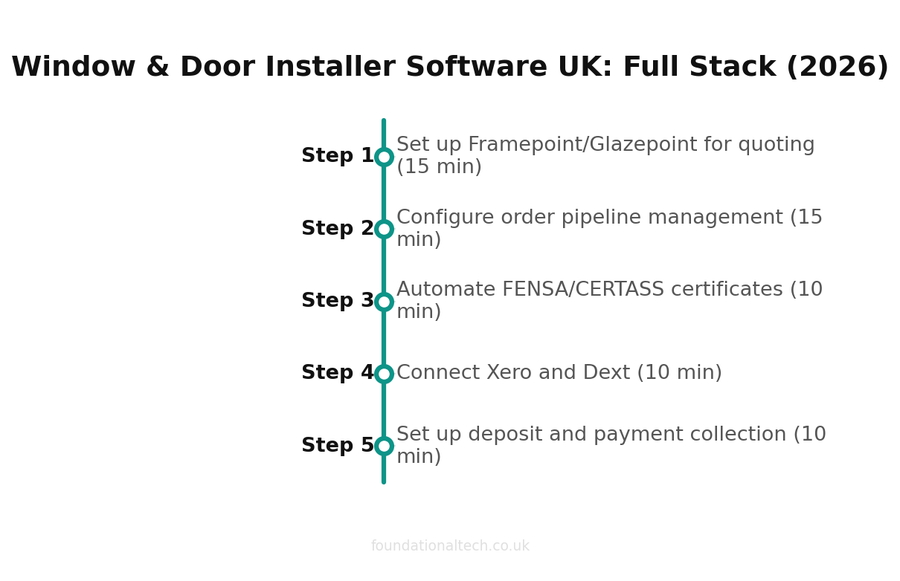
| Step | Action | Time |
|---|---|---|
| 1 | Set up Framepoint/Glazepoint for quoting | 15 min |
| 2 | Configure order pipeline management | 15 min |
| 3 | Automate FENSA/CERTASS certificates | 10 min |
| 4 | Connect Xero and Dext | 10 min |
| 5 | Set up deposit and payment collection | 10 min |
The Money, Mapped: A Real £8,400 Order
Ten windows and a composite front door for a 1990s semi, quoted at £8,400.
Day 0: Customer signs, survey confirmed. Deposit received: £2,520 (30%).
Day 2: Frames ordered from the fabricator against the confirmed measurements. Fabricator invoice due on a 30-day trade account — roughly £3,700 of the order's underlying cost.
Weeks one to five: Manufacturing. Nothing to invoice, nothing to fit, but the fabricator's 30-day clock is running from the day the order was placed, not the day the product arrives.
Week five: Delivery confirmed, install date set. Pre-install check: has anything changed at the property — a new kitchen unit, a different door handle preference — that the survey didn't anticipate?
Day of install: Fitting completed, snagged, signed off. Balance invoice raised: £5,880 (70%), due on completion.
Within 30 days of completion: FENSA or CERTASS notification submitted, certificate logged against the customer record permanently.
Run three or four of these concurrently and the fabricator's 30-day account comes due on the earliest orders right as you're only midway through manufacturing on the newest ones. That's a cash gap that has nothing to do with a customer paying late, and everything to do with the mismatch between when your supplier wants paying and when your own balance payment lands. This is why Article 3 — the full cash flow breakdown for this trade — exists. It walks through managing that fabricator-account timing against your own deposit and balance schedule. It also covers what happens when a customer's survey reveals an unexpected structural lintel job that adds two weeks to a five-week lead time.
£8,400 order mapped
Real-world glazing order showing every cost, margin, and payment stage through the stack
What Comes Next in This Series
Article 2 compares Framepoint, Glazepoint and Pricepoint head-to-head, with UK pricing, a decision matrix and a real setup walkthrough. Article 3 covers the cash flow reality of deposit-then-wait-then-balance trading, fabricator account terms, and managing multiple concurrent orders at different stages of the five-week gap. Article 4 automates the back office: FENSA/CERTASS notification tracking, PAS 24 and U-value documentation, and CIS for the subcontract site work some installers take on. Article 5 maps the full integration stack — quoting tool, Xero, Dext, GoCardless and your fabricator's order portal working as one system. Article 6 covers how window and door businesses are using AI day to day. Article 7 is a prompt playbook: the exact wording to turn a site survey note into a formal quote, or a customer's colour-change request into an updated order. Article 8 walks through setting up an AI assistant that already knows your product range, lead times and certification obligations. Article 9 covers no-code automation connecting your inbox, your quoting tool and Xero. Article 10 is a full case study of one UK glazing business that rebuilt its admin from the ground up.
Related guides: If you found this useful, see our guide on How to Set Up Claude AI Assistant for Window and Door Installers: A Step-by-Step UK Setup Guide (2026) and How to Connect Heatpunk, Payaca, Xero and the DNO Portal: The Complete UK Heat Pump and Solar Integration Map (2026).
How many times in the last two years has a customer, a solicitor or an estate agent chased you for a FENSA or CERTASS certificate on a job you'd genuinely forgotten the details of? How long did it take you to track it down? Reply and let me know.
For a real-world example of compliance gaps, read The Glazier Who Kept His FENSA Certificate in His Head.